

Why Are More & More Singaporeans Switching from Stocks to Forex?

Join our Telegram channel for more market analysis & trading tips: t.me/synapsetrading
Table of Contents
Forex vs Stocks in Singapore: Why Some Traders Switch (and When You Shouldn’t)
Last updated: 3 July 2026 · By Spencer Li, CFTe
Some Singapore traders switch from stocks to forex because forex lets you start with a few hundred dollars, charges no commission, trades 24 hours a day, and gives you enough cheap repetitions to actually learn. Those four things matter most when you are a beginner who needs many small trades to build skill. Forex is not better than stocks in some absolute sense. What changes the outcome is your circle of competence (the set of markets and methods you genuinely understand), not the market itself. So the honest answer is: forex suits the new trader who wants low-cost, high-frequency practice and a schedule that fits around a day job. Stocks suit the trader who wants ownership, dividends, and slower, less leveraged exposure. Below I lay out the real cost differences in a table, the case for forex as a training ground, and the three risk rules I would not start without.
Here is the full breakdown, with the trade-offs left in.
Why are Singapore traders moving from stocks to forex?
The shift started with a real problem on the local exchange. For a stretch in the mid-2010s, the Singapore Exchange (SGX) saw turnover fall and well-known names like Tiger Airways, OSIM, and Eu Yan Sang leave the board. One stockbroker told The Straits Times back then that “stockbroking is looking like a sunset profession now.” New listings dried up too. Across early 2016 the monthly IPO count ran like this:
| Month (2016) | New IPOs on SGX |
|---|---|
| April | 1 |
| May | 1 |
| June | 1 |
| July | 6 |
| August | 2 |
| November | 1 |
(Source: ChannelNewsAsia, 2016. These figures are historical context, not current SGX data.)
With thin volume and a Straits Times Index that drifted sideways, intraday trading on local stocks became hard for the small trader. You needed a large amount of capital to move size in and out, and the liquidity was not always there to do it cleanly.
Forex offered the opposite profile. Deep liquidity, tiny minimum trade sizes, and no commission. For a beginner with a small account, that combination is the draw. The local-stock backdrop has shifted since 2016, but the structural reasons a new trader reaches for forex have not.
Is forex cheaper to trade than stocks?
For a beginner, usually yes, and the gap is mostly about commission and minimum size. Here is the side-by-side I would have wanted when I started.
| Forex | Stocks (typical retail) | |
|---|---|---|
| Minimum to start | From around $500 | Higher; meaningful share lots cost more |
| Smallest trade size | 0.01 lots (about $0.10 per pip) | One lot or board lot; larger dollar commitment |
| Commission | Often zero (cost is in the spread) | Brokerage commission per trade |
| Charts and data | Usually free | Often free, sometimes paid for depth |
| Hours | 24 hours, 5 days a week | Exchange hours only |
| Economic-event timing | Published in advance on a forex calendar | Earnings and news can surprise mid-session |
Two lines in that table do the heavy lifting for a new trader. First, zero commission means each trade costs you less in “tuition fees” paid to the market while you are still learning. Second, the 0.01 lot size means you can risk a few dollars per trade and still get real skin in the game. That is the whole point. You want to make many decisions cheaply.
Do note that, “no commission” does not mean “no cost.” In forex the cost lives in the spread (the gap between the buy and sell price). It is smaller for a small trader, but it is still there. Anyone who tells you forex is free is skipping a line.
Is forex harder to trade than stocks?
Not inherently. Some people insist the forex market is tougher than the stock market. I beg to differ. It is your circle of competence that determines your success, not the raw characteristics of the market. If you understand a market and have an edge in it, that is the market you should trade. The difficulty is in you, not in the ticker.
That reframing matters, because it stops you blaming the instrument. A trader who loses in forex and switches to stocks expecting the market to save him usually loses in stocks too. The market was never the problem.
Forex as a training ground: trade small, trade often
The strongest case for forex as a starting point is that it lets you accumulate experience cheaply. Trading is a numbers game. With a properly developed edge, your account carries a positive expectation, and profit becomes the norm over a long enough run of trades. You cannot reach that long run without taking the trades, and forex lets you take them in small size.
A few things I believe here, hard-won:
Start live, not demo. There is an endless debate about live accounts versus demo accounts. My solution is simple. Start with a live account from the beginning, in tiny size. A demo trade and a live trade feel like different sports. Risking real money, even a few dollars, puts you into the reality of the game, and you learn to sit with the risk that is built into trading. Sooner or later you get used to it. You never get used to it on a demo.
Expect to make silly mistakes early, and budget for them. Every trader with real skin in the game has done at least one of these:
– Traded the wrong lot size (1.00 instead of 0.10, so the position is ten times too big).
– Gone short when you meant to go long.
– Placed a trade only to realise the market was closed.
These sound dumb written down. They are completely normal, and small size is exactly why you want to make them with ten cents on the line, not your rent.
Trade around your life, not against it. The 24-hour market means you choose when to trade. If your day job is punishing, you can trade at night, or over lunch, on a schedule that fits your life instead of fighting it. I like what Tom Sosnoff said about learning to trade: “Trade small, trade often.” Forex is built for exactly that.
The 3 steps to manage forex trading risk
Cheap practice without risk control just lets you lose faster. Three rules I would not start without:
- Think in percentages, not dollars. Risk a fixed small percentage per trade. Percentages take the emotion out of the dollar amount and keep one bad trade from doing real damage.
- Find an edge. Only a genuine edge gives you a profit over the long run. Repetition without an edge is just paying tuition forever.
- Stick to one style. Do not try to be everything at the start. Too many new forex traders try to scalp, swing, and trend-follow all at once. Become profitable in one style first. Diversifying across styles can come later, once you have something that works.
That last one is where most beginners go wrong. The market rewards depth in one approach long before it rewards breadth across five.
Where the human edge comes in
A broker can hand you a $500 account and a 24-hour market. A platform can flag the setup and place the order in a second. What neither will do is stop you from sizing the trade too big after three wins, or talk you out of trading the one market you do not actually understand. Cheap repetitions only compound if the judgment behind them is sound. That judgment, knowing your circle of competence and staying inside it, is the first of the Five Edges no tool can trade for you.
FAQ
Is forex better than stocks for a beginner in Singapore?
For a beginner who wants cheap, frequent practice, forex has real advantages: you can start from around $500, trade 0.01 lots, pay no commission, and trade 24 hours a day around a job. Stocks suit traders who want ownership, dividends, and slower exposure. Neither is universally better; it depends on your goals and which market you actually understand.
How much money do I need to start trading forex in Singapore?
You can start with as little as around $500. Most brokers allow 0.01 lot sizes, which works out to roughly $0.10 per pip, so you can risk a few dollars per trade while you learn.
Does forex trading have commissions?
Many forex brokers charge no commission. The cost is built into the spread (the gap between the buy and sell price) instead. So it is cheaper than commission-based stock trading for a small account, but it is not free.
Should I start with a demo or a live account?
Start live, in very small size, from the beginning. A live trade and a demo trade feel completely different. Risking real money, even a few dollars, teaches you to handle the risk that is built into trading, which a demo account cannot.
How do I manage the risk in forex trading?
Three steps: think in percentages rather than dollars, trade only when you have a genuine edge, and stick to one trading style until you are profitable before adding others.
So, forex or stocks? If you are starting out and want cheap repetitions to build skill, forex makes a strong training ground. If you want ownership and a slower pace, stocks have their place. Either way, the deciding factor is your circle of competence, not the market. Which one are you leaning toward, and why? Let me know in the comments.
And if you want the wider picture of how to choose and trade any market with one routine, read the pillar: The Beginner’s Guide to Trading.
Want a routine that fits a day job? Grab the free 15-Minute Swing Trading Starter Kit. It is the exact process I use to scan once a day and trade any market in 15 minutes.
About the author. Spencer Li is the founder of Synapse Trading and a Certified Financial Technician (CFTe) with 15+ years of trading across stocks, forex, crypto, commodities, and bonds. His trade log is public: every trade since April 2024, dated, losses left in. He has taught a 15-minute daily trading routine since 2014, one system for any market.
Education, not financial advice. Synapse Trading is not licensed by MAS to advise on investment products. Trading carries risk of loss; past performance is not indicative of future results.
Related
The Beginner’s Guide to Trading (pillar) · How to start forex trading in Singapore · What is your circle of competence? · Demo vs live trading account
Want the daily routine? Enter your email for the free 15-Minute Swing Trader's Checklist.
Free, 5 pages, PDF. You get the checklist, then my occasional trading emails. Education only, not financial advice. Unsubscribe anytime.
Where your details go: Kit, our email provider, stores your email address in the United States. Our contract with Kit lets it use your address only to send our emails, and requires Kit to keep it secure. The United States has no national privacy law like Singapore's, so that contract is the main protection. More in our privacy policy.
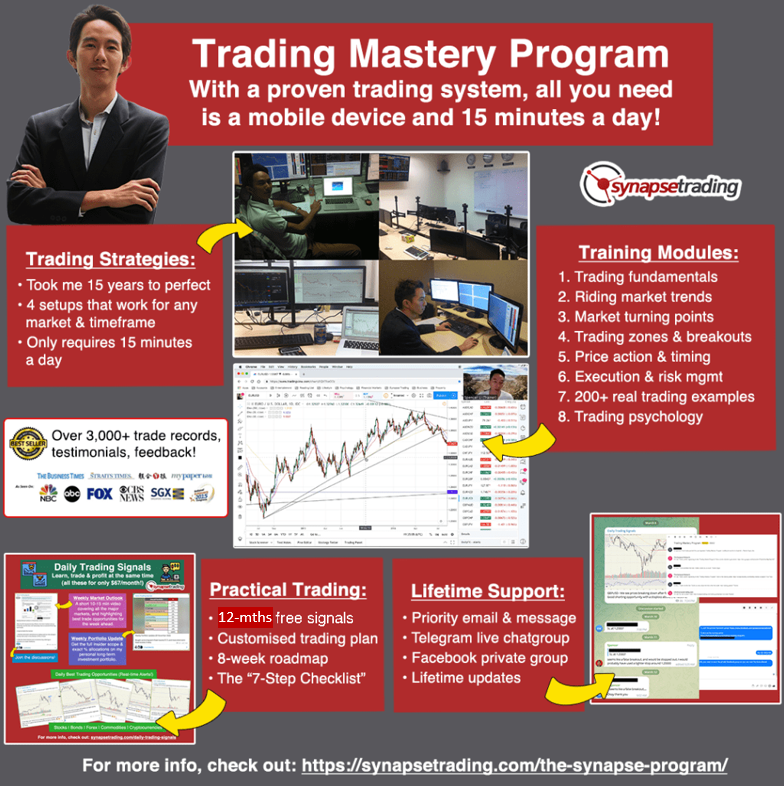 Our flagship mentoring program is suitable for both beginners and advanced traders, covering the 4 strategies which I used over the past 15 years to build up my 7-figure personal trading portfolio.
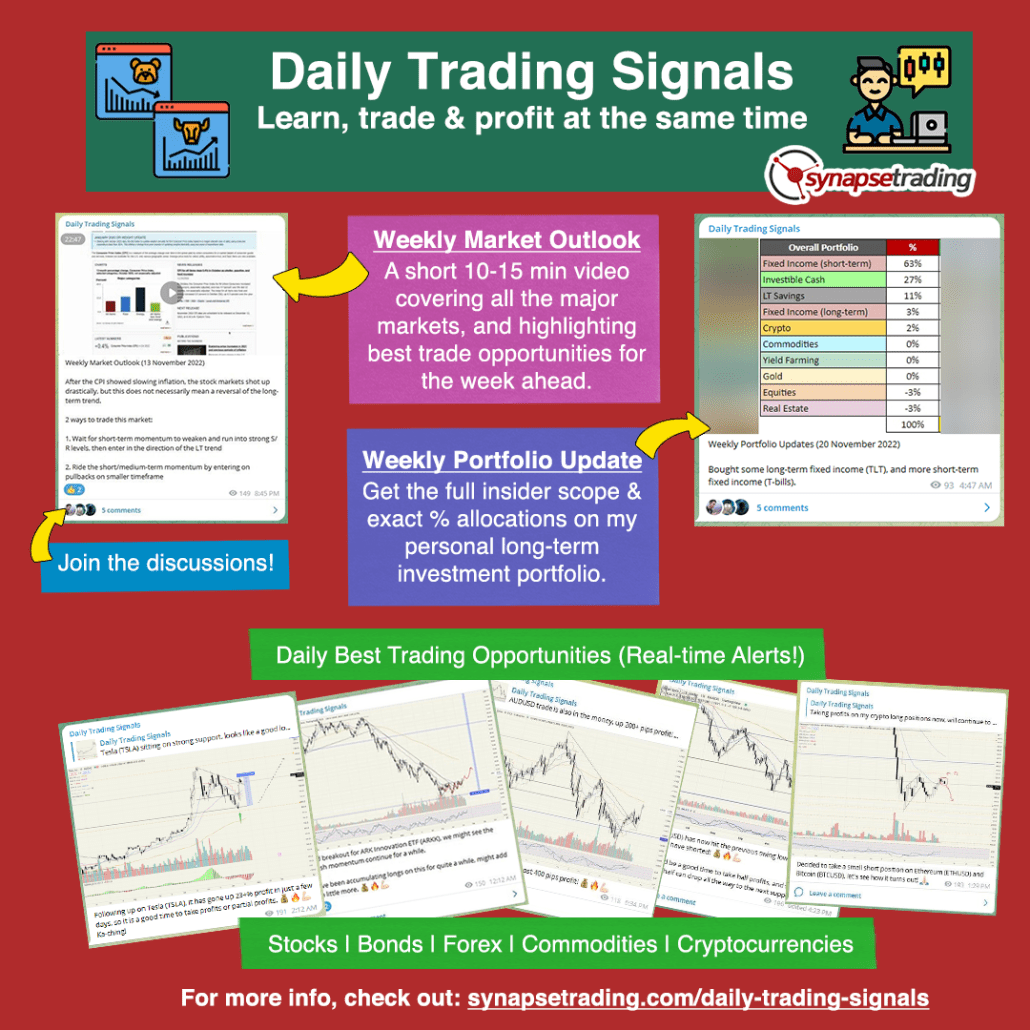 If you're looking for the best trading opportunities every day across various markets, and don't want to spend hours doing the research yourself, check out our private Telegram channel!







Leave a Reply
Want to join the discussion?Feel free to contribute!