• Link to Facebook
  • Link to X
  • Link to Instagram
  • Link to Youtube
  • Link to LinkedIn
  • Link to Mail
Synapse Trading
  • Home
  • About
    • My Background
    • My Trading Journey
    • My Travel Log
    • Media & Interviews
  • Mentoring
    • Trading Mastery Program
    • Results & Testimonials
  • Signals
    • Telegram (Free to join!)
    • Daily Trading Signals
    • Daily Trading Signals (Results)
  • Resources
    • Free Trading Guides
    • Tools & Resources
    • Blog & Infographics
  • Contact
    • Contact Us
    • Partnership Opportunities
  • Click to open the search input field Click to open the search input field Search
  • Menu Menu
Spencer Li

3 Biggest Financial Regrets of Retirees – And How to Avoid Them!

Investing & Portfolio Management
Elderly Poor Singapore

The 3 Biggest Financial Regrets of Retirees in Singapore (and How to Avoid Them)

Last updated: 3 July 2026 · By Spencer Li, CFTe


The three biggest financial regrets Singapore retirees report are: not saving money when they were young, not investing the time to learn how to invest, and overspending on their children. All three are fixable while you still have time. Start saving early so compounding works for you, because $10,000 saved in your twenties grows far more than the same $10,000 saved in your forties or fifties. Spend a few weeks learning to invest across more than just stocks, because a stocks-only portfolio can fall 60 to 80 percent in a crash like 2008. And spend less on expensive things for your kids and more time with them, because that is the part they actually remember.

The good news: none of these require more money. They require earlier, simpler decisions. Here is each regret, why it happens, and the fix.

Regret #1: Not saving money when young

This is the most common regret, and it is universal. Seniors all over the world say the same thing: I should have started saving earlier.

The reason is compounding. Saving $10,000 in your twenties adds up to a lot more than saving $10,000 in your forties or fifties, because the early money has decades longer to grow. The earlier you start, the more time does the work for you.

It also gets harder with age, not easier. Expenses pile up as you get older. Property, health spending, and raising a family take up most of your money. Saving gets a lot harder when the children are begging you for the latest mobile device for their birthdays.

Gambling and entertainment quietly eat away at your nest egg, so stay clear of them. And if you are reading this past your twenties, do not despair. It is never too late to start getting your money habits sorted out.

Regret #2: Not investing the time to learn

Back in the 1980s, investing was genuinely hard to learn without the internet. Today that excuse is gone. Kids these days build a website from scratch without supervision, so you can certainly find a way to learn something that pays you dividends in the long run.

Most people complain about not knowing what to invest in. That is a reasonable complaint. But here is the deeper problem underneath it.

The reason most people cannot invest money is that they do not even invest time to learn how to invest. Time is sacred. Use it wisely, and use it on what matters.

If your entire financial vocabulary is:

  • buying blue-chip stocks for the long term
  • mutual fund investments
  • investment-linked insurance policies (insurance bundled with an investment fund)

then you are missing a large chunk of the pie. A good diversified portfolio holds much more than just stocks. Holding only stocks can be very risky. In the 2008 financial crisis, most blue-chip stocks plunged 60 to 80 percent. Multi-asset, multi-instrument investing (spreading money across stocks, bonds, forex, commodities, and more) is the norm now. If you are not involved, it is time to start.

One more myth worth killing: people assume learning to trade or invest is hugely time-consuming. It is not. Like any skill, it takes a while to learn at first, but after a few weeks you get the hang of it, and managing your finances then takes only a few minutes a day.

Here is the part the brochures skip. The tools are now nearly free. A screener will find a setup, a robo-advisor will rebalance a portfolio, an app will track everything. What none of them supply is the judgment to know which risk is worth taking and the discipline to sit out the rest. That judgment is the one piece you actually have to build yourself, and it is the first of the Five Edges that no tool can hold for you.

Regret #3: Spending too much on the children

Many parents look back on their years as young parents and say the same thing: we should have spent less. The bad outcomes are familiar. Spoilt children. Children who expect a lot but contribute little.

This is not about being stingy. It is about spending on the things that last instead of the things that get thrown away. Among the many unnecessary expenses, parents could do well to trim any of these:

  • Extra-curricular lessons like ballet, music, or swimming, especially if the child is not enjoying them
  • Tuition lessons, since the school system in Singapore is honestly quite robust
  • Expensive pre-school education, because they will not remember it anyway
  • Expensive holidays, which we do not remember a year later
  • Toys that get thrown away three months later
  • Expensive meals at fancy restaurants, because food is still food
  • Overseas university education, when a local degree can be just as profitable for your child
  • Expensive childcare services, when reasonably priced ones do the same job
  • A domestic helper, when teaching the kids to take care of the house makes more sense

We sometimes put too high a premium on a university degree. Pay what is fair and reasonable. Do not spend half a million dollars on one.

And here is the real point. Many parents have money but very little time for their children. Ask any child and you will find they would much rather spend time with their parents than have an expensive holiday in Paris, Dubai, or Tokyo.

In hindsight you always know better. So take the advice of our seniors: spend on what really matters, which is your time. What use is all the cool stuff, the premium lessons, and the holidays, if we miss the one thing that truly counts?

The three regrets at a glance

RegretWhy it happensThe fixStart when
#1 Not saving youngCompounding is invisible early; expenses pile up with ageSave early and automatically; cut gambling and entertainment leaksToday, at any age
#2 Not learning to invest“I don’t know what to buy” plus the myth that it takes too much timeSpend a few weeks learning; diversify beyond stocks; then a few minutes a dayAfter a few weeks of study
#3 Overspending on kidsConfusing money spent with love shownTrim the throwaway expenses; give time insteadBefore the habits set in

How to avoid all three at once

Notice the thread running through every regret. Each one is a trade of a small, early, slightly boring decision for a large, late, painful one. Saving early is boring. Spending two weeks learning to invest is boring. Choosing an evening at home over a flashy holiday is boring. The regret is what arrives when you skip the boring version.

So pick the version your future self will thank you for. Start the savings habit now. Put in the few weeks to learn investing properly, across more than one asset class. And spend on time with the people who matter, not on things they will forget. None of this needs more money. It needs an earlier decision.

FAQ

What is the most common financial regret of retirees in Singapore?
Not saving money when young. It is the single most common regret reported by seniors worldwide, because compounding rewards early savers and expenses only grow heavier with age.

Why does saving early matter so much?
Because of compounding. Saving $10,000 in your twenties grows into far more than the same $10,000 saved in your forties or fifties, since the early money has decades longer to compound.

Is investing only in stocks risky?
Yes. Holding only stocks can be very risky. In the 2008 financial crisis, most blue-chip stocks plunged 60 to 80 percent. A diversified, multi-asset portfolio spreads that risk.

Does learning to invest take a lot of time?
Not for long. Like any skill it takes a few weeks to get the hang of, after which managing your investments takes only a few minutes a day.

How can I avoid these regrets if I am already past my twenties?
It is never too late. Start the savings habit now, spend a few weeks learning to invest beyond stocks, and redirect spending toward time with the people who matter.


The seniors who shared these regrets are not telling you to earn more. They are telling you to decide earlier. Which of the three regrets is the one you would most want to avoid? Let me know in the comments.

And if regret #2 is the one that stings, that is the most fixable of all. Start with the pillar: How to Start Investing and Trading in Singapore: A Beginner’s Guide.

Want the few-minutes-a-day version? Grab the free 15-Minute Swing Trading Starter Kit. It is the exact routine I use to scan once a day and trade any market in 15 minutes, which is the practical answer to regret #2.


About the author. Spencer Li is the founder of Synapse Trading and a Certified Financial Technician (CFTe) with 15 years of trading across stocks, forex, crypto, commodities, and bonds. His trade log is public, 404 trades, losses left in. He teaches low-risk swing trading in 15 minutes a day, one system for any market.

Education, not financial advice. Synapse Trading is not licensed by MAS to advise on investment products. Trading carries risk of loss; past performance is not indicative of future results.


Related

How to Start Investing and Trading in Singapore (pillar) · Why diversify beyond stocks: multi-asset investing · How to learn trading in 15 minutes a day

0 Comments/by Spencer Li
https://synapsetrading.com/wp-content/uploads/2017/01/Elderly-Poor-Singapore.jpg 427 640 Spencer Li https://synapsetrading.com/wp-content/uploads/2019/10/logo.jpg Spencer Li2017-04-12 05:54:292026-07-06 00:31:563 Biggest Financial Regrets of Retirees – And How to Avoid Them!
Spencer Li

Trading Mastery Program (TMP) – Batch Q1 2017 is Ready to Tackle the Big Boys!

News & Events
18 19 Mar TMP 09

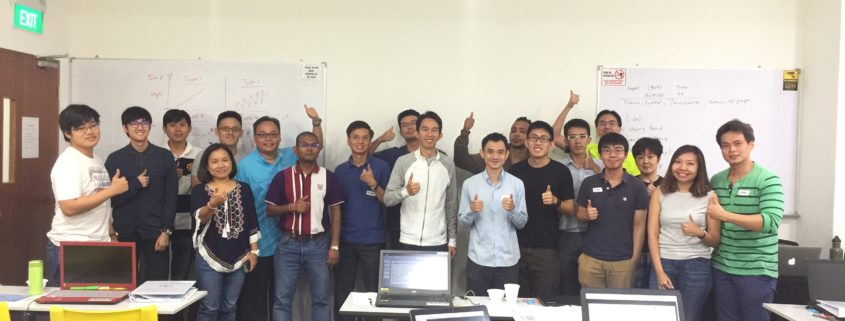
Last month, we concluded another exciting run of our “Trading Mastery Program”, where we imparted our powerful “insider” fund trading strategies to empower another batch of traders to gain an unfair advantage in the market.

Reservations for our next intake are open, and you can start reserving your seats before they run out!
Find out more: http://wp.me/P1riws-31L


Training Feedback from Attendees:

“This course helped me identify weakness of my trading strategy and being able to time it to make it much better.” – Dominic

“If you are looking to gain strong fundamentals in technical and price action, attend this course! Spencer’s methods are well-calculated and systematic. Comprehensive course material and really liked live Q&A on google sheets. Food was great too!” – Ian

“The course started slow and went into climactic with all the swing, turn, break, & bounce. While overwhelmed with the new information, I believe there will always be support from this team!” – Tan Wei Peng

“The course note is very organized. The post-program schedule is useful. Spencer is able to clearly explain the fundamentals and setups well. Making the course easy to comprehend and execute.” – Tan Jiansen

“The training was comprehensive in covering the setups.” – Quek Boon Kiat

“The course provided very good foundation on price action trading strategy and Spencer displayed professionalism and knowledge in conducting the course. The emphasis on the right psychology and trading plan was very useful.” – Tong Kai Meng

“A very informative workshop for beginners. Chart reading is simplified, so are the steps for trading. It gives people realistic expectations of trading and also confidence to enter trading.”

“The course is structured and easy to understand. Gives me the knowledge necessary to do trading with increased confidence.” – Alan

“This is a great course for beginner or experienced traders. Is clear, simple and easy to understand.” – Francis

“Fantastic program, simply the best. Professional. The quiz is superb!” – Syed, Rolls-Royce

“It breaks things down & simplifies information for you to use.” – John Goh

“This mastery program definitely enhanced my knowledge on forex.” – Terrance Tan

“An excellent course for beginner and advance traders. It brings you back to the fundamentals of a good trader and at the same time provide insights for advanced traders.”

“Appreciate that the materials are concise, simple to understand, and actionable. The resources are also made available to us after for reference. More importantly, there is a community to reach out to.” – Li Seng

“Overall, very structured. This course filtered out all the noise regarding trading and made taking the first step much easier! Structured and with actionable follow-up plan, this course is highly recommended!” – Twain, Ferocity


Register Early to Avoid Disappointment!

Reservations for our next intake are open, and you can start reserving your seats before they run out! Find out more: http://wp.me/P1riws-31L

Good luck to all the new “future millionaires”, and see you all at the top! 😀

0 Comments/by Spencer Li
https://synapsetrading.com/wp-content/uploads/2017/04/18-19-Mar-TMP-09.jpg 2448 3264 Spencer Li https://synapsetrading.com/wp-content/uploads/2019/10/logo.jpg Spencer Li2017-04-07 06:02:322019-12-24 22:49:15Trading Mastery Program (TMP) – Batch Q1 2017 is Ready to Tackle the Big Boys!
Spencer Li

The World’s 7 Greatest Currency Trades Ever Made – Key Lessons

Trading Tips
best currency trades

Have you ever wondered, what are some of the most epic forex trades that went down in history? And more importantly, what crucial insights and lessons can we learn from these legendary traders?

1) ANDY KRIEGER – $300 MILLION PROFIT

Andy Krieger is a somewhat unknown trader who made his name at Bankers Trust. He was watching currencies in 1987 after the Black Monday crash, and he saw an opportunity for arbitrage in some overvalued currencies. He became famous because he shorted a few hundred million dollars worth of Kiwi (New Zealand’s currency), and he shorted so much that his position was said to exceed the money supply of New Zealand as a nation.

Andy shorted so much currency that there was not enough currency in circulation to support the short.

The kiwi fell tremendously while he was shorting it and made $300 million for Bankers Trust. Legend has it that a worried New Zealand government official called up Krieger’s bosses and made threats to him. Krieger later left the firm to work for George Soros in his quantum fund.


2) STANLEY DRUCKENMILLER – $2 BILLION TRADE

Stanley Druckenmiller made this historic trade as a trader working for George Soros’ Quantum Fund. He went long on the German mark because of the fall of the Berlin Wall, and the undervaluation that was going on during the reunification between East and West Germany. Legend has it that Stanley initially bet a few hundred million dollars, until Soros told him to raise the bet to $2 billion. That year, the Quantum fund brought in 60% returns.

Stanley is a rather unknown person, but the fact that George Soros hired him is worth noting.

Another trade that Stanley made was in the 1990s. He was buying German bonds, because he expected investors to move from British bonds to German bonds. It was also during the period where Soros broke the Bank of England.


3) GEORGE SOROS – $1 BILLION PROFIT IN THE POUND

George Soros became famous because he shorted the pound aggressively, in fact, so aggressively that he borrowed heavily and make $1 billion in the process.

At that time, Britain wanted to keep the value of the pound above 2.7 German marks, a key feature of the fixed exchange rate mechanism. Many speculators began to take up short positions in the expectation that this fixed exchange rate would not hold.

This was the famous ‘broke the British bank’ trade that shot George Soros to stardom.

Britain even raised its interest rates to double digits to try to attract investors and prop up the buying in its currency, however, the British government soon realized that it would lose lots and lots of money trying to keep the value of the pound. Soros made $1 billion for his fund on this trade.


4) PAUL TUDOR JONES – $100 MILLION PROFIT SHORTING BLACK MONDAY

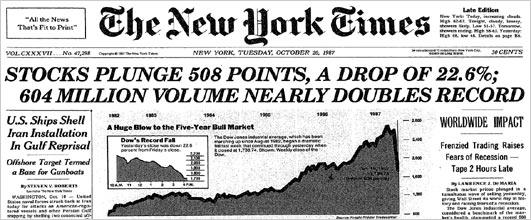
The U.S stock market experienced its largest 1-day percentage decline ever on Black Monday of 1987. This was the most shocking fall the world had seen at that point, and even up to today, no 1-day decline has ever matched Black Monday.

Betting on a black swan event netted Paul Tudor Jones $100 million in profits.

PAUL TUDOR JONESThe 22.6% drop in the Dow in 1987 has not been rivaled even up to 2017.
Source: stock-market-crash.net

Paul Tudor Jones shorted the stock market, tripling his money, and making US$100 million on that trade while the Dow Jones plummeted 22%.


5) ANDREW HALL – $100 MILLION PROFIT BETTING ON OIL

While working for Citigroup, Andrew Hall predicted a 5-year bull-run in oil from 2003-2008, and made the appropriate trades. Oil went from $30 to $100, and Hall brought with him $100 million as part of his compensation plan.

Andrew Hall made it big on oil in his career at Citigroup.

Aside from this brilliance, he reportedly bought 1 million barrels of physical oil in 2009, and stored it, hoping that oil would rise greatly. It did, and from 2009-2011, oil went from $50 to $100. However, his oil fund hasn’t been doing well in the past 5-6 years, and he has had to repeatedly explain the lack of profits to investors.


6) DAVID TEPPER – $4 BILLION PROFITS BUYING BANK STOCKS

David Tepper’s strategy was simple; buy low, sell high. In early 2009, he scooped up big banks like Citigroup and Bank of America, and saw them quadruple and triple in value from their bottoms in 2009.

Nothing spectacular; buy low, sell high.

These trades earned $7 billion for Tepper’s hedge fund. His personal compensation was $4 billion.


7) LOUIS BACON – 86% RETURNS BETTING SADDAM HUSSEIN WOULD INVADE KUWAIT

Louis Bacon went long on oil, short on stocks in the 1990s because of this geopolitical situation. Later, he also correctly bet that the U.S. would quickly defeat Iraq and the oil market would recover.

Bacon’s event-based bets rewarded him handsomely.

LOUIS BACONLouis Bacon explaining what he knows best; geopolitical event trading.
Source: Quotesgram

His hedge fund returned 86% that year because of these trades. Although his strategy is somewhat unconventional, he has excelled in it and carved a niche for himself.


KEY TAKEAWAYS

Many of these traders had decades of trading experience under their belts. Although they all seem like they had a great stroke of luck or a brief moment of brilliance, the preparation and practice that they went through was thorough and gruelling.

I hope that these stories of real traders would motivate you to continue at your game, brush up your skills, engage the financial markets, and stay up-to-date with what’s going on.

2 Comments/by Spencer Li
https://synapsetrading.com/wp-content/uploads/2017/04/best-currency-trades.jpg 496 992 Spencer Li https://synapsetrading.com/wp-content/uploads/2019/10/logo.jpg Spencer Li2017-04-05 06:01:382022-03-09 13:20:12The World’s 7 Greatest Currency Trades Ever Made – Key Lessons
Spencer Li

Here are 5 Reasons Why You May Never Get to Retire Despite working Harder

Investing & Portfolio Management
rat race

As the cost of living continues to increase year after year, you probably would have spent some time pondering about your financial security. You probably would have heard stories of or personally experienced a company downsizing, a pay cut, the loss of your job, mounting expenses, or just a sudden realization that the world isn’t such a stable place.

No matter when you discover this truth, it is critical that you come to terms with it. Only by knowing the truth can you deal with the reality of financial troubles ahead. Last year was marked by uncertainty, and it probably is just the tip of the iceberg of what can happen going forward.

1For most people, wages will never be enough to sustain their lifestyle at retirement.
Source: media.cagle.com

Talk to any taxi driver and he will probably complain to you about any of the following:

  • Rising healthcare costs
  • Rising petrol costs
  • Rising food costs
  • Rising housing costs
  • Instability in the economy

These money issues are real. However, before we go into the solutions, we have to understand where these problems come from.


1. Low Interest Rate Environment

A low interest rate environment means that you need to go beyond your bank deposits to preserve your wealth.

However, despite having more mobile phones than people in Singapore, we are painfully ignorant in financial matters. We are educated, but not wise; we are connected with each other, but disconnected with reality.

Truth be told, most people have no idea how to even match up to the bank interest rate, much less beat the bank interest rate. The average level of financial literacy in Singapore is still shockingly low. To be a decent investor, it would be necessary to at least understand basic financial instruments, financial asset classes, methods of speculation/investment, and simple risk management.

Financial literacy is the first step to fighting inflation. You don’t necessarily need to know exotic strategies like statistical arbitrage, premium collection on SPY options, futures pairs trading, spread betting, or betting on changes in the yield curve. But a basic understanding of market cycles and trading principles will make a large difference in one’s investment results.

2. CPF Alone May Not Be Sufficient

In years of economic boom, Singapore tends to experience inflation of 4-5%. The CPF ordinary account grows at 2.5%, which means your money’s losing value when the economy grows. Counting on CPF alone may help you get by, but would it really sustain the lifestyle you desire? Even if the inflation rate falls to 1-2% a year, very few Singaporeans can say they are able to retire comfortably.

It is more prudent to have something besides CPF to fall back on.

Some solutions include:

  • being willing to downgrade your apartment
  • holding structured deposits (can yield 4% or more)
  • holding high-dividend stocks

However, these strategies will probably only help in wealth preservation, not wealth creation.

For wealth creation, you need far more investment sophistication and dedication.

Doing a refresher for the setups before we embark on live trading! ??? #tradingarcade #realtraders

A post shared by Spencer Li ?? Synapse Trading (@iamrecneps) on Mar 27, 2017 at 5:09am PDT


3. Zero Inflation Could Be the Norm

A world of zero inflation is good for the average consumer (he thinks he won’t be paying more for his food/car/house/petrol), but it’s bad for wages.

Truth be told, when inflation suffers, it is normally a terrible situation for the economy to be in. Remember the productivity drive a few years ago? The government aimed for 2% productivity growth every year, because inflation was terribly low and the country had to do something about it.

sgInflation has fallen and fallen, and has even turned negative in 2015 and part of 2016.
Source: tradingeconomics.com

Stagnating or falling wages can become the norm. With wages in peril, it is even more essential to generate additional streams of income, or risk falling into financial destitution.

Examples of shrinking professions include:

  • F&B services
  • Marketing professionals (yes! because the supply has caught up with demand in recent times)
  • Insurance Agents
  • Property Agents
  • Logistics professionals (yes! because the supply has caught up with demand due to the euphoric onslaught of e-commerce firms)

If you have children, the best thing you can do is to advise them regarding these trends. Don’t be so concerned about their math scores, science scores, or whatever score; look to give them training in these skills, and to explore their interests in these areas.


4. Persistently High Property Prices

This is good news for existing property owners, but bad news for new property buyers. Singapore will continue attracting rich foreign buyers because that’s our value proposition as a nation. This problem keeps worsening as long as our property is affordable to wealthy investors from overseas. The government is likely to step in if property prices start falling.

The issue with high property prices is that most people end up taking 20 to 30-year loans and live with debt for most of their adult life. This keeps the economy stagnant and unable to experience growth like we’ve seen in the 1980s and 1990. A debt-ridden adult is much less likely to splurge. With an entire generation of people living with huge mortgage loans, we won’t see fantastic growth in a very long time.

Opening speaker for SMART Expo SG 2017! Thanks to everyone who came down to support! ? #suntec #property #guestspeaker

A post shared by Spencer Li ?? Synapse Trading (@iamrecneps) on Mar 24, 2017 at 11:55pm PDT


5. Rising Medical Costs and Falling Government Support

Take note: it’s not the government’s fault; blame it on falling birth rates. With a smaller workforce, tax revenues will fall and Singapore will be less able to provide for its elderly.

Singapore will age, and more and more sick people will depend on a smaller proportion of working adults in this country. It’s inevitable that the government cannot support the large number of elderly who will reside in our hospitals and hospices. It’s the same ‘graying’ problem that Japan is facing.

Falling government support, along with higher demand for doctors and strained infrastructure will cause medical bills to rise. Sure, it’ll be great for healthcare stocks, but healthcare spending on the elderly is not expansionary. Basic health economics would differentiate between healthcare spending that improves economic well-being (vaccinations on children, basic sanitation etc.), and healthcare spending that does not improve economic well-being. We’ll be seeing a lot of spending that does little to boost the economy.


So, “What Should I Do?”

The fact that you’re reading this shows that you are concerned for your financial future. Keep learning, reading, and exploring ways to combat this reality. After all, people perish for the lack of knowledge, not the lack of determination. Acquiring the right investment skills, financial management practices, and general knowledge will help protect you and your family from financial destitution.

My greatest hope is that you, the reader, would be motivated to start educating yourself financially, and to get your hands dirty in the investment world.

Cheers, and see you all soon! 😀


RESEARCH SOURCES & REFERENCES

www.blog.linkedin.com/2016/10/20/top-skills-2016-week-of-learning-linkedin
www.cnbc.com/2016/10/20/the-top-10-skills-that-will-get-you-hired.html

0 Comments/by Spencer Li
https://synapsetrading.com/wp-content/uploads/2016/12/rat-race.jpg 1103 1767 Spencer Li https://synapsetrading.com/wp-content/uploads/2019/10/logo.jpg Spencer Li2017-03-28 07:00:002021-03-09 18:26:19Here are 5 Reasons Why You May Never Get to Retire Despite working Harder
Spencer Li

Guest Speaker at the SMART Expo 2017 – How to Build a Solid Investment Portfolio

News & Events
SMART Expo Mar 2017 40

Yesterday, I got invited as a guest speaker at the SMART Expo to share about my investment portfolio and trading strategies.

Check out our event photos below:

Thanks for the invitation, and a big thanks to all those who came down to support! 😀

0 Comments/by Spencer Li
https://synapsetrading.com/wp-content/uploads/2017/03/SMART-Expo-Mar-2017-40.jpg 2448 3264 Spencer Li https://synapsetrading.com/wp-content/uploads/2019/10/logo.jpg Spencer Li2017-03-26 19:24:232018-09-05 02:49:06Guest Speaker at the SMART Expo 2017 – How to Build a Solid Investment Portfolio
Page 105 of 184«‹103104105106107›»

Free Trading Guides

Free Trading Guides

Blog Categories

  • Beginner's Guide
  • Blockchain & Crypto
  • Book Summaries
  • Candlestick Patterns
  • Economics & News Trading
  • Investing & Portfolio Management
  • Living Your Best Life
  • Market Analysis
  • News & Events
  • Price Chart Patterns
  • Promotions
  • Risk & Money Management
  • Stock Trading
  • Testimonials
  • Tools & Resources
  • Trading Psychology
  • Trading Strategies
  • Trading Tips
  • Travel & Lifestyle

Free Trading Guides

Free Trading Guides

Contact Us

Synapse Trading Pte Ltd
Registration No. 201316168H

Whatsapp: +65-8897-1204
Telegram: @iamrecneps
Email: info@synapsetrading.com

Links

Disclaimer
Privacy policy
Terms & Conditions
Contact us
Partnerships

© 2012-2024 Synapse Trading | All rights reserved | - powered by Enfold WordPress Theme
  • Link to Facebook
  • Link to X
  • Link to Instagram
  • Link to Youtube
  • Link to LinkedIn
  • Link to Mail
Scroll to top Scroll to top Scroll to top