• Link to Facebook
  • Link to X
  • Link to Instagram
  • Link to Youtube
  • Link to LinkedIn
  • Link to Mail
Synapse Trading
  • Home
  • About
    • My Background
    • My Trading Journey
    • My Travel Log
    • Media & Interviews
  • Mentoring
    • Trading Mastery Program
    • Results & Testimonials
  • Signals
    • Telegram (Free to join!)
    • Daily Trading Signals
    • Daily Trading Signals (Results)
  • Resources
    • Free Trading Guides
    • Tools & Resources
    • Blog & Infographics
  • Contact
    • Contact Us
    • Partnership Opportunities
  • Click to open the search input field Click to open the search input field Search
  • Menu Menu
Spencer Li

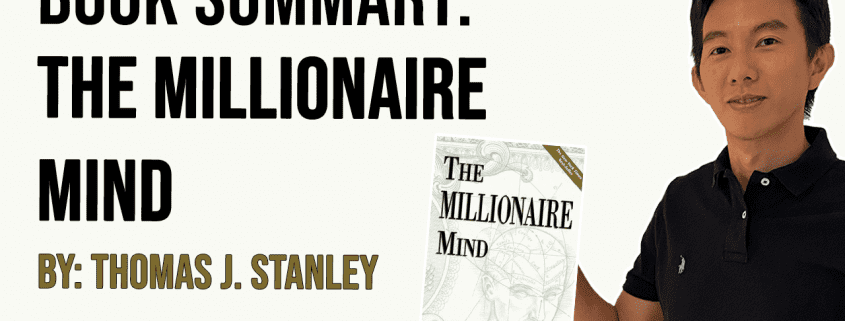
Book Summary: The Millionaire Mind by Thomas J. Stanley

Book Summaries
thumbnail Book Summary The Millionaire Mind by Thomas J Stanley

“The Millionaire Mind” by Thomas J. Stanley: Summary, Key Ideas, and Lessons for Traders

Last updated: 3 July 2026 · By Spencer Li, CFTe


“The Millionaire Mind” by Thomas J. Stanley is a research-based book that studies the habits and mindset of self-made millionaires, and its core finding is simple: most wealth is built, not inherited or won. Drawing on over 20 years of research and interviews with more than 1,000 millionaires, Stanley shows that financial success comes from a small set of repeatable behaviours: living below your means, avoiding consumer debt, staying disciplined toward clear goals, educating yourself about money, and taking calculated (not reckless) risks over a long time horizon. The headline lesson for a trader is the part nobody likes to hear. The edge is not a stock tip or a clever entry. It is self-discipline applied consistently over years. That is exactly the muscle trading demands, and exactly the one most people skip.

Here is what the book actually says, the ideas worth keeping, and how they map onto trading and investing.

What is “The Millionaire Mind” about?

Stanley spent over two decades studying how affluent people actually got there, and “The Millionaire Mind” is the result. His central claim is that financial success is not luck or family money. It is the product of specific habits and attitudes that anyone can learn and practise.

The book debunks the picture most people carry of the wealthy. The typical millionaire in his research is not a flashy spender. They live below their means, avoid debt, educate themselves, and stay patient. Stanley keeps returning to two pillars: financial education and self-discipline. You can have one without the other and stay broke. You need both.

Personally, I read it less as a money book and more as a behaviour book. The numbers are downstream of the habits.

The 10 key ideas from “The Millionaire Mind”

Stanley’s research surfaces ten recurring traits among self-made millionaires:

  1. They live below their means and avoid consumer debt. They prioritise saving and investing over spending, so wealth accumulates over time.
  2. They are disciplined and persistent. Clear goals, a plan to reach them, and a willingness to work hard and make sacrifices.
  3. They are educated about money. They take time to understand financial concepts and make informed decisions.
  4. They are strategic and thoughtful investors. They diversify and look for long-term growth, not quick wins.
  5. They take calculated risks. They accept risk to reach their goals, but carefully and on purpose, not on a whim.
  6. They prioritise their financial well-being. They treat financial health as a real input to overall happiness, and plan accordingly.
  7. They are independent and self-sufficient. They can stand on their own financially and do not rely on others to do it for them.
  8. They are responsible with their money. They see their wealth as serving future generations and their community, not just themselves.
  9. They are generous with time, money, and resources. They value giving back.
  10. They have a strong work ethic and a drive to achieve. They put in the effort and want to succeed.

Notice how few of these are about picking anything. Most are about temperament: patience, discipline, restraint. That is the quiet thesis of the whole book.

The four traits that actually predict wealth (and how they map to trading)

Strip the ten ideas down and the same handful of behaviours keep doing the heavy lifting. Here is how Stanley’s millionaire traits translate to the trading desk.

Millionaire trait (Stanley)What it looks like in tradingThe trap most people fall into
Live below your meansRisk a small, fixed fraction per trade; let the account compoundOver-leveraging to “get rich faster”, then blowing up on one bad run
Discipline and persistenceFollow your system through losing streaks; show up dailyBending the rules after two losses; quitting right before it works
Financial educationUnderstand your edge, your stats, and why the system worksCopying signals you cannot explain or evaluate
Calculated risk, not gamblingDefined stop, defined size, positive expectancyConfusing “bold” with “reckless”; no stop, no plan

The pattern is the same on both sides of the table. Wealth and trading reward the boring, repeatable behaviours and punish the dramatic ones.

How to apply “The Millionaire Mind” to your trading and investing

Stanley closes with ten practical actions. Here they are, framed for someone who trades:

  1. Set clear financial goals and build a plan to reach them.
  2. Live below your means and avoid consumer debt.
  3. Save and invest consistently over the long term.
  4. Educate yourself about money, and keep learning.
  5. Diversify and look for long-term growth potential.
  6. Take calculated risks in pursuit of your goals.
  7. Make your financial well-being a real priority.
  8. Be financially independent and self-sufficient.
  9. Be responsible with money, and think about its impact beyond yourself.
  10. Build a strong work ethic and a genuine drive to achieve.

If you trade, the most load-bearing items on that list are the unglamorous ones: consistent saving and investing, calculated risk, and the discipline to keep doing both. A swing trading system gives you the calculated-risk part on a plate (defined entry, defined stop, defined size). The rest is on you.

Other important points from the book

Beyond the lists, Stanley keeps coming back to five themes worth holding onto:

  • Personal responsibility. You own your financial outcomes. That means taking ownership of your decisions and not blaming external factors for your failures. (This one lands hard for traders. The market did not lose your money, your sizing did.)
  • Education and lifelong learning. Keep acquiring skills and knowledge that move you toward your goals.
  • Self-discipline. Successful people make hard financial decisions and stick to their plans. It comes from clear priorities and consistent effort, not willpower in the moment.
  • Relationships. Family, friends, and business associates shape your financial path. Seek supportive relationships, and be mindful of how your own behaviour affects them.
  • A long-term perspective. Think in years, not days. Weigh the long-term consequences of decisions and stay patient.

Where the human edge comes in

Here is the honest part. None of this is secret. You already know you should save, avoid debt, stay disciplined, and think long term. So does everyone who read the book and changed nothing.

A robo-advisor can diversify a portfolio. A screener can flag a setup. Neither can supply the self-discipline to sit on your hands through a losing streak, or the restraint to size small when you badly want to size big. Stanley’s millionaires were not smarter than everyone else. They were more consistent. Consistency under pressure is the trader’s version of the same trait, and it is the first of the Five Edges no tool can run for you.

FAQ

What is the main message of “The Millionaire Mind”?
That most wealth is built through learnable habits, not inherited or won. Stanley’s research points to living below your means, avoiding debt, self-discipline, financial education, and patient long-term investing as the behaviours that actually predict wealth.

Is “The Millionaire Mind” worth reading for traders?
Yes, if you treat it as a behaviour book rather than a money book. Its core themes (discipline, calculated risk, long-term thinking) are the same psychological edges that separate consistent traders from gamblers.

What is the difference between “The Millionaire Mind” and “The Millionaire Next Door”?
Both are Thomas J. Stanley books built on research into self-made millionaires. “The Millionaire Next Door” focuses on the everyday, frugal profile of the typical millionaire. “The Millionaire Mind” goes deeper into the mindset, attitudes, and decision-making habits behind that wealth.

How many millionaires did Thomas Stanley study?
According to the book, Stanley’s research drew on over 20 years of study and interviews with more than 1,000 millionaires.

What is the single most important habit from the book?
Self-discipline. Stanley keeps returning to it because it is the trait that lets people make hard financial decisions and stick to a plan over years, which is exactly what both wealth-building and trading require.


Now that you have the key lessons from “The Millionaire Mind,” which habit are you weakest on right now? Be honest, then pick one to work on this month. Let me know in the comments.

And if you want the full shelf of wealth and trading books mapped to what each one actually teaches, read the roundup: Best Investing and Trading Books of All Time.

Want the habit, not just the idea? Grab the free 15-Minute Swing Trading Starter Kit. It is the exact routine I use to scan once a day and trade any market in 15 minutes, built so the discipline part is baked into the process.


About the author. Spencer Li is the founder of Synapse Trading and a Certified Financial Technician (CFTe) with 15 years of trading across stocks, forex, crypto, commodities, and bonds. His trade log is public, 404 trades, losses left in. He teaches low-risk swing trading in 15 minutes a day, one system for any market.

Education, not financial advice. Synapse Trading is not licensed by MAS to advise on investment products. Trading carries risk of loss; past performance is not indicative of future results.


Related

Best Investing and Trading Books of All Time (pillar) · The Millionaire Next Door (book summary) · Trading psychology and discipline

0 Comments/by Spencer Li
https://synapsetrading.com/wp-content/uploads/2023/01/thumbnail-Book-Summary-The-Millionaire-Mind-by-Thomas-J.-Stanley.png 720 1280 Spencer Li https://synapsetrading.com/wp-content/uploads/2019/10/logo.jpg Spencer Li2023-01-06 02:29:362026-07-06 02:43:31Book Summary: The Millionaire Mind by Thomas J. Stanley
Spencer Li

Book Summary: The Intelligent Asset Allocator by William Bernstein

Book Summaries
thumbnail Book Summary The Intelligent Asset Allocator by William Bernstein

thumbnail Book Summary The Intelligent Asset Allocator by William Bernstein

The Intelligent Asset Allocator is a comprehensive guide to investing and asset allocation, written by renowned financial author William Bernstein.

The book is aimed at helping investors to understand the principles of asset allocation and to build a diversified portfolio that is suited to their individual goals and risk tolerance.

In this blog post, I will share all about this book and the author, key ideas from the book, and how you can apply it to your own trading & investing journey.

About the Author

William Bernstein is a well-respected financial author and investment advisor, with a background in economics and finance.

In addition to The Intelligent Asset Allocator, he has written several other popular books on investing and personal finance, including The Four Pillars of Investing and The Investor’s Manifesto.

What is the Book About?

The main message of The Intelligent Asset Allocator is that asset allocation is the key to successful investing, and that investors should aim to build a diversified portfolio that is suited to their individual goals and risk tolerance.

The book argues that asset allocation is more important than stock picking in determining long-term investment success, and that investors should focus on building a well-diversified portfolio that includes a mix of different asset classes.

10 Key Ideas from the Book

  1. Asset allocation is the key to successful investing: The book argues that asset allocation is more important than stock picking in determining long-term investment success. To build a successful portfolio, investors should focus on building a well-diversified portfolio that includes a mix of different asset classes.
  2. Diversification is important: The book emphasizes the importance of diversification in reducing portfolio risk and increasing the chances of long-term investment success. To diversify their portfolio, investors should include a mix of different asset classes, such as stocks, bonds, and cash.
  3. Choose the right asset allocation for your goals and risk tolerance: The book argues that investors should choose an asset allocation that is suited to their individual goals and risk tolerance. To determine the right asset allocation, investors should consider their time horizon, risk tolerance, and financial goals.
  4. Understand the risks and rewards of different asset classes: The book explains the risks and rewards of different asset classes, including stocks, bonds, and cash, and how to evaluate the trade-offs between risk and return.
  5. Consider the role of international diversification: The book discusses the benefits of international diversification, including the ability to capture different economic and market conditions and to reduce overall portfolio risk.
  6. Invest in low-cost, diversified index funds: The book advocates investing in low-cost, diversified index funds as a simple and effective way to build a well-diversified portfolio.
  7. Rebalance your portfolio regularly: The book recommends rebalancing your portfolio regularly to ensure that your asset allocation remains aligned with your goals and risk tolerance.
  8. Don’t try to time the market: The book warns against trying to time the market and emphasizes the importance of staying invested for the long-term.
  9. Don’t chase returns: The book advises against chasing returns and emphasizes the importance of building a well-diversified portfolio that is suited to your individual goals and risk tolerance.
  10. Keep costs low: The book stresses the importance of keeping investment costs low and advises investors to choose low-cost index funds whenever possible.

10 Ways to Apply the Teachings

  1. To build an effective asset allocation, it is important to understand your financial goals and risk tolerance. This can help you to choose an asset allocation that is suited to your individual needs and can help you to avoid taking on too much risk or investing in inappropriate assets.
  2. The book emphasizes the importance of diversification in reducing portfolio risk and increasing the chances of long-term investment success. To diversify your portfolio, consider including a mix of different asset classes, such as stocks, bonds, and cash.
  3. The book advocates investing in low-cost index funds as a simple and effective way to build a well-diversified portfolio. Look for funds with low expense ratios and consider using index funds to access a broad range of assets.
  4. The book recommends rebalancing your portfolio regularly to ensure that your asset allocation remains aligned with your goals and risk tolerance. This can help you to avoid taking on too much risk or becoming too heavily concentrated in any one asset class.
  5. The book advises against trying to time the market and emphasizes the importance of staying invested for the long-term. Rather than trying to predict market movements, focus on building a well-diversified portfolio and holding it for the long haul.
  6. The book advises against chasing returns and emphasizes the importance of building a well-diversified portfolio that is suited to your individual goals and risk tolerance. Rather than trying to find the hottest investment trend, focus on building a balanced portfolio that is suited to your needs.
  7. The book discusses the benefits of international diversification, including the ability to capture different economic and market conditions and to reduce overall portfolio risk. Consider including international assets in your portfolio to add diversification and potentially improve your risk-return profile.
  8. The book stresses the importance of keeping investment costs low and advises investors to choose low-cost index funds whenever possible. Look for funds with low expense ratios and consider using index funds to keep costs down.
  9. The book advises against letting emotions drive investment decisions and emphasizes the importance of staying disciplined and sticking to your investment plan. To avoid making emotional decisions, consider working with a financial advisor or using automated investment tools.
  10. The book encourages investors to educate themselves and to stay up-to-date on the latest investment trends and strategies. Consider reading other books on investing and personal finance, attending financial workshops or seminars, and seeking the guidance of a financial advisor to help you make informed investment decisions.

The Power of Diversification

One of the key stories and takeaways from “The Intelligent Asset Allocator” by William Bernstein involves the concept of “Diversification as the Only Free Lunch” in investing, which Bernstein emphasizes throughout the book.

In the book, Bernstein shares an anecdote about Harry Markowitz, the Nobel Prize-winning economist who developed Modern Portfolio Theory (MPT) in the 1950s. Markowitz’s research showed that by combining different types of assets (stocks, bonds, international assets, etc.), investors could achieve higher returns with lower risk than they could with any single asset class alone. This revolutionary insight demonstrated that diversification could reduce a portfolio’s risk without sacrificing returns, which Bernstein refers to as the “only free lunch” in investing.

Bernstein explains how, through the lens of MPT, one could construct a portfolio that maximizes return for a given level of risk by carefully selecting a mix of asset classes that don’t move in perfect sync with one another. For instance, during periods of stock market volatility, bonds may provide stability and reduce the overall portfolio’s drawdown, while international assets can offer additional diversification due to differing economic cycles.

The Value of Asset Allocation Over Stock Picking

The critical takeaway from Bernstein’s analysis is that asset allocation matters more than individual stock selection in determining long-term investment success. By focusing on a well-diversified asset mix rather than attempting to time the market or pick winning stocks, investors can achieve better risk-adjusted returns.

Bernstein illustrates this with historical data, showing that portfolios with a diversified mix of asset classes perform better over the long term than portfolios concentrated in a single asset class. He emphasizes that while it’s tempting to chase high returns in specific stocks or sectors, a diversified portfolio is more resilient in market downturns, providing smoother returns over time.

Concluding Thoughts

The Intelligent Asset Allocator is a comprehensive guide to investing and asset allocation, written by renowned financial author William Bernstein.

The main message of the book is that asset allocation is the key to successful investing, and that investors should aim to build a diversified portfolio that is suited to their individual goals and risk tolerance.

The book provides a clear and concise overview of the principles of asset allocation, including the risks and rewards of different asset classes and the importance of diversification.

It also offers practical advice on how to choose the right asset allocation, invest in low-cost index funds, and rebalance your portfolio regularly.

Overall, I would recommend The Intelligent Asset Allocator to beginner and intermediate investors who are looking to learn more about asset allocation and how to build a well-diversified portfolio.

While the book may not be suitable for more advanced investors, it provides a valuable introduction to the principles of asset allocation and offers practical advice on how to build a successful investment portfolio.

Now that I have covered all the key learning points of this book, would you consider adding it to your reading list?

For those who have already read it, what are some of your key learning points?

Let me know in the comments below!


best books on trading and investing

If you would like to find more book summaries and recommendations, also check out: “Best Investing & Trading Books of All Time”

0 Comments/by Spencer Li
https://synapsetrading.com/wp-content/uploads/2023/01/thumbnail-Book-Summary-The-Intelligent-Asset-Allocator-by-William-Bernstein.png 720 1280 Spencer Li https://synapsetrading.com/wp-content/uploads/2019/10/logo.jpg Spencer Li2023-01-06 02:17:382024-11-05 18:14:03Book Summary: The Intelligent Asset Allocator by William Bernstein
Spencer Li

Book Summary: The Black Swan by Nassim Nicholas Taleb

Book Summaries
thumbnail Book Summary The Black Swan by Nassim Nicholas Taleb

The Black Swan by Nassim Taleb: Summary, 10 Key Ideas, and What It Means for Traders

Last updated: 3 July 2026 · By Spencer Li, CFTe


The Black Swan, by Nassim Nicholas Taleb, is a book about rare, high-impact events that nobody saw coming, and why we are so bad at preparing for them. A “black swan” is Taleb’s term for an event that is (1) a huge outlier, (2) carries an extreme impact, and (3) gets explained away as predictable only after the fact. The 2008 crash, 9/11, and the rise of the internet are all black swans. Taleb’s core argument is simple: we spend our energy forecasting the ordinary and the known, so the rare events that actually move our lives and our portfolios catch us undefended. His advice is not to predict the next black swan (you can’t) but to build your life and your trading so a bad one cannot wipe you out, and a good one can pay you off. For a trader, that is the whole lesson: survive the tail, and stay positioned to catch it.

Here is the short version of the author, the book, the 10 key ideas, how to apply them, and what I actually use from it at the trading desk.

Who is Nassim Taleb?

Nassim Nicholas Taleb is a former options trader, risk manager, philosopher, and statistician. He spent years on trading desks before he wrote about them, so the ideas come from someone who put money on the line, not just theory.

The Black Swan is the second book in his “Incerto” series on uncertainty. The others are Fooled by Randomness, Antifragile, and Skin in the Game, and the ideas run across all four. If a concept below sounds bigger than one book, that is why.

What is the book about?

The book is about the impact of highly improbable events, and how badly we prepare for them.

Taleb’s claim is that we focus too much on the predictable and the known. We build neat models of a tidy world, and then a rare event we never modelled does most of the damage (or delivers most of the upside). His examples run from 9/11 to the internet, both of which reshaped the world and neither of which was in anyone’s forecast.

The takeaway is not “predict the unpredictable.” It is the opposite. Accept that you cannot forecast black swans, then arrange your affairs so you are robust to the bad ones and exposed to the good ones.

The 10 key ideas, at a glance

Taleb covers a lot of ground. Here are the ten ideas that matter most, in one table, with the plain version of each and where it bites a trader.

IdeaWhat it meansWhy it matters to a trader
Black swansRare, high-impact, hard-to-predict events, good or badThe few days that make or break your year are the ones nobody forecast
Narrative fallacyWe invent tidy stories to explain messy eventsThe clean “reason” the market moved is usually built after the fact
Precautionary principleBe more cautious when the downside is severe and the odds are unclearSize for the trade that can ruin you, not the one that probably won’t
The black swan problemWe overgeneralise from the past and assume tomorrow looks like yesterday“It has never dropped that far” is not a stop-loss
Fooled by randomnessWe credit skill for luck and blame luck for failureA winning streak in a bull market is not the same as edge
AntifragilitySome systems get stronger under stress, not just survive itBuild a book that benefits from volatility instead of fearing it
The Lindy effectThe longer something has lasted, the longer it is likely to lastOld, proven methods tend to outlive the latest fad
Survivorship biasWe study the winners and never count the deadEvery “this strategy made millions” hides the ones it bankrupted
Black swan blindnessWe underrate rare events even after living through themMemory of the last crash fades fast; the risk does not
Erring on the side of cautionWhen failure is catastrophic and odds are uncertain, stay conservativeProtect the downside first, chase the upside second

The thread running through all ten: the rare event dominates the average one, and our instincts are tuned for the average. That gap is where people blow up.

How to apply it: 10 practical moves

The ideas are only useful if they change what you do. Here is Taleb’s advice in action.

  1. Build resilience in. Diversify, and keep a safety net, so one bad event does not end the game.
  2. Embrace randomness. Stop trying to control the uncontrollable. Plan to be wrong, and survive being wrong.
  3. Avoid over-simplification. Respect that systems are complex. The clean model is usually hiding the risk, not removing it.
  4. Foster diversity. Diverse inputs, people, and experiences. Monocultures break in one blow.
  5. Seek out antifragile opportunities. Look for positions and habits that gain from disorder rather than just tolerate it.
  6. Avoid groupthink. Go looking for the view that disagrees with you. The herd is most confident right before it is wrong.
  7. Get skin in the game. Have a real personal stake in the outcome. Advice from people with nothing on the line is cheap.
  8. Use storytelling carefully. Stories help you rehearse for the unexpected, as long as you know they are rehearsals, not predictions.
  9. Seek multiple sources. Every single source carries a bias. Triangulate.
  10. Stay open to new ideas. Be willing to challenge what you already believe. The black swan rarely fits your current model.

What I actually use from The Black Swan as a trader

I will be honest. Not everything in a book like this survives contact with a real trading account. Two ideas did, and I use them every week.

The first is antifragility. Markets change fast, and a method built to perform only in calm conditions is fragile by definition. So I would rather hold a position structured to do better when volatility expands, and trade a system that is robust across regimes, than one finely tuned to last month’s market. Embracing the challenge, instead of bracing against it, is what keeps me growing as a trader rather than just defending.

The second is avoiding groupthink. The trading world runs on herd mentality. It is easy to follow the crowd, and most of the time the crowd is fine, right up until it is not. The book pushed me to be more critical of my own assumptions and to actively seek out the opposite view before I commit. That one habit has saved me more than any indicator.

Personally, I treat the rest of the book as context rather than instructions. It changes how I see risk. It does not tell me where to put a stop.

Where the human edge comes in

Here is the part a model cannot do for you. An algorithm can size a position, run a backtest, and tell you the historical odds in a second. What it cannot do is decide how much of your capital should be exposed to an event that has never happened in the data it was trained on. That is a judgment about the unknown, and the unknown is exactly what The Black Swan is about. The math is the easy part. Sizing for the tail you cannot see, and refusing to bet the account on a model that has never met a crisis, is the discipline, and it is one of the Five Edges no machine trades for you.

FAQ

What is a black swan event in simple terms?
A black swan is a rare, high-impact event that is almost impossible to predict beforehand and looks obvious only in hindsight. Taleb’s three tests are: it is a large outlier, it carries an extreme impact, and people rationalise it as predictable after it happens.

Is The Black Swan worth reading for traders?
Yes, but read it for how it reshapes your view of risk, not for trading tactics. It will not give you entries or stops. It will make you size more carefully and treat your forecasts with more suspicion, which for most traders is the more valuable lesson.

What is the main message of The Black Swan?
That we cannot predict rare, high-impact events, so we should stop trying and instead build our lives and portfolios to survive the bad ones and benefit from the good ones. Robustness beats prediction.

What is the difference between The Black Swan and Antifragile?
The Black Swan diagnoses the problem: rare events dominate, and we cannot forecast them. Antifragile prescribes the solution: build systems that gain from disorder. They are best read as a pair.

What is antifragility?
Antifragility is Taleb’s term for systems that get stronger under stress and volatility, rather than merely resisting it (robust) or breaking under it (fragile). A trading approach that performs better when markets get wild is antifragile.


Would you add The Black Swan to your reading list? And if you have already read it, what stuck with you? Let me know in the comments.

For more of the books that shaped how I trade, read the roundup: Best Investing and Trading Books of All Time.

Want the system behind the discipline? Grab the free 15-Minute Swing Trading Starter Kit. It is the exact routine I use to scan once a day and trade any market in 15 minutes.


About the author. Spencer Li is the founder of Synapse Trading and a Certified Financial Technician (CFTe) with 15 years of trading across stocks, forex, crypto, commodities, and bonds. His trade log is public, 404 trades, losses left in. He teaches low-risk swing trading in 15 minutes a day, one system for any market.

Education, not financial advice. Synapse Trading is not licensed by MAS to advise on investment products. Trading carries risk of loss; past performance is not indicative of future results.


Related

Best Investing and Trading Books of All Time (pillar) · Fooled by Randomness summary · Antifragile summary · Trading psychology and risk management

0 Comments/by Spencer Li
https://synapsetrading.com/wp-content/uploads/2023/01/thumbnail-Book-Summary-The-Black-Swan-by-Nassim-Nicholas-Taleb.png 720 1280 Spencer Li https://synapsetrading.com/wp-content/uploads/2019/10/logo.jpg Spencer Li2023-01-05 21:02:172026-07-06 00:31:56Book Summary: The Black Swan by Nassim Nicholas Taleb
Spencer Li

Book Summary: Capital in the Twenty-First Century by Thomas Piketty

Book Summaries
thumbnail Book Summary Capital in the Twenty First Century by Thomas Piketty

Capital in the Twenty-First Century (Piketty): Summary, Key Ideas, and What It Means for Investors

Last updated: 3 July 2026 · By Spencer Li, CFTe


“Capital in the Twenty-First Century” by Thomas Piketty argues that wealth grows faster than wages, so without deliberate intervention, capital piles up in fewer and fewer hands over time. His central finding, drawn from over two centuries of tax and income data across many countries, is captured in one short inequality: r is greater than g. Here r is the return on capital (what money makes when it is invested, roughly 4 to 5 percent historically) and g is the growth rate of the economy (how fast wages and output rise, often closer to 1 to 2 percent). When the return on owning things outpaces the growth of earning a living, the people who already own capital pull steadily ahead of the people who work for a paycheck. Piketty’s policy fix is a global tax on wealth. His warning is that left alone, this gap widens until it threatens social and political stability. For an investor, the uncomfortable practical reading is simpler still: if capital compounds faster than labour, you want to be an owner of capital, not only a seller of your time.

I read this as a trader, not as an economist, and the book is worth your attention even if you disagree with every policy in it. Here is what is actually in it, the one equation that carries the whole argument, the criticisms worth knowing, and the way I think an investor should take it.

Who is Thomas Piketty?

Thomas Piketty is a French economist and a professor at the École des Hautes Études en Sciences Sociales in Paris. He built his reputation on the patient, unglamorous work of assembling long-run data on income and wealth, going back through tax records spanning more than two hundred years and many countries. “Capital in the Twenty-First Century,” published in 2013, is his best-known work, and it turned a dense academic project into a global bestseller and a genuine public argument about inequality.

What makes him worth reading is the data, not the slogans. Whatever you think of his conclusions, the historical record he assembled is the real contribution. Hence even his critics tend to argue with his interpretation rather than dismiss the evidence outright.

What is the book actually about?

The book makes one big claim and defends it with history: wealth inequality is not a passing accident of capitalism but a built-in tendency, and it has waxed and waned for specific historical and political reasons, not natural ones.

Piketty’s reasoning runs like this. Over the long sweep of history, the return on capital has usually been higher than the growth rate of the overall economy. Money already invested grows faster than the economy that working people earn their living from. So the share of total wealth held by those who already own capital tends to rise, decade after decade, unless something interrupts it. The twentieth century did interrupt it, through two world wars, the Great Depression, and high post-war taxes, which destroyed or redistributed a lot of capital. Piketty’s worry is that the second half of the twentieth century was the exception, and that without deliberate action, the old pattern of high concentration returns.

He argues this matters for two reasons. It is a moral problem, because extreme concentration is hard to square with a fair society. And it is an economic and political one, because too much concentration can breed instability and, he argues, even drag on growth. His proposed remedy is a coordinated global tax on wealth, which he concedes is politically difficult. His view is that ordinary tools, like progressive income tax alone, are not enough to offset the r-minus-g engine.

The one equation: r is greater than g

If you remember one thing from this book, make it this. The whole argument compresses into a single comparison between two rates.

  • r is the rate of return on capital: what wealth earns when it is invested, across stocks, bonds, real estate, and business ownership. Piketty puts the long-run figure at roughly 4 to 5 percent.
  • g is the growth rate of the economy: how fast total output and, broadly, wages grow. Historically this is often lower, closer to 1 to 2 percent over long stretches.

When r is greater than g, capital grows faster than the economy that wages come from. The gap between the two, r minus g, is what Piketty says sets the speed of wealth concentration. The bigger that gap, the faster wealth pools at the top. This is also why inherited wealth matters so much in his account: when old money compounds faster than the economy grows, fortunes built generations ago can outpace fortunes earned through work today.

Do note that r is greater than g is a description of a historical tendency, not an iron law of physics. It can be, and has been, overridden, by war, by depression, by tax policy, and by faster economic growth. That nuance gets lost in the slogan, and it matters for the criticisms below.

The key ideas, without the repetition

The original summary lists ten points that mostly restate one another. Stripped down, Piketty is really making five arguments:

  1. Wealth inequality is persistent, not random. Concentration of wealth has recurred across countries and centuries. It is a feature of the system, not a glitch.
  2. It is political and historical, not natural. The level of inequality is shaped by wars, crises, and policy choices, so it can be changed by different choices.
  3. r greater than g is the engine. When the return on capital outpaces economic growth, wealth concentrates, and the size of that gap sets the pace.
  4. Inherited wealth compounds the effect. Old capital growing faster than new earnings entrenches advantage across generations.
  5. Ordinary fixes are not enough, in his view. Progressive income tax alone does not offset the engine; Piketty’s headline proposal is a coordinated global wealth tax.

Capital income vs labour income

Here is the tension at the heart of the book, laid out plainly. It is the difference between making money by owning things and making money by working.

Capital income (owning)Labour income (working)
SourceReturns on stocks, bonds, property, businessesWages and salary for your time
Long-run growth rater, historically about 4 to 5 percentTied to g, often about 1 to 2 percent
Scales withCapital already owned (and it compounds)Hours in the day (it does not compound)
Who benefits mostThose who already hold wealth, including heirsThose still building from a paycheck
Piketty’s worryPulls steadily ahead over timeFalls behind unless growth is fast

The table is not investment advice, and it is not a promise that capital always beats labour every year (in any single decade it may not). It is the long-horizon picture Piketty draws from the data, and it is the reason an investor cannot ignore the book even while disagreeing with its politics.

The criticisms worth knowing

Piketty’s work has drawn both heavy praise and serious pushback, and a fair summary has to include both.

Some economists have questioned the accuracy and comprehensiveness of his data, or how he stitched different historical sources together. Others accept the data but reject the conclusions, arguing that the proposed remedies, a global wealth tax above all, are politically unrealistic or could do more harm than good by discouraging investment. There are also technical debates about whether r reliably stays above g in the future, or whether faster growth and changing returns could close the gap on their own.

Personally, I take the historical record more seriously than the policy prescription. You can think the diagnosis is largely right and the prescribed cure is unworkable, and many reasonable people land exactly there. The honest move is to read the data with a critical eye, hold both the evidence and the objections in mind, and not treat the book as either gospel or propaganda. It offers a framework for thinking about the problem, not a one-size-fits-all solution.

How should an investor read this book?

This is where most trading-blog summaries go wrong. They turn Piketty into a political to-do list, vote this way, donate here, advocate for that. That is the author’s call to action, and you are free to take it or leave it. It is not the part that changes how you handle your own money.

The part that should change your behaviour is the engine itself. If, over a lifetime, capital tends to compound faster than wages grow, then the single most important financial decision most people make is whether they ever cross from being only a seller of their time to also being an owner of capital. You do not need to agree with the global wealth tax to take that lesson. Hence the practical, unglamorous reading of a 700-page book about inequality is this: get on the ownership side of the line, start early, and let compounding do the slow work that r is greater than g describes.

That is also where it connects to everything else on this site. Buying assets is owning capital. Trading is one active way to grow it, and long-term investing is another. The book is a reminder of why building and holding capital matters in the first place, underneath any particular strategy. Read it alongside the case for low-cost long-term ownership in The Little Book of Common Sense Investing and the local picture of how wealth actually stacks up in the report on the net worth of the average Singaporean.

Where the human edge comes in

A model can tell you r is greater than g. It can even tell you, on average, that owning capital beats selling your time. What it cannot do is decide your split, how much of your life energy you convert into owned assets versus how much you spend, when to start, and whether you have the discipline to keep compounding through the decade when the gap closes and ownership feels like a bad idea. Piketty supplies the macro fact. The judgment about what you personally do with it is yours, and that is the first of the Five Edges no equation can supply for you.

FAQ

What is the main message of Capital in the Twenty-First Century?
The main message is that wealth tends to grow faster than the economy, summed up as r is greater than g, so capital concentrates in fewer hands over time unless deliberate policy intervenes. Piketty argues this is a recurring historical pattern, not a natural inevitability, and proposes a global wealth tax to counter it.

What does r is greater than g mean?
It means the return on capital (r), historically about 4 to 5 percent, has usually been higher than the growth rate of the economy (g), often about 1 to 2 percent. When money already invested grows faster than wages and output, those who own capital pull ahead of those who earn a salary, and the gap, r minus g, sets how fast wealth concentrates.

Is Capital in the Twenty-First Century worth reading?
Yes, especially for the long-run historical data on income and wealth, which is the book’s real contribution. It is long and dense, and many readers disagree with its policy proposals, but the underlying picture of how capital compounds relative to wages is valuable for anyone thinking about building wealth.

What are the main criticisms of Piketty’s book?
Critics have questioned the accuracy and stitching of his historical data, argued that his proposed global wealth tax is politically unrealistic or economically harmful, and debated whether r will reliably stay above g in the future. A common position is to accept much of the diagnosis while rejecting the prescribed cure.

What is the practical takeaway for an investor?
If capital compounds faster than wages over the long run, the key decision is whether you ever become an owner of capital rather than only a seller of your time. The investor-side reading of the book is to get on the ownership side early and let compounding work, regardless of where you land on its politics.


Now that you have Piketty’s core argument and the one equation behind it, the real question is what you do with it: are you building capital, or only earning wages? Have you read this one? Let me know your key takeaway in the comments.

For more, browse the full shelf: Best Investing and Trading Books of All Time.

Want a system for the active side of building capital? Grab the free 15-Minute Swing Trading Starter Kit, the exact routine I use to scan once a day and trade any market in 15 minutes.


About the author. Spencer Li is the founder of Synapse Trading and a Certified Financial Technician (CFTe) with 15 years of trading across stocks, forex, crypto, commodities, and bonds. His trade log is public, 404 trades, losses left in. He teaches low-risk swing trading in 15 minutes a day, one system for any market.

Education, not financial advice. Synapse Trading is not licensed by MAS to advise on investment products. Trading carries risk of loss; past performance is not indicative of future results.


Related

Best Investing and Trading Books of All Time (pillar) · The Little Book of Common Sense Investing (Bogle) · Net worth of the average Singaporean · The Intelligent Investor summary

0 Comments/by Spencer Li
https://synapsetrading.com/wp-content/uploads/2023/01/thumbnail-Book-Summary-Capital-in-the-Twenty-First-Century-by-Thomas-Piketty.png 720 1280 Spencer Li https://synapsetrading.com/wp-content/uploads/2019/10/logo.jpg Spencer Li2023-01-05 17:44:032026-07-06 01:03:16Book Summary: Capital in the Twenty-First Century by Thomas Piketty
Spencer Li

Book Summary: The Wealth of Nations by Adam Smith

Book Summaries
thumbnail Book Summary The Wealth of Nations by Adam Smith

The Wealth of Nations by Adam Smith: Summary, Key Ideas, and What It Teaches Traders

Last updated: 3 July 2026 · By Spencer Li, CFTe


The Wealth of Nations, written by Adam Smith in 1776, is the book that laid the foundation for modern free-market economics, and its core idea is the “invisible hand”: individuals acting in their own self-interest, inside a competitive market, tend to produce outcomes that benefit society as a whole. Smith’s argument is that a free market, where prices are set by supply and demand rather than by government, is the most efficient way to allocate resources. The book’s most quoted ideas are the division of labour (specialisation raises productivity), the price system as a coordination tool, and the case for free trade and competition. For a trader or investor, the practical takeaway is simple: markets are run by self-interested participants reacting to supply, demand, and price, so your edge comes from reading that behaviour, not from arguing with it.

Here is the author, the central ideas, and how I actually apply the book to trading.

Who was Adam Smith?

Adam Smith was a Scottish economist and philosopher, born in 1723, widely regarded as one of the founders of modern economics. Besides The Wealth of Nations, he wrote The Theory of Moral Sentiments, which deals with human sympathy and morality. People forget that Smith was a moral philosopher first and an economist second. That matters, because the “invisible hand” was never an excuse for greed. It was an observation that, under the right conditions, private interest and public good can line up.

What is The Wealth of Nations about?

The book is a broad analysis of how an economy works and what role it plays in society. The central message is the invisible hand (the idea that self-interested individuals, transacting freely, can collectively benefit society without anyone planning it). From there, Smith builds the case for a free-market economy where supply and demand set prices, and where the government’s job is limited rather than central.

Do note that, this is an 18th-century book. The world it describes is simpler than ours. But the mechanics it identifies, specialisation, price signals, competition, capital accumulation, still drive every market you trade today.

The 10 key ideas, and how they apply

Smith’s argument is usually compressed into ten ideas. Here they are next to the practical move each one suggests, so you can see the theory and the application side by side.

#Key idea from the bookWhat it meansHow to apply it
1Division of labourSpecialising on one task raises efficiency and outputSpecialise. Get good at one market or one setup before spreading thin.
2Role of self-interestPeople acting in their own interest can benefit the wholeMake decisions that serve your real goals, not what looks impressive.
3The price systemPrices set by supply and demand allocate resourcesRead price as information. It is the market telling you where demand is.
4Benefits of free tradeFree exchange across borders raises prosperityStay open to opportunities outside your home market.
5Limited role of governmentThe state should supply public goods, not run the marketRecognise that intervention distorts prices. Factor policy risk in, do not assume it.
6Capital drives growthAccumulated capital powers economic growthBuild and reinvest capital. Compounding is the long game.
7Importance of competitionCompetition lowers prices and raises qualityCompete to improve. Assume the other side of your trade is sharp.
8Role of wagesWages are set by the supply and demand for labourUnderstand that your pay, and your edge, is priced by the market too.
9Education and skillsSkills drive individual and collective prosperityInvest in your own learning. It is the highest-return capital you own.
10Market sets pricesPrices come from the market, not an authorityRespect the market’s price. Do not fight the tape because you “know better”.

The thread running through all ten, for a trader, is the price system. Smith’s whole framework says prices are not random and they are not handed down. They are the running output of millions of self-interested decisions. That is exactly what a chart is. Price action is the invisible hand drawn on a screen.

A few more points worth keeping

Beyond the headline ten, Smith makes four observations that still hold up:

  • Entrepreneurship drives growth. Starting and running a business is one of the main engines of an economy.
  • Technological progress raises efficiency and productivity. New tools let the same effort produce more.
  • The financial system (banks and other institutions) matters, because it moves capital to where it is useful.
  • Taxes can drag on the economy by distorting prices and discouraging activity.

Hence, when you read a market, you are not just reading a chart. You are reading the combined effect of entrepreneurs, technology, credit, and policy, all of it expressed back to you as price.

Where the human edge comes in

Smith’s market is a crowd of self-interested participants competing on price. That is also a fair description of every market you trade. An AI can summarise this book in a second, and it can scan a thousand charts for you. What it cannot do is sit in that competitive crowd and supply the judgment, the discipline, and the emotional control to act well when your own self-interest is screaming the wrong thing at you. Smith described the game. Playing it well is still your job, and that is the first of the Five Edges that AI cannot trade for you.

My view: read it for the mental model, not the tactics

Personally, I would not read The Wealth of Nations for a trading edge. It will not give you a setup. What it gives you is a mental model: a clear picture of why prices move, why competition matters, and why specialisation pays. That model is worth more over a career than any single pattern.

I would recommend it to anyone who wants to understand how markets actually work underneath the candles. Just go in knowing it is a foundation, not a playbook.

FAQ

What is the main idea of The Wealth of Nations?
The main idea is the “invisible hand”: individuals acting in their own self-interest, within a free and competitive market, tend to benefit society as a whole. Smith argued that prices set by supply and demand allocate resources more efficiently than government planning.

When was The Wealth of Nations written, and by whom?
It was written by Adam Smith, a Scottish economist and philosopher, and published in 1776. It is widely considered one of the founding works of modern economics and capitalism.

What is the “invisible hand”?
The invisible hand is Smith’s term for the way self-interested individuals, transacting freely in a market, can collectively produce outcomes that benefit society without anyone directing them to. It is the book’s most famous concept.

Is The Wealth of Nations useful for traders and investors?
Indirectly, yes. It will not give you a strategy, but it explains why prices move and why markets are efficient at allocating resources. That mental model helps you read price action as information rather than noise.

What is the difference between The Wealth of Nations and The Theory of Moral Sentiments?
The Wealth of Nations is Smith’s work on economics and markets. The Theory of Moral Sentiments, his earlier book, deals with human sympathy and morality. Together they show Smith saw self-interest and moral behaviour as connected, not opposed.


Now that you have the key learning points, would you add The Wealth of Nations to your reading list? And if you have already read it, what stuck with you? Let me know in the comments.

For more summaries like this, read the roundup: Best Investing and Trading Books of All Time.

Want a system to put the theory to work? Grab the free 15-Minute Swing Trading Starter Kit. It is the exact routine I use to scan once a day and trade any market in 15 minutes.


About the author. Spencer Li is the founder of Synapse Trading and a Certified Financial Technician (CFTe) with 15 years of trading across stocks, forex, crypto, commodities, and bonds. His trade log is public, 404 trades, losses left in. He teaches low-risk swing trading in 15 minutes a day, one system for any market.

Education, not financial advice. Synapse Trading is not licensed by MAS to advise on investment products. Trading carries risk of loss; past performance is not indicative of future results.


Related

Best Investing and Trading Books of All Time (pillar) · The Intelligent Investor summary · Reminiscences of a Stock Operator summary

0 Comments/by Spencer Li
https://synapsetrading.com/wp-content/uploads/2023/01/thumbnail-Book-Summary-The-Wealth-of-Nations-by-Adam-Smith.png 720 1280 Spencer Li https://synapsetrading.com/wp-content/uploads/2019/10/logo.jpg Spencer Li2023-01-05 02:52:232026-07-06 03:23:43Book Summary: The Wealth of Nations by Adam Smith
Page 50 of 184«‹4849505152›»

Free Trading Guides

Free Trading Guides

Blog Categories

  • Beginner's Guide
  • Blockchain & Crypto
  • Book Summaries
  • Candlestick Patterns
  • Economics & News Trading
  • Investing & Portfolio Management
  • Living Your Best Life
  • Market Analysis
  • News & Events
  • Price Chart Patterns
  • Promotions
  • Risk & Money Management
  • Stock Trading
  • Testimonials
  • Tools & Resources
  • Trading Psychology
  • Trading Strategies
  • Trading Tips
  • Travel & Lifestyle

Free Trading Guides

Free Trading Guides

Contact Us

Synapse Trading Pte Ltd
Registration No. 201316168H

Whatsapp: +65-8897-1204
Telegram: @iamrecneps
Email: info@synapsetrading.com

Links

Disclaimer
Privacy policy
Terms & Conditions
Contact us
Partnerships

© 2012-2024 Synapse Trading | All rights reserved | - powered by Enfold WordPress Theme
  • Link to Facebook
  • Link to X
  • Link to Instagram
  • Link to Youtube
  • Link to LinkedIn
  • Link to Mail
Scroll to top Scroll to top Scroll to top