

What is Epicureanism? (11 Practical Ways to Apply it in Your Life!)
Want the daily routine? Get the free 15-Minute Swing Trader’s Checklist. Get it free →
What Is Epicureanism, and How Do You Apply It in Daily Life?
Last updated: 2 June 2026 · By Spencer Li, CFTe
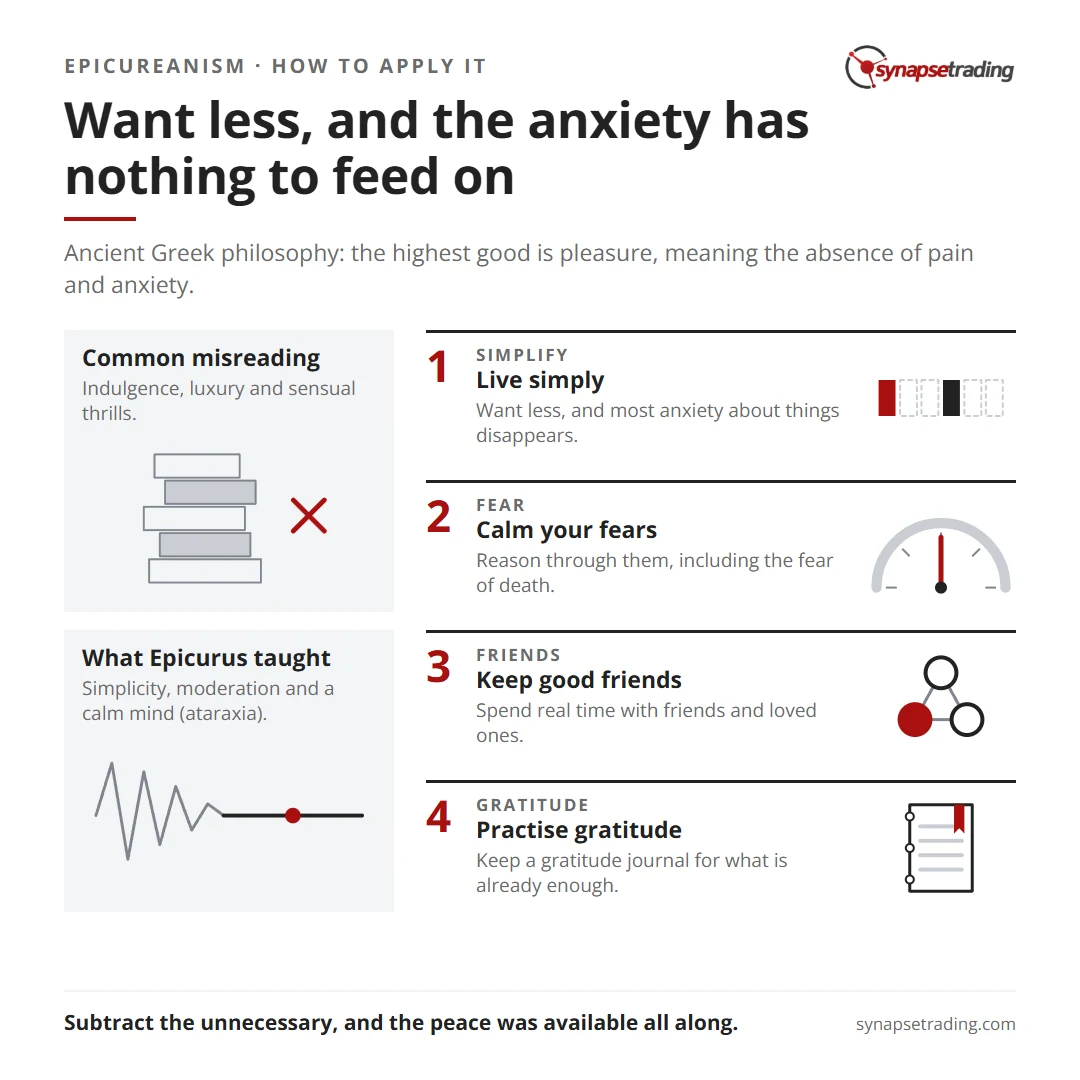
Epicureanism is an ancient Greek philosophy, founded by Epicurus in the 4th century BCE, that treats pleasure as the highest good but defines pleasure as the absence of pain and anxiety. The goal is a calm, stable contentment the Greeks called ataraxia (a state of inner peace and freedom from disturbance). You reach it not by acquiring more, but by wanting less: living simply, keeping good friends close, calming your fears (especially the fear of death), and being grateful for what is already enough. To apply it day to day, you trim unnecessary desires, invest in friendship, take care of body and mind, and practise being content in the present. It is, in short, the opposite of the modern “more is better” treadmill.
So no, Epicureanism is not about indulgence, even though the word “epicure” now means a lover of fine food. Epicurus himself lived on bread, water, and the occasional pot of cheese. Let me explain what he actually taught, and how you can use it.
What is Epicureanism?
Epicureanism is the philosophy that the point of life is to pursue pleasure and avoid pain, but with a careful definition of what pleasure means. For Epicurus, the highest pleasure is not a thrill or a feast. It is ataraxia: a steady, untroubled peace of mind.
The path to it has a few clear pillars:
- Live simply. Want less, and most of your anxiety about getting and keeping things disappears.
- Calm your fears. Especially the big two, the fear of the gods and the fear of death, which Epicurus argued are both unfounded.
- Keep good friends. Epicurus rated friendship above almost everything else for a happy life.
- Use reason. Understand how the world actually works, and irrational dread loses its grip.
Epicurus did not say “get more so you feel less anxious.” He said “want less, and the anxiety has nothing to feed on.” That is a different operating system from the one most of us run.
Where did Epicureanism come from?
Epicureanism was founded by Epicurus, born on the island of Samos and later settled in Athens, where he set up a school in a garden on the edge of the city. The school took its nickname from the place: “The Garden.”
He built on two earlier ideas. From Democritus he took atomism, the view that everything is made of tiny, indestructible particles (atoms) moving through empty space, and that natural events can be explained by those atoms rather than by the whims of gods. From the Cyrenaics he took the idea that pleasure is the goal of life, then corrected it: true pleasure, he argued, is found in inner peace.
The Garden was unusual for its time. It welcomed women and even enslaved people as students, which was rare. Epicurean communities, also called Gardens, spread across the Greek and Roman world, and the philosophy stayed influential well into the Roman period.
What does Epicureanism actually teach? (the common misreadings)
The biggest trap with Epicureanism is the modern word “epicurean,” which suggests a person devoted to luxury and rich food. That is almost the reverse of what Epicurus meant. Here is the gap between the popular version and the original, side by side.
| Common misreading | What Epicurus actually taught |
|---|---|
| Chase as much pleasure as possible | Chase the absence of pain and anxiety (ataraxia); a calm mind beats an excited one |
| Indulgence and luxury | Simplicity and moderation; bread and water, friends, a quiet life |
| Pleasure means sensual thrills | The highest pleasure is mental tranquillity |
| Fear death and the afterlife | Death is nothing to us; while we exist it is not here, and when it comes we do not |
| More possessions equal more happiness | Most desires are unnecessary; contentment comes from wanting less |
| Friends are optional | Friendship is one of the surest sources of a happy life |
This is why classifying Epicurus as a hedonist is misleading. He was a hedonist only in the technical sense that pleasure is the goal. In practice, his prescription looks closer to a minimalist monk than a party host.
What are the benefits of Epicureanism?
Adopting Epicurean principles tends to deliver a handful of practical benefits:
- A simpler, calmer life. Cutting back on excess removes a large source of stress and craving.
- Inner peace (ataraxia). Wisdom and self-control, applied steadily, produce a stable contentment that does not depend on the next acquisition.
- Stronger relationships. Treating friendship as essential, not optional, builds a support network that carries you through hard times.
- Less fear. Reasoning through your fears, including the fear of death, removes a lot of background dread.
- Clearer thinking. Reason and logic, applied to your own life, replace superstition and panic with understanding.
- A more ethical life. Living virtuously, with kindness and fairness, is treated not as a chore but as part of the good life.
How do you apply Epicureanism in daily life?
You apply Epicureanism by deliberately wanting less, investing in people, calming your fears, and practising contentment in the present. Here are the practical moves, drawn straight from the philosophy.
Live simply and moderately. Avoid excess. Focus on the essentials. A simple daily habit: set aside a few minutes for reflection, and practise gratitude for what you already have.
Invest in friendship and community. Spend real time with friends and loved ones. Build a supportive circle around you, whether through a club, a shared interest, or community work.
Practise self-control and wisdom. Use a daily practice, meditation or quiet study, to strengthen self-control and keep learning about the world and yourself.
Mind your thoughts and emotions. Journaling and mindfulness help you notice negative thought patterns and replace them with steadier ones.
Live virtuously. Kindness and fairness are part of the package. Small, repeated acts (helping someone, volunteering, watching how your actions land on others) compound.
Cultivate gratitude. Keep a gratitude journal, thank the people who matter, and take time to appreciate the everyday and the natural world.
Protect body and mind. Exercise, eat well, sleep enough, and seek help when you are struggling. Epicurus put avoidance of pain at the centre, and your health is the foundation of that.
Find balance. Pursue pleasures, but do not become a slave to any one of them. Set limits, and keep variety in your life.
Be content with what you have. Set realistic expectations, and notice what actually brings you contentment rather than what you are told should.
Live in the present. Stop replaying the past and pre-living the future. Focus on the task in front of you and the moment you are in.
Aim at ataraxia. The thread through all of the above is inner peace. Understand your place in the world, control your desires, and the calm follows.
Hence, the practical heart of Epicureanism is not a single dramatic change. It is a steady trimming of what you crave, paired with a steady investment in what reliably makes life good.
Who are famous examples of Epicureans?
Several historical figures lived by, or were shaped by, Epicurean ideas. Some applied the principles loosely rather than strictly, filtered through their own time and beliefs.
- Lucretius: Roman poet and philosopher, and the great popularizer of Epicureanism in Rome. His poem De Rerum Natura (On the Nature of Things) lays out the whole system. He urged people to focus on the present and to stop fearing death, which he saw as a natural part of the cycle of life.
- Horace: Roman poet and a generation younger than Lucretius, who wrote often about Epicurean themes. His refrain was to live simply, avoid excess, focus on the essentials, and be content with what you have.
- Seneca: Roman philosopher, statesman, and playwright. Also primarily a Stoic, he drew on Epicurus too, quoting him approvingly on living virtuously, simply, and free from fear.
Concluding thoughts
Epicureanism offers a different answer to the question of how to live well. Instead of chasing fleeting pleasures and possessions, it asks you to focus on the essentials, live simply, keep good friends, calm your fears, and find contentment in the present.
I think its central insight holds up remarkably well after two thousand years. We spend a lot of energy trying to add things to our lives to feel at peace. Epicurus quietly suggests the opposite: subtract the unnecessary, and the peace was available all along.
Now that you have the gist of what Epicureanism is and how to apply it, do you think it is a philosophy you would want to adopt? And if you already live by some of it, what other practical ways have you put it to work? Let me know in the comments.
FAQ
Is Epicureanism about indulgence and luxury?
No. The modern word “epicure” suggests a lover of luxury, but Epicurus taught simplicity and moderation. He defined pleasure as the absence of pain and anxiety (ataraxia), and lived on bread, water, and the company of friends.
What is ataraxia?
Ataraxia is the Epicurean goal: a state of inner peace and freedom from disturbance. You reach it through wisdom, self-control, simple living, and by calming your fears rather than feeding your desires.
Is Epicureanism the same as Stoicism?
No, but they overlap. Both prize self-control, reason, and freedom from fear. Stoicism centres on virtue and accepting what you cannot change; Epicureanism centres on pleasure (defined as tranquillity) and on simplicity and friendship.
What did Epicurus say about death?
Epicurus argued that death is “nothing to us”: while we are alive, death is not present, and once death comes, we no longer exist to experience it. The point was to remove the fear of death as a source of anxiety.
How do I start applying Epicureanism today?
Start small. Trim one or two unnecessary wants, invest real time in a friendship, take care of your sleep and health, and spend a few minutes each day on gratitude and reflection. The philosophy is built from steady habits.
About the author. Spencer Li is The 15-Minute Trader and the founder of Synapse Trading. He is a Certified Financial Technician (CFTe) with 15+ years of trading, run from 70+ countries. He holds a B.Acc and B.BM from SMU. Every trade he takes is public, dated, losses left in. He teaches rules-based swing trading in 15 minutes a day, one system for any market.
Reflective essay, not financial or psychological advice.
Related
Stoicism for traders and everyday life · How to find meaning and live your best life
Want the daily routine? Enter your email for the free 15-Minute Swing Trader's Checklist.
Free 5-page PDF, then occasional trading emails. Education only, not financial advice. Unsubscribe anytime. Kit stores your email in the US: see our privacy policy.
Want to learn the full method? The Trading Mastery Program teaches the 4 strategies I have traded since 2011. It suits beginners and experienced traders.
Rather follow the trades as they happen? Daily Trading Signals is our Telegram channel: my trade ideas with entry, stop and exit, and every trade is public.
Questions about this post? Ask in the free Telegram channel →
Educational content only, not personalised financial advice. Trading carries risk, including loss of capital. Past performance is not indicative of future results. Synapse Trading is not licensed or regulated by MAS.

