• Link to Facebook
  • Link to X
  • Link to Instagram
  • Link to Youtube
  • Link to LinkedIn
  • Link to Mail
Synapse Trading
  • Home
  • About
    • My Background
    • My Trading Journey
    • My Travel Log
    • Media & Interviews
  • Mentoring
    • Trading Mastery Program
    • Results & Testimonials
  • Signals
    • Telegram (Free to join!)
    • Daily Trading Signals
    • Daily Trading Signals (Results)
  • Resources
    • Free Trading Guides
    • Tools & Resources
    • Blog & Infographics
  • Contact
    • Contact Us
    • Partnership Opportunities
  • Click to open the search input field Click to open the search input field Search
  • Menu Menu
Spencer Li

What is a Crypto Blockchain 51% Attack? (Compared to 34% Attack?)

Blockchain & Crypto
Thumbnail What is a Crypto Blockchain 51 Attack

What Is a 51% Attack on a Blockchain? (And How It Is Prevented)

Last updated: 3 July 2026 · By Spencer Li, CFTe


A 51% attack happens when a single miner or group gains control of more than 50% of a blockchain’s mining power (its “hash rate”), which lets them mine faster than everyone else and rewrite recent transaction history. With that majority, an attacker can stop new transactions from confirming and double-spend their own coins (spend the same coin twice). What they cannot do is steal coins out of your wallet or reverse a transaction that is already deep in the chain. So the damage is real, but it is mostly temporary and limited to recent, unconfirmed activity.

The catch is scale. On a huge network like Bitcoin or Ethereum, buying more than half the mining power is so expensive that it is, in practice, not worth it. The real-world victims have always been smaller coins (Grin, Vertcoin, Bitcoin Gold, Ethereum Classic), where hash rate is cheap enough to rent. The two main defences are simple: keep mining power spread out so no one passes 50%, or switch the network to Proof of Stake, where an attacker has to risk their own money to misbehave.

Here is how the attack works, what it can and cannot do, the real cases, and how networks defend against it.

What is a 51% attack?

A 51% attack occurs when one party in a blockchain network controls more than 50% of its computational power. That majority lets them mine new blocks faster than the rest of the network combined.

Why does that matter? Because the chain follows the longest valid version. If you can build blocks faster than everyone else, you can produce a longer chain and force the network to accept your version of events. You can alter recent data or stop transactions from confirming without getting consensus from anyone else.

Blockchains are secure by design, but they are not perfect. There is no way to guarantee every participant is honest. On Bitcoin, miners decide which transactions go into the next block, so a miner could choose to leave out transactions that do not suit them.

For most large cryptocurrencies, including Bitcoin and Ethereum, this stays theoretical. The computing power needed to out-mine an established network is impossibly large. You mostly see selfish miner behaviour in smaller skirmishes like “penny wars,” where small players spam low-value transactions to push up the per-kilobyte fee they earn. To handle this, most blockchains build in hard fork protocols that can change the rules if needed.

What can a 51% attacker actually do?

This is where most explanations overstate the danger, so let me be precise. A majority attacker can do a specific list of things, and there is an equally specific list they cannot do.

Can doCannot do
Double-spend their own coins (spend the same coin twice)Steal coins from your wallet directly
Block or delay new transactions from confirmingReverse a transaction already buried deep in the chain
Reorganise recent blocks and run an alternate historyCreate coins out of thin air or change old, settled balances
Redirect their own transactions (broadcast one, mine another)Break the network’s cryptography

So an attacker with majority hash rate can form their own consensus, run a different version of recent history, and double-spend. They can also block transactions they do not want confirmed. All of this hurts end users, because someone with majority power can bend the chain’s near-term rules in ways nobody signed up for.

This is one reason some people prefer off-chain solutions like Segregated Witness (SegWit) or the Lightning Network for everyday Bitcoin payments. Those move activity off the main chain, so they do not depend on heavy on-chain hashing to settle.

How a 51% attack disrupts the network

Most large networks, including Bitcoin and Ethereum’s original design, run on Proof of Work (PoW). Under PoW, the network aims to add a new block roughly every 10 minutes. To add one, a miner has to solve a hard mathematical puzzle, which is near-impossible without serious computing power.

In a 51% attack, the attacker uses their majority to interfere with unconfirmed blocks and transactions. That is the disruption: not stealing settled funds, but jamming and rewriting the recent edge of the chain. Users can lose access to digital assets in the short term, which understandably shakes trust in the network’s reliability.

Is the damage permanent?

Do note that the damage is usually temporary. A 51% attacker can disrupt the chain and invalidate recent transactions, but they generally cannot rewrite settled history.

Here is the part that calms people down. If you already sent Bitcoin to another person or a merchant and that transaction is buried in the chain, an attacker cannot reverse it. They can stop future transactions from confirming, and they can double-spend their own coins, but those are different things from reaching into a settled payment and undoing it. Once the attack ends, normal access to funds returns.

So even if it looks like money has vanished during an attack, it does not stay gone forever.

51% attack vs 34% attack: what is the difference?

People sometimes confuse the two, so here is the clean line between them.

34% attack51% attack
Share of mining powerLess than half, but a large minorityMore than half (majority)
What it can doTamper with the ledger to a limited degreeRun an alternate chain, double-spend, block transactions
SeverityLimitedFar more severe
Why it worksEnough power to interfereEnough power to outpace the entire main network

A 34% attacker can meddle with the ledger but cannot dominate it. A 51% attacker, with more than half the power available, can create competing versions of the chain and out-mine the main network. That is the difference between vandalism and control.

Real 51% attacks: the case file

The theory matters less than the track record. Every real attack has hit a smaller coin, because smaller coins have cheaper hash rate. Here are the four from the original post.

CoinWhat happenedNetwork response
GrinAn unknown miner took 57% of Grin’s hash power. The attacker’s intent was never clear.Grin shut off payouts, told miners to pause, then re-established the network with extra safeguards.
VertcoinAttacked several times. In one, attackers replaced genuine blocks with their own.Switched to a more robust PoW system and cut out powerful mining chips to keep mining community-based.
Bitcoin Gold (BTG)Uses Equihash and GPU mining instead of ASICs. An unknown miner took over 51% of hash rate in 2018; another attack in 2020 caused two chain reorganisations in two days, with a large sum double-spent.The community pushed for a more secure algorithm. There was suspicion that hidden ASIC devices were involved.
Ethereum Classic (ETC)Attacked three times in a single month in 2020. ETC’s decentralised PoW makes 51% attacks hard to mitigate.Prices were not badly hit, but user trust in the network fell.

Notice the common thread: privacy coins, forks, and minority networks. None of these were Bitcoin or Ethereum proper. The size of the network is itself the security.

Can a 51% attack be prevented?

Blockchain is decentralised, but it is not immune to attack. There are two practical defences.

Keep mining power spread out. The simplest protection is to make sure no single miner or pool ever holds more than 50% of total hash rate. If no one can pass the line, no one can run the attack. This is partly social and partly built into how a healthy network distributes its mining.

Use Proof of Stake (PoS) instead of Proof of Work. Under PoS, validators (not miners) produce blocks, and they have to lock up their own cryptocurrency as a stake. To attack the network, they would have to risk forfeiting that entire stake. The bigger the stake at risk, the less rational it is to misbehave. This is a large part of why Ethereum moved to Proof of Stake.

Hence, the strongest network is not the one with the cleverest cryptography. It is the one where attacking it costs more than it could ever pay, either because the hash rate is too expensive to corner, or because the attacker’s own money is on the line.

Where the human edge comes in

A scanner can tell you a coin’s hash rate is concentrated, or that its market cap is small enough to rent an attack against. That data is free now. What it will not do is supply the judgment to size your exposure to a thin, attackable network smaller than you would a blue-chip one, or to treat “cheap to attack” as a real risk rather than a footnote. The chain’s security is the easy part to look up. Pricing that security into your own position is the judgment, and judgment is the first of the Five Edges no tool can trade for you.

FAQ

What is a 51% attack in simple terms?
It is when one party controls more than half of a blockchain’s mining power and uses that majority to mine faster than everyone else, letting them rewrite recent transactions and double-spend their own coins. They cannot steal funds from your wallet or reverse settled payments.

Can Bitcoin suffer a 51% attack?
In theory, yes. In practice, no one has done it, because buying more than half of Bitcoin’s mining power would cost an impossibly large amount. The networks that have actually been attacked are much smaller coins like Grin, Vertcoin, Bitcoin Gold, and Ethereum Classic.

Is my money safe during a 51% attack?
Mostly. An attacker can block new transactions and double-spend their own coins, but they cannot reverse a payment that is already deep in the chain or steal coins out of your wallet. Once the attack ends, normal access returns.

What is the difference between a 51% attack and a 34% attack?
A 34% attacker has a large minority of mining power and can tamper with the ledger to a limited degree. A 51% attacker has the majority, which is far more severe: they can run an alternate chain, block transactions, and double-spend.

How do you prevent a 51% attack?
Keep mining power spread out so no single party passes 50%, or switch the network to Proof of Stake, where attackers must risk forfeiting their own staked cryptocurrency to misbehave.


Now that you know what a 51% attack can and cannot do, can you tell which small tokens are most exposed to one? Let me know in the comments.

And if you want the full picture of how blockchains and crypto fit together, read the pillar: The Ultimate Guide to Blockchain and Cryptocurrencies.

Want a calmer way to trade crypto and any other market? Grab the free 15-Minute Swing Trading Starter Kit. It is the exact routine I use to scan once a day and trade any market in 15 minutes.


About the author. Spencer Li is the founder of Synapse Trading and a Certified Financial Technician (CFTe) with 15 years of trading across stocks, forex, crypto, commodities, and bonds. His trade log is public, 404 trades, losses left in. He teaches low-risk swing trading in 15 minutes a day, one system for any market.

Education, not financial advice. Synapse Trading is not licensed by MAS to advise on investment products. Trading carries risk of loss; past performance is not indicative of future results.


Related

The Ultimate Guide to Blockchain and Cryptocurrencies (pillar) · What is Proof of Stake vs Proof of Work · What is a blockchain fork · How to value a cryptocurrency

0 Comments/by Spencer Li
https://synapsetrading.com/wp-content/uploads/2022/09/Thumbnail-What-is-a-Crypto-Blockchain-51-Attack.png 720 1280 Spencer Li https://synapsetrading.com/wp-content/uploads/2019/10/logo.jpg Spencer Li2022-09-28 14:15:202026-07-06 01:52:10What is a Crypto Blockchain 51% Attack? (Compared to 34% Attack?)
Spencer Li

What are Blockchain Forks & How do they Affect Your Trading Platform?

Blockchain & Crypto
Thumbnail What are Blockchain Forks How do they Affect Your Trading Platform

Blockchain Forks Explained: Soft Fork vs Hard Fork (and What It Means for Your Crypto)

Last updated: 3 July 2026 · By Spencer Li, CFTe


A blockchain fork is when a cryptocurrency’s chain splits into two paths because the network’s software rules changed. A soft fork is backward-compatible: old nodes (computers running the network) still work, so the chain stays as one. A hard fork is not backward-compatible: it creates a permanent new chain, and you end up holding coins on both the old and the new chain. That is the whole thing in two sentences. A soft fork is an upgrade everyone can live with; a hard fork is a divorce. Bitcoin Cash splitting from Bitcoin in 2017 was a hard fork. SegWit on Bitcoin was a soft fork. As a holder, the practical question is simple: a soft fork rarely needs you to do anything, while a hard fork forces a choice (old chain, new chain, or claim both).

Here is what each fork actually is, why developers choose one over the other, and how it affects your holdings and your exchange.

What is a blockchain fork?

Cryptocurrencies like Bitcoin (BTC) and Ethereum (ETH) run on decentralized, open-source software called a blockchain (a shared ledger of transactions that anyone can read and contribute code to). Because it is open-source, the network relies on its community of developers to keep the code current.

A fork is when that chain of data suddenly diverges into two branches. The new branch shares all of the earlier branch’s history, then heads off in its own direction. From the split point on, each branch goes its own way.

Forks happen for many reasons, but they fall into two buckets:

  • Accidental forks. Thousands of miners (the computers that race to add new blocks) are working at once. Sometimes two of them mine the same block at nearly the same moment. The network resolves this on its own: it keeps building on the longer chain and abandons the shorter one. No drama, no new coin.
  • Intentional forks. Here the network does not reconverge. Developers deliberately change the protocol (the blockchain’s core rulebook), for example to alter the block size, reduce block time, or test a new consensus algorithm. Intentional forks are the ones worth understanding, and they come in two flavours: soft and hard.

Soft fork vs hard fork: what is the difference?

The whole distinction comes down to one word: compatibility.

A hard fork is a permanent divergence that creates a brand-new chain and makes the old rules invalid on it. Every node has to adopt the new rules to stay on the new chain. Nodes on the two chains can no longer talk to each other. This usually happens when developers simply cannot agree on a proposed change. When it happens, users and miners face a decision: keep running the old software (stay on the legacy chain) or upgrade to the new one. Either way, you now hold coins on both chains. You still own the legacy coin, and you can claim the new chain’s coin. Any node that refuses to upgrade gets kicked off the new main chain, because it cannot process the new consensus rules.

A soft fork is the gentle version. Its changes are backward-compatible with the pre-fork blocks. Blocks created under the new rules are still valid under the old rules, so nodes do not have to upgrade. You can keep running the old software and still take part in the network. Soft forks tighten the rulebook rather than rewrite it, so the community is nudged onto the new rules instead of being forced. If you never update, things keep working and you still interact with everyone who did update.

Here is the side-by-side.

Soft forkHard fork
CompatibilityBackward-compatible (new blocks still valid under old rules)Not compatible (old and new chains cannot communicate)
Must nodes upgrade?No, old software still worksYes, to stay on the new chain
ResultOne chain, upgradedTwo permanent chains
New coin created?NoYes, holders end up with coins on both chains
Typical useRoutine upgrades and improvementsMajor rule changes, or an unresolved community split
ExamplesBitcoin SegWitBitcoin Cash, Ethereum Classic

What are the different types of soft forks?

Not all soft forks activate the same way. There are two:

  • User-activated soft fork (UASF). Nodes agree to switch on the new rules at a specified block height (a point in the chain’s count). Once activated, those nodes enforce the new rules on every block from then on and reject blocks built under the old rules. A UASF only activates once a majority of hash power (mining power) has signalled support. The risk: if a lot of hash power stays on the old version, you can get a replay attack, where a transaction made on one chain also appears on the other.
  • Miner-activated soft fork (MASF). This one activates at an agreed-upon block number, triggered by nodes and miners at regular intervals, so there is a built-in delay before full activation. MASFs are generally less disruptive than UASFs because they do not interfere with how users create transactions.

Blockchain forks in practice: the real examples

Most coins have an independent developer community responsible for upgrading the network, so forks happen whenever they add features or harden security. Developers can also use a fork to spin off an entirely new currency and ecosystem. The most famous splits:

EventTypeWhenWhat changed
Bitcoin Cash (BCH)Hard forkMid-2017Forked from Bitcoin; block size limit raised from 1 MB to 8 MB, later to 32 MB
Ethereum Classic (ETC)Hard forkOctober 2016A group rejected the new hard-fork rules and kept running the old Ethereum chain, later renamed ETC
Bitcoin SegWitSoft fork2017Segregated Witness restructured transactions without splitting the chain; un-upgraded nodes still participate
Ethereum to EthashSoft fork,Moved off Bitcoin’s SHA256 algorithm to Ethash via a forward-compatible upgrade

A couple of things to notice from these.

Bitcoin Cash and Ethereum Classic both came from disagreement. BCH split off after the community could not agree on how to upgrade Bitcoin’s software, so the BCH side loosened the restrictions on what you could do. ETC was the opposite reflex: a group that rejected a hard-fork change and chose to keep the old chain alive. Same mechanism, opposite motivations.

SegWit is the instructive one. It was widely assumed that changing Bitcoin’s transaction structure would need a hard fork. The developers found a forward-compatible way to ship it as a soft fork instead, so nodes that never updated still work on the network. That is the pattern: because a hard fork can split the community in two, developers usually try to solve the problem with a soft fork first, and only hard-fork when there is no compatible path.

If a coin you hold goes through a hard fork, this is the knowledge that lets you decide which branch to follow.

How do forks affect a trading platform?

This is the part that touches your money directly. A hard fork can change how you buy, sell, or trade a coin, because it briefly turns one asset into two.

Not every exchange handles this the same way. Some platforms only list coins they consider viable to trade, which means an upcoming hard fork might be unsupported or trading might be disabled entirely while it resolves. Other platforms support all hard forks. A few even let you buy during a fork by giving you access to the funds and the new coin before trading opens elsewhere, which can give you an early read on how the change will hit your portfolio. The practical takeaway: before a known fork, check how your specific platform plans to handle it, because “do nothing and it sorts itself out” is true for a soft fork and not always true for a hard fork.

Where the human edge comes in

Here is the honest bit. Knowing the mechanics of a fork is the easy half, and frankly an AI can recite the soft-vs-hard difference for you in a second. What the textbook will not do is sit you down before a contentious hard fork and ask whether you actually want exposure to a brand-new coin born out of a community that just fractured, or whether the cleaner move for your book is to step aside through the noise and reassess after the dust settles. That call is judgment, sizing, and a bit of psychology under uncertainty. It is the same skill that separates a good trader from a well-read one, and it is the first of the Five Edges no model trades for you.

FAQ

What is the difference between a soft fork and a hard fork?
A soft fork is backward-compatible, so old nodes keep working and the chain stays unified; it is used for routine upgrades. A hard fork is not backward-compatible, so it creates a permanent second chain, and holders end up with coins on both. SegWit was a soft fork; Bitcoin Cash was a hard fork.

Do I get free coins from a hard fork?
Effectively yes. After a hard fork you still hold your original coin on the legacy chain and can claim the new chain’s coin as well, so you hold the asset on both chains. Whether the new coin holds any value is a separate question entirely.

Is Bitcoin Cash a hard fork or a soft fork?
Bitcoin Cash (BCH) is a hard fork. It split from Bitcoin in mid-2017 and raised the block size limit from 1 MB to 8 MB, later to 32 MB.

What is a UASF versus a MASF?
A user-activated soft fork (UASF) switches on new rules at a set block height once a majority of mining power signals support. A miner-activated soft fork (MASF) activates at an agreed block number triggered by miners, with a built-in delay, and is usually less disruptive.

Should I sell before a fork or hold through it?
There is no one answer, and this is not advice. A soft fork rarely requires you to do anything. For a contentious hard fork, the real question is whether you want exposure to a new, untested chain or would rather reduce risk through the event. Check how your exchange handles the fork before deciding.


So, the next time a coin you hold announces a fork, you will know which kind it is and what it asks of you. Would you sell your tokens and buy back after the split, or hold straight through it? Let me know in the comments below.

And if you want the full picture on how blockchains, coins, and DeFi fit together, read the pillar: The Ultimate Guide to Blockchain and Cryptocurrencies.

Want a system instead of more crypto trivia? Grab the free 15-Minute Swing Trading Starter Kit. It is the exact routine I use to scan once a day and trade any market, crypto included, in 15 minutes.


About the author. Spencer Li is the founder of Synapse Trading and a Certified Financial Technician (CFTe) with 15 years of trading across stocks, forex, crypto, commodities, and bonds. His trade log is public, 404 trades, losses left in. He teaches low-risk swing trading in 15 minutes a day, one system for any market.

Education, not financial advice. Synapse Trading is not licensed by MAS to advise on investment products. Trading carries risk of loss; past performance is not indicative of future results.


Related

The Ultimate Guide to Blockchain and Cryptocurrencies (pillar) · What is Bitcoin and how does it work · Proof of work vs proof of stake · How to start trading cryptocurrency

0 Comments/by Spencer Li
https://synapsetrading.com/wp-content/uploads/2022/09/Thumbnail-What-are-Blockchain-Forks-How-do-they-Affect-Your-Trading-Platform.png 720 1280 Spencer Li https://synapsetrading.com/wp-content/uploads/2019/10/logo.jpg Spencer Li2022-09-28 13:57:072026-07-06 00:31:56What are Blockchain Forks & How do they Affect Your Trading Platform?
Spencer Li

Weekly Market Wrap: The Bears are Back in Full force!

Market Analysis
Melbourne Australia

After the rate hike last week, and the continued hawkish tone of the Fed, the market bears are now back in full force!

As we mentioned in our video last week, the long-term trend is still bearish, so the short-term rebound of the market was an excellent shorting opportunity.

And those shorts have paid off, when markets plunged after the FOMC, and all shorts are deeply in the money now. If the markets continue to fall, this could end up being our most profitable month this year!

Next week, the strategy largely remains the same, which is to accumulate more short positions on any pullbacks.

Stay tuned for more profitable trading opportunities in our Daily Trading Signals Telegram channel!


Melbourne Australia

[Photo: Melbourne, Australia – See my full travel photo log!]

For our weekly market wrap, we go through some of the trade calls and analysis from last week, which gives us valuable insights for the week ahead.

We cover 3 main markets with a total of 200+ counters, so we will never run out of trading opportunities:

  • Forex, CFDs, commodities, bonds
  • US stocks, ETFs, global stock indices
  • Cryptocurrencies, crypto indices

By covering a broad range of markets, we can focus our attention (and capital) on whichever market currently gives the best returns.

Click here to receive all these signals in real-time for only $67 a month! You will get several signals a day, and even taking just 1 trade the whole month can easily cover the fee, so what are you waiting for? Trading Signals Commodity 050322 emoji


Weekly Market Outlook Video

Trading Signals Weekly market outlook video 170922

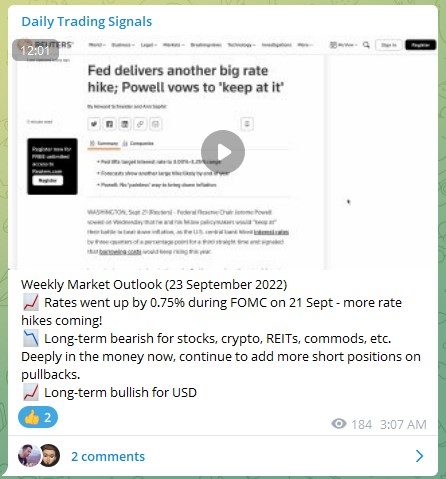
Weekly Market Outlook (17 September 2022)
? High CPI numbers bad for risk assets
? FOMC on 21 Sept – more rate hikes coming
? Long-term bearish for stocks, crypto, REITs, commods, etc


Weekly Portfolio Update

Trading Signals Portfolio 170922

Weekly Portfolio Update (17 September 2022)

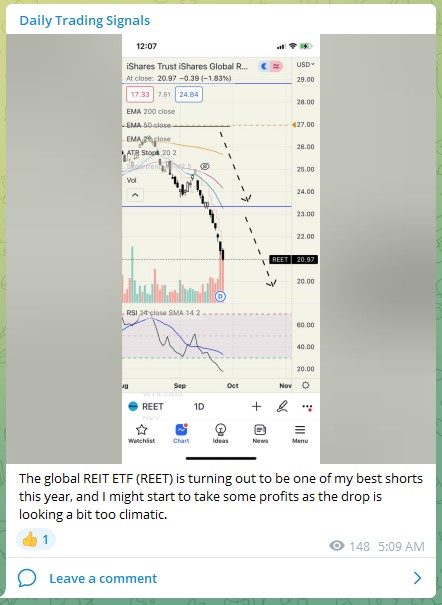
Currently bearish on stocks and REITs, accumulating short positions. Most of cash is held in USD since it is the strongest.


Forex & Commodities Market Highlights

Trading Signals AUDUSD 170922

AUDUSD Crossing 0.66701
Aussie vs. US Dollar
Break new lows!


Trading Signals USDSGD 170922

USDSGD Crossing 1.41091
US Dollar vs SG Dollar
Break new highs!


Trading Signals USDSGD 210922

USDSGD breaking new highs, which is why I have been advocating holding USD for the past few months. ????


Trading Signals EURUSD 210922

Like I mentioned many times before, EURUSD is a good short on pullbacks.


Trading Signals DXY 210922

US Dollar Index (DXY) poised to continue heading up, as markets eye the FOMC tonight.


Stock & Bond Market Highlights

Trading Signals bond yield news 190922

U.S. investment-grade bond yields are the highest since 2009, at an average 5.14%. pic.twitter.com/XIuQELONAY

— Lisa Abramowicz (@lisaabramowicz1) September 19, 2022


Trading Signals fed hike rate news 210922

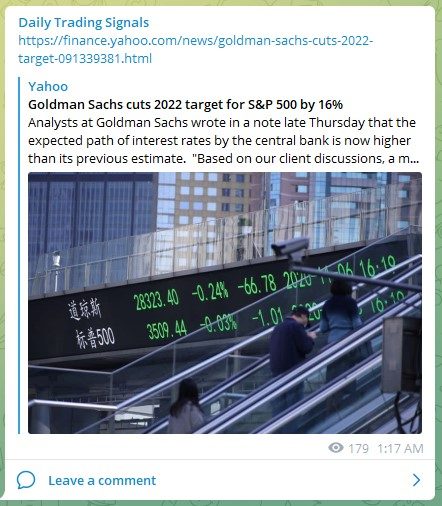
https://www.reuters.com/markets/europe/fed-set-big-rate-hike-waters-get-choppy-worlds-central-banks-2022-09-21/


Trading Signals fomc news 210922 1

https://www.investing.com/analysis/fomc-meeting-preview-100bps-unlikely-but-longer-rate-hike-path-in-play-200630031

Crypto Market Highlights

Trading Signals ETHUSD 190922

ETHUSD Crossing 1350.76
Ethereum
Break swing low


Click here to receive all these signals in real-time for only $67 a month! You will get several signals a day, and even taking just 1 trade the whole month can easily cover the fee, so what are you waiting for? Trading Signals Commodity 050322 emoji

Good luck, and may next week bring more excellent profits!

0 Comments/by Spencer Li
https://synapsetrading.com/wp-content/uploads/2022/09/Melbourne-Australia.jpg 1512 2016 Spencer Li https://synapsetrading.com/wp-content/uploads/2019/10/logo.jpg Spencer Li2022-09-23 10:52:172022-09-24 02:41:44Weekly Market Wrap: The Bears are Back in Full force!
Spencer Li

Best Ways (Where & How) to Buy Bitcoin and Other Cryptocurrencies

Blockchain & Crypto
Thumbnail for Where and How to Buy Bitcoin and Other Cryptocurrencies

Have you ever wondered, what is the best way to buy Bitcoin and other cryptocurrencies?

Cryptocurrencies are on their way to becoming mainstream and are here to stay.

No one can say how long they’ll be around, but they have already made a mark on the world and are becoming more popular by the day.

Not only do they make it easier for people to send and receive money, but they also offer a level of privacy that traditional currencies don’t.

While many people are still wondering what all the fuss is about, many others are busy buying cryptocurrencies.

So, if you are one of those sitting on the fence and wondering what all the fuss is about and how you can get involved in this growing market, then you’ve come to the right post.

This post will discuss all the ins and outs of cryptocurrencies, including why they are valuable, where to buy as well as how to buy them.

So, before you get involved in this growing market, let’s understand the basics.


Infographic for Best Ways Where and How to Buy Bitcoin and Other Cryptocurrencies psd

Introduction to Cryptocurrency

Many people thought that cryptocurrencies were only a passing fad.

However, in the past years, it has been evident that they are here to stay.

So, what exactly is cryptocurrency?

In simple language, cryptocurrencies are digital currencies that are created and stored on the blockchain.

The blockchain is a digital ledger that keeps track of every transaction ever made with a cryptocurrency.

This allows people to keep track of their money without having to trust any third party like a bank or government.

If we talk about the cryptocurrency types, then the most popular ones are Bitcoin and Ethereum.

  • Bitcoin is the first and foremost valuable cryptocurrency that was created in 2009 by an anonymous developer named Satoshi Nakamoto. It is a decentralized currency, which means no central authority can control it or inflate its value.
  • Ethereum is the second most known cryptocurrency after Bitcoin. It was developed in 2013 by a team of developers led by Vitalik Buterin and is used more as a platform for decentralized applications (dApps).

Apart from this, there are many more, like IOTA, Litecoin, Neo, and Cardano.

So, it’s difficult to answer which one is better than the others. The only thing that matters is what you want to achieve with the currency.

If you want a cryptocurrency that can be used for payments and storing value, then Bitcoin is the best choice.

On the other side, if you choose a platform to create dApps or smart contracts, then Ethereum is your best bet.

Why are They Valuable?

Cryptocurrencies are valuable because they are decentralized, meaning no one governing body controls it.

It’s also encrypted so that only the owner of the wallet has access to their funds.

This makes it super challenging for hackers to steal your money.

Also, the fact is that cryptocurrencies are global means they can be sent anywhere in the world without any hassle.

This makes them highly valuable to those who need to send money overseas.

How to Buy Crypto?

If you are a beginner or new to the world of cryptocurrencies, then you will feel lost in this big sea.

But no panic; here is a step-by-step guide to help you understand the process of buying cryptocurrency.

1. Choose a cryptocurrency to invest in

There are many different cryptocurrencies, so the the first step is to decide what cryptocurrency you want to invest in.

Bitcoin (BTC) is one of the most popular choices because it’s been around since 2009 and has proven itself a valuable investment option.

You can also choose Ethereum (ETH), Ripple (XRP), Litecoin (LTC), and others, depending on which ones appeal to you most.

2. Choose a broker or crypto exchange

The next step is to choose a broker or crypto exchange.

A broker will help you to purchase cryptocurrency, but you’ll need to be careful to choose a reputable one.

A crypto exchange is like an online bank where you can buy and sell cryptocurrency.

This option is easier than using a broker, but it’s also less secure because it doesn’t have the same security measures in place.

However, some exchanges are better than others, so make sure that you research the ones that interest you before choosing one.

If you are looking for a list of recommendations, you can check our full list of tools and resources.

3. Create your account

Feeling excited? You should be!

The next crucial step is to open up your crypto account.

Once you have chosen a broker or crypto exchange, you’ll need to sign up for an account with them.

This will involve providing some personal information like your name and address, but it also means that the company has all of your details in case anything goes wrong.

4. Fund your account

You will need to fund your account before you can buy any cryptocurrency.

This means that you need to deposit some money into the exchange so that it can be used as a base currency amount for buying or selling cryptocurrencies.

The amount of funds you need to deposit will depend on how much cryptocurrency you want to buy and what type of coin it is (e.g., Bitcoin or Ethereum).

5. Place your order

Once you have deposited funds into your account, it’s time to place an order.

This is when you tell the exchange what type of coin you want to buy and how much of it.

You should also specify which currency should be used as a base (e.g., USD) and whether or not you want immediate delivery or if you want to set up a future date for receiving the coins.

6. Store safely

Once your order has been placed, you will receive your coins at the specified wallet address, and it is then crucial to keep it safe.

Storing your crypto assets on an exchange might be convenient, but it is also more vulnerable to theft.

So, if you want to avoid this, then consider using an offline hardware wallet. They allow you to store your private keys on secure devices that are not connected to the internet.

This way, if someone were to steal them from you, they would be unable to access your coins.

Now that you are equipped with how to buy Bitcoin and other cryptocurrencies let’s move on to where to buy.

Where to Buy Crypto?

You will be mesmerized to know that the value of Bitcoin has increased from $0.5 to $20,000 in just months.

This is the reason why people are investing in Bitcoin and other cryptocurrencies today.

However, with numerous such choices available, it can be confusing to find a reliable place to buy your coins.

That’s why we’ve come together with this handy guide on the best places to buy Bitcoin and other cryptocurrencies online.

There are two ways to get started.

One is going through a broker, and the second is using a cryptocurrency exchange.

Below are the pros and cons of both options so that, in the end, you are piped line with the right information to make an informed choice.

a) Broker:

A broker is simply a person or a company that acts as an intermediary between you and the cryptocurrency exchange.

They provide a platform where you can buy, sell, and trade cryptocurrencies.

The benefit of using a broker is that they offer a simple and convenient way of purchasing Bitcoin or other cryptocurrencies.

You can also use a broker to sell your coins when you want to close your positions or rotate back to fiat currency.

The only drawback is that they charge higher fees than cryptocurrency exchanges do.

b) Cryptocurrency exchange:

A cryptocurrency exchange is a platform where you can buy and sell cryptocurrencies.

It works much like a stock exchange, except that it deals with digital currencies instead of stocks or bonds.

The primary benefit of using a cryptocurrency exchange is that it provides you with a wide range of coins to choose from.

You can also use it to trade different cryptocurrencies against each other.

The only drawback is that you’ll have to pay fees for each transaction, which can be pretty high if you make a lot of trades.

Concluding Thoughts

Cryptocurrencies are becoming increasingly mainstream, and with that comes an increase in the number of ways to buy Bitcoin and other digital assets.

While there are many different exchanges available, not all of them are created equal.

It is supreme to do your own research to find an exchange that is reputable and offers the features that you are looking for.

Now that I have shared where and how to buy Bitcoin and various cryptocurrencies, which do you think is the best way to do it?

Let me know in the comments below.


thumbnail the ultimate guide to blockchain and crypto assets

If you would like to learn more about crypto & DeFi, also check out: “The Ultimate Guide to Blockchain & Cryptocurrencies”

0 Comments/by Spencer Li
https://synapsetrading.com/wp-content/uploads/2022/09/Thumbnail-for-Where-and-How-to-Buy-Bitcoin-and-Other-Cryptocurrencies.png 720 1280 Spencer Li https://synapsetrading.com/wp-content/uploads/2019/10/logo.jpg Spencer Li2022-09-19 02:17:492023-01-04 16:03:34Best Ways (Where & How) to Buy Bitcoin and Other Cryptocurrencies
Spencer Li

Weekly Market Wrap: Inflation Continues to Plague Markets!

Market Analysis
Kutna Hora Czech Republic

With inflation continuing to plague markets, based on the most recent CPI numbers, the Fed is most likely going to continue hiking interest rates, which is bearish for the markets.

In my last weekly market outlook video, I mentioned that the long-term trend is still bearish, and we should either by waiting to short, or short-term trading positions if going long (to ride the bullish momentum early last week).

Now that the market bears are back in full force, we have started to initiate short positions, and I expect to be adding more short positions on pullbacks as prices continue to fall.

Stay tuned for more updates in our “Daily Trading Signals” Telegram channel!


Kutna Hora Czech Republic

[Photo: Kutna Hora, Czech Republic – See my full travel photo log!]

For our weekly market wrap, we go through some of the trade calls and analysis from last week, which gives us valuable insights for the week ahead.

We cover 3 main markets with a total of 200+ counters, so we will never run out of trading opportunities:

  • Forex, CFDs, commodities, bonds
  • US stocks, ETFs, global stock indices
  • Cryptocurrencies, crypto indices

By covering a broad range of markets, we can focus our attention (and capital) on whichever market currently gives the best returns.

Click here to receive all these signals in real-time for only $67 a month! You will get several signals a day, and even taking just 1 trade the whole month can easily cover the fee, so what are you waiting for? Trading Signals Commodity 050322 emoji


Weekly Market Outlook Video

Trading Signals weekly market outlook 120922

Weekly Market Outlook (12 September 2022)
? FOMC on 21 Sept – more rate hikes coming
? Ethereum merge in a few days
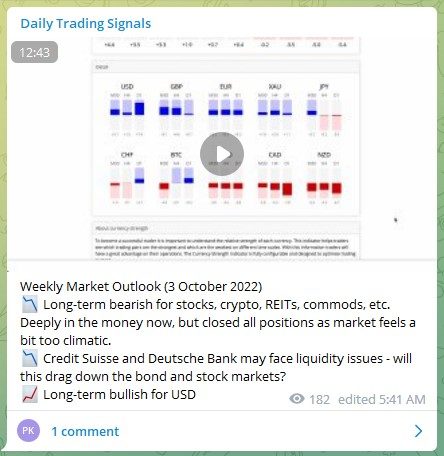
? Long-term bearish for stocks, crypto, REITs, commods, etc
? Short-term bullishness (swing trading opportunities)


Weekly Portfolio Update

Trading Signals Portfolio 120922

Weekly Portfolio Update (12 September 2022)

Not having much positions now as I am overseas, and the market direction is not very clear yet.


Forex & Commodities Market Highlights

Trading Signals AUDUSD 130922

AUDUSD Crossing 0.69137
Aussie vs. US Dollar
Break swing high


Trading Signals NZDCHF 130922

NZDCHF Crossing 0.58200
NZ Dollar vs. Swiss France
TP1 for short positions


Trading Signals Inflation CPI 130922

Inflation is STILL rising.

8.3% CPI even with a 10.6% decline in the gas index.

And winter is coming. pic.twitter.com/S7xicZ6eop

— Ryan Selkis ? (@twobitidiot) September 13, 2022


Stock & Bond Market Highlights

Trading Signals SP500 and Nasdaq 120922

Stock indices (S&P 500 and NASDAQ 100) are still in a long-term bear trend, but short-term bullishness provides swing trading opportunities.

Use a smaller timeframe to enter on pullbacks, with a tight stoploss.


Trading Signals Stocks News 140922

https://www.wsj.com/articles/global-stocks-markets-dow-update-09-14-2022-11663139340


Crypto Market Highlights

Trading Signals ETHUSD 120922

As the merge approaches (in about 3 days), watch out for the critical zone for Ethereum (ETHUSD) to see if the downtrend resumes after the merge.


Trading Signals ETH news 110922

https://cointelegraph.com/news/ethereum-ready-for-the-merge-as-last-shadow-fork-completes-successfully


Click here to receive all these signals in real-time for only $67 a month! You will get several signals a day, and even taking just 1 trade the whole month can easily cover the fee, so what are you waiting for? Trading Signals Commodity 050322 emoji

Good luck, and may next week bring more excellent profits!

0 Comments/by Spencer Li
https://synapsetrading.com/wp-content/uploads/2022/09/Kutna-Hora-Czech-Republic.jpg 1536 2048 Spencer Li https://synapsetrading.com/wp-content/uploads/2019/10/logo.jpg Spencer Li2022-09-15 23:28:042022-09-18 00:49:39Weekly Market Wrap: Inflation Continues to Plague Markets!
Page 60 of 184«‹5859606162›»

Free Trading Guides

Free Trading Guides

Blog Categories

  • Beginner's Guide
  • Blockchain & Crypto
  • Book Summaries
  • Candlestick Patterns
  • Economics & News Trading
  • Investing & Portfolio Management
  • Living Your Best Life
  • Market Analysis
  • News & Events
  • Price Chart Patterns
  • Promotions
  • Risk & Money Management
  • Stock Trading
  • Testimonials
  • Tools & Resources
  • Trading Psychology
  • Trading Strategies
  • Trading Tips
  • Travel & Lifestyle

Free Trading Guides

Free Trading Guides

Contact Us

Synapse Trading Pte Ltd
Registration No. 201316168H

Whatsapp: +65-8897-1204
Telegram: @iamrecneps
Email: info@synapsetrading.com

Links

Disclaimer
Privacy policy
Terms & Conditions
Contact us
Partnerships

© 2012-2024 Synapse Trading | All rights reserved | - powered by Enfold WordPress Theme
  • Link to Facebook
  • Link to X
  • Link to Instagram
  • Link to Youtube
  • Link to LinkedIn
  • Link to Mail
Scroll to top Scroll to top Scroll to top