

Proof of Work vs. Proof of Stake: Which One is Better?
Want the daily routine? Get the free 15-Minute Swing Trader’s Checklist. Get it free →
Proof of Work vs Proof of Stake: What’s the Difference?
Last updated: 23 August 2026 · By Spencer Li, CFTe
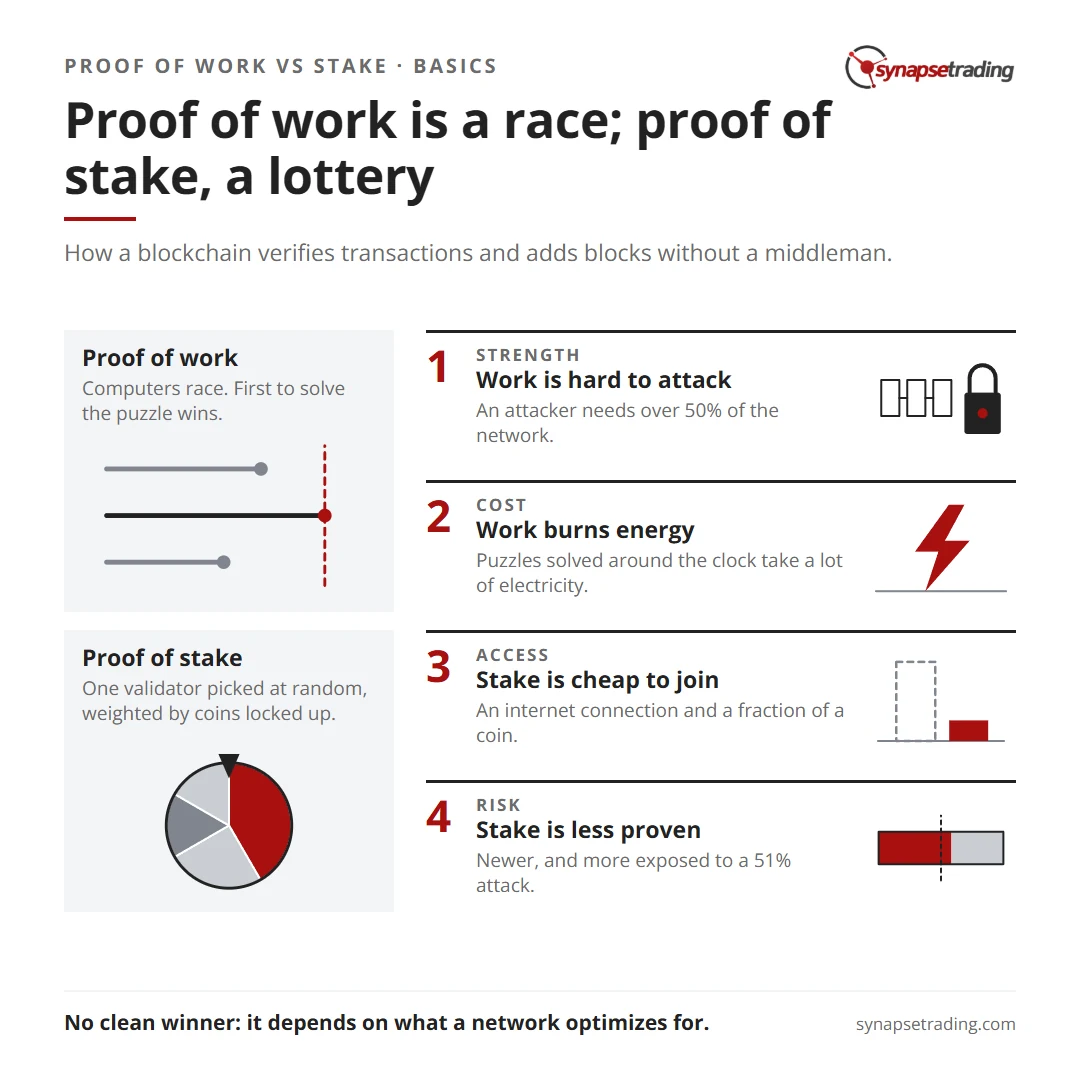
Proof of work (PoW) and proof of stake (PoS) are the two main ways a blockchain verifies transactions and adds new blocks without a middleman. The core difference is what you have to spend to earn the right to validate. In proof of work, computers compete to solve a hard math puzzle, and the winner spends real energy and hardware to add the next block. In proof of stake, there is no race. The network picks one validator at random, weighted by how many coins that validator has locked up (staked), and they confirm the block instead. PoW is older, more battle-tested, and harder to attack, but it burns a lot of electricity. PoS is newer, far more energy efficient, and cheaper to join, but it is less proven at scale. Bitcoin (BTC) still runs on PoW. Ethereum (ETH) moved from PoW to PoS in 2022, and newer coins like Cardano (ADA) and Solana (SOL) launched on PoS from the start.
Here is how each system works, what it costs, and where each one is strong or weak.
What is proof of work (PoW)?
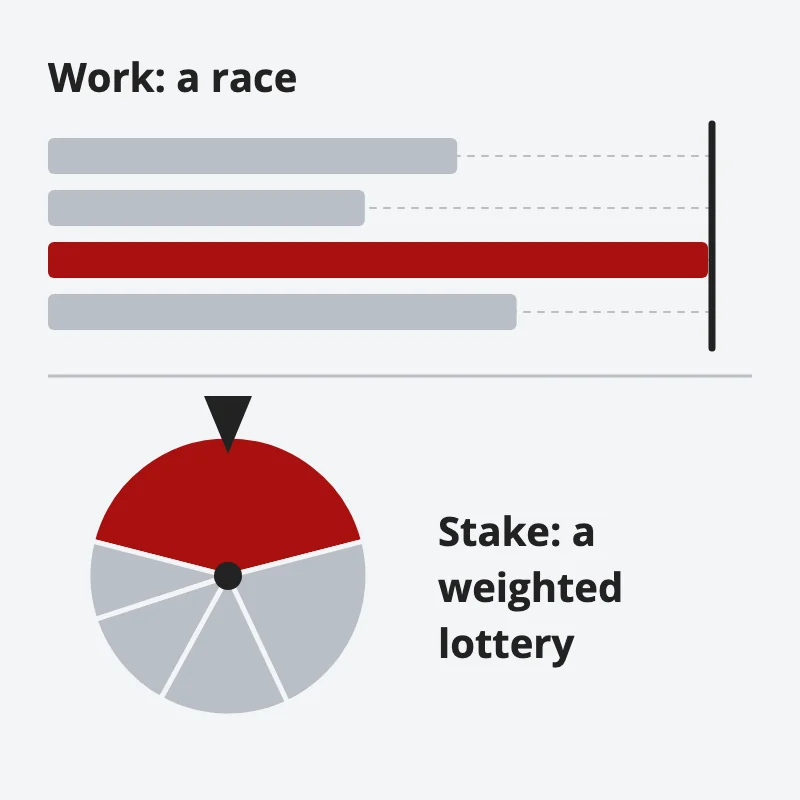
In a proof of work system, a group of computers compete to solve complex mathematical problems to validate transactions and add new blocks to the blockchain. The first one to solve the problem receives a reward in the form of cryptocurrency.
Because the energy and computing resources needed to solve the puzzle are often compared to the real-world effort of digging precious metals out of the ground, this process is called mining (using computing power to solve the puzzle and earn the right to add a block).
The book Digital Gold by Nathaniel Popper uses a simple analogy for the puzzle at the heart of Bitcoin:
It is easy to get 2,903 times 3,571 by writing the numbers down and multiplying. It is much harder to work backwards and figure out which two numbers multiply together to make 10,366,613.
The miner who cracks the problem first gets to add the next block of transactions and broadcast it to the network of nodes (the computers that hold a copy of the ledger and check new blocks). Those nodes audit the existing ledger and the new block. If everything checks out, the new block is linked to the one before it, forming the chain. The miner is then paid in coins for the energy and hardware they spent.
PoW, mining, and security
Mining consumes a lot of power, and that cost is the point. It secures the network by making sure only those who can prove they spent real resources are allowed to add transactions. By design, attacking a PoW system like Bitcoin is exceedingly difficult, time-consuming, and expensive.
To pull off an attack, you would have to buy and rig up expensive mining equipment, pay for the electricity to run it, win the race to solve the puzzle, and add a block stuffed with counterfeit coins. The moment the network’s nodes audit that block against the previous ledger, the fake coins are caught and the block is rejected.
The only way around this is to control the network outright. Counterfeiting bitcoin is virtually impossible unless an attacker owns over 50% of the network, meaning at least 51% of both the combined computing power of all miners (the hashrate) and the network’s nodes. Given the size of the Bitcoin network and the sheer energy miners pour into it, a 51% attack on Bitcoin today is almost impossible.
So if PoW checks all the boxes, why is part of the crypto world moving to proof of stake?
What is proof of stake (PoS)?
A member of the Bitcointalk forum who went by QuantumMechanic proposed proof of stake in 2011. His core point was simple: opening mining up to everyone and letting them all burn energy competing against each other is wasteful.
So PoS replaces the race with a lottery. One node is chosen at random to validate the next block. There are no miners. There are validators (nodes that lock up coins for the right to confirm blocks). They do not mine blocks either. They “forge” or “mint” them. The reward is the transaction fees attached to that block.
The selection is not pure chance, though. Before a node can be considered, it has to stake a certain amount of coins into the network, and the size of that stake raises its odds of being picked.
Here is the intuition. Say Walt stakes $100 into the network and Skyler stakes $1,000. Skyler’s chance of being chosen to forge the next block is ten times higher. The bigger your stake, the more often you win the right to validate.
One more detail worth noting: the stake is always larger than what a validator earns in fees. That keeps validators financially motivated to play fair, because cheating risks a stake worth more than the reward.
PoW vs PoS, side by side
The two systems solve the same problem (how to agree on the truth without a middleman) using opposite incentives. PoW asks you to spend energy. PoS asks you to lock up money.
| Proof of Work (PoW) | Proof of Stake (PoS) | |
|---|---|---|
| Who validates | Miners | Validators |
| How blocks are made | Mining (solve a math puzzle) | Forging / minting (chosen by stake) |
| What you spend | Hardware + ongoing electricity | Coins locked up as a stake |
| Selection | First to solve the puzzle wins | Random, weighted by stake size |
| Energy use | Very high | Low |
| Barrier to entry | High (rigs + power) | Low (buy a fraction of a coin) |
| Maturity at scale | Most proven (Bitcoin since 2009) | Newer, less battle-tested |
| Main risk | Energy cost, scaling limits | Sybil and 51% attacks, centralization of stake |
| Example coins | Bitcoin (BTC) | Ethereum (ETH), Cardano (ADA), Solana (SOL) |
Advantages of proof of work
Mining is a fiercely competitive industry, and that competition does useful work. Miners are always hunting for cheaper energy and faster, more efficient chips to lower their costs. Whoever finds the cheapest power and builds the better hardware wins, which keeps pushing the whole system forward.
PoW has also been the most proven way to maintain consensus while keeping users secure inside a distributed ledger. The reason is the cost itself. PoW demands an upfront hardware cost and a continuous spend on resources to keep participating, where PoS only asks for a single upfront stake. That ongoing cost is exactly what makes PoW so hard to fake.
Disadvantages of proof of work
The energy that powers Bitcoin’s PoW algorithm draws constant criticism for its carbon footprint. By one estimate, the Bitcoin network alone consumes as much energy as the entire countries of Ukraine and Norway combined. That comes straight from the design: miners have to solve hard math problems around the clock to validate transactions, and that takes enormous computational power, which takes a lot of electricity.
The traceability of a blockchain is a double-edged sword too. On one hand, it adds transparency and builds trust between users. On the other, every single transaction is permanently visible to everyone, which is a problem for people who value their privacy. The US Internal Revenue Service (IRS), for example, has successfully tracked down suspected tax evaders by matching records from bitcoin exchanges against data from banks and brokerages. Traceability will likely stay a sticking point for as long as crypto is used as a payment system rather than just an investment vehicle.
Advantages of proof of stake
The headline advantage of PoS is energy efficiency. With PoW, miners burn a lot of power running computers to solve puzzles, which is expensive and hard on the environment. With PoS, validators are not solving puzzles at all. They stake their coins and earn rewards based on how much they have staked, so the energy bill is tiny by comparison.
PoS also tends to be more censorship resistant. In a PoW system, a small group of large miners can, in principle, choose to censor certain transactions. In a PoS system, everyone who holds coins has a stake and therefore a say, which makes it much harder for any one party to block or refuse transactions.
And PoS has a far lower barrier to entry. To start validating a PoS coin, you really only need an internet connection and enough money to buy a fraction of a coin. That is it. You can even do it from a smartphone. With no expensive hardware required, PoS is much more accessible to the average person.
Disadvantages of proof of stake
PoS is younger, and it shows. No PoS system has yet scaled to the level of the largest networks while staying as decentralized and safe as the most advanced PoW systems. These are solvable problems, and newer consensus designs like Casper aim to fix them, but they are not solved yet.
A few specific weak spots:
- Absent validators. If a chosen validator does not show up to do its job, the block stalls. This is usually handled by lining up a large pool of backup validators in case the primary one fails.
- Sybil attacks. Because validating power is spread across many small holders rather than concentrated in a few miners, a PoS network can be more exposed to a Sybil attack (where one attacker spins up many fake identities to gain outsized control).
- 51% attacks. PoS can also be more vulnerable to a 51% attack, where a single entity quietly accumulates more than half of the staked currency and uses it to push through bad blocks.
So which one is better?
Honestly, there is no clean winner, and anyone selling you one is overselling. Both systems have real strengths and real weaknesses, and the right answer depends on what a given network is optimizing for. If the priority is maximum security and a long track record, PoW still leads. If the priority is energy efficiency, low fees, and easy access, PoS makes the better case.
The direction of travel is clear, though. Ethereum completed its move from PoW to PoS in 2022 (the event the community called “the merge”), and most new coins now launch on PoS by default. PoW remains the home of the oldest and most valuable network, Bitcoin, and shows no sign of switching.
Personally, I do not treat this as a question I need to “win.” As a trader, I do not pick a coin because I admire its consensus mechanism. The mechanism tells you something about a network’s security, cost, and energy story, and that is useful context. It does not tell you whether the chart is a buy. A scanner can label a coin PoW or PoS in a second. It cannot supply the judgment to size the position, manage the risk, and decide whether the trade is even worth taking. That judgment is the human edge, and it is the part no algorithm trades for you.
FAQ
What is the main difference between proof of work and proof of stake?
In proof of work, computers compete by spending energy to solve a math puzzle, and the winner adds the next block. In proof of stake, there is no race. A validator is chosen at random, weighted by how many coins they have staked, and they confirm the block instead. PoW spends electricity; PoS locks up money.
Is proof of stake more secure than proof of work?
Not yet, by most measures. PoW is the more battle-tested system and is extremely expensive to attack at scale, which is why Bitcoin still uses it. PoS is far more energy efficient but newer, and it can be more exposed to Sybil attacks and to a 51% attack if one party accumulates enough of the staked supply.
Which cryptocurrencies use proof of work, and which use proof of stake?
Bitcoin (BTC) is the flagship proof of work coin. Ethereum (ETH) moved from PoW to PoS in 2022, and coins like Cardano (ADA) and Solana (SOL) were built on proof of stake from the start.
Why is proof of work criticized for energy use?
PoW miners must solve complex math problems around the clock to validate transactions, which takes huge amounts of computing power and therefore electricity. By one estimate the Bitcoin network alone uses as much energy as the countries of Ukraine and Norway combined.
Is proof of stake replacing proof of work?
For new networks, largely yes. Most new coins launch on PoS, and Ethereum’s 2022 switch was a major milestone. But PoW still secures Bitcoin, the oldest and largest network, so the two systems are likely to coexist rather than one fully replacing the other.
Now that you know how proof of work and proof of stake differ, which one do you think wins out in the long run? Let me know in the comments.
And if you want the bigger picture on how blockchains and coins actually fit together, read the pillar: The Ultimate Guide to Blockchain and Cryptocurrencies.
Want a simple way to trade any market, including crypto? Grab the free 15-Minute Swing Trading Starter Kit. It is the exact routine I use to scan once a day and trade in 15 minutes, the same approach whether the chart is a stock, a forex pair, or a coin.
About the author. Spencer Li is The 15-Minute Trader and the founder of Synapse Trading. He is a Certified Financial Technician (CFTe) with 15+ years of trading, run from 70+ countries. He holds a B.Acc and B.BM from SMU. Every trade he takes is public, dated, losses left in. He teaches low-risk swing trading in 15 minutes a day, one system for any market.
Education, not financial advice. Synapse Trading is not licensed by MAS to advise on investment products. Trading carries risk of loss; past performance is not indicative of future results.
Related
The Ultimate Guide to Blockchain and Cryptocurrencies · What is Bitcoin and how does it work · What is Ethereum · Best Ways (Where & How) to Buy Bitcoin and Other Cryptocurrencies
Want the daily routine? Enter your email for the free 15-Minute Swing Trader's Checklist.
Free 5-page PDF, then occasional trading emails. Education only, not financial advice. Unsubscribe anytime. Kit stores your email in the US: see our privacy policy.
Want to learn the full method? The Trading Mastery Program teaches the 4 strategies I have traded since 2011. It suits beginners and experienced traders.
Rather follow the trades as they happen? Daily Trading Signals is our Telegram channel: my trade ideas with entry, stop and exit, and every trade is public.
Questions about this post? Ask in the free Telegram channel →
Educational content only, not personalised financial advice. Trading carries risk, including loss of capital. Past performance is not indicative of future results. Synapse Trading is not licensed or regulated by MAS.

