Thumbnail What are Peak Experiences

Thumbnail What are Peak Experiences

Have you ever had a moment in your life where you were completely immersed in an activity, feeling a sense of awe and wonder, and experiencing a deep sense of connection and fulfillment?

These intense moments of positive emotion and enlightenment are what we refer to as peak experiences, or “flow states.”

These moments can be transformative and help us feel more connected to the world around us.

In this blog post, we will explore what peak experiences are, their origins, and the benefits they offer.

We will also look at some examples of peak experiences and discuss how to incorporate them into your daily life.


What are Peak Experiences?

Peak experiences, also known as “peak moments” or “flow states,” are moments of intense psychological or emotional joy, awe, or wonder that can be accompanied by a feeling of transcendence or unity with the universe.

These experiences are often described as life-changing and may have a profound impact on an individual’s sense of self and their perception of the world around them.

During a peak experience, an individual may feel completely immersed and involved in an activity, leading to a sense of personal growth and fulfillment.

This sense of immersion is often characterized by a feeling of being completely present and focused in the moment, and may involve a sense of challenge and growth as well.

Peak experiences may be triggered by a variety of different activities and experiences, and can take many different forms.

Some people may experience peak moments through artistic or creative endeavors, while others may find them through physical activities or sports.

Still others may experience peak moments through spiritual or religious practices, or through moments of deep connection with others.

Regardless of the specific form they take, peak experiences are often described as transformative and may have a lasting impact on an individual’s sense of self and their perception of the world.

They may also contribute to a sense of purpose and meaning, and can be an important source of fulfillment and happiness.

Origins of Peak Experiences

The concept of peak experiences was first introduced by psychiatrist and humanistic psychologist Abraham Maslow in his theory of self-actualization.

Maslow was interested in understanding the psychological and spiritual growth of individuals, and he believed that peak experiences were moments of profound insight and understanding that had the potential to bring about significant personal transformation.

He described peak experiences as “sudden, dramatic, and emotionally charged,” and believed that they could provide individuals with a sense of unity, transcendence, and connection to a higher power or purpose.

Maslow’s theory of self-actualization and peak experiences has had a significant influence on the field of psychology and the study of human motivation and growth.

His ideas have been further developed and refined by other researchers and practitioners, and the concept of peak experiences has become an important topic of study in fields such as positive psychology, education, and management.

Despite some criticism and debate over the specifics of Maslow’s theory, peak experiences continue to be recognized as valuable and transformative experiences that can contribute to personal and spiritual development.

Benefits of Peak Experiences

There are many potential benefits to having peak experiences, including:

  • Increased creativity and problem-solving abilities
  • Greater feelings of happiness and well-being
  • Improved focus and productivity
  • Enhanced personal and professional growth
  • A sense of connection to others and the world around you

Examples of Peak Experiences

Peak experiences are intense moments of positive emotion, connection, and enlightenment that can be transformative and help individuals feel more connected to the world around them.

Some examples of peak experiences may include:

  • A moment of profound spiritual connection, such as during a religious ceremony or during a moment of meditation
  • A moment of intense emotional connection with another person, such as falling in love or having a deep conversation with a close friend or during an act of kindness
  • A moment of personal accomplishment, such as finishing a marathon or achieving a long-term goal
  • A moment of awe and wonder, such as seeing a natural wonder or experiencing something new and exciting
  • A moment of intense emotion, such as the birth of a child or the death of a loved one
  • A moment of artistic or creative inspiration, such as composing music or writing a poem
  • A moment of intense physical connection, such as during a dance performance or a sports event
  • A moment of intense focus and concentration, such as during meditation or a difficult task
  • A moment of intense physical sensation, such as bungee jumping or skydiving
  • A moment of connection with nature, such as hiking in the mountains or swimming in the ocean
  • A moment of intense self-discovery, such as during a retreat or therapy session
  • A moment of profound understanding or realization, such as when a complex problem is finally solved or a difficult concept is finally grasped

These moments can be deeply personal and may vary from person to person. They are often described as intense, life-changing, and meaningful.

How to Have More Peak Experiences

If you are looking to have more peak experiences in your life, try the following:

  • Identify activities that you find deeply engaging and enjoyable: Pay attention to what kinds of activities bring you a sense of flow and fulfillment, and make an effort to prioritize and incorporate these activities into your life.
  • Set aside dedicated time to focus on these activities without distractions: This might mean setting aside specific blocks of time to engage in your chosen activity, or finding a quiet and distraction-free environment to work in.
  • Seek out new challenges and experiences that stretch your abilities and encourage personal growth: To incorporate this element into your daily life, try seeking out new experiences and activities that challenge you and help you to develop new skills and knowledge. This could involve learning a new hobby or sport, taking on new responsibilities at work, or tackling a difficult problem or project.
  • Practice mindfulness and stay present in the moment: This might involve practicing mindfulness techniques, such as focusing on your breath or paying attention to your senses, to help you stay present and focused.
  • Foster a sense of gratitude and appreciation for the experiences and opportunities you have: This helps to enhance your sense of fulfillment and satisfaction, and can also contribute to a greater sense of connection to others and the world around you. Make an effort to regularly reflect on and appreciate the experiences and opportunities you have, and express gratitude to those around you who support and enable your growth and development.

It’s also important to note that peak experiences are not always easy or enjoyable in the moment.

They may involve hard work, struggle, and even failure. However, it is through these challenges that we often grow and learn the most.

Concluding Thoughts

Peak experiences, or “flow states,” are intense moments of joy, awe, and wonder that can bring about a feeling of transcendence and personal growth.

By identifying and engaging in activities that bring you fulfillment, setting aside dedicated time to focus on these activities, seeking out new challenges, practicing mindfulness, and fostering gratitude, you can incorporate peak experiences into your daily life and benefit from their transformative effects.

Now that I have shared what peak experiences are about, and the practical ways you can apply it in your life, do you think this is something you will want to make a part of your life?

Let me know in the comments below.


thumbnail an unofficial guide to living our best life beyond financial freedom

If you are excited to get more life hacks, also check out: “Beyond Financial Freedom: An Unofficial Guide to Living Your Best Life”


Song Kol Lake Kyrgyzstan

In the recent NFP report, the US economy added 223,000 jobs in December, which was slightly better than expected, and the unemployment rate fell to 3.5%.

Average hourly earnings increased by 4.6% year-over-year, which was lower than the expected 5.0% increase and the revised prior reading of 4.8%.

The US stock market rallied strongly after the release of this data due to the strong labor market and easing wage pressures, but we will need to see next week if this rally continues.

The focus will shift to the inflation report next week, and traders expect that inflation may fall further than expected.

The ISM services index also fell into contraction territory for the first time since May 2020, suggesting that the service sector of the economy may be struggling.

For a more detailed analysis (weekly market outlook video), and real-time trading signals, check out our “Daily Trading Signals” Telegram channel!


Song Kol Lake Kyrgyzstan

[Photo: Song-Kol Lake, Kyrgyzstan – See my full travel photo log!]

For our weekly market wrap, we go through some of the trade calls and analysis from last week, which gives us valuable insights for the week ahead.

We cover 3 main markets with a total of 200+ counters, so we will never run out of trading opportunities:

By covering a broad range of markets, we can focus our attention (and capital) on whichever market currently gives the best returns.

Click here to receive all these signals in real-time for only $67 a month! You will get several signals a day, and even taking just 1 trade the whole month can easily cover the fee, so what are you waiting for?


Weekly Market Outlook Video

Trading Signals weekly video 2 020123

Trading Signals weekly video 020123

daily trading signals comments 070123

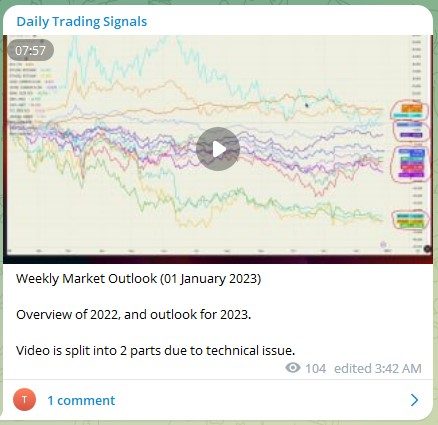
Weekly Market Outlook (01 January 2023)

Overview of 2022, and outlook for 2023.

Video is split into 2 parts due to technical issue.


Portfolio Highlights

Trading Signals Weekly portfolio 020123

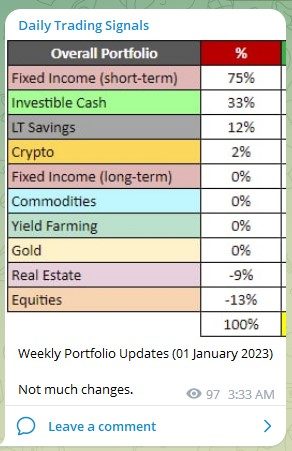
Weekly Portfolio Updates (01 January 2023)

Not much changes.


Trading Signals clusters 020123

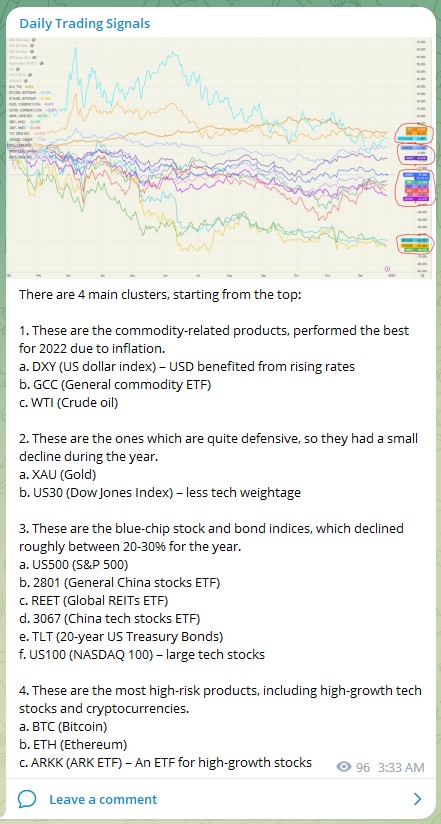
There are 4 main clusters, starting from the top:

1. These are the commodity-related products, performed the best for 2022 due to inflation.
a. DXY (US dollar index) – USD benefited from rising rates
b. GCC (General commodity ETF)
c. WTI (Crude oil)

2. These are the ones which are quite defensive, so they had a small decline during the year.
a. XAU (Gold)
b. US30 (Dow Jones Index) – less tech weightage

3. These are the blue-chip stock and bond indices, which declined roughly between 20-30% for the year.
a. US500 (S&P 500)
b. 2801 (General China stocks ETF)
c. REET (Global REITs ETF)
d. 3067 (China tech stocks ETF)
e. TLT (20-year US Treasury Bonds)
f. US100 (NASDAQ 100) – large tech stocks

4. These are the most high-risk products, including high-growth tech stocks and cryptocurrencies.
a. BTC (Bitcoin)
b. ETH (Ethereum)
c. ARKK (ARK ETF) – An ETF for high-growth stocks


Forex & Commodities Market Highlights

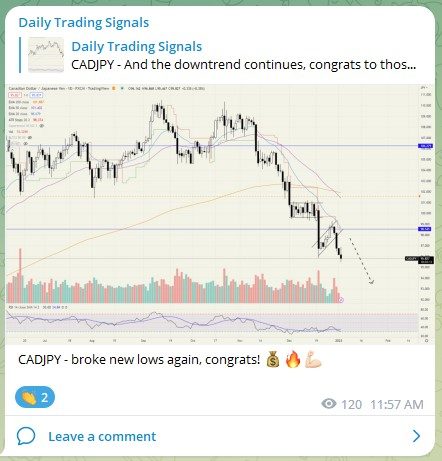
Trading Signals CADJPY 030123

CADJPY – broke new lows again, congrats! 💰🔥💪🏻


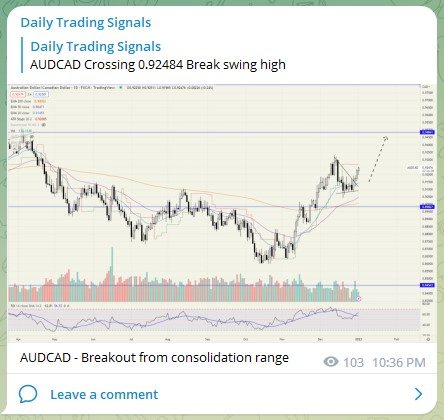
Trading Signals AUDCAD 020123

AUDCAD – Breakout from consolidation range


Trading Signals CHFJPY 030123

CHFJPY – Major trend is changing as prices try to break below the 200-EMA.

ST & MT price action is bearish, good opportunity for a short trade.


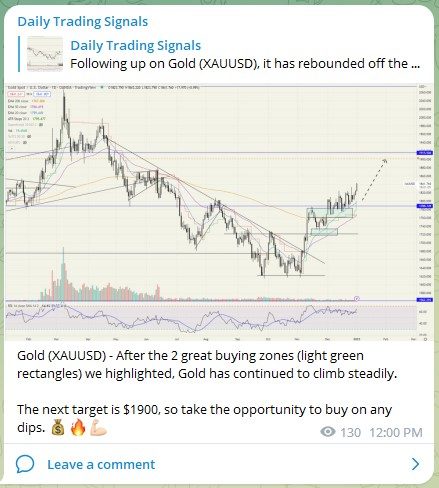
Trading Signals XAUUSD 020123

Gold (XAUUSD) – After the 2 great buying zones (light green rectangles) we highlighted, Gold has continued to climb steadily.

The next target is $1900, so take the opportunity to buy on any dips. 💰🔥💪🏻


Stock & Bond Market Highlights

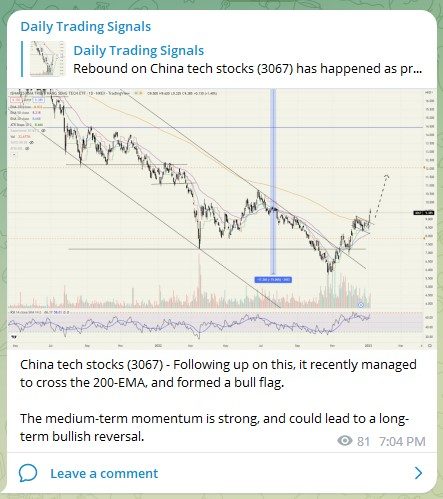
Trading Signals Chinatech 030123

China tech stocks (3067) – Following up on this, it recently managed to cross the 200-EMA, and formed a bull flag.

The medium-term momentum is strong, and could lead to a long-term bullish reversal.


Trading signals stock market 020123

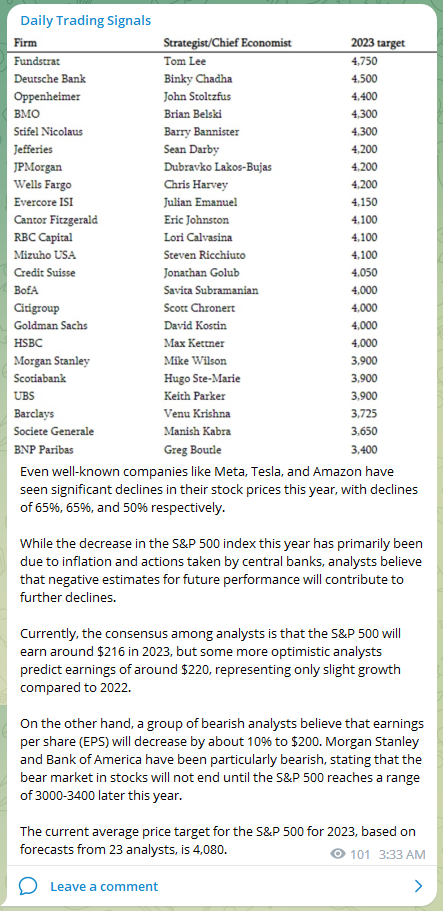
Even well-known companies like Meta, Tesla, and Amazon have seen significant declines in their stock prices this year, with declines of 65%, 65%, and 50% respectively.

While the decrease in the S&P 500 index this year has primarily been due to inflation and actions taken by central banks, analysts believe that negative estimates for future performance will contribute to further declines.

Currently, the consensus among analysts is that the S&P 500 will earn around $216 in 2023, but some more optimistic analysts predict earnings of around $220, representing only slight growth compared to 2022.

On the other hand, a group of bearish analysts believe that earnings per share (EPS) will decrease by about 10% to $200. Morgan Stanley and Bank of America have been particularly bearish, stating that the bear market in stocks will not end until the S&P 500 reaches a range of 3000-3400 later this year.

The current average price target for the S&P 500 for 2023, based on forecasts from 23 analysts, is 4,080.


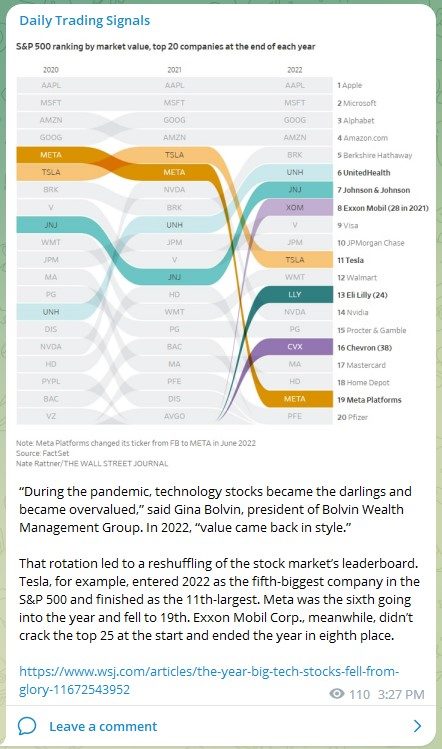
Trading Signals tech stocks 020123

https://www.wsj.com/articles/the-year-big-tech-stocks-fell-from-glory-11672543952


Click here to receive all these signals in real-time for only $67 a month! You will get several signals a day, and even taking just 1 trade the whole month can easily cover the fee, so what are you waiting for?

Good luck, and may next week bring more excellent profits!

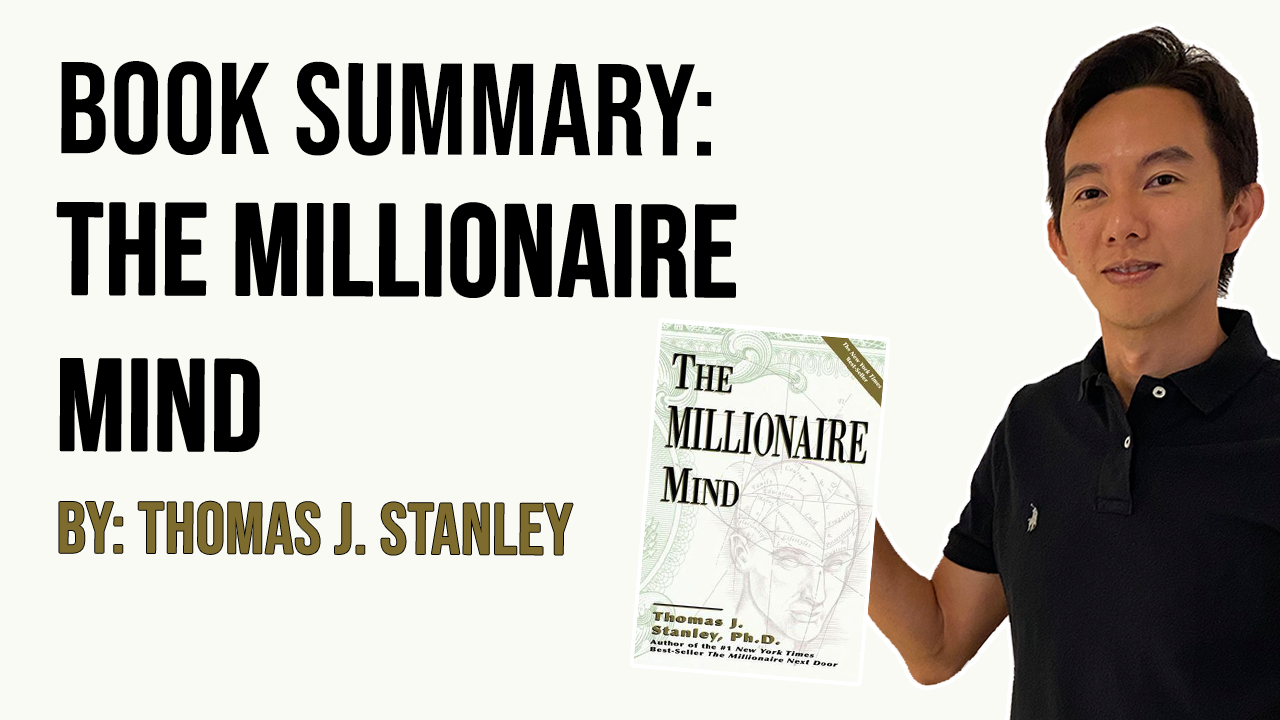
thumbnail Book Summary The Millionaire Mind by Thomas J Stanley

thumbnail Book Summary The Millionaire Mind by Thomas J Stanley

“The Millionaire Mind” by Thomas J. Stanley is a book that explores the financial habits and mindsets of wealthy individuals.

Based on years of research and interviews with over 1,000 millionaires, the book aims to provide practical and actionable advice for building wealth and achieving financial success.

In this blog post, I will share all about this book and the author, key ideas from the book, and how you can apply it to your own trading & investing journey.


About the Author

Stanley, a renowned researcher and author, spent over 20 years studying the wealth-building habits of the affluent, and “The Millionaire Mind” is the culmination of his research.

The book is a must-read for anyone looking to improve their financial standing and build wealth over the long-term.

What is the Book About?

In “The Millionaire Mind,” Stanley debunks many of the myths about the wealthy and reveals the often surprising habits and attitudes that contribute to their financial success.

One of the main messages of the book is that financial success is not simply a matter of luck or inherited wealth, but rather the result of specific habits and behaviors that can be learned and practiced by anyone.

Stanley also emphasizes the importance of financial education and self-discipline in building wealth, and provides practical advice on how to develop the financial habits of the wealthy.

10 Key Ideas from the Book

  1. Millionaires live below their means and avoid consumer debt. They prioritize saving and investing over spending and are able to accumulate wealth over time as a result.
  2. Millionaires are disciplined and persistent in their pursuit of financial goals. They set clear financial goals and develop a plan to achieve them, and they are willing to work hard and make sacrifices in order to reach their objectives.
  3. Millionaires are educated about financial matters and seek out opportunities to learn and grow. They take the time to understand financial concepts and make informed decisions about their money.
  4. Millionaires are strategic and thoughtful in their investments. They diversify their portfolio and seek out opportunities with the potential for long-term growth.
  5. Millionaires are not afraid to take calculated risks. They are willing to take on a certain level of risk in order to achieve their financial goals, but they do so in a careful and strategic manner.
  6. Millionaires prioritize their financial well-being. They understand that their financial health is a key factor in overall happiness and well-being, and they prioritize their financial goals accordingly.
  7. Millionaires are independent and self-sufficient. They are able to stand on their own two feet financially and are not reliant on others for their financial well-being.
  8. Millionaires are responsible with their money. They understand that their wealth is not just for themselves, but also for the benefit of future generations and their communities.
  9. Millionaires are generous with their time, money, and resources. They understand the value of giving back and are willing to share their wealth with others.
  10. Millionaires have a strong work ethic and a desire for achievement. They are driven to succeed and are willing to put in the effort to achieve their financial goals.

10 Ways to Apply the Teachings

  1. Set clear financial goals and develop a plan to achieve them.
  2. Live below your means and avoid consumer debt.
  3. Save and invest consistently over the long-term.
  4. Educate yourself about financial matters and seek out opportunities to learn and grow.
  5. Diversify your investments and seek out opportunities with long-term growth potential.
  6. Take calculated risks in pursuit of your financial goals.
  7. Prioritize your financial well-being and make it a key factor in your overall happiness and well-being.
  8. Be independent and self-sufficient financially.
  9. Be responsible with your money and consider the impact of your wealth on future generations and your community.
  10. Have a strong work ethic and a desire for achievement, and be willing to put in the effort to reach your financial goals.

Other Important Points from the Book

  • The importance of personal responsibility: Stanley argues that individuals are responsible for their own financial success, and that this requires a commitment to personal growth and development. This means taking ownership of one’s own financial decisions and not blaming external factors for financial failures.
  • The role of education and knowledge: Stanley emphasizes the value of education and lifelong learning in achieving financial success. He suggests that individuals should seek out opportunities to learn new skills and knowledge that will help them achieve their financial goals.
  • The importance of self-discipline: Stanley argues that successful individuals have a high level of self-discipline, which allows them to make difficult financial decisions and stick to their financial plans. This requires setting clear goals and priorities, and making consistent efforts towards achieving those goals.
  • The role of relationships: Stanley argues that personal relationships, including those with family, friends, and business associates, can have a significant impact on financial success. He suggests that individuals should seek out supportive relationships that can help them achieve their financial goals, and be mindful of the impact their own behavior has on these relationships.
  • The value of a long-term perspective: Stanley suggests that individuals should take a long-term approach to financial planning, rather than making short-term, reactive decisions. This requires thinking about the long-term consequences of financial decisions, and being patient in the pursuit of financial goals.

Concluding Thoughts

In conclusion, “The Millionaire Mind” is a must-read for anyone looking to improve their financial standing and build wealth over the long-term.

The book provides a wealth of practical and actionable advice, as well as a deep understanding of the financial habits and mindsets of the wealthy.

Stanley’s research and insights offer valuable guidance for anyone looking to improve their financial knowledge and make smart financial decisions.

I would recommend this book to anyone seeking to improve their financial standing, from beginners looking to build a solid foundation for their financial future to experienced investors seeking to refine their wealth-building strategies.

Whether you are looking to create an additional source of income from trading, or simply want to better manage your finances, “The Millionaire Mind” offers valuable insights and practical advice for achieving your financial goals.

Now that I have covered all the key learning points of this book, would you consider adding it to your reading list?

For those who have already read it, what are some of your key learning points?

Let me know in the comments below!


best books on trading and investing

If you would like to find more book summaries and recommendations, also check out: “Best Investing & Trading Books of All Time”

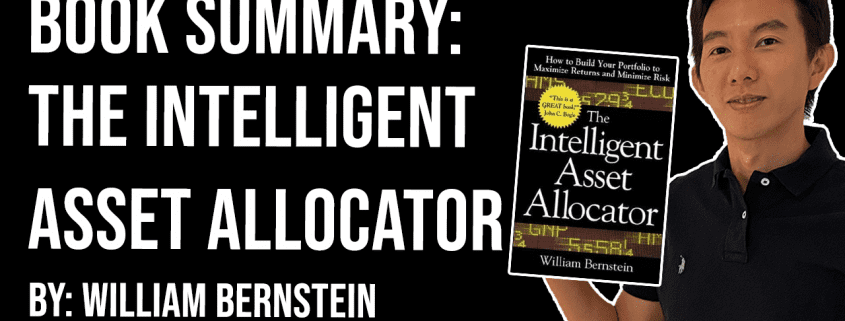
thumbnail Book Summary The Intelligent Asset Allocator by William Bernstein

thumbnail Book Summary The Intelligent Asset Allocator by William Bernstein

The Intelligent Asset Allocator is a comprehensive guide to investing and asset allocation, written by renowned financial author William Bernstein.

The book is aimed at helping investors to understand the principles of asset allocation and to build a diversified portfolio that is suited to their individual goals and risk tolerance.

In this blog post, I will share all about this book and the author, key ideas from the book, and how you can apply it to your own trading & investing journey.

About the Author

William Bernstein is a well-respected financial author and investment advisor, with a background in economics and finance.

In addition to The Intelligent Asset Allocator, he has written several other popular books on investing and personal finance, including The Four Pillars of Investing and The Investor’s Manifesto.

What is the Book About?

The main message of The Intelligent Asset Allocator is that asset allocation is the key to successful investing, and that investors should aim to build a diversified portfolio that is suited to their individual goals and risk tolerance.

The book argues that asset allocation is more important than stock picking in determining long-term investment success, and that investors should focus on building a well-diversified portfolio that includes a mix of different asset classes.

10 Key Ideas from the Book

  1. Asset allocation is the key to successful investing: The book argues that asset allocation is more important than stock picking in determining long-term investment success. To build a successful portfolio, investors should focus on building a well-diversified portfolio that includes a mix of different asset classes.
  2. Diversification is important: The book emphasizes the importance of diversification in reducing portfolio risk and increasing the chances of long-term investment success. To diversify their portfolio, investors should include a mix of different asset classes, such as stocks, bonds, and cash.
  3. Choose the right asset allocation for your goals and risk tolerance: The book argues that investors should choose an asset allocation that is suited to their individual goals and risk tolerance. To determine the right asset allocation, investors should consider their time horizon, risk tolerance, and financial goals.
  4. Understand the risks and rewards of different asset classes: The book explains the risks and rewards of different asset classes, including stocks, bonds, and cash, and how to evaluate the trade-offs between risk and return.
  5. Consider the role of international diversification: The book discusses the benefits of international diversification, including the ability to capture different economic and market conditions and to reduce overall portfolio risk.
  6. Invest in low-cost, diversified index funds: The book advocates investing in low-cost, diversified index funds as a simple and effective way to build a well-diversified portfolio.
  7. Rebalance your portfolio regularly: The book recommends rebalancing your portfolio regularly to ensure that your asset allocation remains aligned with your goals and risk tolerance.
  8. Don’t try to time the market: The book warns against trying to time the market and emphasizes the importance of staying invested for the long-term.
  9. Don’t chase returns: The book advises against chasing returns and emphasizes the importance of building a well-diversified portfolio that is suited to your individual goals and risk tolerance.
  10. Keep costs low: The book stresses the importance of keeping investment costs low and advises investors to choose low-cost index funds whenever possible.

10 Ways to Apply the Teachings

  1. To build an effective asset allocation, it is important to understand your financial goals and risk tolerance. This can help you to choose an asset allocation that is suited to your individual needs and can help you to avoid taking on too much risk or investing in inappropriate assets.
  2. The book emphasizes the importance of diversification in reducing portfolio risk and increasing the chances of long-term investment success. To diversify your portfolio, consider including a mix of different asset classes, such as stocks, bonds, and cash.
  3. The book advocates investing in low-cost index funds as a simple and effective way to build a well-diversified portfolio. Look for funds with low expense ratios and consider using index funds to access a broad range of assets.
  4. The book recommends rebalancing your portfolio regularly to ensure that your asset allocation remains aligned with your goals and risk tolerance. This can help you to avoid taking on too much risk or becoming too heavily concentrated in any one asset class.
  5. The book advises against trying to time the market and emphasizes the importance of staying invested for the long-term. Rather than trying to predict market movements, focus on building a well-diversified portfolio and holding it for the long haul.
  6. The book advises against chasing returns and emphasizes the importance of building a well-diversified portfolio that is suited to your individual goals and risk tolerance. Rather than trying to find the hottest investment trend, focus on building a balanced portfolio that is suited to your needs.
  7. The book discusses the benefits of international diversification, including the ability to capture different economic and market conditions and to reduce overall portfolio risk. Consider including international assets in your portfolio to add diversification and potentially improve your risk-return profile.
  8. The book stresses the importance of keeping investment costs low and advises investors to choose low-cost index funds whenever possible. Look for funds with low expense ratios and consider using index funds to keep costs down.
  9. The book advises against letting emotions drive investment decisions and emphasizes the importance of staying disciplined and sticking to your investment plan. To avoid making emotional decisions, consider working with a financial advisor or using automated investment tools.
  10. The book encourages investors to educate themselves and to stay up-to-date on the latest investment trends and strategies. Consider reading other books on investing and personal finance, attending financial workshops or seminars, and seeking the guidance of a financial advisor to help you make informed investment decisions.

The Power of Diversification

One of the key stories and takeaways from “The Intelligent Asset Allocator” by William Bernstein involves the concept of “Diversification as the Only Free Lunch” in investing, which Bernstein emphasizes throughout the book.

In the book, Bernstein shares an anecdote about Harry Markowitz, the Nobel Prize-winning economist who developed Modern Portfolio Theory (MPT) in the 1950s. Markowitz’s research showed that by combining different types of assets (stocks, bonds, international assets, etc.), investors could achieve higher returns with lower risk than they could with any single asset class alone. This revolutionary insight demonstrated that diversification could reduce a portfolio’s risk without sacrificing returns, which Bernstein refers to as the “only free lunch” in investing.

Bernstein explains how, through the lens of MPT, one could construct a portfolio that maximizes return for a given level of risk by carefully selecting a mix of asset classes that don’t move in perfect sync with one another. For instance, during periods of stock market volatility, bonds may provide stability and reduce the overall portfolio’s drawdown, while international assets can offer additional diversification due to differing economic cycles.

The Value of Asset Allocation Over Stock Picking

The critical takeaway from Bernstein’s analysis is that asset allocation matters more than individual stock selection in determining long-term investment success. By focusing on a well-diversified asset mix rather than attempting to time the market or pick winning stocks, investors can achieve better risk-adjusted returns.

Bernstein illustrates this with historical data, showing that portfolios with a diversified mix of asset classes perform better over the long term than portfolios concentrated in a single asset class. He emphasizes that while it’s tempting to chase high returns in specific stocks or sectors, a diversified portfolio is more resilient in market downturns, providing smoother returns over time.

Concluding Thoughts

The Intelligent Asset Allocator is a comprehensive guide to investing and asset allocation, written by renowned financial author William Bernstein.

The main message of the book is that asset allocation is the key to successful investing, and that investors should aim to build a diversified portfolio that is suited to their individual goals and risk tolerance.

The book provides a clear and concise overview of the principles of asset allocation, including the risks and rewards of different asset classes and the importance of diversification.

It also offers practical advice on how to choose the right asset allocation, invest in low-cost index funds, and rebalance your portfolio regularly.

Overall, I would recommend The Intelligent Asset Allocator to beginner and intermediate investors who are looking to learn more about asset allocation and how to build a well-diversified portfolio.

While the book may not be suitable for more advanced investors, it provides a valuable introduction to the principles of asset allocation and offers practical advice on how to build a successful investment portfolio.

Now that I have covered all the key learning points of this book, would you consider adding it to your reading list?

For those who have already read it, what are some of your key learning points?

Let me know in the comments below!


best books on trading and investing

If you would like to find more book summaries and recommendations, also check out: “Best Investing & Trading Books of All Time”

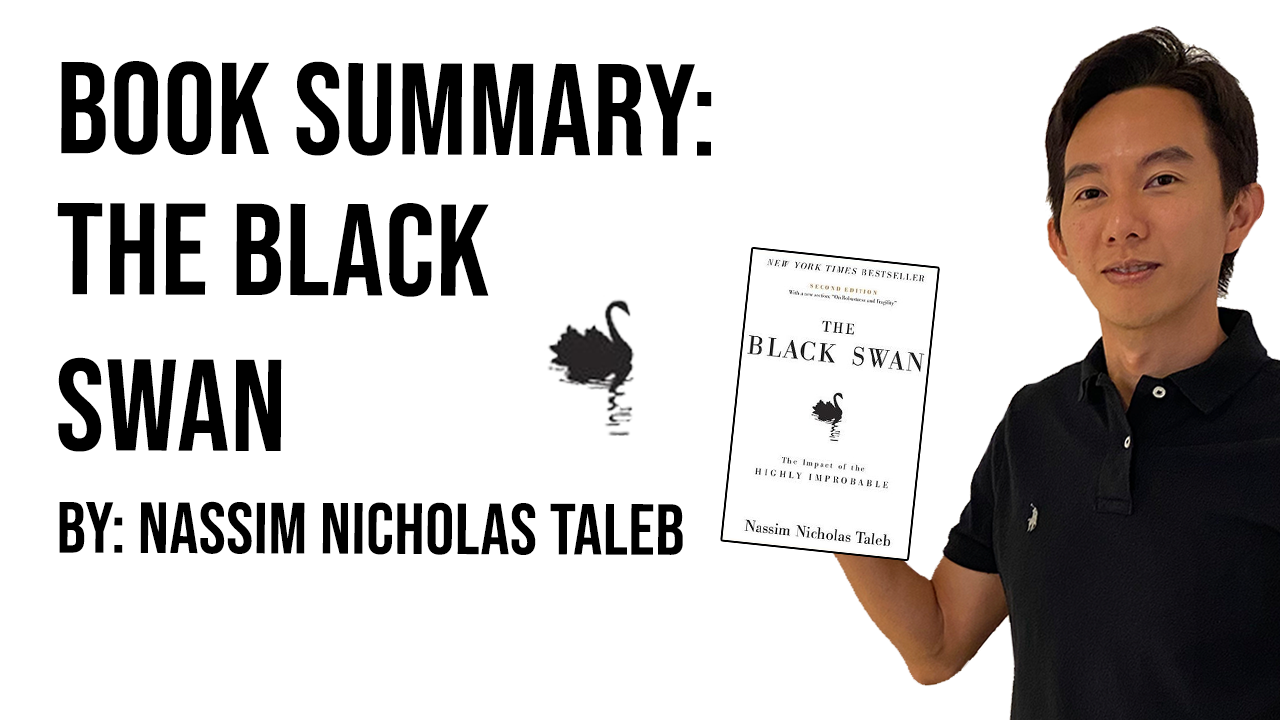
thumbnail Book Summary The Black Swan by Nassim Nicholas Taleb

thumbnail Book Summary The Black Swan by Nassim Nicholas Taleb

The Black Swan: The Impact of the Highly Improbable, written by Nassim Nicholas Taleb, is a thought-provoking book that challenges the way we think about random events and their impact on our lives.

The book has gained widespread recognition and has been hailed as a modern classic, with many calling it a must-read for anyone interested in the ways in which the world works.

In this book summary, we will delve into the background of the author, the main message of the book, and 10 key ideas that are explored in the pages of The Black Swan.

We will also provide 10 actionable ways to apply the teachings of the book and other points to consider.

To finish off, we will discuss how the book has personally helped me in my trading journey and provide some practical examples of the main topic in relation to two randomly chosen themes.

In this blog post, I will share all about this book and the author, key ideas from the book, and how you can apply it to your own trading & investing journey.


About the Author

Nassim Nicholas Taleb is a former trader, a philosopher, and a statistician.

He is known for his work on the concept of “Black Swans,” which he defines as highly improbable events that have a significant impact on our world.

Taleb has a background in finance and has worked as a trader and a risk manager.

He has also written several other books, including Fooled by Randomness, Antifragile, and Skin in the Game.

What is the Book About?

The Black Swan is about the impact of highly improbable events on our lives and how we should be prepared for them.

The book argues that we often focus too much on the predictable and the known, and as a result, we are not adequately prepared for the unexpected.

The book uses a wide range of examples, from the 9/11 attacks to the rise of the internet, to illustrate the impact of Black Swans on our world.

The main message of the book is that we should be prepared for the unpredictable and embrace it, rather than trying to predict or control it.

10 Key Ideas from the Book

10 Key Ideas:

  1. The world is characterized by extreme events that are difficult to predict and have a disproportionate impact on our lives and our understanding of the world. These events, which Taleb calls “black swans,” can be positive or negative, but they are always unexpected and have far-reaching consequences.
  2. The narrative fallacy is the tendency to explain the world in terms of stories and to oversimplify complex events in order to make them more comprehensible. This can lead to a distorted view of the world and a lack of awareness of the role of randomness and uncertainty.
  3. The precautionary principle states that we should be more cautious in situations where the consequences of failure are high and the likelihood of success is uncertain. This principle can be applied to a range of areas, including investing, business, and policymaking.
  4. The black swan problem refers to the difficulty of predicting and preparing for extreme events that have a significant impact on our lives. This problem is exacerbated by our tendency to overgeneralize from past experience and to assume that the future will be similar to the past.
  5. The concept of “fooled by randomness” refers to the tendency to attribute success to skill and failure to luck, even when the opposite may be true. This can lead to overconfidence and a false sense of control.
  6. The idea of “antifragility” suggests that some systems and organizations are not just resistant to stress and adversity, but actually thrive and become stronger as a result. These systems are characterized by a high degree of redundancy and a decentralized structure, which allows them to adapt and evolve in the face of change.
  7. “The Lindy effect” refers to the idea that the longer something has been around, the longer it is likely to continue to be around. This principle can be applied to a range of areas, including technology, culture, and social norms.
  8. The concept of “survivorship bias” refers to the tendency to focus on the successes and overlook the failures, leading to an overly optimistic view of the world. This bias can be found in a range of areas, including investing, business, and policymaking.
  9. The idea of “black swan blindness” refers to the tendency to underestimate the likelihood and impact of black swan events, even when they have occurred in the past. This can lead to a lack of preparedness for future events
  10. The idea “erring on the side of caution” advocates for taking a more cautious and conservative approach in situations where the potential consequences of failure are high and the chances of success are uncertain. By doing so, we can better protect ourselves and our communities from the impact of unexpected events.

10 Ways to Apply the Teachings

  1. Build resilience into your life: The book suggests ways in which you can build resilience into your life, such as by diversifying your investments and building up a safety net.
  2. Embrace randomness: Rather than trying to predict or control the unpredictable, the book suggests that we should embrace randomness and be prepared for it.
  3. Avoid over-simplification: The book advises against over-simplification and suggests that we should be mindful of the complexities of systems.
  4. Foster diversity: The book recommends that we foster diversity in our lives, both in terms of the people we interact with and the experiences we have.
  5. Seek out antifragile opportunities: The book introduces the concept of antifragility and suggests that we should seek out opportunities that allow us to thrive in the face of uncertainty and change.
  6. Avoid groupthink: The book advises against groupthink and suggests that we should seek out diverse viewpoints and encourage independent thinking.
  7. Take on skin in the game: The book advises that we should be willing to put our own skin in the game and have a personal stake in the outcome.
  8. Use storytelling to prepare for Black Swans: The book suggests that storytelling can be a powerful tool for preparing for the unpredictable and suggests ways in which we can use it.
  9. Seek out multiple sources of information: The book advises that we should seek out multiple sources of information and be mindful of the biases that may be present in any one source.
  10. Be open to new ideas: The book suggests that we should be open to new ideas and be willing to challenge our existing beliefs.

Practical Application & Tips

As a trader, I have found The Black Swan to be a valuable resource for understanding the unpredictable nature of the markets.

The book’s emphasis on the importance of being prepared for the unexpected has helped me to adopt a more flexible approach to trading.

By embracing randomness and being open to new ideas, I have been able to adapt to changing market conditions and find new opportunities.

One of the themes that I found particularly useful was the concept of antifragility.

The book’s suggestion to embrace challenges and seek out new experiences has helped me to become more resilient in the face of uncertainty.

This has been especially valuable in the fast-moving world of trading, where conditions can change rapidly.

By cultivating antifragility, I have been able to thrive in the face of market challenges and continue to grow as a trader.

Another theme that has been valuable to me is the idea of avoiding groupthink.

The book’s warning against the dangers of groupthink has helped me to be more critical of my own assumptions and to seek out diverse perspectives.

This has been especially important in the trading world, where it can be easy to get caught up in the herd mentality and follow the crowd.

By being open to different viewpoints and questioning my own assumptions, I have been able to make more informed trading decisions.

Overall, The Black Swan has been a valuable resource for me in my trading journey.

The book’s emphasis on the importance of being prepared for the unexpected and embracing randomness has helped me to adapt to changing market conditions and find new opportunities.

The concepts of antifragility and avoiding groupthink have also been invaluable in helping me to become a more resilient and critical thinker.

Concluding Thoughts

The Black Swan is a thought-provoking book that challenges the way we think about random events and their impact on our lives.

The book’s emphasis on the importance of being prepared for the unexpected, embracing randomness, and cultivating antifragility is valuable for anyone looking to better understand the unpredictable world in which we live.

I would recommend this book to traders, investors, and anyone interested in the ways in which the world works.

It is a must-read for anyone looking to better understand the unpredictable nature of the world and how to prepare for it.

Now that I have covered all the key learning points of this book, would you consider adding it to your reading list?

For those who have already read it, what are some of your key learning points?

Let me know in the comments below!


best books on trading and investing

If you would like to find more book summaries and recommendations, also check out: “Best Investing & Trading Books of All Time”