

Best Habits to Improve Trading Psychology
Want the daily routine? Get the free 15-Minute Swing Trader’s Checklist. Get it free →
5 Habits to Beat Cognitive Biases in Trading
Last updated: 14 July 2026 · By Spencer Li, CFTe
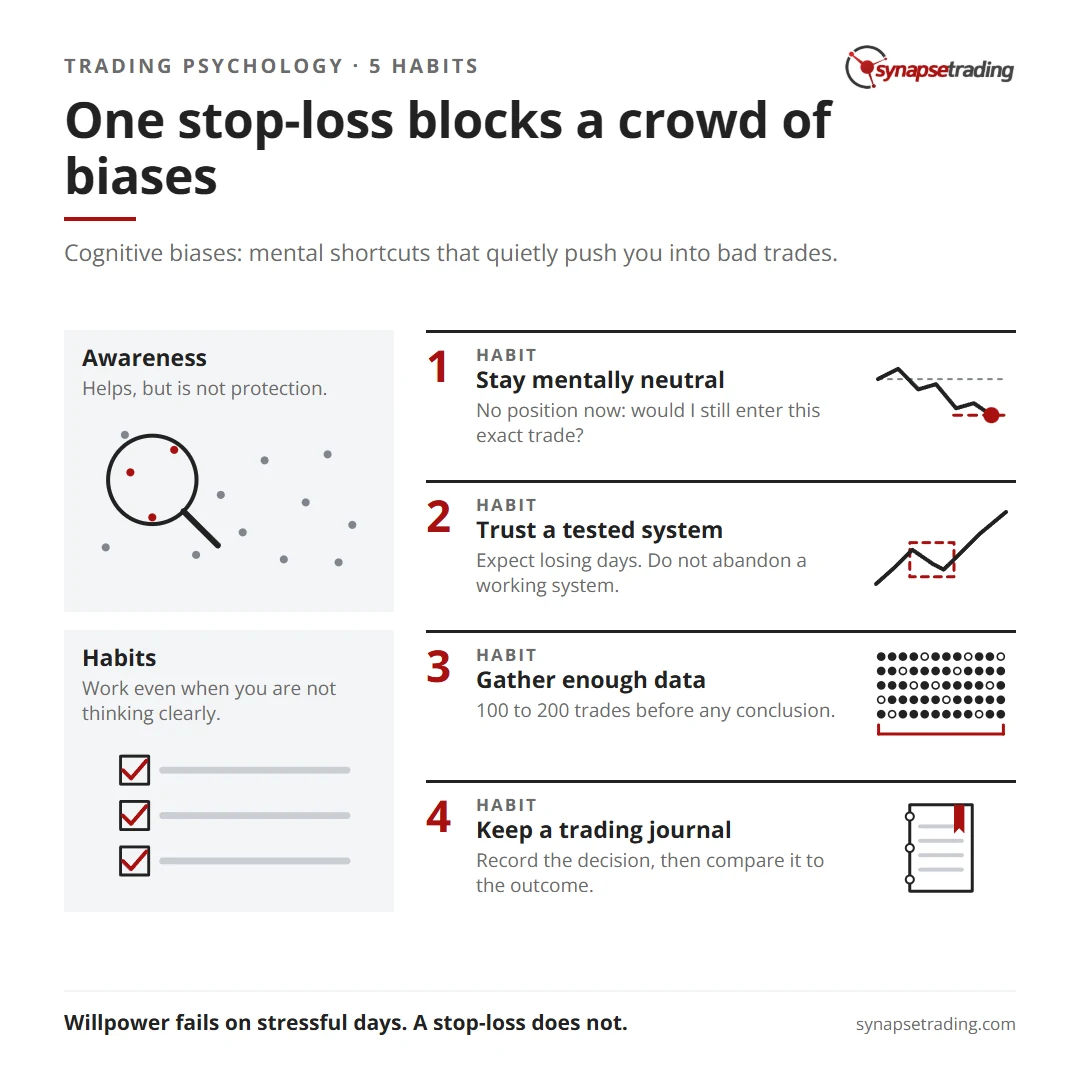
You cannot delete cognitive biases (the mental shortcuts that quietly push you into bad trades), but you can build habits that stop them from reaching your account. The five that do the most work are simple: stay mentally neutral even while holding a position, trust a system you have actually tested, always use a stop-loss, gather at least 100 to 200 trades before you judge anything, and keep a trading journal. None of these require you to be a calmer person or to spot every bias in real time. They are rules and routines that take the decision out of your hands at the exact moment your brain is least trustworthy. That is the point. Willpower fails on stressful days. A stop-loss does not.
Here are the five habits, what each one defends against, and why it works.
Why can’t you just “be aware” of your biases?
Knowing the biases helps. Once you can name loss aversion (holding losers too long because losses hurt more than gains feel good) or confirmation bias (only noticing the evidence that agrees with your trade), you start to catch yourself.
But awareness is not protection. Staying 100% alert all day is not realistic, and the days it matters most, the stressful, fast, emotional ones, are exactly the days your alertness is lowest. So the goal is not to think harder. The goal is to build habits that work even when you are not thinking clearly.
The 5 habits, side by side
Each habit targets a specific set of biases. Here is the map.
| Habit | What you do | Biases it defends against |
|---|---|---|
| 1. Stay mentally neutral | Hold positions as if you could re-enter them fresh at any moment | Endowment, anchoring, cognitive dissonance |
| 2. Trust a tested system | Expect losing days; do not abandon a working system after normal losses | Recency, overconfidence, panic-driven discarding |
| 3. Always use a stop-loss | Pre-set an exit; let it take you out automatically | Loss aversion, endowment, regret aversion, anchoring, optimism, cognitive dissonance |
| 4. Gather enough data | 100 to 200 trades, and backtests across different conditions, before any conclusion | Representativeness |
| 5. Keep a trading journal | Record the decision, then compare it to the outcome | Confirmation, optimism, hindsight, overconfidence, self-attribution |
Habit 1: stay mentally neutral, even with open positions
The trap is ownership. The moment you hold a position, your brain starts defending it instead of judging it.
The fix is a single question. Ask yourself: if I had no position right now, would I still choose to enter this exact trade?
If the answer is yes, hold. If you are unsure, that hesitation is the bias talking, not the chart. You can always close the position and enter it again later. Yes, that costs a little in fees, and most people will not do it, which is precisely why it works. Closing and re-deciding from scratch resets you to neutral and breaks the spell of ownership.
Habit 2: have confidence in your system, and let it lose sometimes
Every system has losing days. That is not a flaw in the system; it is the cost of doing business.
So when the losses arrive and they are within the range you already expect, do not panic and discard your trading system. The mistake is not losing. The mistake is abandoning a working approach on a bad week, right before the winning days that recoup those losses and more.
This habit only works if you did Habit 4 first. You can only stay calm through a drawdown if you have enough data to know the drawdown is normal. Without that, every losing streak feels like proof the system is broken, and you blow it up at the worst possible time.
Habit 3: always use a stop-loss
This is the highest-leverage habit on the list, because a single rule neutralizes a whole crowd of biases at once: loss aversion, endowment bias, regret aversion bias, anchoring bias, optimism bias, cognitive dissonance, and more.
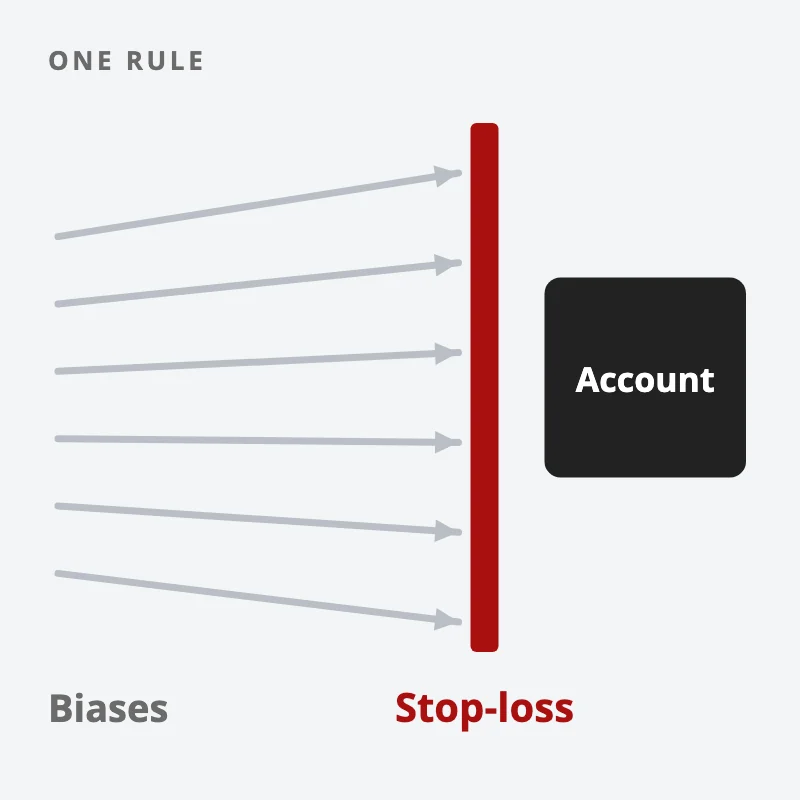
Here is the mechanism. The moment you are stopped out, you are flat. And a flat trader is a neutral trader. With no position to defend, you can look at the chart honestly and take a position in either direction, long or short, with no baggage. The stop does not just cap your loss. It hands you back a clear head.
Set the stop when you enter, before the position has any emotional grip on you. Then let it do its job.
Habit 4: make sure you have enough data
Small samples lie. Three winning trades feel like a winning strategy; three losers feel like a broken one. Both are noise. This is representativeness bias: treating a tiny sample as if it represents the whole.
So set a floor. Before drawing any conclusion about your performance, have at least 100 to 200 trades on the record. And if you are backtesting a strategy, test it over a long enough period and across different market conditions (trending, ranging, volatile, quiet), not just the stretch where it happened to shine.
Personally, this is the habit traders skip most, because conclusions feel available after a handful of trades. They are not.
Habit 5: keep a trading journal
Record more than your results. Record your decision-making at the time you made it: what you saw, why you entered, what you expected.
Why this matters: it lets you compare the decision you made with the outcome it produced. That single comparison is what defuses the after-the-fact biases that rewrite your memory, confirmation bias, optimism bias, hindsight bias (“I knew it would do that”), overconfidence bias, and self-attribution bias (winners were skill, losers were bad luck). Your memory will quietly edit the story to make you look smart. A journal written in the moment does not let it.
Where the human edge comes in
Software can flag your biases now. A journal app will chart your win rate; an AI can read your notes back and point out that you only ever blame the market for losses. That part is getting cheap. What no tool will do is make you close a position you have fallen in love with, or hold a system through the losing week it was always going to have. The discipline to actually follow the rule, on the stressful day, when it costs you something, is the edge. That is psychology and discipline, two of the Five Edges no scanner can trade for you.
FAQ
How do you overcome cognitive biases in trading?
You do not overcome them by willpower; you build habits that work without it. The five that matter most: stay mentally neutral while holding positions, trust a tested system through normal losses, always use a stop-loss, collect 100 to 200 trades before judging your results, and keep a trading journal.
How many trades do I need before I can judge my strategy?
At least 100 to 200 trades, and a backtest run across different market conditions. Smaller samples trigger representativeness bias, where a handful of results feels like proof when it is really just noise.
Why does a stop-loss help with psychology, not just risk?
Because the moment it takes you out, you are flat, and a flat trader is a neutral trader. With no position to defend, you stop rationalizing and can judge the chart honestly. One rule defuses loss aversion, endowment, regret aversion, anchoring, and optimism bias at once.
What should I write in a trading journal?
Record the decision and your reasoning at the time, not just the result. That lets you compare your thinking to the outcome later, which is what neutralizes hindsight bias, overconfidence, and self-attribution bias.
Should I close a position if I am unsure about it?
Ask yourself whether you would enter that exact trade fresh today. If you are unsure, the uncertainty is usually the bias of ownership talking. You can close and re-enter later; resetting to neutral is worth the small cost.
Which of these five do you already do, and which is the one you keep skipping? For most traders it is the journal. Let me know in the comments.
If you want the full picture of how biases shape your trading, read the pillar: The Complete Guide to Investing and Trading Psychology.
Want the system that makes these habits automatic? Grab the free 15-Minute Swing Trading Starter Kit. It is the exact daily routine I use to scan once a day and trade any market in 15 minutes, with the stop-loss and journal steps built in.
About the author. Spencer Li is The 15-Minute Trader and the founder of Synapse Trading. He is a Certified Financial Technician (CFTe) with 15+ years of trading, run from 70+ countries. He holds a B.Acc and B.BM from SMU. Every trade he takes is public, dated, losses left in. He teaches rules-based swing trading in 15 minutes a day, one system for any market.
Education, not financial advice. Synapse Trading is not licensed by MAS to advise on investment products. Trading carries risk of loss; past performance is not indicative of future results.
Related
The Complete Guide to Investing and Trading Psychology · Cognitive biases in trading · How to keep a trading journal
Want the daily routine? Enter your email for the free 15-Minute Swing Trader's Checklist.
Free 5-page PDF, then occasional trading emails. Education only, not financial advice. Unsubscribe anytime. Kit stores your email in the US: see our privacy policy.
Want to learn the full method? The Trading Mastery Program teaches the 4 strategies I have traded since 2011. It suits beginners and experienced traders.
Rather follow the trades as they happen? Daily Trading Signals is our Telegram channel: my trade ideas with entry, stop and exit, and every trade is public.
Questions about this post? Ask in the free Telegram channel →
Educational content only, not personalised financial advice. Trading carries risk, including loss of capital. Past performance is not indicative of future results. Synapse Trading is not licensed or regulated by MAS.

