

Regret Aversion Bias – Would You Rather Be Right, or Avoid Being Wrong?
Join our Telegram channel for more market analysis & trading tips: t.me/synapsetrading
Table of Contents
Regret Aversion Bias in Trading: What It Is and How to Beat It
Last updated: 3 July 2026 · By Spencer Li, CFTe
Regret aversion bias is the tendency to avoid making a decision because you fear it will look wrong in hindsight, so you would rather do nothing than risk the pain of regret. In trading, it shows up in three ways: you hold a losing position too long because closing it means admitting you were wrong, you hesitate to enter after a string of losses when you should be acting, and you refuse to sell a winner on bad signals because you cannot stand the thought of it running higher without you. It is a fear of feeling bad later, not a real read of the market. The way out is not a clever trick. It is confidence in a tested method, so that any single trade, win or lose, is just one repeat of a process you trust. Discipline and consistency are what dissolve the regret.
Let me break down where this bias hides and how to trade around it.
What is regret aversion bias?
Regret aversion is a cognitive bias (a built-in thinking error) where you avoid a decisive action because you are trying to forestall the pain of regret that comes with a poor choice. The catch is that “doing nothing” is also a choice, and it carries its own regret. You are not escaping the decision. You are just hiding from one half of it.
In everyday life this looks harmless. You keep the same phone plan, the same gym you never use, the same job, because changing and being wrong feels worse than staying and being stuck. In trading, the same instinct quietly costs you money.
How regret aversion shows up in traders
There are three classic patterns, and most traders run all three without noticing.
You hold losers too long. Closing a losing position means realising the loss and admitting the entry was a mistake. So you hold, hoping it comes back, because as long as it is open you have not officially been wrong. The loss grows while you protect your ego.
You freeze after a losing streak. After a few losses, the instinct is to retreat, conserve, and lick your wounds. That feels safe. But the market does not know you are on a streak, and the best setups often come right after the worst stretch. Regret aversion makes you hesitate most at the exact moments that merit acting.
You cling to winners past the exit. This one is sneaky because it wears the mask of greed. You get a clear negative signal on a profitable position, but you will not sell, because you are terrified the stock soars even higher the moment you are out. The regret you are dodging is not “I lost money.” It is “I left money on the table.” So you give the profit back instead.
Errors of commission vs errors of omission
Regret-averse traders are trying to avoid two different kinds of mistake, and the second one is the one almost nobody accounts for.
| What it is | Example in trading | The regret you fear | |
|---|---|---|---|
| Error of commission | A misguided action you took | You entered a bad trade and lost | “I should not have done that” |
| Error of omission | A misguided inaction, an opportunity skipped | You sat out a setup that ran without you | “I should have done that” |
Here is the trap. We feel the pain of commission errors loudly, because there is a clear action to blame. We barely register omission errors, because nothing happened, so there is nothing to point at. That asymmetry is exactly why regret aversion pushes you toward inaction. Inaction feels free, even when it is quietly the more expensive mistake.
What about herding behaviour?
Herding is regret aversion in a crowd. When you follow the mass consensus, you are not just hoping the crowd is right. You are buying insurance against future regret, because if everyone is wrong together, the responsibility is diffused and you do not have to feel singled out for the bad call.
That is comforting and it is dangerous. The whole point of having an edge is doing something the crowd is not. If your only reason for a trade is that everyone else is in it, you have outsourced your decision to the very people you are supposed to be trading against.
What is the best solution for regret aversion?
The way out is to have genuine confidence in your method and your skill, so that a string of losses does not shake you off your process. When you know that in the long run you will recoup those losses and turn a profit by catching the big moves, a single loss stops feeling like a verdict on you. It is just one sample in a system you trust. The key here is discipline and consistency.
This is why a process beats a feeling. A backtested, written rule set does not get embarrassed. It does not remember yesterday’s loss. It just tells you what the setup is worth and whether today’s chart qualifies. A scanner can flag the setup for you in a second, but it will not give you the discipline to take the trade after three losses in a row, or to close a winner on a sell signal. That part, sitting with the discomfort and executing anyway, is the human edge. Discipline is one of the Five Edges no tool can trade for you.
Even the man who built modern portfolio theory admitted he managed his own money by managing his regret:
“I visualized my grief if the stock market went way up and I wasn’t in it, or if it went way down and I was completely in it. My intention was to minimize my future regret, so I split my retirement plan contributions 50/50 between bonds and equities.”
, Harry Markowitz, father of Modern Portfolio Theory
Personally, I read that quote as permission, not a flaw. Markowitz did not pretend he was a robot. He acknowledged the regret was real, then built a rule (a fixed 50/50 split) so the feeling could not drive his decisions in the moment. That is the move. You do not delete the emotion. You build a process that runs regardless of it.
How to apply this to your own trading
A few practical handles:
- Pre-decide your exits. If your stop and your sell signal are written before you enter, closing a losing or winning position is just following the plan, not admitting a mistake. The ego never enters the room.
- Track omission, not just commission. Keep a note of the qualifying setups you skipped out of fear. When you see how much those “safe” non-trades cost, the asymmetry corrects itself.
- Make the streak irrelevant. Size every trade the same way relative to your account, so loss number six is just as routine as loss number one. The streak only has power if your sizing reacts to it.
- Trade your system, not the crowd. If you cannot explain the entry without “everyone is in this,” it is not your trade.
If you want the full picture of how the mind sabotages trades, read the pillar: The Complete Guide to Investing and Trading Psychology.
FAQ
What is regret aversion bias in simple terms?
Regret aversion is avoiding a decision because you fear it will look wrong later, so you do nothing instead. In trading it makes you hold losers too long, freeze after losses, and refuse to sell winners on bad signals, all to dodge the pain of regret.
How does regret aversion affect traders?
It pushes traders toward inaction. They hold losing positions to avoid admitting the loss, hesitate to enter after a losing streak, and cling to profitable positions past the exit signal because they cannot stand the idea of the stock running higher without them.
What is the difference between an error of commission and an error of omission?
An error of commission is a misguided action you took, like entering a bad trade. An error of omission is a misguided inaction, like skipping a good setup that then ran without you. We feel commission errors more sharply, which is why regret aversion biases us toward doing nothing.
Is herding behaviour caused by regret aversion?
Largely, yes. Following the crowd diffuses responsibility, so if the consensus is wrong, you do not feel singled out for the bad call. That makes herding a way of buying insurance against future regret, at the cost of any real edge.
How do you overcome regret aversion in trading?
Build genuine confidence in a tested method and trade it with discipline and consistency. When you trust the process over the long run, a single loss stops feeling like a personal verdict, and pre-decided exits turn closing a trade into following a plan rather than admitting a mistake.
So, which version of regret aversion do you catch yourself in most, the held loser, the post-streak freeze, or the winner you would not let go? Naming it is the first step to trading around it.
Want the system behind the discipline? Grab the free 15-Minute Swing Trading Starter Kit. It’s the exact routine I use to scan once a day and trade any market in 15 minutes, so the decisions are made before the emotion shows up.
About the author. Spencer Li is the founder of Synapse Trading and a Certified Financial Technician (CFTe) with 15+ years of trading across stocks, forex, crypto, commodities, and bonds. His trade log is public: every trade since April 2024, dated, losses left in. He has taught a 15-minute daily trading routine since 2014, one system for any market.
Education, not financial advice. Synapse Trading is not licensed by MAS to advise on investment products. Trading carries risk of loss; past performance is not indicative of future results.
Related
The Complete Guide to Investing and Trading Psychology (pillar) · Loss aversion bias · Disposition effect · Herding behaviour in trading
Want the daily routine? Enter your email for the free 15-Minute Swing Trader's Checklist.
Free, 5 pages, PDF. You get the checklist, then my occasional trading emails. Education only, not financial advice. Unsubscribe anytime.
Where your details go: Kit, our email provider, stores your email address in the United States. Our contract with Kit lets it use your address only to send our emails, and requires Kit to keep it secure. The United States has no national privacy law like Singapore's, so that contract is the main protection. More in our privacy policy.
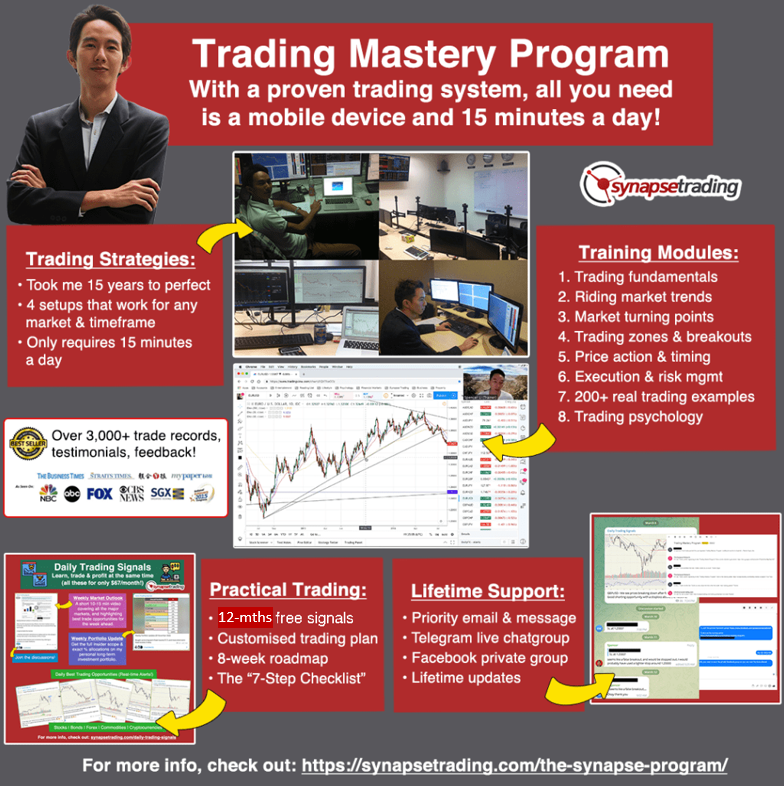 Our flagship mentoring program is suitable for both beginners and advanced traders, covering the 4 strategies which I used over the past 15 years to build up my 7-figure personal trading portfolio.
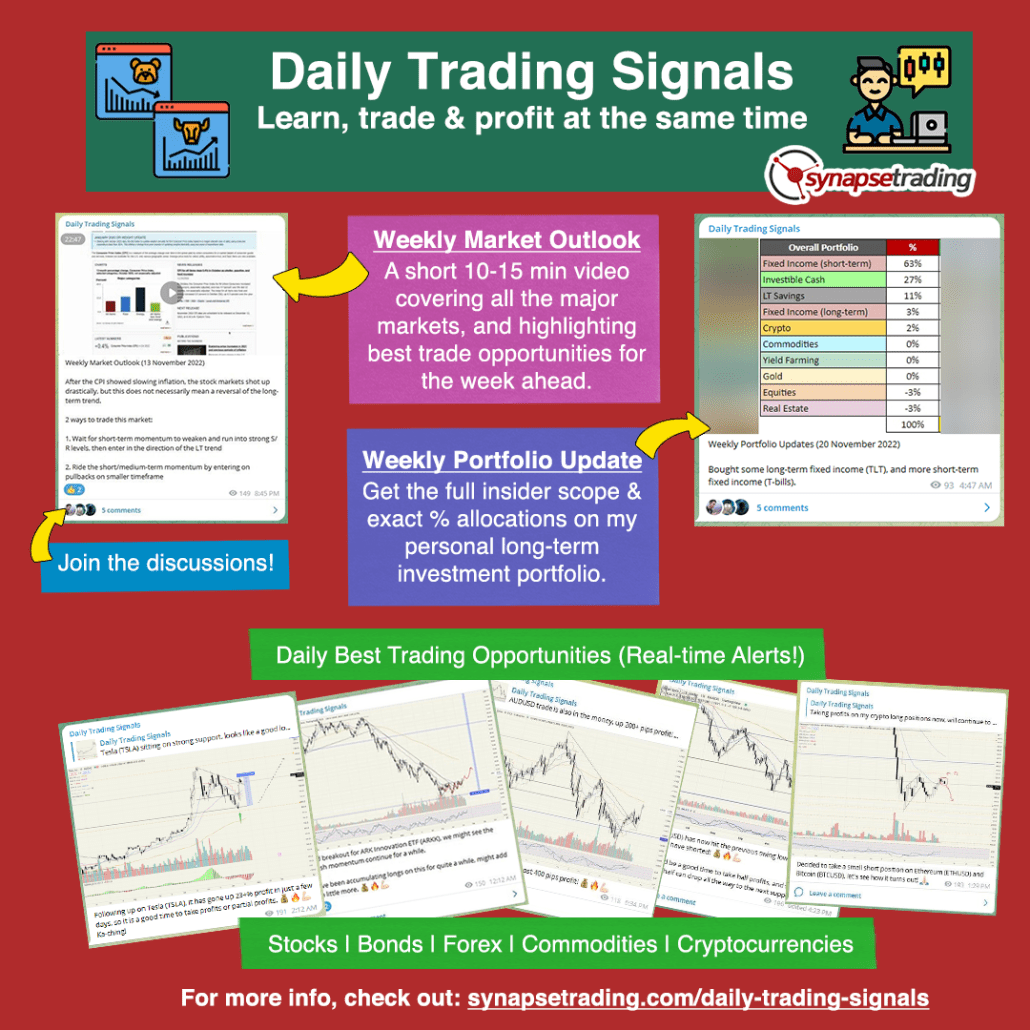 If you're looking for the best trading opportunities every day across various markets, and don't want to spend hours doing the research yourself, check out our private Telegram channel!


Leave a Reply
Want to join the discussion?Feel free to contribute!