

Self-Attribution Bias – Don’t Confuse Brains With a Bull Market!
Join our Telegram channel for more market analysis & trading tips: t.me/synapsetrading
Table of Contents
Self-Attribution Bias in Trading: Why You Think You’re Better Than You Are
Last updated: 3 July 2026 · By Spencer Li, CFTe
Self-attribution bias is the tendency to credit your wins to your own skill while blaming your losses on bad luck, the broker, the platform, or the news. In trading it is dangerous for one simple reason: it quietly inflates how good you think you are. It comes in two flavours. Self-enhancing bias is claiming too much credit when a trade works. Self-protecting bias is denying responsibility when a trade fails. Both distort your scorecard in the same direction, upward. Left unchecked, the bias does two concrete kinds of damage: you stop learning from mistakes you refuse to see, and you drift into overconfidence, sizing up because you believe you have an edge you have not actually proven. The fix is not motivation or willpower. It is a record. Log every trade, win and loss, treat both objectively, and let the numbers grade you instead of your ego.
Here is how the bias works, why it fools good traders, and the one habit that beats it.
What is self-attribution bias?
Self-attribution bias (also called self-serving attributional bias) is the tendency to ascribe your successes to innate qualities like talent or foresight, while blaming your failures on outside influences like bad luck. It is one of the most common cognitive biases in behavioural finance, and trading is where it does the most quiet harm, because the feedback (your profit and loss) is delayed, noisy, and easy to misread.
There are two kinds, and it helps to keep them separate.
Self-enhancing bias is the propensity to claim an irrational degree of credit for your successes. If you intended to succeed and the outcome lined up with that intention, you perceive the result as proof your actions worked, regardless of whether your actions actually played any crucial role. The trade went your way, so your analysis must have been brilliant.
Self-protecting bias is the corollary, the irrational denial of responsibility for failure. When a trade goes wrong, you protect your self-esteem psychologically as you try to make sense of the loss. It was not your call that was bad. It was the broker, the platform, the surprise headline, the rigged market.
The two types, side by side
| What it is | The story you tell yourself | The damage | |
|---|---|---|---|
| Self-enhancing bias | Over-crediting your wins | “I called that perfectly, I’m a good trader” | Overconfidence, sizing up on an edge you never proved |
| Self-protecting bias | Denying blame for your losses | “Bad luck. The broker, the news, the platform” | You never see the mistake, so you never learn from it |
Notice that both biases bend the data the same way. One inflates the wins, the other deflates the responsibility for losses. Put together, they hand you a scorecard that says you are better than you are.
How it actually harms traders
This is not an abstract psychology problem. It impairs traders in two specific ways.
First, people who cannot perceive the mistakes they have made are, consequently, unable to learn from those mistakes. If every loss was someone else’s fault, there is nothing to fix. You repeat the same error for years and call it bad luck.
Second, traders who disproportionately credit themselves when good outcomes arrive become detrimentally overconfident in their own market savvy. That is the on-ramp to overconfidence bias, where you trade bigger and more often because you believe in an edge that the actual numbers do not support.
When trades turn out well, people like to think their method and analysis were fantastic, and that they are good traders. When trades do not turn out well, people blame their broker, their platform, the news, basically anything but themselves. Over time, this leads traders to think they are much better than they actually are.
What is the best solution for self-attribution bias?
The fix is not insight or affirmations. It is bookkeeping, done honestly.
Treat both winning and losing trades as objectively as possible. Tabulate and record them to build a running record. Then do an objective post-trade analysis, reviewing your records to learn from past mistakes, the real ones, in your own writing, before you had a chance to rewrite the story.
With enough data, you can analyse the consistency of your methods and returns honestly. The wins and losses sit in the same column, attributed the same way, and the pattern shows itself. As they say, the numbers do not lie.
This is exactly why my own trade journal is public, every trade since April 2024, with the losses left in. A public log is the cheapest cure for self-attribution bias I know, because you cannot quietly delete the trades that embarrass you.
Where the human edge comes in
A trading bot does not flatter itself. It does not remember a loss as bad luck and a win as genius. That neutrality is its advantage. Yours, as a human, is judgment, but judgment only compounds if it is honestly graded. A journal is how you borrow the machine’s objectivity. The discipline to log the ugly trade exactly as it happened, and to read your own record without spin, is the psychology and accountability edge, and it is one of the Five Edges no tool will keep for you.
FAQ
What is self-attribution bias in trading?
Self-attribution bias is the tendency to credit winning trades to your own skill while blaming losing trades on outside factors like bad luck, your broker, or the news. Over time it makes traders believe they are more skilled than their actual results show.
What are the two types of self-attribution bias?
The two types are self-enhancing bias (claiming too much credit for successes) and self-protecting bias (denying responsibility for failures). Both distort your self-assessment upward.
How does self-attribution bias lead to overconfidence?
When you over-credit yourself for wins, you start to believe you have a reliable edge. That belief leads you to trade bigger and more often, which is overconfidence bias, even when the underlying numbers do not support the confidence.
How do you overcome self-attribution bias as a trader?
Keep an objective trade record of every win and loss, then do a post-trade analysis reviewing those records. With enough data you can judge your methods and returns honestly, because the numbers do not lie.
Why does a trading journal help with self-attribution bias?
A journal forces you to attribute wins and losses the same objective way, in writing, before you can rewrite the story in your favour. A public journal is even stronger, because you cannot quietly delete the trades that embarrass you.
So, be honest with yourself. Do you keep a real record of your trades, or just the highlight reel in your head?
If you want the full set of trading biases and how to beat each one, read the pillar: The Trader’s Guide to Behavioural Finance and Trading Psychology.
Want a routine that keeps you honest? Grab the free 15-Minute Swing Trading Starter Kit. It includes the simple trade-log and review habit I use to scan once a day and trade any market in 15 minutes.
About the author. Spencer Li is the founder of Synapse Trading and a Certified Financial Technician (CFTe) with 15+ years of trading across stocks, forex, crypto, commodities, and bonds. His trade log is public: every trade since April 2024, dated, losses left in. He has taught a 15-minute daily trading routine since 2014, one system for any market.
Education, not financial advice. Synapse Trading is not licensed by MAS to advise on investment products. Trading carries risk of loss; past performance is not indicative of future results.
“Don’t confuse brains with a bull market.”
Related
The Trader’s Guide to Trading Psychology (pillar) · Overconfidence bias in trading · How to keep a trading journal · Confirmation bias in trading · Loss aversion
Want the daily routine? Enter your email for the free 15-Minute Swing Trader's Checklist.
Free, 5 pages, PDF. You get the checklist, then my occasional trading emails. Education only, not financial advice. Unsubscribe anytime.
Where your details go: Kit, our email provider, stores your email address in the United States. Our contract with Kit lets it use your address only to send our emails, and requires Kit to keep it secure. The United States has no national privacy law like Singapore's, so that contract is the main protection. More in our privacy policy.
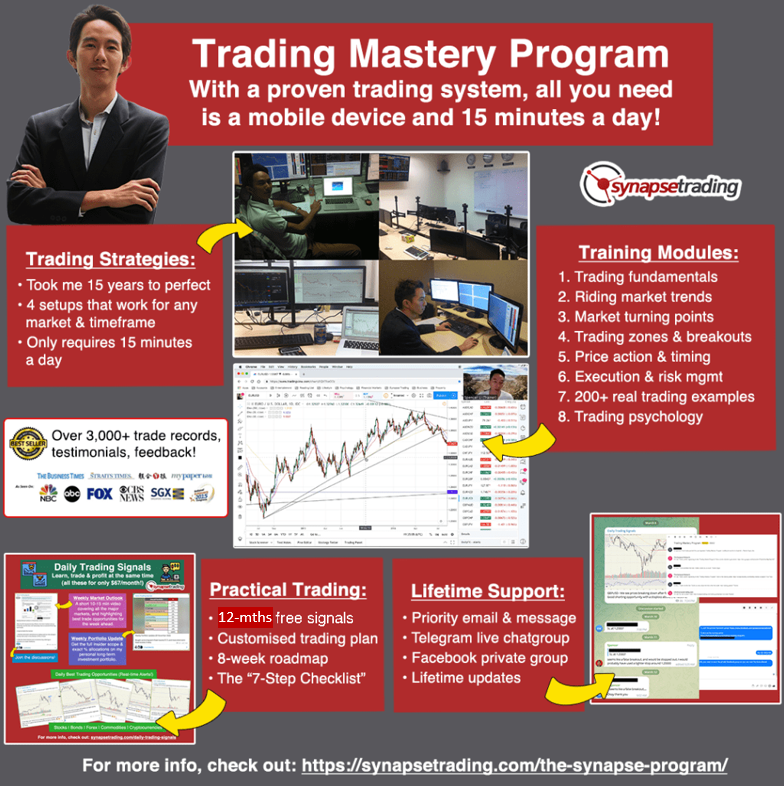 Our flagship mentoring program is suitable for both beginners and advanced traders, covering the 4 strategies which I used over the past 15 years to build up my 7-figure personal trading portfolio.
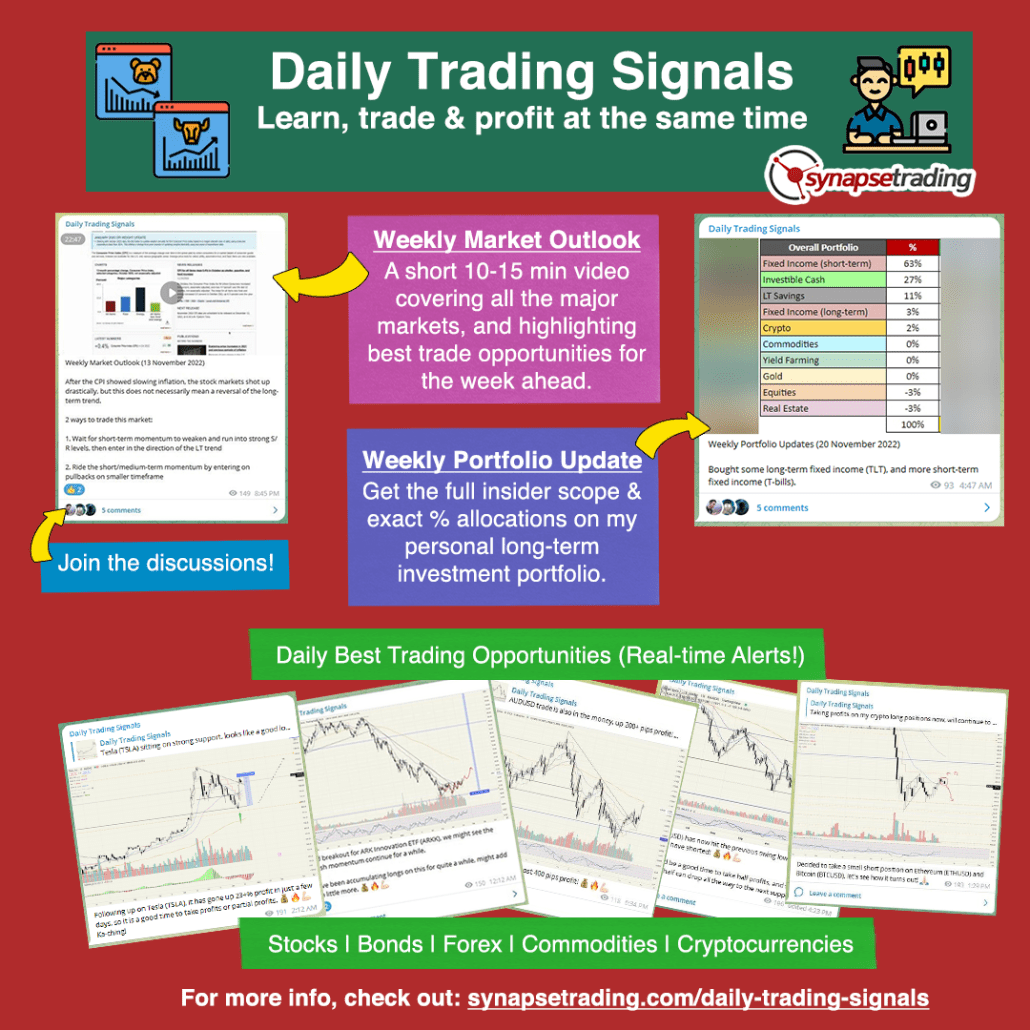 If you're looking for the best trading opportunities every day across various markets, and don't want to spend hours doing the research yourself, check out our private Telegram channel!


Leave a Reply
Want to join the discussion?Feel free to contribute!