

Optimism Bias – Why Most People Think They Can Beat the Market
Want the daily routine? Get the free 15-Minute Swing Trader’s Checklist. Get it free →
Optimism Bias in Trading: Why You Think You’re a Better Trader Than You Are
Last updated: 2026-06-14 · By Spencer Li, CFTe
Optimism bias is the tendency to overestimate the chance of good outcomes and underestimate the chance of bad ones, and in trading it shows up as believing the losses that hit “other people” will not hit you. It is the same instinct that makes most drivers rate themselves above the median, which cannot be true for most of a group. At the desk it does three things: it makes you think you are beating the market when you have not adjusted for inflation, commissions, and what an index fund would have returned; it makes you size up on hope after a rosy forecast; and, the most dangerous of all, it convinces you that you are an above-average trader simply because you are an optimistic person. The fix is not to become a pessimist. It is to make optimism prove itself with numbers, a logged track record, costs subtracted, position sizing that assumes you could be wrong.
Here is how the bias works, where it costs you, and how to trade around it.
What is optimism bias?
Most people have heard of “rose-tinted glasses” and know that the wearer sees the world with undue optimism. Studies bear this out. Ask people to rate themselves on positive traits, driving ability, looks, sense of humour, physique, and most rate themselves above average. Logically, that cannot be true for most of a group. The average is the average. This is sometimes called the “above-average effect” (the illusion that you sit above the median on traits where, by definition, half the group cannot).
Traders are not immune. We tend to be overly optimistic about the markets, the economy, and the performance of the investments we make. Many overly optimistic traders believe bad investments only happen to “others”. That oversight quietly damages portfolios, because you stop mindfully acknowledging the potential for adverse consequences in the decisions you make.
How does optimism bias hurt traders?
It does its damage in three places, and they get worse as you go down the list.
| Danger | What it looks like | What it actually costs you |
|---|---|---|
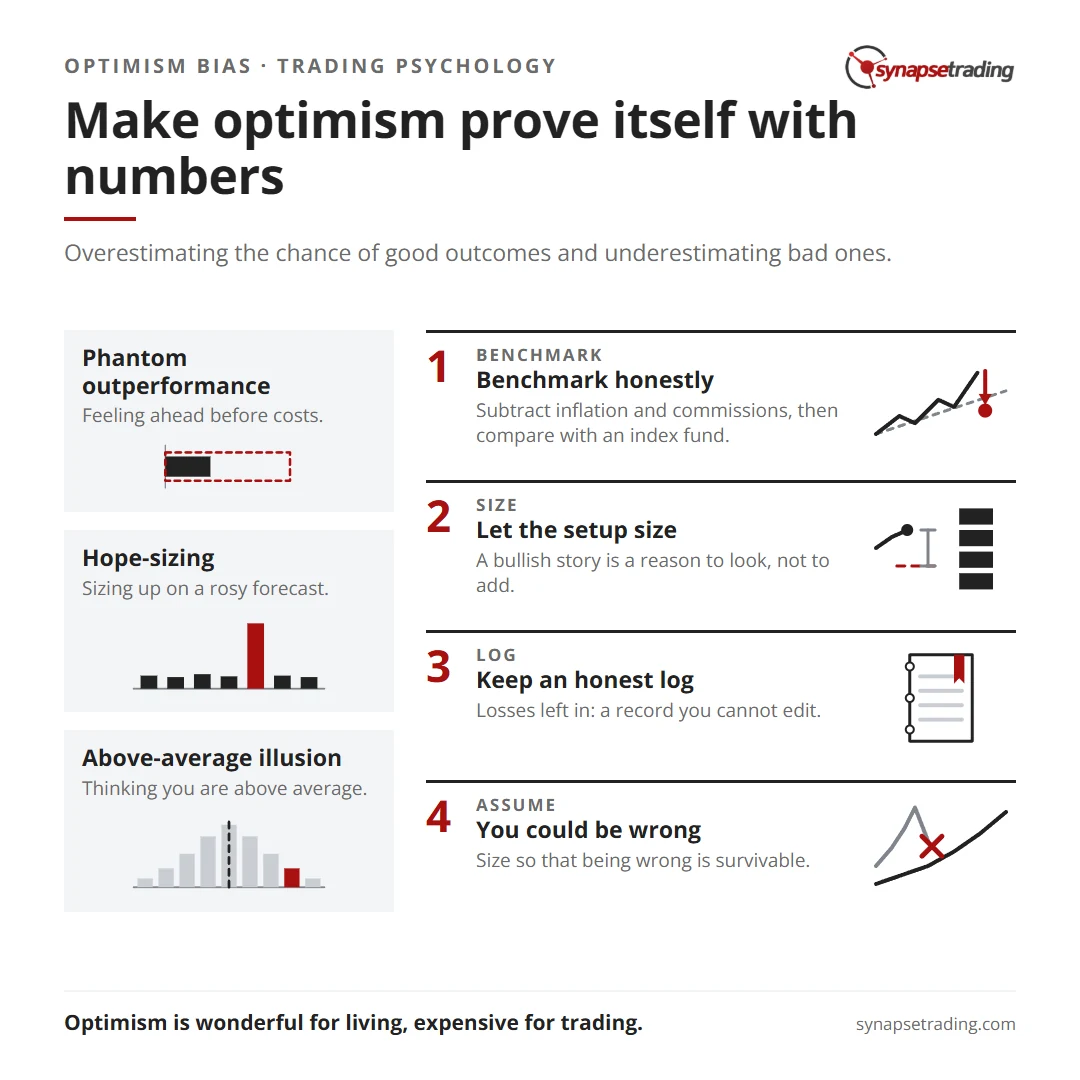
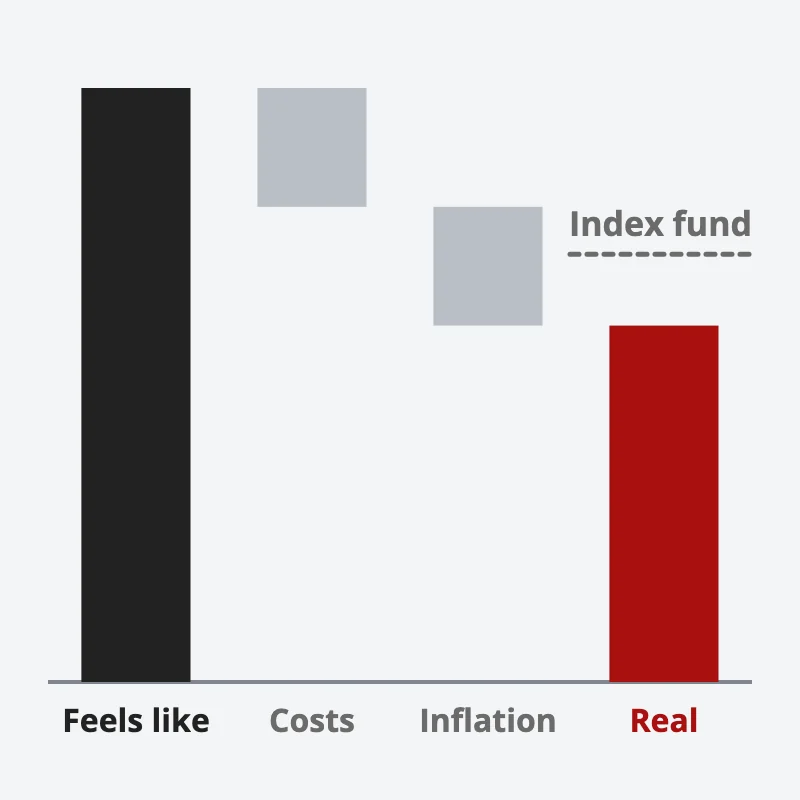
| Phantom outperformance | You feel like you are beating the market | You have not subtracted inflation, commissions, and the return a plain index fund would have given you. The “edge” may be negative. |
| Hope-sizing | A rosy forecast or earnings number gets you excited | You take a larger or riskier position than your rules allow, on hope rather than on the setup |
| The above-average illusion | You assume you are an above-average trader | You generalise general optimism into trading skill, which feeds straight into overconfidence bias and the size of the next mistake |
The first one is sneaky because it feels like success. You see a green number and stop there. You do not run the comparison that matters: against an index fund, after costs, after inflation, am I actually ahead? Often the honest answer is no, and optimism is what stops you from asking.
The second is the one that blows up accounts. Optimism reads a bullish forecast as a reason to push more chips in. Hope is not a position-sizing model.
What is the biggest danger of optimism bias?
The biggest danger is not any single trade. It is what optimism does to your self-assessment.
Optimism bias can make you believe you are an above-average trader simply because you are an optimistic person by nature, or that you are above average in other parts of life too, driving, social skills, judgement. That belief then feeds overconfidence bias (trading too big, too often, and too sure), and overconfidence is where real damage compounds.
How do you trade against optimism bias?
You do not fix optimism by trying to feel less hopeful. You fix it with structure that makes optimism earn its keep.
- Benchmark honestly. Before you call yourself a good trader, subtract inflation and commissions, then compare against what a simple index fund would have returned over the same period. If you are not clearly ahead of that, the optimism is doing the talking.
- Let the setup size the trade, not the forecast. A bullish story is a reason to look, not a reason to add. Decide your size from the rules before the hope shows up.
- Keep a public, honest log. Losses left in. Nothing deflates the above-average illusion faster than a record you cannot edit after the fact. (Mine is public for exactly this reason.)
- Assume you could be wrong on every trade. Size so that being wrong is survivable, not just so that being right is profitable.
Where the human edge comes in
A model can flag a setup and a calculator can size a trade. Neither can notice that you are talking yourself into a position because you are in a good mood, or that your “edge” disappears once you subtract the costs you would rather not look at. That noticing, catching your own optimism before it spends your money, is psychology, and psychology is one of the Five Edges an algorithm cannot trade for you. The bias is human. The discipline to price it in has to be human too.
As Robin Williams put it, “Comedy is acting out optimism.” Optimism is wonderful for living. It is expensive for trading, unless you make it show its working.
FAQ
What is optimism bias in trading?
Optimism bias is the tendency to overestimate good outcomes and underestimate bad ones. In trading it shows up as assuming losses happen to “other people”, overrating your own skill, and reading rosy forecasts as a reason to take bigger risks.
How is optimism bias different from overconfidence bias?
Optimism bias is about outcomes (you expect things to go well). Overconfidence bias is about ability (you overrate your own skill and judgement). Optimism often feeds overconfidence: feeling generally optimistic convinces a trader they are an above-average trader, which then leads to oversized, over-frequent trades.
Why do most traders think they are above average?
Because of the “above-average effect”, a well-documented illusion where most people rate themselves above the median on positive traits, which is statistically impossible for most of a group. Traders apply the same flattering self-rating to their trading skill.
How do I reduce optimism bias in my own trading?
Benchmark your returns honestly against an index fund after inflation and commissions, keep a complete and unedited trade log (losses included), size positions from your rules rather than from a bullish story, and assume any single trade could be wrong.
Optimism bias rarely travels alone. If you want the wider map of how your own mind works against you at the desk, read the pillar: A Trader’s Guide to Behavioral Finance and Trading Psychology.
Want to take the emotion out of the decision? Grab the free 15-Minute Swing Trading Starter Kit. It is the exact rules-based routine I use to scan once a day and trade any market in 15 minutes, so the setup sizes the trade, not the mood.
About the author. Spencer Li is The 15-Minute Trader and the founder of Synapse Trading. He is a Certified Financial Technician (CFTe) with 15+ years of trading, run from 70+ countries. He holds a B.Acc and B.BM from SMU. Every trade he takes is public, dated, losses left in. He teaches rules-based swing trading in 15 minutes a day, one system for any market.
Education, not financial advice. Synapse Trading is not licensed by MAS to advise on investment products. Trading carries risk of loss; past performance is not indicative of future results.
Related
A Trader’s Guide to Behavioral Finance and Trading Psychology · Overconfidence bias in trading · Confirmation bias in trading · Loss aversion and the disposition effect
Want the daily routine? Enter your email for the free 15-Minute Swing Trader's Checklist.
Free 5-page PDF, then occasional trading emails. Education only, not financial advice. Unsubscribe anytime. Kit stores your email in the US: see our privacy policy.
Want to learn the full method? The Trading Mastery Program teaches the 4 strategies I have traded since 2011. It suits beginners and experienced traders.
Rather follow the trades as they happen? Daily Trading Signals is our Telegram channel: my trade ideas with entry, stop and exit, and every trade is public.
Questions about this post? Ask in the free Telegram channel →
Educational content only, not personalised financial advice. Trading carries risk, including loss of capital. Past performance is not indicative of future results. Synapse Trading is not licensed or regulated by MAS.

