

Hindsight Bias – When People Say “I Knew It All Along!”
Join our Telegram channel for more market analysis & trading tips: t.me/synapsetrading
Table of Contents
Hindsight Bias in Trading: Why “I Knew It All Along” Is Costing You Money
Last updated: 3 July 2026 · By Spencer Li, CFTe
Hindsight bias is the tendency to believe, after an event has happened, that you saw it coming all along, even when you did not. In trading, it quietly rewrites your memory: after a win you remember being certain, and after a loss you forget you ever placed the trade. Both versions are false, and both stop you from learning. The bias matters because it makes you overrate your own foresight, underestimate how uncertain the market actually was, and take bigger risks on the back of skill you do not really have. The fix is not willpower. It is a written record. Keep a trading journal that logs your reasoning and your emotions before the outcome is known, so your past self can correct your present memory. That single habit is the most reliable defense against the “I knew it all along” trap.
Here is how the bias works, why it is so damaging for traders specifically, and exactly how to beat it.
What is hindsight bias?
Hindsight bias is the impulse that insists: “I knew it all along.” Once an event has happened, people affected by it perceive that the event was predictable, even when it was not.
Why does the mind do this? Because the outcome that actually happened is easy to picture, while the infinite array of outcomes that could have happened but did not is almost impossible to hold in your head. The real result crowds out all the alternatives. So people overestimate the accuracy of their own predictions.
To be clear, this does not mean people cannot make accurate predictions. It means a person may simply believe they made an accurate prediction, after the fact, when they did not.
Why hindsight bias is dangerous for traders
The damage runs deeper than a bruised ego. A trader subject to hindsight bias assumes the outcome they observed was the only outcome that was ever possible. So they underestimate the uncertainty that existed before the event, and they underrate all the results that could have materialized but did not.
That distortion poisons your future forecasting in two specific ways.
After a winning trade, hindsight-biased traders rewrite their own memories to make the win look predictable, as if they always knew. Over time this inspires excessive risk-taking, because they come to believe they have superior predictive ability. They size up. They skip the checklist. They stop respecting the role of luck.
After a losing trade, the same traders “rewrite history” the other way. They block out the memory of the bad call to ease the embarrassment. This is a form of self-deception, close cousin to cognitive dissonance (the discomfort of holding two conflicting beliefs at once). It prevents them from ever learning from the mistake, because in their memory the mistake never quite happened.
There is a compounding problem here too. Hindsight bias is linked to anchoring (the tendency to lock onto an early reference point and judge everything against it). Because anchoring makes it hard to reconstruct an unbiased state of mind, and hindsight bias makes you exaggerate the quality of your past foresight, the two reinforce each other. You end up confidently wrong, and convinced you were right all along.
The single biggest cost: hindsight bias prevents you from learning from your mistakes. And in trading, learning from mistakes is the entire game.
Win or loss: the two faces of the bias
The bias does not feel the same after a win as it does after a loss, but it does the same damage either way. Here is the pattern, side by side.
| After a winning trade | After a losing trade | |
|---|---|---|
| The memory distortion | “I knew that was going to work” | “I never really committed to that one” |
| What gets rewritten | The uncertainty you felt before entry | The fact that you took the trade at all |
| The hidden bias at work | Overconfidence in your foresight | Self-deception, cognitive-dissonance relief |
| The downstream cost | Excessive risk-taking, you size up on false skill | No learning, you repeat the same mistake |
| What the journal would show | You were far less certain than you remember | You did place it, here is exactly why |
The journal column is the point. In both rows, a written record taken before the outcome corrects a memory that has since been edited.
How do you overcome hindsight bias in trading?
As with most biases, the first step is unglamorous: understand and admit that you are susceptible. You are not the exception. Nobody is.
The practical fix is a trading journal. Use it to record, for every trade:
- Your analysis and the actual reasons you took the trade.
- Your thought process at the moment of entry.
- The emotional swings that went with the whole trade, from entry to exit.
The key is the timing. You write it down before you know how the trade ends. That way, when you look back after the event, the journal holds your real, unedited state of mind. It will not let you pretend you were certain when you were anxious, or pretend you never took the trade you would rather forget. It prevents the disillusioned, after-the-fact thinking that the bias depends on.
The behavioral-finance writer James Montier put it as plainly as anyone:
“You didn’t know it all along; you just think you did.”
That sentence is worth pinning above your desk.
Where the human edge comes in
A trading bot will never suffer hindsight bias. It does not have a memory to flatter or an ego to protect. But it also will not catch yours. No algorithm can tell you that the confident story you are telling about last week’s winner is a fiction your brain wrote after the fact. That correction takes honest self-review, a written record, and the discipline to read it back when it stings. The pattern recognition is getting cheap. The self-honesty is not, and it remains the part of the edge no machine can trade for you.
FAQ
What is hindsight bias in simple terms?
Hindsight bias is the tendency to believe an event was predictable after it has already happened, even when there was no way to know the outcome in advance. It is the “I knew it all along” feeling, and it usually is not true.
How does hindsight bias affect traders specifically?
It makes traders rewrite their memories. After wins they remember being certain, which breeds overconfidence and excessive risk-taking. After losses they block out the bad trade, which prevents them from learning. Both distortions damage future decision-making.
What is the difference between hindsight bias and anchoring?
Hindsight bias makes you overrate your past foresight after an outcome is known. Anchoring makes you fix on an early reference point and judge everything against it. They are linked, because anchoring makes it harder to recover an unbiased view, which feeds the hindsight distortion.
How do I overcome hindsight bias when trading?
Keep a trading journal. Record your analysis, your reasoning, and your emotions for every trade before you know the result. Reading it back later corrects the memory your brain has since edited, so you can actually learn from each trade.
Is hindsight bias the same as overconfidence?
No, but they feed each other. Hindsight bias makes you think you predicted past events accurately. That false track record then fuels overconfidence in your future predictions, which is when the position sizing gets dangerous.
So, which version of the bias do you fall into more often, rewriting your wins or burying your losses? Be honest with yourself, then go check your journal.
If you want to go deeper on the mental traps that quietly drain trading accounts, read the pillar: The Complete Guide to Investing and Trading Psychology.
Want a system that takes the emotion out of the decision? Grab the free 15-Minute Swing Trading Starter Kit. It’s the exact once-a-day routine I use to scan, journal, and trade any market in 15 minutes, with the rules written down so my future self cannot rewrite them.
About the author. Spencer Li is the founder of Synapse Trading and a Certified Financial Technician (CFTe) with 15+ years of trading across stocks, forex, crypto, commodities, and bonds. His trade log is public: every trade since April 2024, dated, losses left in. He has taught a 15-minute daily trading routine since 2014, one system for any market.
Education, not financial advice. Synapse Trading is not licensed by MAS to advise on investment products. Trading carries risk of loss; past performance is not indicative of future results.
Related
The Complete Guide to Investing and Trading Psychology (pillar) · Anchoring bias in trading · How to keep a trading journal · Cognitive dissonance in trading
Want the daily routine? Enter your email for the free 15-Minute Swing Trader's Checklist.
Free, 5 pages, PDF. You get the checklist, then my occasional trading emails. Education only, not financial advice. Unsubscribe anytime.
Where your details go: Kit, our email provider, stores your email address in the United States. Our contract with Kit lets it use your address only to send our emails, and requires Kit to keep it secure. The United States has no national privacy law like Singapore's, so that contract is the main protection. More in our privacy policy.
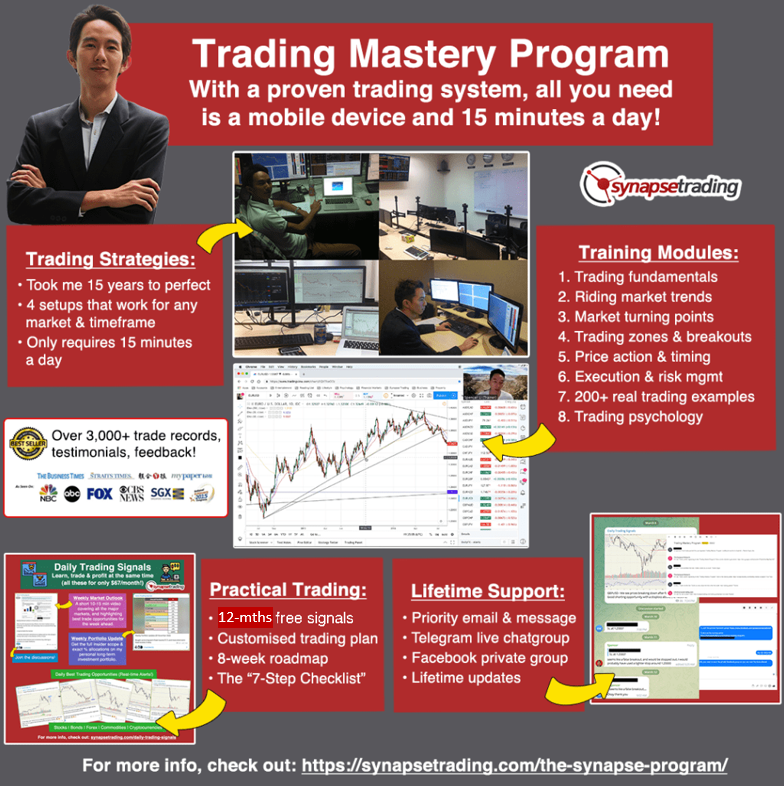 Our flagship mentoring program is suitable for both beginners and advanced traders, covering the 4 strategies which I used over the past 15 years to build up my 7-figure personal trading portfolio.
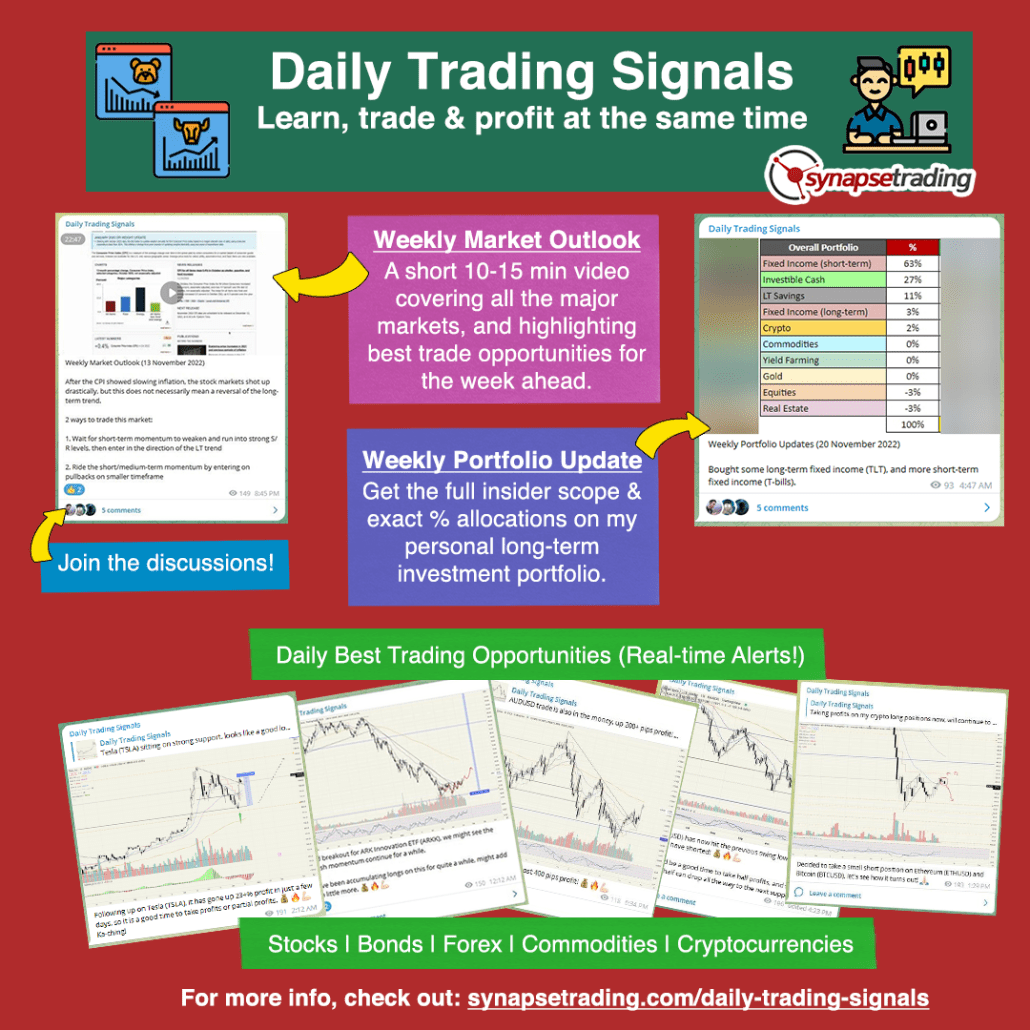 If you're looking for the best trading opportunities every day across various markets, and don't want to spend hours doing the research yourself, check out our private Telegram channel!


Leave a Reply
Want to join the discussion?Feel free to contribute!