

Representativeness Bias in Trading: Why a Small Sample Fools You, and How to Judge a System Properly
Want the daily routine? Get the free 15-Minute Swing Trader’s Checklist. Get it free →
By Spencer Li, CFTe · Last updated: 26 October 2026
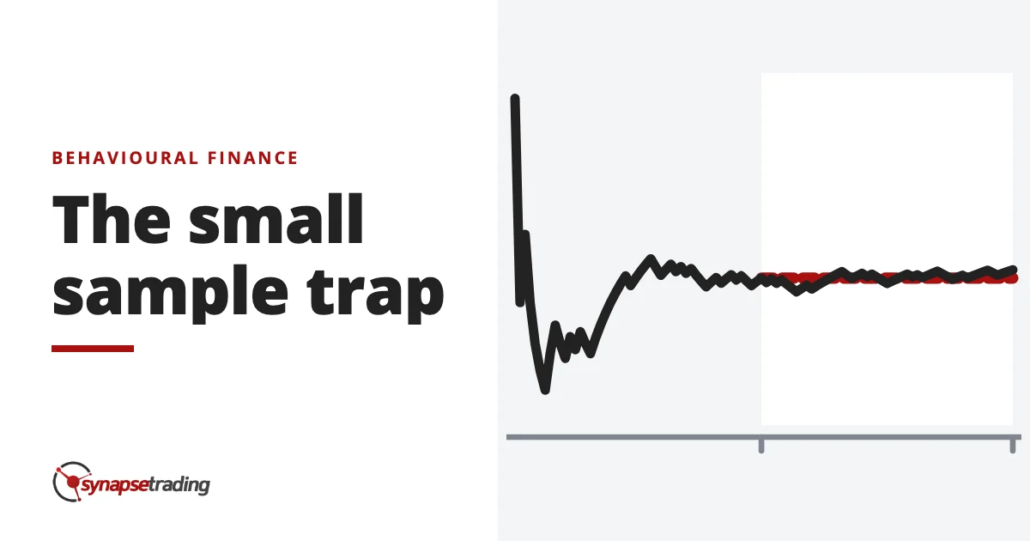
Representativeness bias is the habit of judging how likely something is by how much it looks like a pattern you already know, instead of by the actual numbers. In trading, the version that costs the most is sample-size neglect, also called the law of small numbers, where a handful of results gets treated as if it describes the whole picture. Three good stock tips make a broker look like a genius, and a short backtest makes a system look like it works. The fix is easy to say and dull to do: judge any system or any person over a large sample, and count the misses as carefully as the hits.
What is representativeness bias?
When I first wrote about this bias on this blog in July 2011, I started with the way people sort the world into boxes. We classify objects and ideas so that life makes sense, and when something new turns up that fits none of our boxes, we push it into the closest one anyway, on a rough best fit.
That instinct is fine for choosing a restaurant. It is a problem in markets, because a best fit feels like a probability without being one.

There are two main types of representativeness bias.
| Type | What happens | Where it shows up in trading |
|---|---|---|
| Base-rate neglect | You ignore how common something is, because the story is vivid | A chart that looks like the start of a huge run, however rarely that shape becomes one |
| Sample-size neglect | You treat a small sample as if it represents the whole | A short backtest, a hot streak, or a broker’s three good picks |
In 2011 I focused on the second type, because it turns up far more often in trading, and it still does.
What did Tversky and Kahneman find in 1971?
The name comes from a short paper by Amos Tversky and Daniel Kahneman, “Belief in the Law of Small Numbers”, published in Psychological Bulletin in 1971. Their test subjects were rather surprising. They were professional psychologists, handed a questionnaire at meetings of the Mathematical Psychology Group and the American Psychological Association.
One question asked them to imagine a significant result from an experiment on 20 subjects. If you ran 10 more subjects, how likely was that smaller group to show a significant result on its own? The median answer was .85, while the authors put a much more reasonable estimate at about .48. Only 9 of their 84 respondents gave an answer between .40 and .60.
So these were trained scientists, and most of them still expected a small sample to look just like the big one. The authors described the belief as a law of small numbers, “which asserts that the law of large numbers applies to small numbers as well.” They also noted, drily, that “acquaintance with formal logic and with probability theory does not extinguish erroneous intuitions.”
The same paper takes a swipe at the gambler’s fallacy, the belief that a run of heads makes tails due. They put that one with some wit: “Even the fairest of coins, however, given the limitations of its memory and moral sense, cannot be as fair as the gambler expects it to be.”
How does a short backtest fool you?
In the paper, Tversky and Kahneman imagine a psychologist testing which of two toys babies prefer. Four of the first five babies pick the same toy, and the researcher starts to feel quite confident. Yet a quick computation shows that the chance of a result that lopsided, with no real preference at all, “is as high as 3/8.”
Now swap the babies for trades. Suppose you test a system that has no edge at all, so every trade is a coin flip. What are the odds that at least 4 of your first 5 trades are winners?
There are 32 possible ways 5 trades can land.
5 of them have exactly 4 winners, and 1 has all 5.
6 out of 32 is about 19%, or roughly 1 in 5.
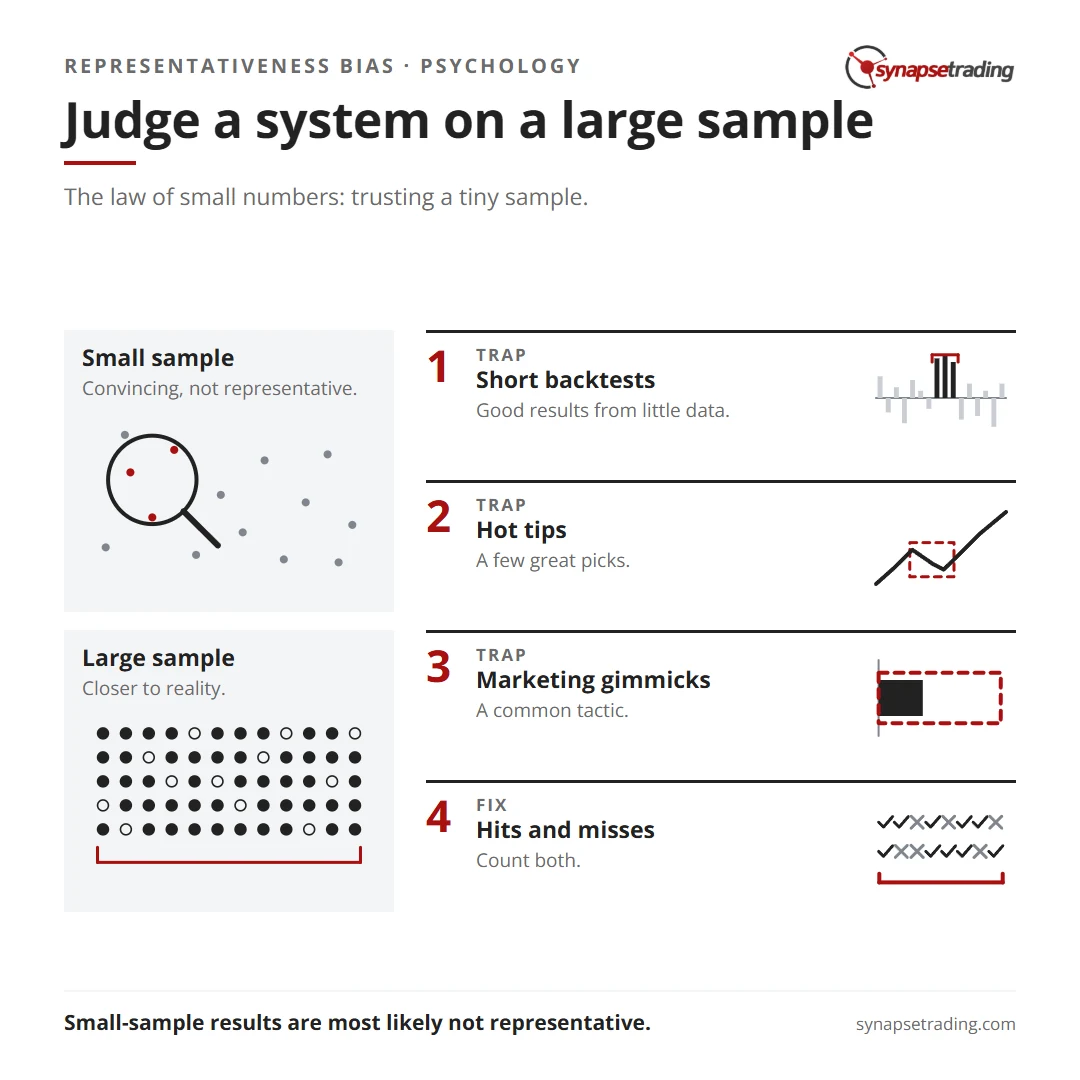
So if 5 people each test a useless system over 5 trades, one of them will probably see 4 or 5 winners and decide they have found something. That person is also the one most likely to tell everyone about it. In 2011 I called this “a common tactic applied in marketing gimmicks”, and the screenshots of a hot week on social media have only made it cheaper.
The paper puts the believer’s mistake in one line. He “has undue confidence in early trends,” and the early trend in trading is the first few weeks of a new system, which happen to be when you feel most excited about it. If you want the full process, I wrote a guide on how to backtest a trading strategy properly.
Testing a system this way does not need hours at the screen, and my free 15-minute swing trader checklist is the daily routine I use myself.
Why is a hot tip so convincing?
Back in 2011, I used the example of someone saying, “my broker gave me three great stock picks over the past month, and each stock is up by over 10%.” It is enough to convince most people that the broker is a genius.
Run the same coin arithmetic on it. If each pick is really a coin flip, three winners in a row comes up 1 time in 8. Out of a room of 8 brokers giving random tips, you would expect one of them to have a perfect month, and that broker is the one whose clients tell their friends.
What makes the tip so persuasive is that we immediately invent a reason for it. Tversky and Kahneman noticed this in their psychologists too. The believer, they wrote, “rarely attributes a deviation of results from expectations to sampling variability, because he finds a causal ‘explanation’ for any discrepancy.” In markets the explanation writes itself, because the broker read the sector well, or has a contact, or simply has a feel for it. The lucky streak gets a story, and the story gets your money.
How many trades are enough to judge a system?
My own rule of thumb is to give a system 100 to 200 trades before judging it. On 20 October 2026, a trader on Reddit’s r/Daytrading pushed back on exactly this kind of rule: “The ‘backtest 100 trades’ rule is off by 20x for some strategies.”
They are right, and I checked their arithmetic to be sure. The number of trades you need depends on how big your edge is against how spread out your results are. Their formula puts a system that wins 40% of the time, with winners twice the size of its losers, at about 216 trades. A scalp that wins 52% of the time at one to one needs about 2,500, because its edge per trade is tiny.
So the concession is a real one. When I first wrote this post in 2011 it gave no number at all. The 100 to 200 I use now is a rough floor for a swing system with a decent reward-to-risk, rather than a law. A thinner edge needs far more trades, and if you tested six systems and kept the best one, you need more again. I go through the full arithmetic in my post on the law of large numbers in trading.
But the usual direction of the mistake is the same in both places. In the 1971 paper, the psychologists’ median advice for a repeat study was 20 subjects, and the authors showed that gave the student only slightly better than even odds of a significant result. The instinct was for a sample that was too small, and in trading it nearly always is too.
What is the fix?
My answer in 2011 was simple. If you want to evaluate a system or a person’s stock-picking skill, do it “over a large sample size, and count both the hits and misses.” I still think that is the whole fix, and the rest is detail.
Tversky and Kahneman reached a similar place from the research side. They doubted the bias could be fully unlearned, so they recommended a habit instead: “The obvious precaution is computation.” Before you trust a result, work out how likely it would be by pure luck, which is exactly what the coin arithmetic above does.
In practice, that comes down to three habits.
- Ask for the size of the sample before the result. Five trades, five weeks or three tips tell you very little, however impressive they look.
- Ask for the misses. A track record with the losses left out is marketing. My own trade log is public for this reason, every trade dated, losses left in.
- Be most suspicious of the cleanest results. A short, recent, flawless run is the easiest thing in the world for luck to produce.
Sample size is only one of the traps in your own head, and it sits in the Mindset part of the 3 Ms of trading. For the rest of them, my guide to trading psychology and my free trading guides cover them one at a time.
Judging a system fairly is a habit, and the free 15-minute swing trader checklist is the routine I run every day.
FAQ
What is representativeness bias in simple terms?
It is judging how likely something is by how much it resembles a familiar pattern, instead of by the real numbers. In trading it makes a short run of wins feel like proof of a lasting edge.
What is the difference between base-rate neglect and sample-size neglect?
Base-rate neglect means ignoring how common an outcome is to begin with, while sample-size neglect means treating a small sample as if it represents the whole. Traders run into the second one far more often.
What is the law of small numbers?
It is the mistaken belief that a small sample will look just like the population it came from. Tversky and Kahneman named it in a 1971 paper, as a play on the real law of large numbers.
How many trades do I need before I trust a backtest?
It depends on the size of your edge. As a rough floor, I give a swing system 100 to 200 trades, and a system with a thin edge per trade can need thousands.
How do I avoid falling for a hot stock tip?
Ask how many tips there were in total, and how many of them lost. Three winners in a row happen by luck about 1 time in 8.
Do experts fall for representativeness bias too?
Yes. The 1971 study asked professional psychologists, and most of them overestimated how reliably a small sample would repeat a result.
What is the smallest sample you have ever trusted, a backtest, a tip or a hot week, and how did it turn out? Let me know in the comments.
And if you want a routine that keeps you honest about your own results in 15 minutes a day, grab the free 15-minute swing trader checklist.
About the author. Spencer Li is The 15-Minute Trader and the founder of Synapse Trading. He is a Certified Financial Technician (CFTe) with 15+ years of trading, run from 70+ countries. He holds a B.Acc and B.BM from SMU. Every trade he takes is public, dated, losses left in. He teaches rules-based swing trading in 15 minutes a day, one system for any market.
Education, not financial advice. Synapse Trading is not licensed by MAS to advise on investment products. Trading carries risk of loss, and past performance is not indicative of future results.
Want the daily routine? Enter your email for the free 15-Minute Swing Trader's Checklist.
Free 5-page PDF, then occasional trading emails. Education only, not financial advice. Unsubscribe anytime. Kit stores your email in the US: see our privacy policy.
Want to learn the full method? The Trading Mastery Program teaches the 4 strategies I have traded since 2011. It suits beginners and experienced traders.
Rather follow the trades as they happen? Daily Trading Signals is our Telegram channel: my trade ideas with entry, stop and exit, and every trade is public.
Questions about this post? Ask in the free Telegram channel →
Educational content only, not personalised financial advice. Trading carries risk, including loss of capital. Past performance is not indicative of future results. Synapse Trading is not licensed or regulated by MAS.


Trackbacks & Pingbacks
[…] is why a hot streak proves very little. Our post on representativeness bias covers why the brain sees a pattern in 10 trades […]
[…] pull to judge early is very human. Our minds read patterns into short runs, which is the representativeness bias, the danger of a small sample size. Knowing it exists does not switch it off, so the rule has to be written down before the streak […]
[…] get backwards, so it is worth being precise. Conservatism bias can look like it conflicts with representativeness bias, but the two are opposite errors of […]
Comments are closed.