

Cognitive Dissonance Bias – This Can’t Be True!
Join our Telegram channel for more market analysis & trading tips: t.me/synapsetrading
Table of Contents
Cognitive Dissonance in Trading: Why You Refuse to Cut a Losing Trade
Last updated: 3 July 2026 · By Spencer Li, CFTe
Cognitive dissonance is the mental discomfort you feel when new information contradicts a position you already hold, and in trading it is the bias that keeps you in a losing trade long after you should have cut it. You buy a stock because you think the trend is up. The chart then prints evidence that the trend is down. Instead of acting on the new evidence, your mind goes to work defending the old decision, because admitting the trade was wrong feels worse than holding the loss. That is cognitive dissonance. It shows up in two forms: you start noticing only the data that supports your trade (selective perception), and you keep making choices that justify staying in it (selective decision making). The fix is not complicated, but it is uncomfortable: the moment you sense the discomfort, name it, look at the trade honestly, and if it is broken, close it. The discomfort is the signal, not the enemy.
Here is what the bias is, why it makes you hold losers, and the exact habit that beats it.
What is cognitive dissonance?
In psychology, a cognition is an attitude, an emotion, a belief, or a value. Cognitive dissonance is the state of imbalance that happens when two cognitions collide. When newly acquired information conflicts with what you already believe, you feel mental discomfort, and the term covers the whole scramble that follows as you try to harmonize the two and make the discomfort go away.
People go to great lengths to convince themselves the decision they already made was the right one, precisely to avoid the discomfort of having been wrong. Psychologists conclude that people perform far-reaching rationalizations to synchronize their cognitions and keep their psychological stability. In plain terms: it is easier to bend the story than to admit the mistake, so that is what the mind does by default.
How cognitive dissonance shows up in a trade
Take a simple example. You go long a stock because you read the trend as up. That is your cognition. Then a new signal appears that favours a downtrend. Now you have two cognitions that cannot both be true, and that imbalance is uncomfortable. Cognitive dissonance kicks in to relieve the discomfort, usually by whispering that maybe the new signal does not really count, or maybe the trend is just pausing, or maybe you were right all along.
You did not change your mind because the chart changed. You changed your reading of the chart to protect the position you already had. That is the trap.
The two kinds of cognitive dissonance bias
The bias splits into two sub-types, and it helps to be able to name which one is running on you in the moment.
| Sub-type | What it does | What it sounds like in your head | The damage |
|---|---|---|---|
| Selective perception | You only register information that affirms the course you already chose | “See, this one indicator still agrees with me.” | You stop reading the market objectively and miss the signals that disagree |
| Selective decision making | You rationalize new actions to justify sticking with the original course | “I’ll just give it a bit more room, the stop was too tight anyway.” | You resist cutting losses and invent excuses rather than admit the entry was wrong |
Selective perception filters what you see. Selective decision making bends what you do. Most blown trades use both at once: you stop noticing the evidence against you, and you keep making little decisions that keep you in.
Why this is dangerous for traders
The danger is not subtle. A trader who is not bias-free cannot read the market objectively and cannot adapt fast enough when conditions change. The market does not care which side you took, but cognitive dissonance makes you care, and caring about being right is how you stop seeing what is actually happening.
The most expensive symptom is the resistance to cutting losses. Selective decision making is the machine that manufactures the excuses: the stop was unfair, the news was a one-off, it will come back tomorrow. Each excuse is the mind protecting itself from the discomfort of admitting the initial entry was wrong. The position keeps bleeding while the story keeps improving.
What is the best way to overcome cognitive dissonance in trading?
The key is to immediately admit that a faulty cognition has occurred, address the feeling of unease directly, and take rational action. If you think you have made a bad trading decision, analyse the decision. If the fears prove correct, confront the problem head-on and fix it. Do not negotiate with the discomfort. Use it.
Personally, I treat the unease as a tap on the shoulder rather than something to suppress. The moment a trade starts to feel uncomfortable, that feeling is usually a new cognition arriving before my conscious mind has caught up. The discipline is to stop, look, and ask one question: if I were flat right now, would I put this trade on at this price? If the answer is no, the only reason I am still in it is to avoid admitting I was wrong. That is not a reason to hold.
A few habits make this easier in practice:
- Decide your exit before you enter, in writing. A pre-committed stop is a decision your unbiased self made for your biased self.
- Treat being wrong as data, not as a verdict on you. A wrong trade is information about the market, nothing more. The faster you accept it, the faster you adapt.
- When you catch yourself building an excuse, name it out loud as selective decision making. Naming the bias breaks its grip.
Where the human edge comes in
A screener will flag a broken setup the instant the chart turns against you. It will not feel the discomfort of being wrong, which means it will also not rationalize, hold, and hope. That part is yours. The edge is not in seeing the signal that contradicts your trade, software can do that. The edge is in acting on it before your mind has talked you out of it. That is psychology, the third of the Five Edges, and it is the one no tool can trade for you.
There is a 400-year-old version of this same advice. Shakespeare put it in the mouth of Polonius, advising his son Laertes in Hamlet:
This above all: to thine own self be true,
And it must follow, as the night the day,
Thou canst not then be false to any man.
In trading, being true to yourself means refusing to lie to yourself about a position. The market will tell you the truth. Your job is to listen before the bias edits it.
FAQ
What is cognitive dissonance in trading?
Cognitive dissonance in trading is the mental discomfort that arises when new market information contradicts a position you already hold, and the rationalizing you do to relieve that discomfort. It most often shows up as refusing to cut a losing trade because admitting the entry was wrong feels worse than holding the loss.
What are the two types of cognitive dissonance bias?
The two types are selective perception, where you only register information that confirms the course you already chose, and selective decision making, where you rationalize new actions to justify sticking with your original decision.
Why does cognitive dissonance make traders hold losing trades?
Because cutting the trade means admitting the original decision was wrong, which triggers discomfort. Selective decision making relieves that discomfort by generating excuses (the stop was too tight, the news was a fluke, it will recover), so the trader holds instead of acting on the evidence.
How do I overcome cognitive dissonance when trading?
Admit the faulty cognition the moment you notice the discomfort, analyse the trade honestly, and act on the conclusion. A practical test: if you were flat right now, would you take this trade at this price? If not, the only reason you are still in it is to avoid being wrong, and that is not a reason to hold.
Is cognitive dissonance the same as confirmation bias?
They are closely related but not identical. Confirmation bias is the tendency to seek out information that supports your view. Cognitive dissonance is the discomfort that drives that behaviour once contradictory information shows up, and selective perception is the part of it that overlaps most with confirmation bias.
So here is the honest question to sit with. The next time a trade turns against you and your mind starts building the case for holding, will you notice that you are doing it?
If you want the full set of biases and the routine that keeps them from running your account, read the pillar: The Trader’s Guide to Trading Psychology and Behavioral Finance.
Want the system that takes the emotion out of the exit? Grab the free 15-Minute Swing Trading Starter Kit. It’s the exact once-a-day routine I use to trade any market in 15 minutes, with the rules decided before the market can make me feel anything.
About the author. Spencer Li is the founder of Synapse Trading and a Certified Financial Technician (CFTe) with 15+ years of trading across stocks, forex, crypto, commodities, and bonds. His trade log is public: every trade since April 2024, dated, losses left in. He has taught a 15-minute daily trading routine since 2014, one system for any market.
Education, not financial advice. Synapse Trading is not licensed by MAS to advise on investment products. Trading carries risk of loss; past performance is not indicative of future results.
Related
The Trader’s Guide to Trading Psychology (pillar) · Confirmation bias in trading · Loss aversion and the disposition effect · How to cut losses and let winners run
Want the daily routine? Enter your email for the free 15-Minute Swing Trader's Checklist.
Free, 5 pages, PDF. You get the checklist, then my occasional trading emails. Education only, not financial advice. Unsubscribe anytime.
Where your details go: Kit, our email provider, stores your email address in the United States. Our contract with Kit lets it use your address only to send our emails, and requires Kit to keep it secure. The United States has no national privacy law like Singapore's, so that contract is the main protection. More in our privacy policy.
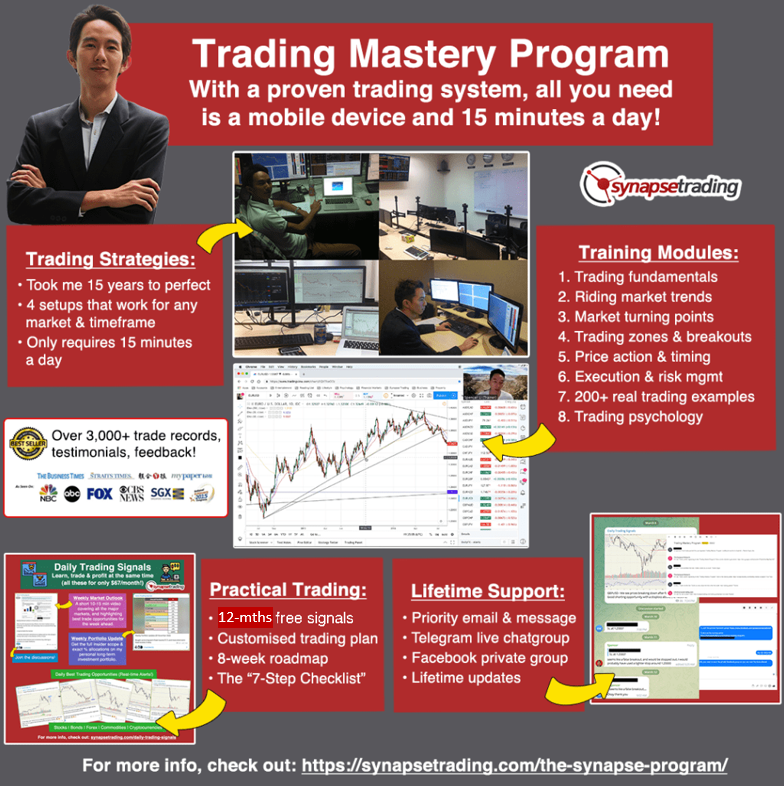 Our flagship mentoring program is suitable for both beginners and advanced traders, covering the 4 strategies which I used over the past 15 years to build up my 7-figure personal trading portfolio.
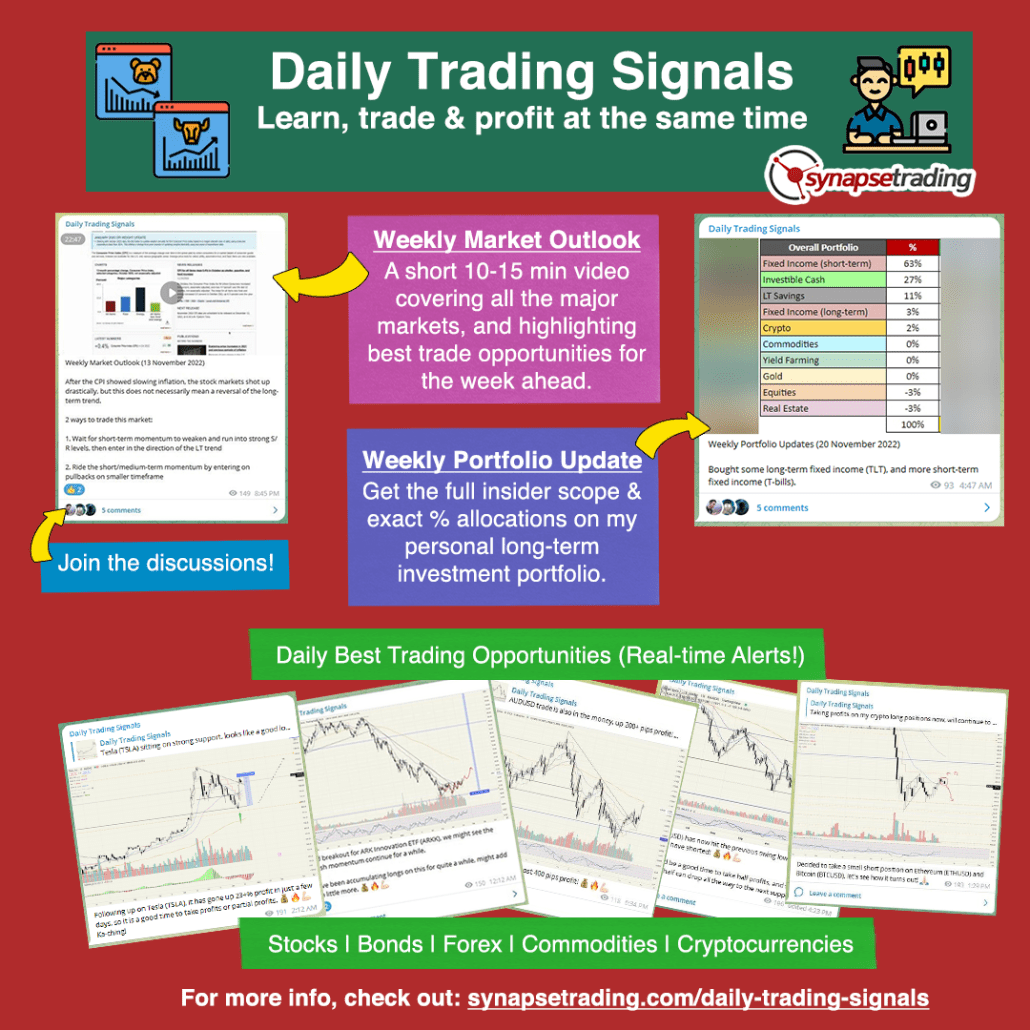 If you're looking for the best trading opportunities every day across various markets, and don't want to spend hours doing the research yourself, check out our private Telegram channel!

Following you for sometimes now, wise writings .keep it up!!
Thanks!