

How to Develop Patience & Discipline in Trading
Join our Telegram channel for more market analysis & trading tips: t.me/synapsetrading
Table of Contents
Patience and Discipline in Trading: Why Waiting Is the Edge
Last updated: 3 July 2026 · By Spencer Li, CFTe
Patience and discipline are what let you trade good timing instead of guessing at it. Trading is 99% waiting and researching, and 1% executing, so the discipline to sit still through the 99% is the whole skill. Most losing traders have it backwards: they cannot stand inaction, so they keep forcing trades that are not the best opportunities, and they end up with a lot of activity and very little profit. The fix is to trade like a sniper, not a machine-gunner. Do the planning, stake out the target, and only pull the trigger on an excellent setup. Two rules carry most of the weight. First, do not chase a trade you missed, because chasing forces you off your plan, ruins your entry price, and wrecks your risk management. Second, step away after a string of losses, before impulsive trading or revenge trading turns one bad day into a spiral.
Here is how patience actually protects your money, and the two emotional traps that quietly undo it.
Why is patience so important in trading?
In trading there is a time for action and a time for inaction. Most people cannot stand the inaction. Maybe they think trading is supposed to be full of action, so they keep hunting for opportunities to do something, even when the opportunities in front of them are mediocre.
Let’s be honest. Good opportunities are rare. The best opportunities are rarer still.
That is the line that reframes everything: trading is 99% waiting (and researching) and 1% action (executing the trade). If you are doing the opposite, throwing in trades all day, you get plenty of activity and very little profitability.
So approach trading like a sniper rather than someone spraying a machine gun. Do all the planning and stake out the target. Wait for the right timing. Only pull the trigger when you have an excellent opportunity. Make every shot count.
Sniper vs machine-gunner: two ways to trade
| Sniper (disciplined) | Machine-gunner (impulsive) | |
|---|---|---|
| Mindset | Inaction is part of the job | Inaction feels like failure |
| Trade frequency | Few, only the best setups | Many, takes most charts as “opportunities” |
| Plan | Sticks to defined setups | Improvises, uses random chart analysis to justify the trade |
| Entry | Waits for the planned price | Chases whatever just moved |
| Typical result | High activity-to-profit efficiency | Lots of activity, very little profit |
The pattern is the easy part to see. Living on the sniper side of that table, day after day, is the discipline almost nobody trains.
Should you chase a trade you missed?
No. Chasing a missed trade is one of the most common ways disciplined plans fall apart, and it is almost always the wrong move.
Back when I was doing full-time proprietary day-trading, we watched the markets for hours waiting for the best opportunities. Sometimes we would all be eyeing one big, juicy trade that we knew would likely be the trade of the day. It might be an unscheduled news announcement, price taking out a key level (breaking support or resistance), or a pullback to enter a trend. Whatever it was, the event usually happened fast, so the window was tiny. We would wait patiently, watching prices.
Now here is the tragic part. After waiting for hours, you suddenly have to go to the restroom. You rush for a 5-minute toilet break, dash back to your desk, and find that the move you had been waiting for happened while you were gone. The breakout fired, and price is now well above your planned entry.
The big question: will you still take the trade even though it is no longer optimal? Will you chase it?
Many people would. It is a bad idea. Chasing causes you to deviate from your trading plan, and when you take sub-optimal trades, you get sub-optimal results. It is painful, but it is wiser to pass and wait for the next better opportunity.
After all, it is better to miss the boat than to leave on one full of holes.
How does a good entry make risk management easier?
You might be wondering what entry timing has to do with risk management. The link is direct.
If you execute a trade according to your plan, you already have a planned stop-loss (the price at which you exit a losing trade to cap the damage) for that trade. Enter at your planned price, and risk management is easy: you just use the planned stop.
Deviate from the plan, say by chasing a missed trade, and the plan becomes useless. Suppose you planned to go long with a reward-to-risk ratio of 2:1 (you stand to make 2 dollars for every 1 dollar risked), but you entered late and price has already run well above your intended entry. Where do you put your stop?
If you keep the old stop-loss price, the distance from your worse entry is now larger, so you have to cut your lot size to keep the dollar risk the same. And even after you do that, your reward-to-risk ratio is now worse than 2:1, because your reward shrank while your risk stayed put. So is this still a good trade? Usually not. A bad entry quietly degrades every number that made the trade worth taking in the first place.
What are the emotional traps that break discipline?
We all hate losing money, so a losing trade can trigger us emotionally and send us into a downward spiral of bad decisions. Two self-destructive behaviours show up again and again.
| Trap | What triggers it | What it looks like | The fix |
|---|---|---|---|
| Impulsive trading | Greed, hope, and FOMO (fear of missing out) | Seeing every chart as a great opportunity, skipping the plan and research, trading on “gut feel” | Stick strictly to your defined setups; stop using random chart analysis to justify trades |
| Revenge trading | An unlucky trade or a string of losses; bruised ego | Taking more trades to “win it back” or “teach the market a lesson”, with no plan or risk control | Take a break after a string of losses and mentally recalibrate |
Impulsive trading
This usually comes from greed and hope. People are afraid of missing out, so they start seeing every trade as a great opportunity and want to take as many as possible. When this happens, they usually do not bother to follow a trading plan (assuming they have one) or do any research. They just go with gut feel and call it analysis.
To be honest, that is closer to gambling than trading. If you are new and you find yourself spotting an opportunity on every single chart, watch out for impulsive trading. Stick strictly to your setups, and do not use random chart analysis to justify impulsive trades.
Revenge trading
This usually follows a particularly unlucky trade (price almost hits your target, then reverses to take out your stop) or a string of losses. People feel cheated or angry, or their ego takes a hit after a run of “failures”. So they take more trades to win, to take revenge on the market or teach it a lesson.
At that point they have stopped following the plan and stopped managing risk, and trading in that psychological state usually produces even more losses. This is why it is often a good idea to take a break after a string of losses, so you can mentally recalibrate before you sit back down.
Where the human edge comes in
A scanner will flag a clean setup in a second, and an alert will ping you the moment price takes out your level. That part is now free. What no tool will do is tell you to stand aside after the move you wanted has already run, size the trade down when your entry is worse than planned, or close the platform and walk away after three losses in a row before revenge trading starts. The setup is the easy part. The discipline to wait through the 99%, and to not trade when you are tilted, is the judgment that compounds. That is the part worth training, and it is one of the Five Edges no algorithm can trade for you.
FAQ
What does patience mean in trading?
Patience in trading means waiting for the few high-quality setups instead of forcing trades out of boredom or FOMO. Trading is roughly 99% waiting and researching and 1% executing, so most of the skill is sitting still until an excellent opportunity actually appears.
Should I chase a trade I missed?
No. Chasing a missed trade forces you off your plan, gives you a worse entry price than you intended, and degrades your reward-to-risk ratio and stop placement. It is usually wiser to pass and wait for the next better opportunity.
What is the difference between impulsive trading and revenge trading?
Impulsive trading is driven by greed, hope, and FOMO, where you take too many trades on gut feel without a plan. Revenge trading is driven by anger after a loss or losing streak, where you take more trades to “win it back”. Both abandon the trading plan and usually make things worse.
How do I stop revenge trading?
Take a break after a string of losses. Stepping away lets you mentally recalibrate, so you sit back down following your plan and your risk rules instead of trying to teach the market a lesson.
Why does a good entry make risk management easier?
If you enter at your planned price, you can use your planned stop-loss as-is and your reward-to-risk ratio holds. A late or chased entry forces you to either widen risk or cut lot size, and it shrinks your reward-to-risk, so the trade is no longer the one you planned.
So, are you trading like a sniper or like a machine-gunner? Be honest about which one your last ten trades looked like, and let me know in the comments.
If you want the full framework on staying disciplined under pressure, read the pillar: The Complete Guide to Investing and Trading Psychology.
Want the system that makes waiting easy? Grab the free 15-Minute Swing Trading Starter Kit. It’s the exact once-a-day routine I use to scan, plan, and trade any market in 15 minutes, so most of your day is the patient 99% by design.
About the author. Spencer Li is the founder of Synapse Trading and a Certified Financial Technician (CFTe) with 15 years of trading across stocks, forex, crypto, commodities, and bonds. His trade log is public, 404 trades, losses left in. He teaches low-risk swing trading in 15 minutes a day, one system for any market.
Education, not financial advice. Synapse Trading is not licensed by MAS to advise on investment products. Trading carries risk of loss; past performance is not indicative of future results.
Related
The Complete Guide to Investing and Trading Psychology (pillar) · How to deal with trading losses · How to build a trading plan · Reward-to-risk ratio explained
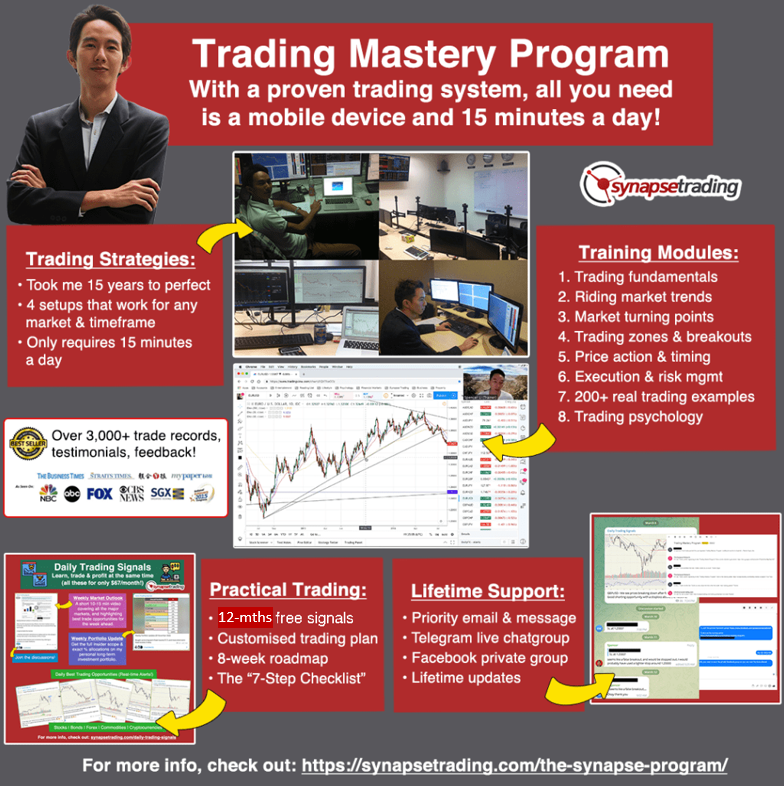 Our flagship mentoring program is suitable for both beginners and advanced traders, covering the 4 strategies which I used over the past 15 years to build up my 7-figure personal trading portfolio.
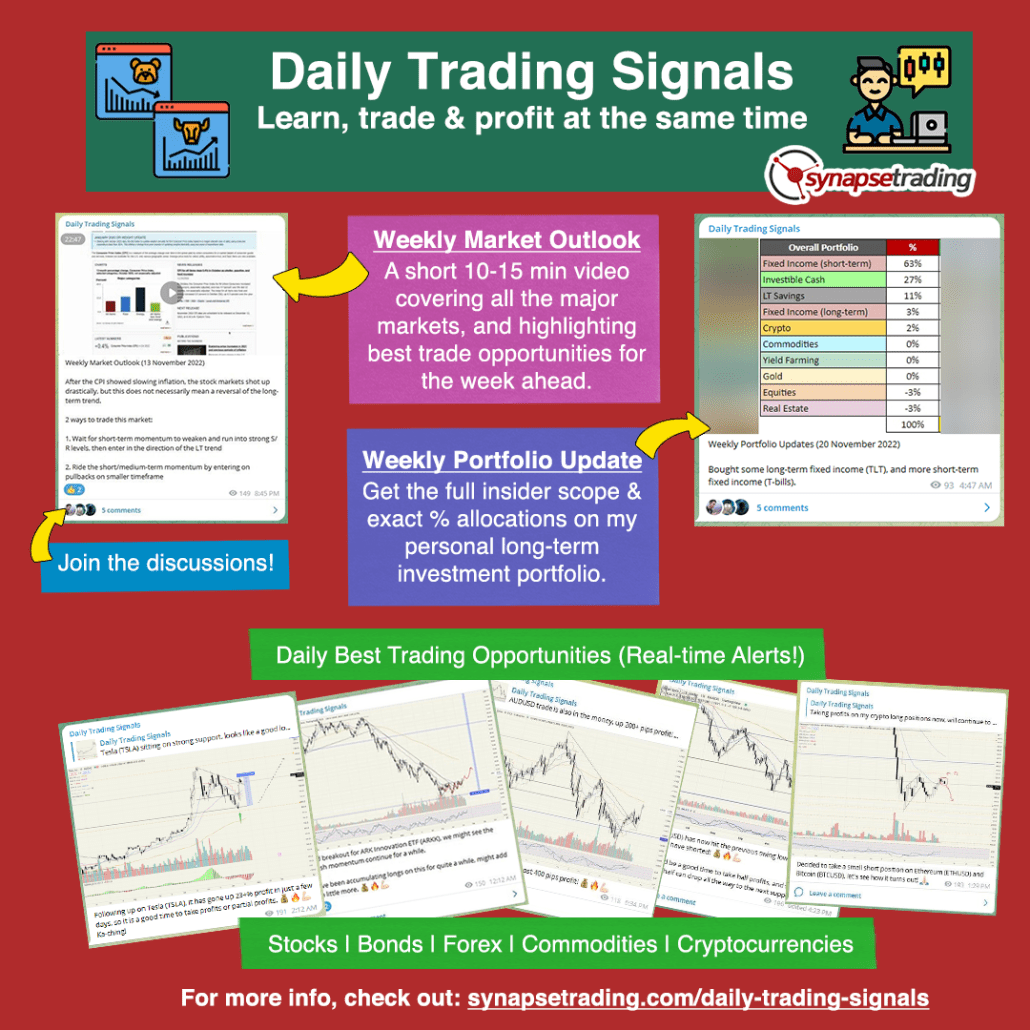 If you're looking for the best trading opportunities every day across various markets, and don't want to spend hours doing the research yourself, check out our private Telegram channel!


Leave a Reply
Want to join the discussion?Feel free to contribute!