

Endowment Bias – Do You Really “Own” a Trading Position?
Join our Telegram channel for more market analysis & trading tips: t.me/synapsetrading
Table of Contents
Endowment Bias in Trading: Why You Hold Losing Positions Too Long
Last updated: 3 July 2026 · By Spencer Li, CFTe
Endowment bias (a behavioral-finance term for valuing something more simply because you own it) is what makes traders hold losing positions far longer than they should. Standard economics says the price you would pay to buy an asset should equal the price you would accept to sell it. In real life the two are not equal. Once you own a position, you anchor to it, you feel the loss of giving it up more sharply than the gain of holding something better, and so you sit on the loser instead of rotating into a stronger trade. The fix is a single question you ask yourself out loud: “If I held no position right now, would I open this exact trade today?” If the answer is no, you are not holding the trade because it is good. You are holding it because it is yours. That is the bias talking, and it is costing you the better trade you could be in instead.
Here is where the bias comes from, how it shows up at the screen, and the one habit that breaks it.
What is endowment bias?
Endowment bias is the tendency to put a higher value on an object once you own it than you would if you did not own it yet.
The cleanest way to see it: imagine two versions of you. One owns a position and is deciding whether to keep it. The other owns nothing and is deciding whether to buy that same position fresh. Standard economic theory says both versions should value it identically. Your willingness to pay for it (as the buyer) should equal your willingness to accept for it (as the seller). In practice the owner demands more to let it go than the non-owner would pay to get it. Same asset, two different prices, and the only thing that changed is who is holding it.
The mechanism underneath is loss aversion. Giving up something already in your “endowment” (your set of holdings) registers as a loss, and losses hurt more than equivalent gains feel good. So the position gets a premium in your head that has nothing to do with its actual prospects.
How endowment bias shows up in trading
This is the bias that keeps you married to a losing position.
You bought the stock. It dropped. There is a better setup right in front of you, with higher expected upside. The rational move is to close the loser and rotate into the better trade. But you do not, because the position feels like yours. Selling it means crystallising the loss and admitting the entry was wrong, and that registers as giving something up. So you freeze.
That freeze has a name: decision paralysis. You place an irrational premium on the price you would need to be paid to let the position go, and that premium is high enough that you just hold. The market does not care that the position is yours. It will keep moving with or without your attachment to it.
Here is the same idea in a table, which is the fastest way to catch yourself doing it:
| The owner (you, holding it) | The fresh buyer (you, with no position) | |
|---|---|---|
| What you feel | “This is mine. Selling means I lose.” | “Is this the best place for my capital right now?” |
| Reference point | Your entry price | The current setup on its own merits |
| What you weigh | The pain of crystallising the loss | The upside versus other available trades |
| Likely action | Hold the loser, hope it comes back | Buy only if it is genuinely the best option |
| Whose decision is cleaner | Distorted by ownership | Distorted by nothing |
The fresh buyer is making the better decision every time. The trick is to force yourself into the fresh buyer’s seat while you are actually the owner.
What is the best way to break free from endowment bias?
Ask yourself one question: “If I did not have any positions at the moment, would I still choose to take the position I am currently holding?”
If you answered no, then you are holding for the wrong reason, and you owe yourself an honest look at why you are still in it.
That question works because it strips out the ownership. It puts you back in the fresh buyer’s seat. You are no longer defending a past entry or protecting your ego from a realised loss. You are just asking whether this is the best home for your money today, which is the only question that should ever decide whether you stay in a trade.
Personally, I run this check on every open position during my once-a-day review. It takes seconds, and it has talked me out of more “let me just give it a bit longer” holds than any indicator ever has.
As Jonathan Swift put it:
“A wise man should have money in his head, but not his heart.”
That is the whole lesson in one line. The moment a position lives in your heart instead of your head, endowment bias has you.
Where the human edge comes in
A screener can rank every setup in the market for you in a second, and tell you the loser you are holding is no longer the best use of your capital. What it cannot do is make you act on that, close a trade you have grown attached to, and admit the entry was wrong without flinching. The data is now free. The discipline to override your own ownership instinct is not, and it is one of the edges no algorithm trades for you. The screen will show you the better trade; only you can let go of the worse one.
FAQ
What is endowment bias in simple terms?
Endowment bias is valuing something more just because you own it. The classic test: people demand a higher price to sell an object than they would have paid to buy the same object minutes earlier.
Why does endowment bias make traders hold losing positions?
Because closing the loser feels like giving something up, and giving something up registers as a loss. Loss aversion makes that pain outweigh the larger gain available from rotating into a better trade, so traders freeze and hold.
What is the difference between endowment bias and loss aversion?
Loss aversion is the broader principle that losses hurt more than equivalent gains feel good. Endowment bias is one specific result of it: once you own something, parting with it feels like a loss, so you overvalue it.
How do I overcome endowment bias when trading?
Ask yourself whether you would open the exact position today if you held nothing. If the answer is no, the only reason you are still in it is that you own it, which is not a reason to hold.
Is endowment bias the same as the sunk cost fallacy?
They are close cousins and often show up together. Endowment bias is about overvaluing what you own; the sunk cost fallacy is about staying in because of what you have already spent or lost. Both keep you in trades you should have left.
So next time you are sitting on a position that has gone the wrong way, run the test before you do anything else: no positions, fresh start, would you buy it today? Let me know in the comments how often your answer surprises you.
If you want the rest of the mental traps that quietly drain trading accounts, read the pillar: The Complete Guide to Investing and Trading Psychology.
Want the routine that keeps the emotion out of it? Grab the free 15-Minute Swing Trading Starter Kit. It is the exact once-a-day process I use to review every open position and trade any market in 15 minutes.
About the author. Spencer Li is the founder of Synapse Trading and a Certified Financial Technician (CFTe) with 15+ years of trading across stocks, forex, crypto, commodities, and bonds. His trade log is public: every trade since April 2024, dated, losses left in. He has taught a 15-minute daily trading routine since 2014, one system for any market.
Education, not financial advice. Synapse Trading is not licensed by MAS to advise on investment products. Trading carries risk of loss; past performance is not indicative of future results.
Related
Complete Guide to Investing and Trading Psychology (pillar) · Loss aversion in trading · The sunk cost fallacy for traders · How to cut losing trades
Want the daily routine? Enter your email for the free 15-Minute Swing Trader's Checklist.
Free, 5 pages, PDF. You get the checklist, then my occasional trading emails. Education only, not financial advice. Unsubscribe anytime.
Where your details go: Kit, our email provider, stores your email address in the United States. Our contract with Kit lets it use your address only to send our emails, and requires Kit to keep it secure. The United States has no national privacy law like Singapore's, so that contract is the main protection. More in our privacy policy.
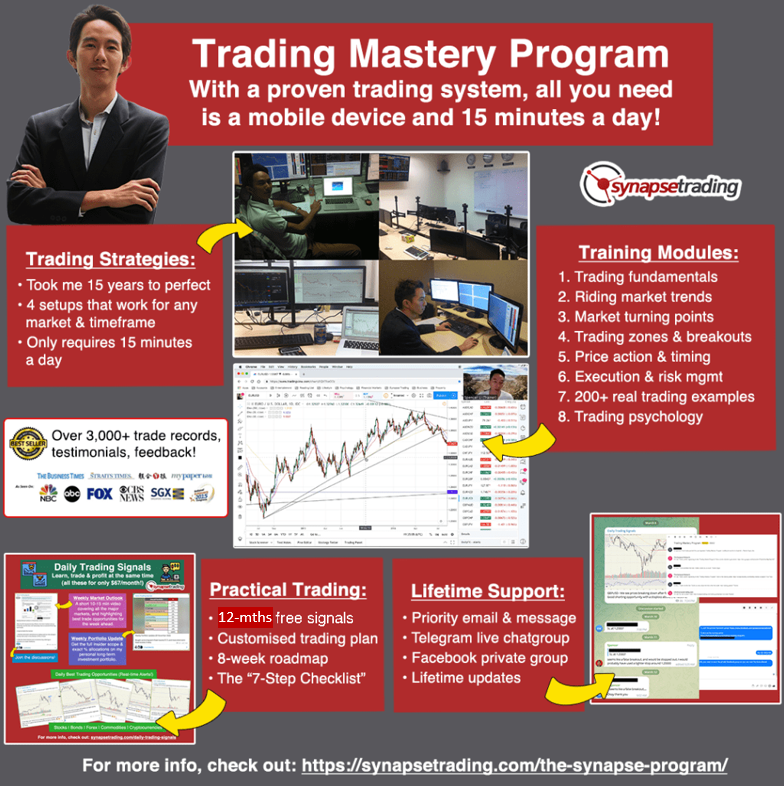 Our flagship mentoring program is suitable for both beginners and advanced traders, covering the 4 strategies which I used over the past 15 years to build up my 7-figure personal trading portfolio.
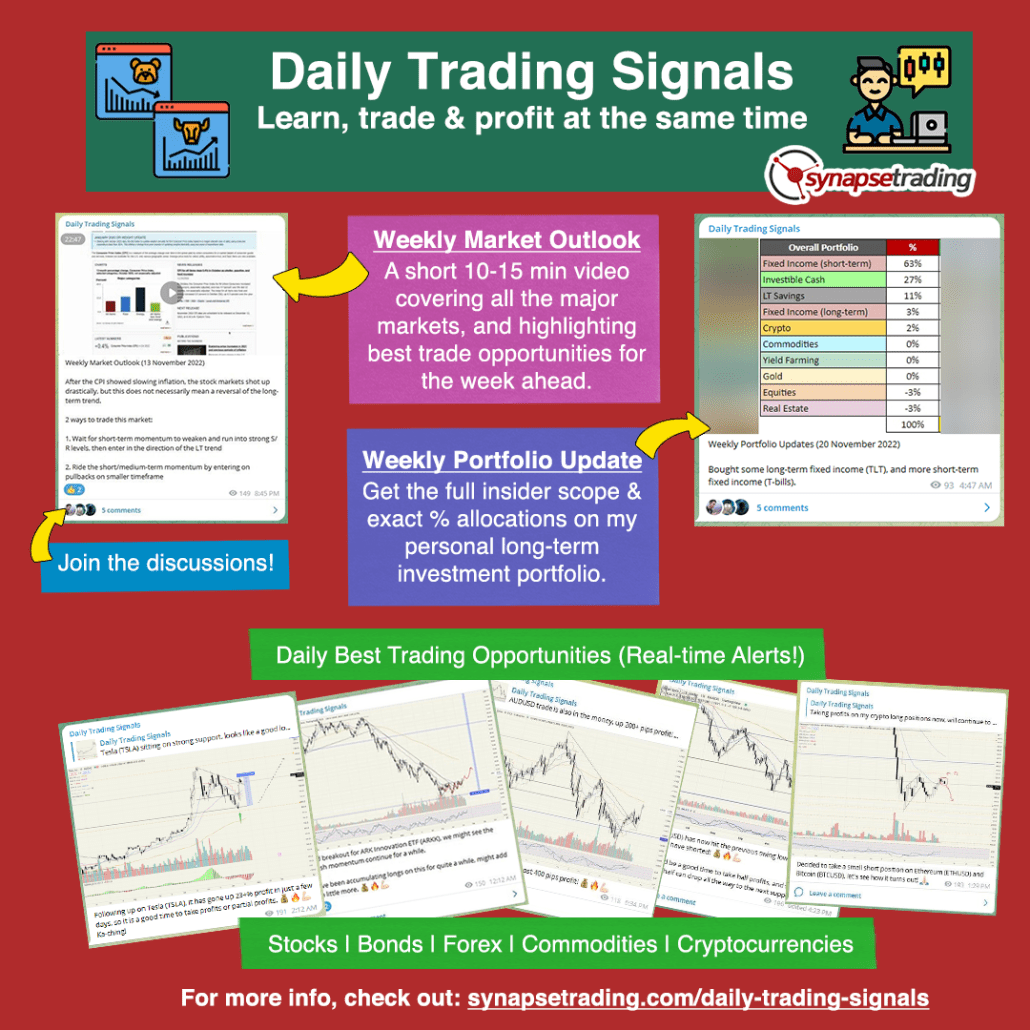 If you're looking for the best trading opportunities every day across various markets, and don't want to spend hours doing the research yourself, check out our private Telegram channel!

Leave a Reply
Want to join the discussion?Feel free to contribute!