• Link to Facebook
  • Link to X
  • Link to Instagram
  • Link to Youtube
  • Link to LinkedIn
  • Link to Mail
Synapse Trading
  • Home
  • About
    • My Background
    • My Trading Journey
    • My Travel Log
    • Media & Interviews
  • Mentoring
    • Trading Mastery Program
    • Results & Testimonials
  • Signals
    • Telegram (Free to join!)
    • Daily Trading Signals
    • Daily Trading Signals (Results)
  • Resources
    • Free Trading Guides
    • Tools & Resources
    • Blog & Infographics
  • Contact
    • Contact Us
    • Partnership Opportunities
  • Click to open the search input field Click to open the search input field Search
  • Menu Menu

Tag Archive for: trading psychology

Spencer Li

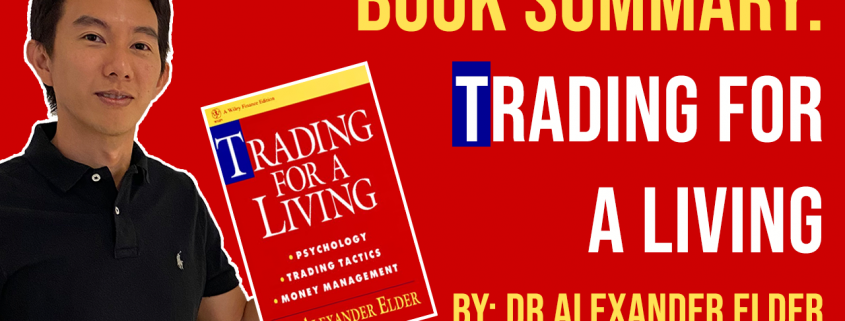
Book Summary: Trading for a Living by Dr Alexander Elder (Psychologist)

Book Summaries
thumbnail trading for a living

thumbnail trading for a living

Dr. Alexander Elder is a well-known trader and author who has written extensively on the topic of trading psychology.

He is a strong advocate for the importance of managing one’s emotions and developing a disciplined approach to trading.

In his book “Trading for a Living,” Elder emphasizes the importance of having a clear set of rules and sticking to them, as well as the need to manage risk and protect capital.

He also discusses the psychological pitfalls that traders can fall into, such as overconfidence and fear, and offers practical advice for overcoming these challenges.

This was one of the first few books I read when I started my trading journey, and it is a very good overview of everything you need to know to become a complete trader.

In this blog post, I will give a detailed summary of the book, and pull out the key learning points and strategies that Dr Elder has shared in the book.


About Dr. Alexander Elder

Before diving into the book, it is important to understand the author’s background, and why he has such a deep understanding of trading psychology.

Dr. Alexander Elder is a psychiatrist and trader who is known for his work on trading psychology and technical analysis.

Born in Leningrad (now St. Petersburg), Russia, Elder grew up in a family of scientists and engineers.

He studied medicine at the First Leningrad Medical Institute and later worked as a ship’s doctor in the Soviet merchant marine.

In 1977, Elder immigrated to the United States, where he completed his medical training and worked as a psychiatrist.

However, he also had a passion for the stock market, and he began trading and studying technical analysis in his spare time.

In the late 1980s, Elder began writing and teaching about trading, and he quickly gained a reputation as a leading expert on the psychological aspects of trading.

In 1995, he published his first book, “Trading for a Living”, which became a bestseller and established him as a leading authority on trading psychology.

He has also developed a number of technical indicators and trading tools, including the Elder-Ray indicator and the Force Index.

He has written several other books on trading, including “Come into My Trading Room,” which are considered classics in the field.

Elder also runs a trading school and offers courses and workshops on trading.

Overview of “Trading for a Living” Book

“Trading for a Living” is the flagship book written by Alexander Elder, which was first published in 1993 and has since become a classic in the field of trading.

In the book, Elder discusses his experiences as a trader and offers advice and strategies for how to successfully trade the financial markets.

He covers a range of topics, including risk management, trading psychology, and technical analysis, and provides practical advice for how to develop a successful trading plan.

The book is aimed at both novice and experienced traders, and Elder emphasizes the importance of discipline, patience, and self-awareness in achieving success in the markets.

He also offers guidance on how to avoid common pitfalls and mistakes that can undermine a trader’s performance.

The book also includes practical advice and real-life examples that can help traders develop a consistent and successful approach to the markets.

The 3 M’s of Trading

One of the key concept mentioned in the book is the importance of the 3 M’s of trading.

The 3 M’s of trading refer to three key factors that can affect the success of a trade. These factors are:

  1. Markets: A trader must have a thorough understanding of the market they are trading in, including its trends, key players, and regulatory environment. This knowledge allows the trader to make informed decisions and anticipate potential market movements.
  2. Methodology: A trader must have a clear and well-defined trading strategy, including entry and exit points, risk management techniques, and position sizing. This ensures that the trader is able to implement their strategy consistently and effectively.
  3. Mindset: A trader’s mindset is crucial to their success. A trader must be disciplined and focused, able to handle the emotional ups and downs of the market without letting them affect their decision-making. They must also be willing to continuously learn and adapt in order to stay ahead of the competition.

These 3 M’s are interdependent, and a trader must focus on all three in order to achieve success in the markets.

A trader who understands the market and has a solid trading methodology may still fail if they lack the discipline and focus to implement their strategy effectively.

Similarly, a trader with a great mindset may struggle if they do not have a deep understanding of the market or a well-defined trading plan.

The 3 M’s of trading are crucial for any trader who wants to succeed in the markets.

By focusing on markets, methodology, and mindset, traders can increase their chances of making profitable trades and achieving their financial goals.

Triple Screen System

Another popular tool created by Dr. Alexander Elder is the triple screen system, which he covered in the book.

The system is based on the idea that markets move in three distinct phases: the trend, the sideways range, and the impulse.

The first step in the triple screen system is to identify the dominant time frame for the market you are trading.

This is typically the weekly chart for long-term traders, the daily chart for intermediate-term traders, and the hourly or minute chart for short-term traders.

This dominant time frame is referred to as the “screen” in the triple screen system.

Once the dominant time frame has been identified, the trader then looks at the other two time frames to see if they are in alignment with the dominant time frame.

For example, if the dominant time frame is the daily chart and it is showing an uptrend, the trader would look at the hourly and minute charts to see if they are also showing an uptrend.

If the other time frames are in alignment with the dominant time frame, the trader can enter a trade in the direction of the dominant trend.

The triple screen system also includes a number of other elements, such as the use of oscillators to identify overbought and oversold conditions and the use of moving averages to identify support and resistance levels.

However, the core of the system is the use of multiple time frames to identify the dominant trend and to confirm trades.

Overall, the triple screen trading system is a powerful approach to technical analysis that can help traders identify and confirm trade setups.

By using multiple time frames to identify the dominant trend, traders can improve their chances of success and increase their profitability.

Trading Psychology

Another key theme of the book is the role of psychology in trading.

Trading psychology refers to the study of the psychological factors that influence the behavior of traders and investors.

This includes factors such as emotions, attitudes, beliefs, and cognitive biases, as well as the psychological effects of the market environment and the individual trader’s personal circumstances.

One of the key challenges of trading psychology is the need to manage emotions effectively.

Emotions such as fear, greed, and hope can have a powerful impact on a trader’s decision-making and can lead to impulsive and irrational behavior.

For example, fear of losing money can cause a trader to exit a trade prematurely, while greed can cause a trader to hold onto a losing trade for too long.

Another challenge of trading psychology is the need to overcome cognitive biases, which are systematic errors in thinking that can lead to poor decision-making.

For example, the confirmation bias is the tendency to seek out information that supports one’s existing beliefs, while the overconfidence bias is the tendency to overestimate one’s own ability or knowledge.

Dr. Elder argues that success in trading depends not only on technical knowledge and skills, but also on a trader’s mental and emotional state.

He provides a number of practical tools and techniques that traders can use to develop a healthy and disciplined approach to trading, including the use of daily self-assessment and journaling.

Other useful ways to improve trading psychology include developing a well-defined trading plan, using risk management techniques to protect against losses, and practicing mindfulness and meditation to improve emotional control.

Trading psychology is an important aspect of successful trading, and traders who are able to manage their emotions and overcome cognitive biases are likely to be more successful in the market.

By understanding and addressing the psychological challenges of trading, traders can improve their decision-making and increase their profitability.

Additional Trading Tips & Strategies

Here are some general tips and strategies mentioned in the book:

  1. Develop a trading plan that outlines your goals, risk management strategies, and entry and exit rules for each trade.
  2. Keep a trading journal to track your performance and identify areas for improvement.
  3. Use technical analysis to identify potential trading opportunities and set stop-loss orders to limit your potential losses.
  4. Don’t let emotions, such as fear and greed, influence your trading decisions.
  5. Be patient and disciplined, and only take trades that have a high probability of success.
  6. Manage your risk by limiting the amount of capital you expose to the markets on any given trade.
  7. Continuously educate yourself and stay up-to-date on market developments and trends.
  8. Don’t expect to get rich quick from trading; success takes time and hard work.
  9. Don’t be afraid to take a break from trading if you are feeling overwhelmed or stressed.
  10. Always have a long-term perspective and focus on developing your skills and knowledge as a trader.

Concluding Thoughts

“Trading for a Living” by Alexander Elder is an excellent book for beginners, because it is comprehensive in its coverage, and includes a clear and practical approach to tackling the markets.

In addition, the focus on psychology is a refreshing approach, especially coming from a professional psychologist, because this is one topic which is commonly overlooked in most other books.

Now that I have shared all the key lessons from this book, would you consider reading it?

And if you have already read it, what are some of your key take-aways from the book?

Let me know in the comments below!


best books on trading and investing

If you would like to find more book summaries and recommendations, also check out: “Best Investing & Trading Books of All Time”

0 Comments/by Spencer Li
https://synapsetrading.com/wp-content/uploads/2022/12/thumbnail-trading-for-a-living.png 720 1280 Spencer Li https://synapsetrading.com/wp-content/uploads/2019/10/logo.jpg Spencer Li2022-12-13 20:42:112023-02-01 18:49:28Book Summary: Trading for a Living by Dr Alexander Elder (Psychologist)
Spencer Li

Overconfidence Bias in Trading – How Can I Ever Be Wrong?

Trading Psychology
Overconfidence Bias in Trading

Overconfidence Bias in Trading: What It Is and How to Fix It

Last updated: 3 July 2026 · By Spencer Li, CFTe


Overconfidence bias in trading is the unwarranted faith in your own judgment, predictions, and abilities, the gap between how good you think your decisions are and how good they actually are. It shows up in two forms: prediction overconfidence (your forecasts are too precise, your confidence intervals too narrow) and certainty overconfidence (you are too sure you are right). It hurts your trading in concrete ways: you take positions too large, skip the stoploss, hold losers too long, and trade too often. The fix is one disciplined habit. No matter how good your analysis is, assume your edge is at most 60-70%, which means there is always a 30-40% chance you are wrong. Trade from that number and you keep your risk management, your contingency plan, and your stoploss in place. Trading is a game of probabilities, and nothing is 100%.

Here is what the bias is, the two types, how each one damages your account, and how to keep it in check.

What is overconfidence bias?

Consider this: “Despite the fact that more than 90% of car accidents involve human error, three-quarters (73 percent) of drivers consider themselves better-than-average drivers.”

That sounds delusional. The same thing happens in trading. Most people think they can beat the markets. But is that true?

First, what is confidence? According to Wikipedia, confidence is “a state of being clear-headed either that a hypothesis or prediction is correct or that a chosen course of action is the best or most effective.” The word comes from the Latin fidere, “to trust.” So self-confidence is trust in yourself, and that is a good thing to have.

But too much of a good thing turns bad. Overconfidence bias (the unwarranted faith in one’s intuitive reasoning, judgments, and cognitive abilities) is what you get when there is too much of it. In plain terms, people think they are smarter and make better decisions than they actually do.

“Too many people overvalue what they are not and undervalue what they are.” – Malcolm S. Forbes

Why does overconfidence bias happen?

Studies have shown that people overestimate two separate things:

  • Their own predictive abilities, and
  • The precision of the information they have been given.

In the first case, people think they are smarter than they are. In the second, they think their information is better than it is.

Here is the everyday version. Someone gets a tip from a broker, or reads something off the internet, and they are ready to place a trade right away on the strength of that perceived knowledge advantage. But if there is no logical basis for the advantage, the edge does not exist at all, no matter what the trader thinks he knows. They are too confident the information is accurate without doing the work to verify it before acting.

There is one more layer. People are poorly calibrated at estimating probabilities. Events they think are certain to happen are often less than 100% certain to happen.

What are the two types of overconfidence bias?

There are two kinds, and they fail in different ways. Prediction overconfidence is about how accurately right you think you are. Certainty overconfidence is about how likely you think you are to be right.

What it isHow it soundsHow it shows up in trading
Prediction overconfidenceYour confidence intervals are too narrow, your forecasts too precise“It will hit exactly $182.50 in 11 days”Chasing precise price targets, trusting “expert” forecasts, betting on a pinpoint that no one can actually call
Certainty overconfidenceYou are too sure your judgment is correct“This is a sure-win”Oversized positions, higher risk, no stoploss, no contingency, blind to the chance of a loss

Prediction overconfidence bias

Here the confidence intervals traders assign to their predictions are too narrow. The classic example is “experts” forecasting precise price targets. You see it in the news all the time, a celebrity or an analyst or a bank putting out some ridiculous price projection.

It is simply not possible to forecast with that kind of accuracy. Even professional traders only get an idea of direction and some idea of magnitude. No one is going to pinpoint the exact price a stock reaches on an exact day. That is prediction overconfidence, or most of the time, just fabricating numbers for attention.

Certainty overconfidence bias

Here traders are too certain of their judgments. At the professional level, even when you find a good trade, you are at most 60-70% certain, and that is good enough to be profitable over the long run.

But when an amateur sees that same trade, they get 90-100% certain it is a winner. So they treat every trade as a “sure-win,” go blind to the prospect of a loss, and then feel surprised and disappointed when it performs poorly.

That same overconfidence pushes them into larger positions, higher risk, and no contingency plan or stoploss. After all, why would you need a stoploss if your trade is a “sure-win”?

How does overconfidence bias affect your trading?

The dangers are numerous, and they stack:

  • You go blind to warning signs. If you overestimate your ability to pick a winner, you stop seeing the information that says your decision was wrong. That gets you into bad trades and keeps you in losing ones.
  • You overtrade. If you believe you have special knowledge, you trade more often than your real edge justifies.
  • You underestimate downside. In the worst cases this means trading with no stoploss at all, which is how small mistakes become account-ending ones.

How do you prevent overconfidence bias?

There is a fine line between confidence and overconfidence. You need enough confidence to trust your analysis and not get swayed by the crowd, yet not so much that you think your analysis is 100% correct.

The rule that holds the line is a single number. No matter how good your analysis and research is, assume the edge you have is at most 60-70%, which means there is still a 30-40% chance you are wrong.

Enter every trade with that mentality and the rest follows naturally. You do your proper risk and money management. You keep a contingency plan. You place your stoploss to cap the downside. That is the whole defence, and it works because it is built into your process rather than relying on you to feel humble in the moment.

Always keep in mind: trading is a game of probabilities, and nothing is 100%.

Where the human edge comes in

A backtest can hand you a strategy with a positive expectancy. A screener can rank a hundred setups in a second. What no tool will do is hold your size down when a setup feels like a sure thing, or make you place the stoploss you do not think you need. Overconfidence is not a data problem, it is a judgment problem, and judgment is the first of the Five Edges a machine cannot trade for you. The 60-70% rule is how you install that judgment as a habit instead of a feeling.

FAQ

What is overconfidence bias in trading?
Overconfidence bias is the unwarranted faith in your own judgment, predictions, and abilities, the gap between how good you think your trading decisions are and how good they actually are. It leads to oversized positions, skipped stoplosses, and overtrading.

What are the two types of overconfidence bias?
Prediction overconfidence (your forecasts are too precise and your confidence intervals too narrow) and certainty overconfidence (you are too sure you are right). The first makes you chase exact price targets, the second makes you treat trades as “sure-wins.”

How does overconfidence affect trading decisions?
It makes you take larger positions, skip the stoploss, hold losers too long because you ignore warning signs, and trade too often because you believe you have special knowledge. All of it underestimates downside risk.

How do you overcome overconfidence bias in trading?
Assume your edge on any trade is at most 60-70%, never higher. That built-in 30-40% chance of being wrong keeps your risk management, contingency plan, and stoploss in place on every trade.

Is confidence bad for trading?
No. Confidence is necessary, you need it to trust your analysis and not get swayed by the crowd. The problem is overconfidence, when you think your analysis is 100% correct. Trading is a game of probabilities, and nothing is 100%.


Now that you know the two types of overconfidence and the 60-70% rule that defends against them, how do you think the bias has affected your own trading decisions? Let me know in the comments.

And if you want the full set of mental traps mapped out, read the pillar: The Complete Guide to Investing and Trading Psychology.

Want a system that takes the ego out of it? Grab the free 15-Minute Swing Trading Starter Kit. It’s the exact routine I use to scan once a day and trade any market in 15 minutes, with the risk rules built in so a “sure-win” feeling can’t blow up your account.


About the author. Spencer Li is the founder of Synapse Trading and a Certified Financial Technician (CFTe) with 15 years of trading across stocks, forex, crypto, commodities, and bonds. His trade log is public, 404 trades, losses left in. He teaches low-risk swing trading in 15 minutes a day, one system for any market.

Education, not financial advice. Synapse Trading is not licensed by MAS to advise on investment products. Trading carries risk of loss; past performance is not indicative of future results.


Related

Complete Guide to Investing and Trading Psychology (pillar) · Loss aversion in trading · Confirmation bias in trading · How to set a stoploss

4 Comments/by Spencer Li
https://synapsetrading.com/wp-content/uploads/2010/12/Overconfidence-Bias-in-Trading.jpg 720 1280 Spencer Li https://synapsetrading.com/wp-content/uploads/2019/10/logo.jpg Spencer Li2021-04-29 16:00:062026-07-06 02:47:50Overconfidence Bias in Trading – How Can I Ever Be Wrong?
Spencer Li

Why Day Trading Will Make You Less Money (And Bring You More Stress)

Trading Psychology
why day trading will make you less money

Most people think that in trading, the more trades you make, the money more you will end up making.

But is this really true?

Traders who adopt this philosophy will constantly be chasing the next big shiny object, reading every piece of news online, and hunting for new opportunities every day.

The danger with this approach is that you stretch yourself too thin, which leads to decision fatigue. Even when the low-hanging fruit and easy opportunities are right in front of you, you might be too busy out hunting to see and seize those trading opportunities.

The allure of excessive trading attracts new traders, who want to make as many trades as possible, and get rich quickly in a short period of time.

Thus they are attracted to day-trading, even though intraday trading is only suitable for the most experienced and advanced traders. Most new traders would be much better of doing swing trading or position trading, where they can hone their skills in a less fast-paced and risky environment.

The advantages of trading less are numerous:
– allows you to focus on the best trades and best strategies
– helps you avoid bad trades and excessive trading
– makes trading less stressful
– do not need to constantly monitor the market
– less transactions means less transaction costs

Hence, for those traders who are making too many trades, it would be good to check your past trading records, and see if trading less might actually improve your trading results.

Enjoy the video, and remember to “like” and “subscribe”!


complete guide to investing and trading psychology cover

If you would like to learn more about trading psychology, also check out: “The Complete Guide to Investing & Trading Psychology”

0 Comments/by Spencer Li
https://synapsetrading.com/wp-content/uploads/2020/03/why-day-trading-will-make-you-less-money.jpg 720 1280 Spencer Li https://synapsetrading.com/wp-content/uploads/2019/10/logo.jpg Spencer Li2020-03-04 19:36:222022-12-21 03:10:26Why Day Trading Will Make You Less Money (And Bring You More Stress)

Free Trading Guides

Free Trading Guides

Blog Categories

  • Beginner's Guide
  • Blockchain & Crypto
  • Book Summaries
  • Economics & News Trading
  • Investing & Portfolio Management
  • Living Your Best Life
  • Market Analysis
  • Markets & Products
  • News & Events
  • Promotions
  • Risk & Money Management
  • Stock Trading
  • Technical Analysis & Price Action
  • Testimonials
  • Tools & Resources
  • Trading Psychology
  • Trading Strategies
  • Trading Tips
  • Travel & Lifestyle

Free Trading Guides

Free Trading Guides

Contact Us

Synapse Trading Pte Ltd
Registration No. 201316168H

Whatsapp: +65-8897-1204
Telegram: @iamrecneps
Email: info@synapsetrading.com

Links

Disclaimer
Privacy policy
Terms & Conditions
Contact us
Partnerships

© 2012-2024 Synapse Trading | All rights reserved | - powered by Enfold WordPress Theme
  • Link to Facebook
  • Link to X
  • Link to Instagram
  • Link to Youtube
  • Link to LinkedIn
  • Link to Mail
Scroll to top Scroll to top Scroll to top