

Trade Less, Make More? What a Study of 66,465 Investors Shows About Overtrading, and How to Stop
Want the daily routine? Get the free 15-Minute Swing Trader’s Checklist. Get it free →
By Spencer Li, CFTe · Last updated: 26 October 2026
Making more trades does not usually make you more money. In the best-known study on this, the households that traded most earned 11.4% a year after costs, while the market returned 17.9%. Before costs, their picks did about as well as those of the households that rarely traded. The extra trading itself was what cost them. Trading less lets you focus on your best setups, skip the marginal ones, pay fewer costs and stop watching the screen all day. To find out whether it would help you, check your past trading records.
I first wrote about this in March 2020. The study and the advice have both held up since.
Does trading more make you more money?
Most people assume trading works like a sales job, where more calls bring more income. So they trade more.
In 2000, the finance professors Brad Barber and Terrance Odean put that idea to a test. They studied 66,465 households with accounts at a large US discount broker from 1991 to 1996. Then they sorted the households by how much they traded. The most active group turned over more than 250% of their portfolio a year.
The result was blunt. Before costs, the frequent traders and the infrequent traders did almost the same. After commissions and spreads, the frequent traders earned 11.4% a year. The least active earned 18.5%, and the market earned 17.9%. The authors titled the paper “Trading Is Hazardous to Your Wealth”.
| Most active households | Least active households | The market | |
|---|---|---|---|
| Net yearly return, 1991-1996 | 11.4% | 18.5% | 17.9% |
Do note what the study measured. These were stock investors in the 1990s, when commissions were far higher than today, so it is not a study of swing traders. But the mechanism carries over. Every trade pays a cost on the way in and the way out, and every trade is a fresh chance to be wrong. If your extra trades are no better than your best ones, the extra costs eat the difference.
I have told my students the same thing for years, in eight words: “The more you trade, the less you make.”
Why do traders end up trading too much?
Barber and Odean blamed overconfidence. People trade because they believe their next idea is better than it really is.
I would add something I see in students all the time. Traders who think more trades mean more money end up chasing the next big shiny object. They read every piece of news online and hunt for a new opportunity every day. Do that for long enough and you stretch yourself too thin, which leads to decision fatigue. Each choice gets a little worse than the one before it.
The irony is that the easy trades are often sitting right in front of you. You are just too busy out hunting to see them.
Personally, I know the pull of the screen. The only time I was glued to it was very early in my career, when I traded professionally for a few years. Since then, the job has become far quieter. As I often tell my community, “trading is actually quite boring, once you’ve learnt everything, it’s just executing the same strategies over and over.”
If you want a routine built around fewer, better trades, my free 15-minute swing trader checklist is the one I use myself.
What can a baseball hitter teach you about trading less?
Ted Williams was one of the great hitters in baseball. He split the strike zone into seventy-seven cells, each about the size of a ball. Then he swung only at pitches in his best cells, even if that meant risking a strikeout.
The story appears in Poor Charlie’s Almanack. An investor there explains that Warren Buffett and Charlie Munger use the same analogy. Buffett’s own version is a punch card with just twenty slots for your whole investing life. With only twenty, you would think hard before using one.
Trading differs from baseball in one important way. Nobody calls a strike on you for letting a pitch go by. You can watch a hundred setups pass and take none of them, and the only cost is a little boredom.
That is why I keep telling students that a good signal “jumps at you from the chart and grabs you by the face”. If you have to squint to see the setup, it probably is not one. Amateurs look for challenges, while professionals look for easy trades.
Munger made the same point about his own style. He rarely buys or sells, and among the gains he lists are lower broker costs and less nonsense to listen to.
Why is day trading the hardest place to start?
New traders want to make as many trades as possible and see results fast. So they are drawn to day trading, which looks like the fast lane.
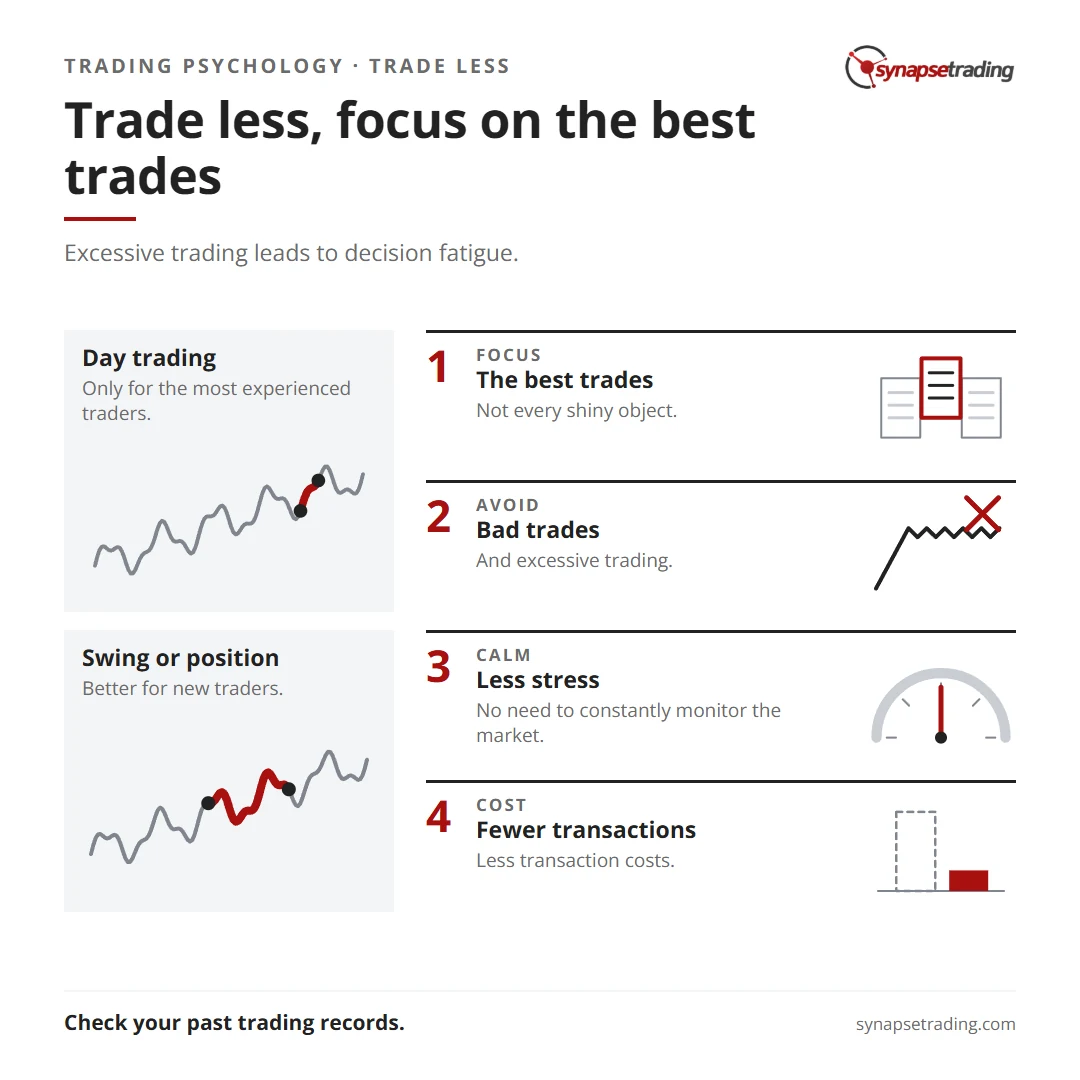
Personally, I think that is backwards. Intraday trading is only suitable for the most experienced and advanced traders. The decisions are faster, the noise is louder and the costs come round more often. That makes it the hardest version of the game to learn.
Most new traders would be much better off with swing trading, holding for days to weeks, or position trading, holding for weeks to months. You build the same skills at a slower pace, with time to think before you act. I compare the two styles properly in swing trading vs intraday trading.
When a student tells me they cannot stop watching the screen, I usually point out that they have drifted into day trading without meaning to.
What are the advantages of trading less?
My 2020 list still stands, and I would not change a word of it.
- You focus on the best trades and the best strategies, instead of spreading your attention across everything.
- You avoid bad trades and excessive trading.
- Trading becomes less stressful, because you stop reacting to every tick.
- You do not need to monitor the market constantly, which gives you your day back.
- Fewer transactions mean lower transaction costs.
Trading less also changes what you do when the market turns difficult. In my weekly outlook on 23 October 2025, the market had gone choppy, and most of my open trades looked less clean than they had a month or two before. I told viewers that “when there are not many good trades, it also makes sense to trade less”, to be defensive.
My reason was simple. Your overall returns are what matter, and they “can actually come from just a handful of really, really solid trades”. So when no good trades are there, “the best thing that you can do is actually just to wait patiently.”
A short daily routine makes that waiting easier, which is what my free 15-minute swing trader checklist is for.
Won’t trading less mean less profit?
On 6 March 2024, a trader on Reddit’s r/Daytrading asked: “Trading less, Less Profit but Better Mental health?” Their worry was that stepping back would protect their peace of mind but cost them money.
It is a fair worry, and I will concede the honest part. If you have a real, tested edge and your extra trades are just as good as your best ones, more trades can mean more total profit. Trading costs have also fallen a long way since the 1990s, so the cost side of the Barber and Odean gap is likely smaller today. And yes, you will miss some moves while you wait.
But the extra trades are rarely as good as the best ones. The best setups are scarce by nature, so most of what you add past them is the marginal stuff you would have skipped on a calm day. That is where the spreads, the small losses and the tiredness come in.
When I miss a move, I let it go. If you missed it, it’s gone, and another good setup will come along. When in doubt, stay out.
How do you know if you are trading too much?
You do not have to guess. The answer is already in your own records.
Pull up your trading journal and go through your trades one by one. Mark each one as either a setup from your plan or a trade you took for some other reason, such as boredom, a headline or a wish to win back a loss. Then compare the two groups.
What you are looking for is a gap between them. If the planned trades carry the account while the extra ones quietly give part of it back, you have your answer. If trading less would have improved your results, the records will show it plainly. My guide to using a trading journal to find your edge walks through how to set one up.
There is one more signal worth watching. If choppy, sideways markets keep frustrating you, it is usually because your setups do not apply there. My advice for those weeks has not changed: “Trade smaller and trade less when the market is harder to trade.”
The patience this needs is a skill, and I wrote more about building it in patience and discipline in trading.
FAQ
Does making more trades make you more money?
Usually it does not. In Barber and Odean’s study of 66,465 households from 1991 to 1996, the most active traders earned 11.4% a year after costs, against 18.5% for the least active.
What is overtrading?
Overtrading means taking trades that are not part of your plan, out of boredom, fear of missing out or a wish to recover a loss. It adds costs and mistakes without adding real opportunities.
Is day trading good for beginners?
For most beginners, no. Intraday trading suits the most experienced traders. Swing or position trading gives a beginner more time to think and a calmer place to learn.
How do I stop overtrading?
Write down the setups you trade, and only take those. Review your records regularly to see which trades carry your results, and step back when the market is choppy.
Why does trading less reduce stress?
You stop reacting to every price move. With fewer positions to watch, you can check the market once a day and get on with your life.
How many of your trades last month came from your plan, and how many came from boredom or a headline? And if you cut the second group out, would your results have been better or worse? Let me know in the comments.
If you want to understand the mindset behind taking fewer, better trades, read my complete guide to trading psychology, and my free trading guides collect the rest.

If you would like to learn more about trading psychology, also check out: “The Complete Guide to Investing & Trading Psychology”
And if you want a routine that keeps you trading in 15 minutes a day instead of watching the screen all day, grab the free 15-minute swing trader checklist.
About the author. Spencer Li is The 15-Minute Trader and the founder of Synapse Trading. He is a Certified Financial Technician (CFTe) with 15+ years of trading, run from 70+ countries. He holds a B.Acc and B.BM from SMU. Every trade he takes is public, dated, losses left in. He teaches rules-based swing trading in 15 minutes a day, one system for any market.
Education, not financial advice. Synapse Trading is not licensed by MAS to advise on investment products. Trading carries risk of loss, and past performance is not indicative of future results.
Want the daily routine? Enter your email for the free 15-Minute Swing Trader's Checklist.
Free 5-page PDF, then occasional trading emails. Education only, not financial advice. Unsubscribe anytime. Kit stores your email in the US: see our privacy policy.
Want to learn the full method? The Trading Mastery Program teaches the 4 strategies I have traded since 2011. It suits beginners and experienced traders.
Rather follow the trades as they happen? Daily Trading Signals is our Telegram channel: my trade ideas with entry, stop and exit, and every trade is public.
Questions about this post? Ask in the free Telegram channel →
Educational content only, not personalised financial advice. Trading carries risk, including loss of capital. Past performance is not indicative of future results. Synapse Trading is not licensed or regulated by MAS.

