• Link to Facebook
  • Link to X
  • Link to Instagram
  • Link to Youtube
  • Link to LinkedIn
  • Link to Mail
Synapse Trading
  • Home
  • About
    • My Background
    • My Trading Journey
    • My Travel Log
    • Media & Interviews
  • Mentoring
    • Trading Mastery Program
    • Results & Testimonials
  • Signals
    • Telegram (Free to join!)
    • Daily Trading Signals
    • Daily Trading Signals (Results)
  • Resources
    • Free Trading Guides
    • Tools & Resources
    • Blog & Infographics
  • Contact
    • Contact Us
    • Partnership Opportunities
  • Click to open the search input field Click to open the search input field Search
  • Menu Menu

Tag Archive for: bitcoin

Spencer Li

Comparison of the new Bitcoin (BTC) ETFs: Which is the Best?

Blockchain & Crypto
btc etf

Best Bitcoin ETF: How to Compare Spot Bitcoin ETFs by Fees

Last updated: 3 July 2026 · By Spencer Li, CFTe


For most people, the best Bitcoin ETF is the cheapest credible spot fund, because every one of them holds the same asset (Bitcoin), so the fee is the main thing you actually control. Among the US spot Bitcoin ETFs, the Bitwise Bitcoin ETF (BITB) has the lowest expense ratio at 0.20%, with Ark 21Shares (ARKB) next at 0.21%, and the big-name funds, iShares (IBIT) from BlackRock, Fidelity (FBTC), and VanEck (HODL), clustered at 0.25%. The old Grayscale Trust (GBTC) sits far above the pack at 1.5%. A spot ETF (one that holds actual Bitcoin, not futures contracts) lets you buy Bitcoin exposure through an ordinary brokerage account, with no wallet, no private keys, and no exchange to trust. Personally, after weighing fees against fund size, I hold ARKB and IBIT. Here is how to compare them yourself, so you pick the one that fits you, not the one with the loudest ad.

What is a spot Bitcoin ETF?

A spot Bitcoin ETF is a fund that holds real Bitcoin and trades on a normal stock exchange. You buy it like any share, through the brokerage you already use.

That word “spot” matters. A spot ETF holds the actual coin. A futures ETF (the older kind, like the ProShares BITO that launched first) holds Bitcoin futures contracts instead, which can drift away from the real Bitcoin price over time. The spot funds track Bitcoin much more directly, which is why their approval was the bigger event.

The appeal is simple. You skip the parts of crypto that scare most people: setting up a wallet, guarding a private key (the secret code that controls your coins, lose it and the coins are gone), and trusting a crypto exchange not to collapse. The ETF issuer handles custody. You just hold a ticker.

How did we get spot Bitcoin ETFs? A short timeline

These funds did not appear overnight. The road to approval ran more than a decade.

  • 2013: The Winklevoss twins filed the first Bitcoin ETF application. It set the template, and it was rejected.
  • 2017 to 2019: A run of SEC rejections, citing market-manipulation worries. ProShares, Direxion, and Bitwise all got turned down.
  • 2020 to 2021: The tone shifted under SEC Chairman Gary Gensler. The first Bitcoin futures ETF, ProShares Bitcoin Strategy (BITO), was approved.
  • 2022 to 2023: More futures ETFs cleared, but spot funds still stalled over market-oversight concerns.
  • 2024: The first US spot Bitcoin ETFs were approved together, the regulatory shift that opened the door to the funds compared below.

So when you hold one of these today, you are holding the end of a long fight, not a brand-new experiment.

What is an expense ratio, and why does it decide the “best” ETF?

The expense ratio is the annual fee a fund charges to hold and run it, written as a percentage of your money in the fund.

A worked example. If an ETF has a 0.20% expense ratio and you put in $100, you pay about 20 cents a year in fees. The fee is taken straight from the fund’s assets, so you never write a cheque, you just earn slightly less than the raw Bitcoin price over time.

Here is why this is the lever that matters. Every spot Bitcoin ETF holds the same thing: Bitcoin. They do not pick better coins or time the market. So if Fund A and Fund B both just hold Bitcoin, the cheaper one wins by default, because the fee is the one number that reliably eats into your return. A lower expense ratio means more of Bitcoin’s move stays in your pocket.

Comparison of the spot Bitcoin ETFs by fee

Below are the US spot Bitcoin ETFs ranked from cheapest to most expensive. Do note that, issuers cut fees and run temporary waivers to win early assets, so always check the current ratio on the issuer’s page before you buy.

ETFTickerExpense ratioNotes
Bitwise Bitcoin ETFBITB0.20%Lowest fee; six-month waiver on the first $1B in assets
Ark 21Shares Bitcoin ETFARKB0.21%Partnered with 21Shares, a crypto specialist
iShares Bitcoin TrustIBIT0.25%Run by BlackRock, the largest asset manager
Fidelity Wise Origin Bitcoin FundFBTC0.25%Backed by Fidelity’s custody and platform
VanEck Bitcoin TrustHODL0.25%Established ETF issuer
Valkyrie Bitcoin ETFBRRR0.25%Started at 0.49%, cut to 0.25%; early waiver
Franklin Bitcoin ETFEZBC0.29%Franklin Templeton
WisdomTree Bitcoin FundBTCW0.30%WisdomTree
Invesco Galaxy Bitcoin ETFBTCO0.39%Invesco plus Galaxy Digital’s crypto desk
Hashdex Bitcoin ETFDEFI0.94%Converted from a futures fund
Grayscale Bitcoin TrustGBTC1.50%Highest fee; longest track record and large asset base

Two things jump out of that table.

First, the fee range is wide: 0.20% at the bottom, 1.5% at the top. That is a 7x gap for funds holding the same asset. Over years, that difference compounds against you.

Second, GBTC is the odd one out. It was the original Bitcoin trust before it converted to an ETF, and it kept the largest asset base and the longest history. Its 1.5% fee is the price of that legacy. Some long-term holders accept it for the track record. For most new money, the cheaper funds are the obvious starting point.

Why spot Bitcoin ETFs mattered for the market

Beyond your own cost, these funds changed who can buy Bitcoin and how.

They lowered the barrier. No wallet, no keys, no exchange. If you can buy a stock, you can buy Bitcoin exposure. That alone pulls in a large group of investors who were never going to set up a crypto wallet.

They added a layer of legitimacy. Regulatory approval of a spot ETF was a signal that Bitcoin is an investable asset inside the traditional system, not just an internet curiosity. That tends to reduce some of the old skepticism.

They made it easy to size small. You can buy a few shares. You do not have to commit to a whole coin or a minimum exchange order. For a beginner who just wants a small, sensible slice of Bitcoin in a diversified portfolio, that fractional access is the practical win.

None of this removes Bitcoin’s volatility. The wrapper is convenient. The asset inside is still the same swinging asset it always was.

Which Bitcoin ETF is best for you?

There is no single “best” fund, only the best fit for your goal. Here is how I would frame the choice.

  • If you are cost-conscious (and most long-term holders should be), start with the cheapest credible fund. BITB at 0.20% leads, with ARKB at 0.21% a hair behind.
  • If you want the biggest, most liquid name, IBIT (BlackRock) and FBTC (Fidelity) at 0.25% trade size and a household brand for a basis point or two of fee.
  • If track record and asset base matter more to you than fee, GBTC is the legacy option, though you pay 1.5% for it.

Personally, I went with ARKB and IBIT, weighing both the expense ratio and the fund’s market size. ARKB gives me a near-rock-bottom fee, and IBIT gives me the deepest liquidity and the BlackRock name. That is my read for my situation, not a recommendation for yours.

Where the human edge comes in

A comparison table can rank these funds by fee in a second, and you should let it. That part is now free. What the table will not do is decide how big a Bitcoin position belongs in your portfolio, or whether you can sit through a 50% drawdown without panic-selling at the bottom. The cheapest ETF in the world does not help if you size it wrong or bail at the worst moment. Picking the fund is the easy part. Sizing it and holding through the volatility is the judgment, and it is the first of the Five Edges no fund can supply for you.

FAQ

What is the best Bitcoin ETF?
For most investors, the best Bitcoin ETF is the cheapest credible spot fund, since they all hold the same asset. BITB has the lowest expense ratio at 0.20%, with ARKB at 0.21% and IBIT, FBTC, and HODL at 0.25%.

What is the cheapest Bitcoin ETF?
The Bitwise Bitcoin ETF (BITB) has the lowest expense ratio at 0.20%, and at launch it also waived fees for six months on the first $1 billion in assets. Always check the current ratio, as issuers change them.

What is the difference between a spot and a futures Bitcoin ETF?
A spot Bitcoin ETF holds actual Bitcoin, so it tracks the price closely. A futures Bitcoin ETF holds futures contracts instead, which can drift away from the real Bitcoin price over time. The spot funds are the more direct way to hold Bitcoin through a brokerage.

Why is GBTC’s fee so high?
Grayscale’s GBTC was the original Bitcoin trust before converting to an ETF, and it kept the longest track record and a large asset base. Its 1.5% expense ratio is far above its peers; it cut the fee to compete but still sits at the top of the range.

Do I still need a crypto wallet if I buy a Bitcoin ETF?
No. The whole point of a spot Bitcoin ETF is that the issuer handles custody. You buy and sell it like a stock through your brokerage, with no wallet and no private keys to manage.


Which one fits how you invest, the rock-bottom fee or the big-name liquidity? Let me know in the comments.

And if you want the bigger picture on crypto beyond the ETF wrapper, read the deeper guide: The Ultimate Guide to Blockchain and Cryptocurrencies.

Want a simple system for any market, crypto included? Grab the free 15-Minute Swing Trading Starter Kit. It’s the exact routine I use to scan once a day and trade any market in 15 minutes.


About the author. Spencer Li is the founder of Synapse Trading and a Certified Financial Technician (CFTe) with 15 years of trading across stocks, forex, crypto, commodities, and bonds. His trade log is public, 404 trades, losses left in. He teaches low-risk swing trading in 15 minutes a day, one system for any market.

Education, not financial advice. Synapse Trading is not licensed by MAS to advise on investment products. Trading carries risk of loss; past performance is not indicative of future results.


Related

The Ultimate Guide to Blockchain and Cryptocurrencies (pillar) · What is Bitcoin and how does it work · How to invest in crypto for beginners · ETF investing for beginners
0 Comments/by Spencer Li
https://synapsetrading.com/wp-content/uploads/2024/01/btc-etf.jpg 825 1449 Spencer Li https://synapsetrading.com/wp-content/uploads/2019/10/logo.jpg Spencer Li2024-01-31 04:58:092026-07-06 00:31:57Comparison of the new Bitcoin (BTC) ETFs: Which is the Best?
Spencer Li

What is Cryptocurrency, and is it a Good Investment?

Blockchain & Crypto
What is a Cryptocurrency and is it a Good Investment thumbnail

Is Cryptocurrency a Good Investment? An Honest Answer for Beginners

Last updated: 3 July 2026 · By Spencer Li, CFTe


Cryptocurrency can be a good investment, but only as a small, high-risk, high-reward slice of a portfolio, never the bulk of it. Crypto is a peer-to-peer digital currency that runs on a blockchain instead of a bank, and the same things that make it exciting (no middleman, fast cross-border transfers, the potential for large gains) also make it dangerous (extreme volatility, exchange hacks, outright fraud). Personally, I hold some, and I treat it as a speculative position I am fully prepared to lose. The honest answer to “is it a good investment for you?” is: yes, if you have an emergency fund, you start small, and you accept that the same coin that can multiply your money can also take all of it. The investors who blow up are the ones who skip those three conditions. The rest of this post explains what crypto actually is, why it swings so hard, and the exact steps I would use to start.

So, is crypto the biggest innovation of our generation, or a scam? Here is how I think about it.

What is cryptocurrency?

A cryptocurrency (or “crypto”) is any peer-to-peer digital currency that uses cryptography (math-based encryption) to create and manage its money supply and confirm transactions.

Bitcoin (BTC) was the first and is still the most well-known, but there are thousands of others. A few you will see often:

  • Ethereum (ETH)
  • Ripple (XRP)
  • Cardano (ADA)
  • Solana (SOL)
  • Tether (USDT), a stablecoin (a token designed to hold a fixed value, usually pegged to the US dollar)

Most cryptocurrencies are decentralized systems built on blockchain technology. The network itself verifies transactions, so there is no central authority like a bank or a government sitting in the middle. In plain terms, no single institution controls it.

It is more mainstream than people assume. Over 30% of all US adults now own crypto, yet despite the headlines and the gains, many still cannot explain what they actually bought.

What is the difference between real money and cryptocurrency?

Real money, like the US dollar, is fiat currency (money that has value because a government says it does). It is not backed by a physical commodity like gold or silver. It is backed by the full faith and credit of the issuing government.

Cryptocurrencies are different. They are decentralized digital assets, not subject to government control or regulation. Bitcoin was created in 2009 as a peer-to-peer electronic cash system designed to work without any central authority.

Because crypto settles on public blockchains rather than through banks, transaction fees can be lower, which lets you send funds across borders cheaply and quickly.

Blockchain explained: proof of work vs proof of stake

Most cryptocurrencies, including Bitcoin, run on a method called proof-of-work.

Proof-of-work asks “miners” (computers competing to validate transactions) to solve complex math problems to find blocks (a group of transactions), and the winner gets a reward, usually the coin itself. The difficulty varies by coin. Common proof-of-work algorithms include SHA-256, Scrypt, X11, Ethash, Equihash, and Lyra2REv2.

The catch is cost. Proof-of-work eats a huge amount of computing power and electricity. After paying for power and hardware, miners can barely break even on what they earn.

To cut that energy use, many coins moved to proof-of-stake instead. With proof-of-stake, how much you can verify is limited by how much crypto you are willing to “stake” (lock up as a deposit) for the chance to participate. It is far more efficient because it removes the energy-intensive math-solving and allows faster verification.

This is why Ethereum completed “the Merge” in September 2022, switching from proof-of-work to proof-of-stake.

Is cryptocurrency a good investment?

Since crypto arrived, people have argued about whether it belongs in a portfolio. Some experts call it a global phenomenon in the making. Others call it a bubble waiting to pop.

Here is the honest pros-and-cons view before I give you my own take.

Potential benefitsReal risks
ControlYour wallet gives you direct control of your assets, no third party can intervene, no intermediary clips a fee on every transferLose your keys and you lose the coins, with no bank to call
TransparencyEvery transaction sits on a public ledger anyone can inspect (parties stay pseudonymous, but the flows are visible)Pseudonymity also attracts scams and bad actors
UpsidePotential for very large growth, fast processing, fraud protection, international acceptanceThe same volatility that gives the upside can wipe you out
SecurityThe consensus mechanism (e.g. proof-of-work) makes it an open system no single party controlsExchanges and projects still get hacked, see below

The risks are not theoretical

Investing in any cryptocurrency carries real risk, from outright fraud to exchange hacks. You can lose all of your investment, and in some setups even more.

Two cases worth remembering:

  • Mt. Gox was once the most popular exchange for trading Bitcoin into dollars and euros, until hackers stole roughly $450 million worth of Bitcoin from users’ wallets. It shut down soon after and filed for bankruptcy protection.
  • CoinDash lost about $7 million in investor money when its site was hacked shortly before its token sale went live.

Then there is volatility. Crypto can swing hard in both directions, sometimes more than once in a single day. That makes it unreliable for long-term savings and unsuitable as everyday spending money. It is far better understood as speculative trading, much like stocks and commodities.

So even with the wild swings and the overnight-millionaire (and overnight-zero) stories, would a prudent investor still put money in?

My answer: crypto might be a good investment for you, provided you treat it as a risky, high-reward gamble that can pay well but can also go to zero. Plenty of people have lost thousands, even millions. Make sure you can manage your risk before committing any meaningful amount of your wealth.

How do I start investing in crypto?

Many would-be investors respond to crypto ads or DMs pushing “get rich quick” schemes. Do not. Instead of an impulsive buy, vet the coin first.

1. Research the currency. Confirm it is legitimate and secure before you hand over any personal or financial information. Read the project’s white paper (the founding document that explains what the coin does). Check security ratings with the Crypto Rating Council and CertiK, and use a price tracker like CoinMarketCap to see how it has performed.

2. Choose a platform. The right exchange depends on how you will use the coin. Will you buy and hold, or trade and cash out regularly? Each platform charges different fees and some limit which transactions you can do. Review the fees, the limits, and the exchange’s security ranking before you commit. I would stick to the top few established players (the ones I list under the tools and resources tab) rather than an obscure exchange.

What should I consider before investing in crypto?

Three rules, in order. Get the first two right before you even think about the third.

1. Build a six-month emergency fund first. Decide what your emergency fund covers, six months of expenses (food, transport, the essentials), or six months of income. Sorry if this sounds boring, but with risk comes caution. You have heard about the one person who turned $1,000 into a fortune overnight. You never hear about the many who watched $1,000 become $0.10. Do not put money into something you do not fully understand.

2. Start small, in blue chips, and dollar-cost average. Passive investing in “blue chip” coins like BTC and ETH is the safer entry. Because crypto is so volatile, the sensible way in is DCA (dollar-cost averaging, buying a fixed amount on a regular schedule so you average your price up and down instead of betting on one entry). A monthly budget of $50 to $100 is a fine place to start. You can also balance crypto against steadier holdings like ETFs (exchange-traded funds) and bonds. As your earning power grows, you can allocate more.

3. Only then, consider active investing. Once your emergency fund and passive portfolio are in place, you can look at active strategies. Again, start small. Allocate no more than 10% of your risk capital to active trading. Earning a yield through staking or yield farming, or using leverage (borrowed money to size up a position), are all mid-to-high-risk plays. Only do them with money you can fully afford to lose.

Notice that none of those three rules are about picking the right coin. The hard part of crypto was never finding the asset, an app will surface the trending token in a second. The hard part is the discipline to size it small, sit through the volatility, and not let a green week talk you out of your own rules. That judgment is the one edge no exchange app supplies, and it is the first of the Five Edges that survive any market.

My take: a small slice, not the bulk

Some people see crypto as an investment opportunity. Others see a volatile gamble. It depends on what you want from the market, and the industry is still so young that no project is guaranteed to survive.

Personally, I think crypto is an exciting opportunity, but it should be treated as a high-risk, high-reward asset. That means it can have a place in your portfolio to boost returns, but it should not form the bulk of it.

If you are already invested, the question I would ask yourself is the one that actually matters: what percentage of your portfolio is in crypto, and could you sleep at night if that slice went to zero tomorrow? If the answer is no, your position is too big.

FAQ

Is cryptocurrency a good investment for beginners?
It can be, as a small, high-risk slice of a diversified portfolio. For most beginners the safer entry is dollar-cost averaging a small monthly amount into blue-chip coins like Bitcoin and Ethereum, only after building a six-month emergency fund.

How much of my portfolio should be in crypto?
There is no single right number, but the principle is that crypto should boost returns at the margin, not form the bulk of your portfolio. Size it so that a total loss of your crypto position would be uncomfortable but not life-changing.

Is cryptocurrency safe?
The blockchain itself is hard to tamper with, but the surrounding ecosystem is not “safe” in the everyday sense. Exchanges get hacked (Mt. Gox lost roughly $450 million in Bitcoin) and projects get defrauded (CoinDash lost about $7 million). The asset is also highly volatile, so you can lose a large part of your money quickly.

What is the difference between proof of work and proof of stake?
Proof-of-work has miners solve energy-intensive math problems to validate transactions and earn coins. Proof-of-stake instead lets holders lock up (“stake”) their coins for the right to validate, which is far more energy-efficient. Ethereum switched from proof-of-work to proof-of-stake in its 2022 Merge.

How do I start investing in crypto step by step?
Research the coin (read its white paper, check ratings on the Crypto Rating Council and CertiK), choose a reputable exchange after comparing fees, limits, and security, build a six-month emergency fund, then start small with dollar-cost averaging into blue chips before ever considering active trading.


Now that you have the honest version, is crypto something you would add to your portfolio, and at what percentage? Let me know in the comments.

And if you want the deeper dive on how the technology actually works, read the companion guide: The Ultimate Guide to Blockchain and Cryptocurrencies.

Want a system for the speculative side? Grab the free 15-Minute Swing Trading Starter Kit. It is the exact routine I use to scan once a day and trade any market, stocks, forex, or crypto, in 15 minutes.


About the author. Spencer Li is the founder of Synapse Trading and a Certified Financial Technician (CFTe) with 15 years of trading across stocks, forex, crypto, commodities, and bonds. His trade log is public, 404 trades, losses left in. He teaches low-risk swing trading in 15 minutes a day, one system for any market.

Education, not financial advice. Synapse Trading is not licensed by MAS to advise on investment products. Trading carries risk of loss; past performance is not indicative of future results.


Related

The Ultimate Guide to Blockchain and Cryptocurrencies (pillar) · What is dollar-cost averaging? · How to build a diversified portfolio · Risk management for traders

0 Comments/by Spencer Li
https://synapsetrading.com/wp-content/uploads/2022/08/What-is-a-Cryptocurrency-and-is-it-a-Good-Investment-thumbnail.png 720 1280 Spencer Li https://synapsetrading.com/wp-content/uploads/2019/10/logo.jpg Spencer Li2022-08-22 19:54:582026-07-06 01:52:09What is Cryptocurrency, and is it a Good Investment?
Spencer Li

Primary Function of the Top 10 Cryptocurrency Coins

Blockchain & Crypto
crypto home study

What Is the Function of Each Cryptocurrency? Top 10 Coins, Explained

Last updated: 3 July 2026 · By Spencer Li, CFTe


Each cryptocurrency coin exists to do one main job, and the top coins split into four buckets: a store of value (Bitcoin), smart-contract platforms that let apps be built on top of them (Ethereum, Cardano, Solana, Polkadot), stablecoins pegged to the US dollar (Tether, USD Coin), and utility or exchange coins tied to a specific business or use (Binance Coin, Ripple, Dogecoin). In short: Bitcoin is digital gold, Ethereum is a programmable platform, stablecoins are dollar substitutes that live on a blockchain, and the rest each solve a narrower problem (cross-border payments, lower fees, chains talking to each other, or simply a meme that took off). If you only remember one thing, remember that a coin’s category tells you most of what it is for.

Here is the function of each of the top 10 coins by market capitalization, one line each, then a table you can keep.

The top 10 cryptocurrency coins and what each one does

CoinTickerCategoryPrimary function
BitcoinBTCStore of valueA store of wealth, digital gold
EthereumETHSmart-contract platformDecentralized platform that lets apps be built on top of it
CardanoADASmart-contract platformSmart-contract platform with lower fees, aimed at specific use cases
TetherUSDTStablecoinPegged 1-to-1 to the US dollar
Binance CoinBNBExchange / utility coinOwned by the largest crypto exchange, Binance
RippleXRPPayments coinA banker’s coin, used to settle global payments across borders
SolanaSOLSmart-contract platformSmart-contract platform using proof of history and proof of stake instead of proof of work
PolkadotDOTInteroperability protocolMulti-chain protocol that lets different blockchains talk to each other
DogecoinDOGEMeme coinA meme coin
USD CoinUSDCStablecoinPegged 1-to-1 to the US dollar

The rankings shift over time, and coins move up and down the list, so treat this as the function reference, not a leaderboard. A coin’s job rarely changes; its price and rank do.

What is a store-of-value coin? (Bitcoin)

Bitcoin (BTC) is the original cryptocurrency, and its job is simple: hold value. People call it digital gold because the supply is capped and nobody can print more of it on a whim. You are not really buying Bitcoin to build an app on it. You are holding it as a store of wealth.

That single function is why Bitcoin tends to be the reference point for the whole market. When people ask “what is crypto doing today,” they usually mean Bitcoin first.

What is a smart-contract platform? (Ethereum, Cardano, Solana, Polkadot)

A smart contract (code that runs automatically on a blockchain when its conditions are met) is what turns a coin from “money” into “a platform.” Ethereum (ETH) is the big one here: it is a decentralized platform that lets developers build apps on top of it, and the coin is the fuel that pays for running them.

The others in this bucket each pitch a different trade-off:

  • Cardano (ADA) is a smart-contract platform with lower fees, aimed at specific use cases.
  • Solana (SOL) is a smart-contract platform that uses proof of history and proof of stake (two ways of agreeing on the ledger) instead of the older proof of work, which is part of why it markets itself on speed.
  • Polkadot (DOT) sits one level up. It is a multi-chain protocol whose job is to let different blockchains talk to each other, rather than being a single app platform on its own.

Do note that, “smart-contract platform” is a category, not a single product. These coins compete on fees, speed, and how they reach agreement, not on doing fundamentally different jobs.

What is a stablecoin? (Tether, USD Coin)

A stablecoin is a coin pegged to a stable asset so its price does not swing. Both of the stablecoins in the top 10 are pegged 1-to-1 to the US dollar:

  • Tether (USDT) is pegged 1-to-1 to the US dollar.
  • USD Coin (USDC) is also pegged 1-to-1 to the US dollar.

The function is the same for both: give you a dollar substitute that lives on a blockchain, so you can hold “cash” inside the crypto system without converting back to a bank account every time. People use them to park value between trades.

What about exchange coins, payment coins, and meme coins? (Binance Coin, Ripple, Dogecoin)

These three do not fit the buckets above, and each has its own narrow job:

  • Binance Coin (BNB) is owned by the largest crypto exchange, Binance. Its function is tied to that business and its ecosystem.
  • Ripple (XRP) is a banker’s coin. Its job is to settle global payments across borders.
  • Dogecoin (DOGE) is a meme coin. That is the honest description, and it is worth being honest about it.

The one thing the category does not tell you

Knowing a coin’s function tells you what it is for. It does not tell you whether it is worth buying, or when. A scanner can sort all ten of these into buckets in a second; it will not tell you which one fits your plan, your risk, or your timing. That judgment is yours, and it is the first of the Five Edges that no tool trades for you.

Personally, I treat the function as step one, the homework, and the actual decision (size, entry, exit) as a separate question entirely. Understanding what a coin does is not the same as having a reason to own it.

FAQ

What is the function of Bitcoin versus Ethereum?
Bitcoin (BTC) is a store of value, often called digital gold. Ethereum (ETH) is a decentralized smart-contract platform that lets apps be built on top of it. One is meant to hold value; the other is meant to run code.

What is a stablecoin, and which top coins are stablecoins?
A stablecoin is a coin pegged to a stable asset so its price stays flat. In the top 10, Tether (USDT) and USD Coin (USDC) are both stablecoins, each pegged 1-to-1 to the US dollar.

What is the difference between a coin and a smart-contract platform?
A plain coin mainly moves or stores value. A smart-contract platform (Ethereum, Cardano, Solana) also lets developers build apps that run automatically on the blockchain. Polkadot is a related case: its job is to connect different blockchains rather than host apps directly.

Is Dogecoin a serious cryptocurrency?
Dogecoin (DOGE) is a meme coin. It trades like any other coin, but its origin and main identity are as a meme rather than a specific technical use case.

Do these crypto functions change over time?
A coin’s core function rarely changes; what changes is its price and its rank by market capitalization. Use the function as a stable reference and check current rankings separately.


Want the bigger picture behind these coins? Read the pillar: The Ultimate Guide to Blockchain and Cryptocurrencies.

New to all this? Grab the free 15-Minute Swing Trading Starter Kit. It’s the exact routine I use to scan once a day and trade any market, crypto included, in 15 minutes.


About the author. Spencer Li is the founder of Synapse Trading and a Certified Financial Technician (CFTe) with 15 years of trading across stocks, forex, crypto, commodities, and bonds. His trade log is public, 404 trades, losses left in. He teaches low-risk swing trading in 15 minutes a day, one system for any market.

Education, not financial advice. Synapse Trading is not licensed by MAS to advise on investment products. Trading carries risk of loss; past performance is not indicative of future results.


Related

The Ultimate Guide to Blockchain and Cryptocurrencies (pillar) · What is Bitcoin and how does it work · How to start trading cryptocurrency

0 Comments/by Spencer Li
https://synapsetrading.com/wp-content/uploads/2018/01/crypto-home-study.jpg 483 725 Spencer Li https://synapsetrading.com/wp-content/uploads/2019/10/logo.jpg Spencer Li2021-09-20 17:54:322026-07-06 01:59:34Primary Function of the Top 10 Cryptocurrency Coins
Spencer Li

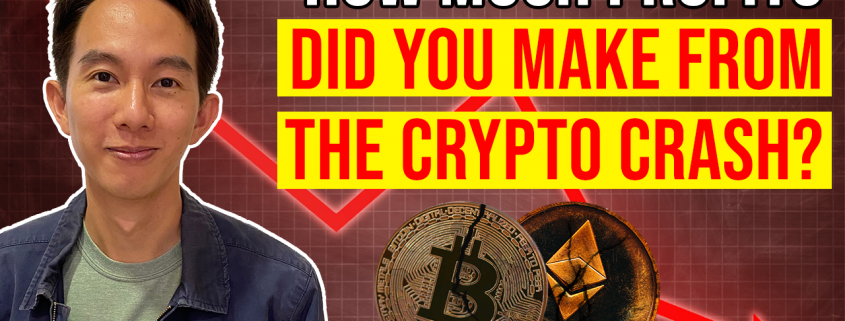
How Much Profits Did You Make from the Crypto Crash?

Market Analysis
thumbnail how much profits did you make from the crypto crash

Recently, there has been a lot of volatility in the Crypto market, with many bullish and bearish factors moving the market, which resulted in a big crash.

In this post, I’m going to do an overview of the crypto and forex market, review some of our recent trades, and discuss the current trading opportunities.

If you want to get all the analysis and charts mentioned in this post ahead of time, don’t forget to join our free telegram channel! https://t.me/synapsetrading


Covid updates

Before we go into the markets, let’s take a quick look at the Covid situation, with a focus on vaccination.

Covid updates

As you can see from this chart, the developed countries have surged ahead with vaccinations, with 50-60% of their population getting at least one dose.

For many of these places, life has almost gone back to normal, and the economic recovery has started.

Unfortunately, this recovery is going to be another K-shape recovery, because if you look at the overall numbers, only 10-15% of the global population has had at least one dose.

My guess is that by Q3 or Q4 this year, travel will resume in some developed countries.

Bitcoin: Shorting the Big Crash!

In early May this year, I started calling for a short on Bitcoin, after seeing the rising wedge pattern which evolved into a head and shoulders pattern.

Bitcoin: Shorting the Big Crash

Bitcoin (BTC/USD) is starting to form a potential reversal pattern. We need to watch out in case this price movement develops. Trade according to the trend! ??


Bitcoin: Buying Opportunity Now

Following up from our Bitcoin (BTC/USD) analysis just a few days ago, we accurately predicted the sharp drop of Bitcoin before it happened!

Congrats to those who followed and shorted! ???


Bitcoin: Buying Opportunity Now?

More recently, I noticed that Bitcoin has bottomed out for the medium-term, so I issued a buy call, which is still valid now.


Bitcoin: Buying Opportunity Now

Following up on our series of uncanny accurate predictions on Bitcoin (BTC/USD), it has now formed a mini double bottom (tweezer bottom), and we could well see a medium-term swing upwards, after the huge sell-down that went into oversold territory.

Though the major trend might still be bearish, this looks like a good low-risk counter-trend buying opportunity to capture a swing up.


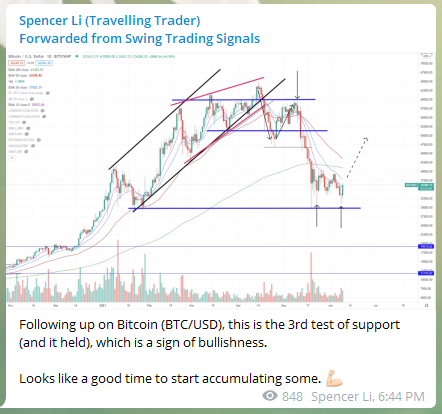
Bitcoin: Buying Opportunity Now 2

Following up on Bitcoin (BTC/USD), this is the 3rd test of support (and it held), which is a sign of bullishness.

Looks like a good time to start accumulating some. ??


Ethereum: Profits from the Crash

Ethereum: Profits from the Crash 2

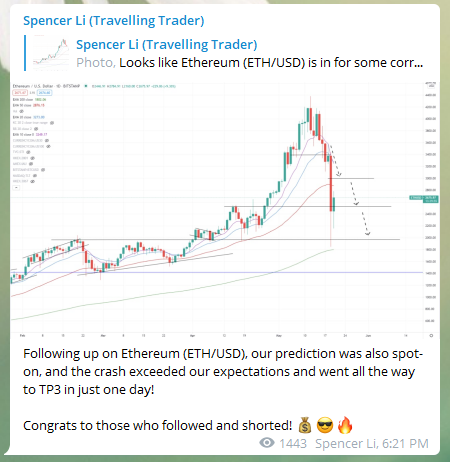
Looks like Ethereum (ETH/USD) is in for some correction as well, with the first major support at 3000. Will reevaluate when prices get there.


Ethereum: Profits from the Crash 2Following up on Ethereum (ETH/USD), our prediction was also spot-on, and the crash exceeded our expectations and went all the way to TP3 in just one day!

Congrats to those who followed and shorted! ???


Recent Forex Trades: AUD/CHF & EUR/JPY

AUD/CHF & EUR/JPY

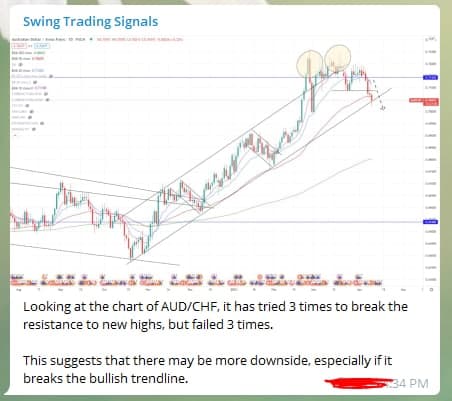
Looking at the chart of AUD/CHF, it has tried 3 times to break the resistance to new highs, but failed 3 times.

This suggests that there may be more downside, especially if it breaks the bullish trendline.


AUD/CHF & EUR/JPY 3

Following up from AUD/CHF, it has broken to new lows as predicted, and is now trending downwards.

Congrats to those who followed! ???


AUD/CHF & EUR/JPY 3EUR/JPY remains on a strong uptrend, clearing the recent resistance, and formed a bull flag after pulling back to the 10&20-EMAs.


AUD/CHF & EUR/JPY 4

Following up on EUR/JPY, it has gone up by +276 pips since our last analysis.

Congrats to those who followed! ???


I have come to the end of this market analysis.

Now that I have shared my views on the various markets, do you think it is a good time to start buying cryptocurrencies?

Let me know in the comments below!

P.S. Check out our mentoring programs if you are keen to start your trading journey today!

2 Comments/by Spencer Li
https://synapsetrading.com/wp-content/uploads/2021/06/thumbnail-how-much-profits-did-you-make-from-the-crypto-crash.png 720 1280 Spencer Li https://synapsetrading.com/wp-content/uploads/2019/10/logo.jpg Spencer Li2021-06-11 19:05:032022-03-07 18:10:53How Much Profits Did You Make from the Crypto Crash?
Spencer Li

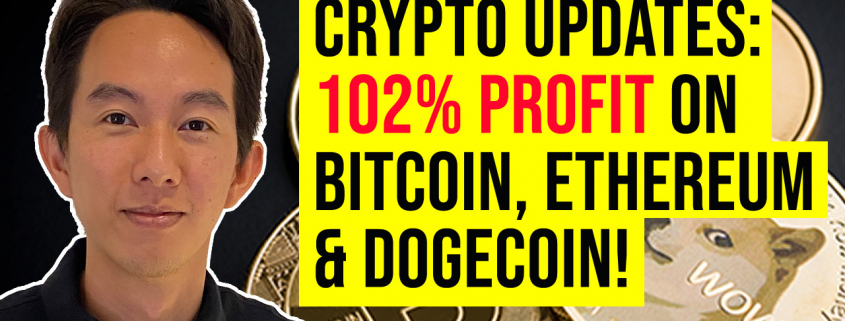
Crypto Updates: 102% Profit on Bitcoin, Ethereum & Dogecoin!

Market Analysis
crypto updates profits

In the most recent FOMC meeting, the Fed held rates unchanged, which was no surprise, and it meant that this liquidity-driven long-term bull market in stocks and crypto will continue running.

Stocks and crypto are actually pretty correlated, and the biggest danger to the uptrend is if yields start rising.

In this post, I’m going to do an overview of the stock and crypto market, as well as review some of our recent trades.


Covid updates

Before we go into the markets, let’s take a quick look at the Covid situation, with a focus on vaccination.

vaccinations

As you can see from this chart, vaccination rollout globally is progressing slowly, with less than 10% of the world population having at least one vaccine dose.

In addition, numerous variants have been detected globally, such as Britain’s B117 strain, Brazilian P1 variant, South Africa’s B1351 and India’s “double-mutant” variant called B1617.

This does not bode well, and we can see a large disparity between the richer and less affluent countries.

Nevertheless, the financial markets seem to disjointed from the real world, as asset prices continue to climb.


Earnings & Employment (NFP)

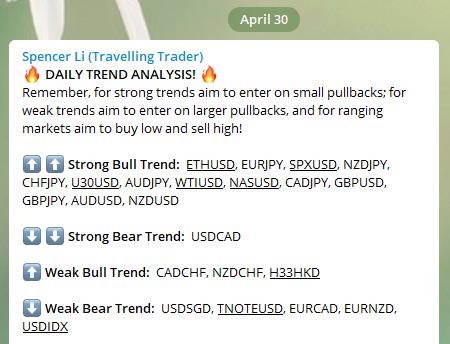
If we look at the daily trends, the crypto market, stock market, and even the oil market are all in a strong bull trend.

vaccinations


And with the recent earnings season, a record 87% of S&P 500 companies have beat earnings estimates, and earnings look to be growing by more than 46%, according to Refinitiv.

Credit Suisse’s chief U.S. equity strategist, Jonathan Golub, has raised his forecast for the S&P 500 based on strong earnings.

He wrote, “we are raising our 2021 S&P 500 price target to 4600 from 4300, representing 9.2% upside from current levels, and 22.5% for the year.”


market-news

This coming week, we will also see the data from the NFP (non-farm payrolls), which will tell us how good the job market is amidst the US recovery from Covid.


Stock Market Targets Hit

In my previous market analysis posts, I predicted the breakout of the S&P 500 with the first target of around 4120 and the second target of 4215.

market-news

On 13 April 2021, it hit the first target of 4120, and in the Telegram screenshot above, I said that it would continue to the next price target of 4215.


SP-500


Just a few days ago, we saw that exact target being hit. Congrats! ???


Bitcoin: 24% profit in 7 days!

Bitcoin was very exciting because we traded it downwards, and then upwards, and both trades were very proftable!

bitcoin-btcusd

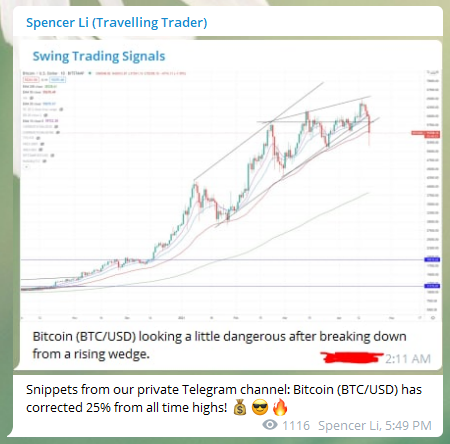
We spotted this rising wedge in Bitcoin, which was bearish, so we took a short position, and from here we saw a 25% correction from its all-time highs.


bitcoin-btcusd1

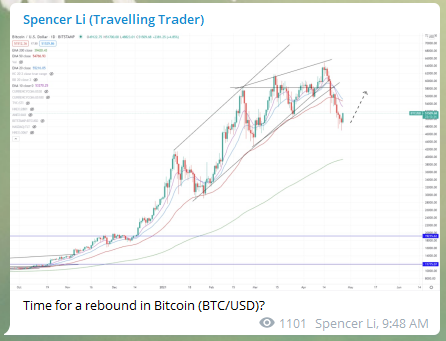
Following that, I pinpointed a rebound for Bitcoin, with uncanny precision.


bitcoin-btcusd3

Within just 2 days, we saw a sharp rebound of 17% from the lows, but we were still not done.


bitcoin-btcusd4

Finally, after 7 days, we took profit at the resistance level, netting a 24% profit in 7 days. Ka-ching! ???


Dogecoin: 38% profit in 5 days!

Dogecoin admittedly was a more volatile creature, so we had to be more careful in finding trading opportunities for this.


bitcoin-btcusd

Finally, we spotted a huge pin bar (bullish hammer candle), and this was the perfect opportunity for a long trade.


bitcoin-btcusd

From there, it went up 38% in the next 5 days, and it still looks like it can continue going up, so we are still holding on to this. ??


Ethereum: 50% Profit in 13 days!

I mentioned in my previous market analysis post that Ethereum is even more bullish than Bitcoin based on the chart, and now you can see why.


bitcoin-btcusd37

In just 13 days after hitting the support level (great place to buy), we netted a profit of 50%, and the price still looks to be heading higher.

At this point, I won’t be too greedy and will take most profits and wait for the next pullback to enter again.


bitcoin-btcusd121

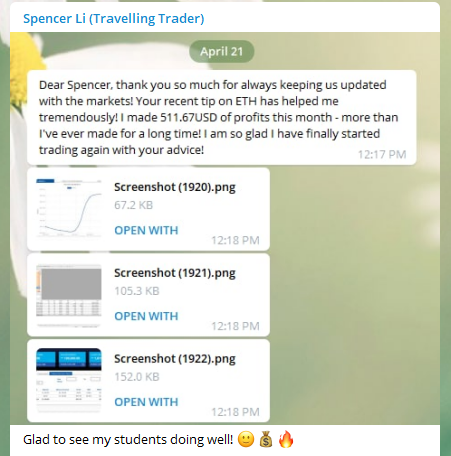
Here’s some feedback from one of my new students, and I’m glad to see they are profiting from the Crypto bull run as well.


I have come to the end of this market analysis.

Now that I have shared my views on the various markets, do you think the markets will continue going up, or will it be a case of “sell in May and go away”?

Let me know in the comments below!

0 Comments/by Spencer Li
https://synapsetrading.com/wp-content/uploads/2021/05/crypto-updates-profits.jpg 720 1280 Spencer Li https://synapsetrading.com/wp-content/uploads/2019/10/logo.jpg Spencer Li2021-05-02 11:20:002022-03-07 18:12:14Crypto Updates: 102% Profit on Bitcoin, Ethereum & Dogecoin!
Page 1 of 3123

Free Trading Guides

Free Trading Guides

Blog Categories

  • Beginner's Guide
  • Blockchain & Crypto
  • Book Summaries
  • Economics & News Trading
  • Investing & Portfolio Management
  • Living Your Best Life
  • Market Analysis
  • Markets & Products
  • News & Events
  • Promotions
  • Risk & Money Management
  • Stock Trading
  • Technical Analysis & Price Action
  • Testimonials
  • Tools & Resources
  • Trading Psychology
  • Trading Strategies
  • Trading Tips
  • Travel & Lifestyle

Free Trading Guides

Free Trading Guides

Contact Us

Synapse Trading Pte Ltd
Registration No. 201316168H

Whatsapp: +65-8897-1204
Telegram: @iamrecneps
Email: info@synapsetrading.com

Links

Disclaimer
Privacy policy
Terms & Conditions
Contact us
Partnerships

© 2012-2024 Synapse Trading | All rights reserved | - powered by Enfold WordPress Theme
  • Link to Facebook
  • Link to X
  • Link to Instagram
  • Link to Youtube
  • Link to LinkedIn
  • Link to Mail
Scroll to top Scroll to top Scroll to top