

Book Summary: Following the Trend by Andreas Clenow
Want the daily routine? Get the free 15-Minute Swing Trader’s Checklist. Get it free →
“Following the Trend” by Andreas Clenow: Book Summary, Key Ideas, and Who Should Read It
Last updated: 24 August 2026 · By Spencer Li, CFTe
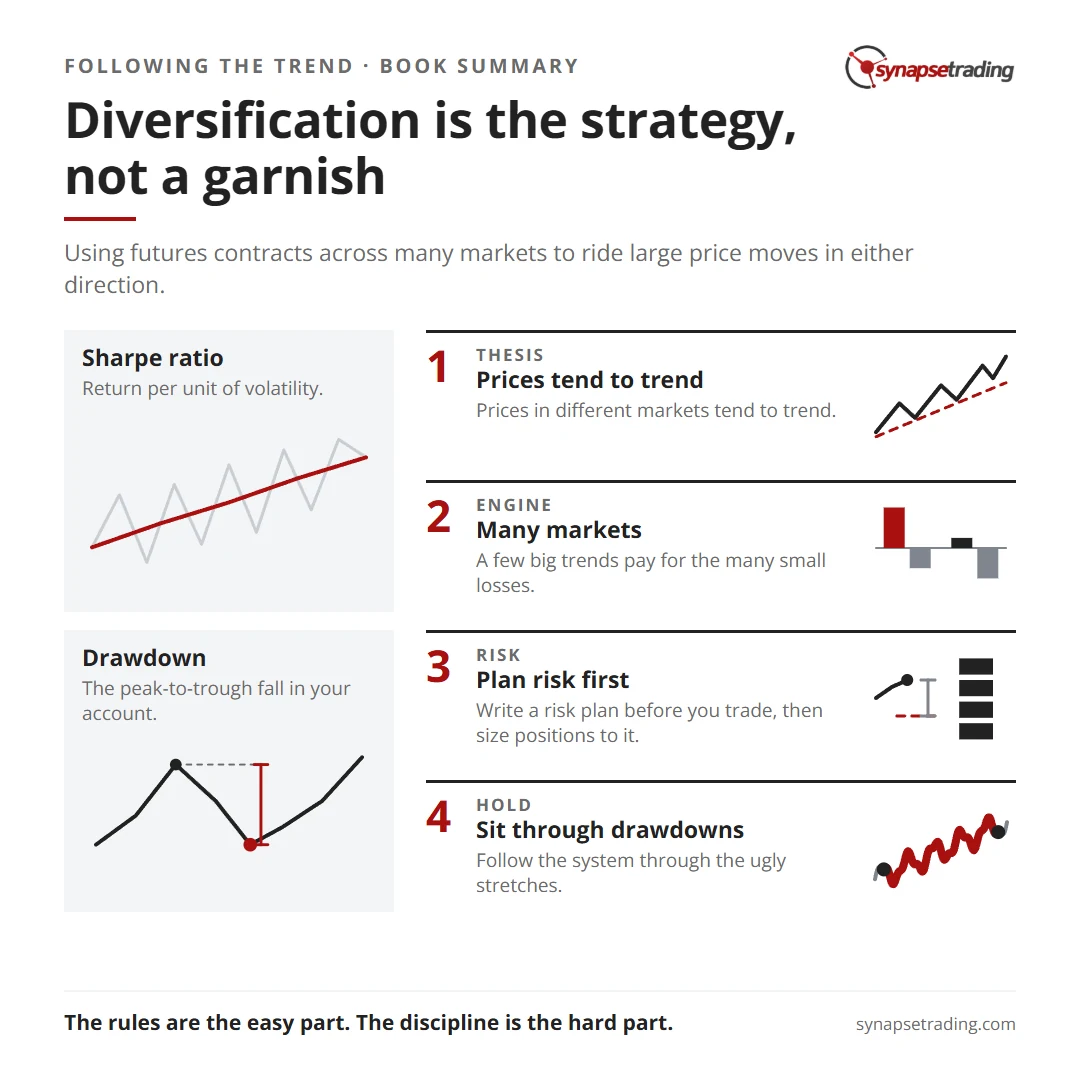
“Following the Trend: Diversified Managed Futures Trading” by Andreas Clenow is a practical guide to systematic trend following, the strategy of using futures contracts across many markets to ride large price moves in either direction. Clenow, CIO and partner of ACIES Asset Management in Zurich, and formerly Reuters’ Global Head of Equity and Commodity Quant Modelling, walks you through how managed futures actually work, why diversification across markets is the engine of the whole approach, and how to evaluate performance honestly using metrics like the Sharpe ratio and drawdown. The core thesis is simple: prices in different markets tend to trend, and a diversified, rules-based system that follows those trends can be a valuable addition to a portfolio. The catch is that it requires real understanding and the stomach for long, painful drawdowns. Personally, I rate it as one of the clearest, least hyped books on the subject. It is best for traders and portfolio managers who want the mechanics of trend following, not beginners looking for a first trading book.
Here is what the book teaches, the ideas worth keeping, and who should actually read it.
What is “Following the Trend” about?
The book explains the ins and outs of managed futures (a strategy that trades futures contracts to bet on the direction of price moves across stocks, bonds, currencies, and commodities). Clenow covers the types of contracts typically used, the benefits and risks of the approach, and how to build a diversified portfolio that incorporates trend following.
What makes it useful is that he does not stop at theory. He shows real-world examples of strategies he has used himself, walks through the mathematics behind trend following, and is honest about where it goes wrong. The main message is that managed futures can earn a real place in a diversified portfolio, but only if you understand the market and the strategies underneath it.
This is not a get-rich book. It is a how-the-machine-works book.
Who is Andreas Clenow?
Andreas Clenow is CIO and partner of ACIES Asset Management in Zurich, and formerly Reuters’ Global Head of Equity and Commodity Quant Modelling. He has over 20 years of experience in the industry, has been a frequent speaker at industry conferences, and has been interviewed and quoted across several financial publications.
That background matters for how you read the book. Clenow writes from inside a real fund, not from the sidelines, so the risk-management and portfolio-construction chapters carry weight that a purely academic treatment would not.
The 10 key ideas, in one table
I find a book like this is easier to hold in your head as a list of claims than as prose. Here are the ten ideas that do the heavy lifting, and why each one matters.
| # | Key idea | Why it matters |
|---|---|---|
| 1 | Managed futures uses futures contracts to bet on the direction of price moves across many markets | It is directional and systematic, not a stock-picking exercise |
| 2 | Prices in different markets tend to trend, and following those trends can be profitable | This is the entire thesis the strategy rests on |
| 3 | The book covers contract types, benefits, risks, and how to build a diversified portfolio | Gives you the full mechanics, not just the highlights |
| 4 | Clenow shows real strategies he has used successfully himself | Grounds the theory in a practitioner’s actual book |
| 5 | Risk management is central, and you need a defined plan before you trade | Trend following lives or dies on how you control losses |
| 6 | Diversification across markets is what mitigates risk | Spreading across uncorrelated markets is the core engine |
| 7 | He maps the managed futures industry and the players in it | Context for where your strategy sits in the wider market |
| 8 | The book examines performance over time and how to evaluate strategies | Teaches you to judge a system, not just admire its returns |
| 9 | He compares fund types, including commodity trading advisers (CTAs) | Helps you choose the right vehicle for your goals |
| 10 | It closes on the future of managed futures, its opportunities and challenges | Frames the strategy as evolving, not a finished answer |
A few of these deserve a closer look.
Diversification is the strategy, not a garnish
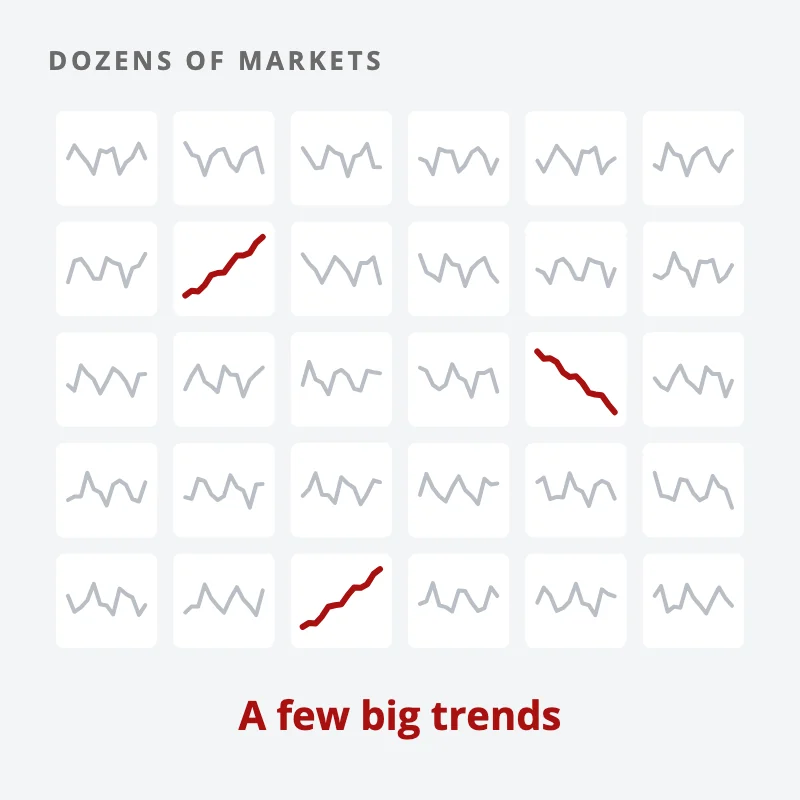
The single most important idea in the book is that diversification across many markets is not a nice-to-have. It is the engine. A trend follower wins because, across dozens of uncorrelated markets, a few large trends pay for the many small losses. Run the same system on one or two markets and you have removed the thing that makes it work.
Risk management before returns
Clenow spends real time on setting up a risk-management plan, because trend following produces long stretches of small losses while you wait for the big trends. Without a plan that sizes positions sensibly and caps your exposure, the drawdowns will shake you out before the payoff arrives.
Judge a system by more than its returns
The book teaches you to evaluate performance with metrics like the Sharpe ratio (return per unit of volatility), drawdown (the peak-to-trough fall in your account), and the information ratio. The point is that a headline return tells you almost nothing on its own. How much pain you took to earn it is the real story.
How to actually apply it
The book gives you a clear set of moves to put the ideas to work. Distilled, they come down to this:
- Research different trend-following strategies and funds, and pick one that fits your goals and risk tolerance.
- Build a diversified portfolio that pairs managed futures with other types of investments.
- Learn the contracts and markets used, and the specific risks and benefits of each.
- Write a risk-management plan before you put money on, then size positions to it.
- Monitor the portfolio regularly and adjust as market conditions change.
Do note that, Clenow is blunt on one point worth repeating: past performance is not a guarantee of future results, and managed futures can be volatile. The drawdowns are real, and they are long.
Where the human edge comes in
A modern platform can backtest a trend-following system in seconds and show you a gorgeous equity curve. That part is close to free now. What it will not do is sit you in the chair through an 18-month drawdown without flinching, or stop you from abandoning the system at the exact moment it is about to work. The rules are the easy part. The discipline to hold position sizing steady and follow the system through the ugly stretches is the hard part, and that is the human edge a backtest can never trade for you.
Should you read it? My honest take
Personally, I would put this on the shelf for anyone serious about systematic trading, but I would not hand it to a complete beginner. It assumes you are comfortable with the idea of futures, position sizing, and reading a performance table. If you have that footing, it is one of the clearest, least hyped books on trend following you can buy, precisely because Clenow writes from inside a real fund and does not dress up the drawdowns.
If you are still picking your first trading book, start elsewhere and come back to this one once the basics are second nature.
For more book picks in the same vein, see our roundup of the best investing and trading books of all time, and if you want the structured reading path, the Synapse book and reading list maps them by level.
FAQ
What is “Following the Trend” by Andreas Clenow about?
It is a practical guide to systematic trend following and managed futures, the strategy of trading futures contracts across many markets to ride large price moves. It covers contracts, diversification, risk management, and how to evaluate performance.
Is “Following the Trend” good for beginners?
Not really. It assumes you are already comfortable with futures, position sizing, and reading performance metrics. Beginners should start with a foundational trading book and come back to this one later.
Who is Andreas Clenow?
CIO and partner of ACIES Asset Management in Zurich, and formerly Reuters’ Global Head of Equity and Commodity Quant Modelling, with over 20 years in the industry. He is a frequent conference speaker and has been quoted across several financial publications.
What is the main lesson of the book?
That diversified, rules-based trend following can earn a place in a portfolio, but only with disciplined risk management and the patience to sit through long drawdowns. Diversification across many markets is the core engine.
What metrics does the book use to judge a strategy?
It uses the Sharpe ratio, drawdown, and the information ratio, to make the point that a headline return means little without knowing how much volatility and pain it took to earn.
Now that you have the key ideas, would you add “Following the Trend” to your reading list? And if you have already read it, what stuck with you most? Let me know in the comments.
Want a system you can actually run? Grab the free 15-Minute Swing Trading Starter Kit. It is the exact routine I use to scan once a day and trade any market in 15 minutes.
About the author. Spencer Li is The 15-Minute Trader and the founder of Synapse Trading. He is a Certified Financial Technician (CFTe) with 15+ years of trading, run from 70+ countries. He holds a B.Acc and B.BM from SMU. Every trade he takes is public, dated, losses left in. He teaches rules-based swing trading in 15 minutes a day, one system for any market.
Education, not financial advice. Synapse Trading is not licensed by MAS to advise on investment products. Trading carries risk of loss; past performance is not indicative of future results.
Related
Best investing and trading books of all time · What is trend following? · Risk management for traders
Want the daily routine? Enter your email for the free 15-Minute Swing Trader's Checklist.
Free 5-page PDF, then occasional trading emails. Education only, not financial advice. Unsubscribe anytime. Kit stores your email in the US: see our privacy policy.
Want to learn the full method? The Trading Mastery Program teaches the 4 strategies I have traded since 2011. It suits beginners and experienced traders.
Rather follow the trades as they happen? Daily Trading Signals is our Telegram channel: my trade ideas with entry, stop and exit, and every trade is public.
Questions about this post? Ask in the free Telegram channel →
Educational content only, not personalised financial advice. Trading carries risk, including loss of capital. Past performance is not indicative of future results. Synapse Trading is not licensed or regulated by MAS.

