

Book Summary: Flash Boys: A Wall Street Revolt by Michael Lewis
Want the daily routine? Get the free 15-Minute Swing Trader’s Checklist. Get it free →
Flash Boys by Michael Lewis: Summary, Key Ideas, and What Traders Can Learn
Last updated: 26 September 2026 · By Spencer Li, CFTe
“Flash Boys: A Wall Street Revolt” is Michael Lewis’s 2014 non-fiction book arguing that the US stock market is rigged in favour of high-frequency trading (HFT) firms (traders who use very fast computers and algorithms to buy and sell in fractions of a second). It follows Brad Katsuyama, a trader who discovers that his orders are being front-run by faster players, and who responds by building IEX, a fairer exchange designed to neutralise the speed advantage. The core claim is simple: a small group of insiders pay for a head start measured in milliseconds, and they use it to skim from everyone else. The book became a New York Times bestseller and put HFT into mainstream conversation.
For a swing trader or long-term investor, the practical takeaway is calmer than the headline. You are not competing with these firms on speed, so the rigging Lewis describes barely touches a trade you hold for days or weeks. What the book is really worth reading for is the lesson underneath the technology: know the structure of the market you trade in, and do not assume the playing field is level.
Here is what the book covers, the key ideas, and where it actually matters for how you trade.
What is Flash Boys about?
The book is about the rise of high-frequency trading and what it did to the stock market. Lewis’s central argument is that the market is rigged in favour of a select group of insiders who use HFT to gain an unfair advantage over ordinary investors.
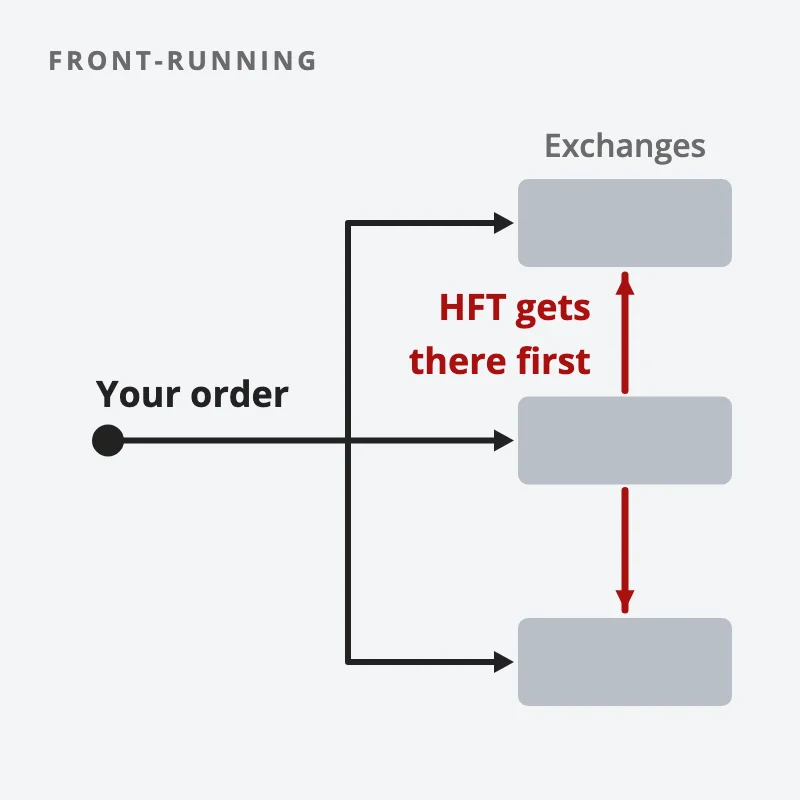
The story is told through Brad Katsuyama, an up-and-coming trader who becomes frustrated when he notices something strange: every time he tries to buy a large block of stock, the price moves away from him before his order fills. He works out that faster traders are seeing his order on one exchange and racing ahead to other exchanges to trade before he gets there. That is front-running, dressed up in fibre-optic cable.
Rather than just complain, Katsuyama builds a solution. He and his team create IEX, a new exchange with a deliberate speed bump (a tiny delay that cancels out the head start the fastest firms had paid for). The book frames IEX as a potential fix for the problem it spends most of its pages describing.
About the author: Michael Lewis
Michael Lewis is a financial journalist and author known for turning complex finance into stories regular readers can follow. His other well-known books include “The Big Short” (the 2008 housing collapse) and “Moneyball” (data versus gut in baseball).
His strength is the same in all three: take a closed, jargon-heavy world and explain it through a few characters you actually care about. That is why Flash Boys reads like a thriller even though the subject is market microstructure. Do note that this is also its limitation, which I will come back to.
The 10 key ideas, at a glance
The original post listed the book’s main points. Here they are grouped so you can see what is a claim about the market versus what is a claim about the people in it.
| # | Key idea | What it means |
|---|---|---|
| 1 | HFT runs on speed | Powerful computers and algorithms buy and sell at speeds no human can match |
| 2 | Speed is an edge you can buy | Faster firms see information and reach exchanges sooner, so they trade first |
| 3 | The market is fragmented | Orders travel across many exchanges, and the gap between them is where HFT operates |
| 4 | Lewis says the market is rigged | Structured to favour HFT firms over ordinary investors |
| 5 | HFT affects volatility and liquidity | The book argues it can increase volatility and reduce real liquidity |
| 6 | The exchanges are part of the problem | They sell speed and access, so their incentives are not neutral |
| 7 | Brad Katsuyama is the protagonist | A trader who finds the problem and decides to act |
| 8 | IEX is the proposed fix | An exchange with a speed bump to cancel the HFT head start |
| 9 | The deeper theme is integrity | The book is as much about fairness in finance as it is about technology |
| 10 | It calls for reform | More transparency and regulation to level the playing field |
If you only remember one row, make it #4 and #8 together: Lewis defines a problem (the market is rigged for speed) and offers a concrete answer (a fairer venue), which is what makes the book feel like more than a complaint.
Does high-frequency trading affect ordinary traders?
For a day trader scalping a few ticks, market structure matters, and Flash Boys is directly relevant. For a swing trader or investor, it matters far less than the book’s tone suggests.
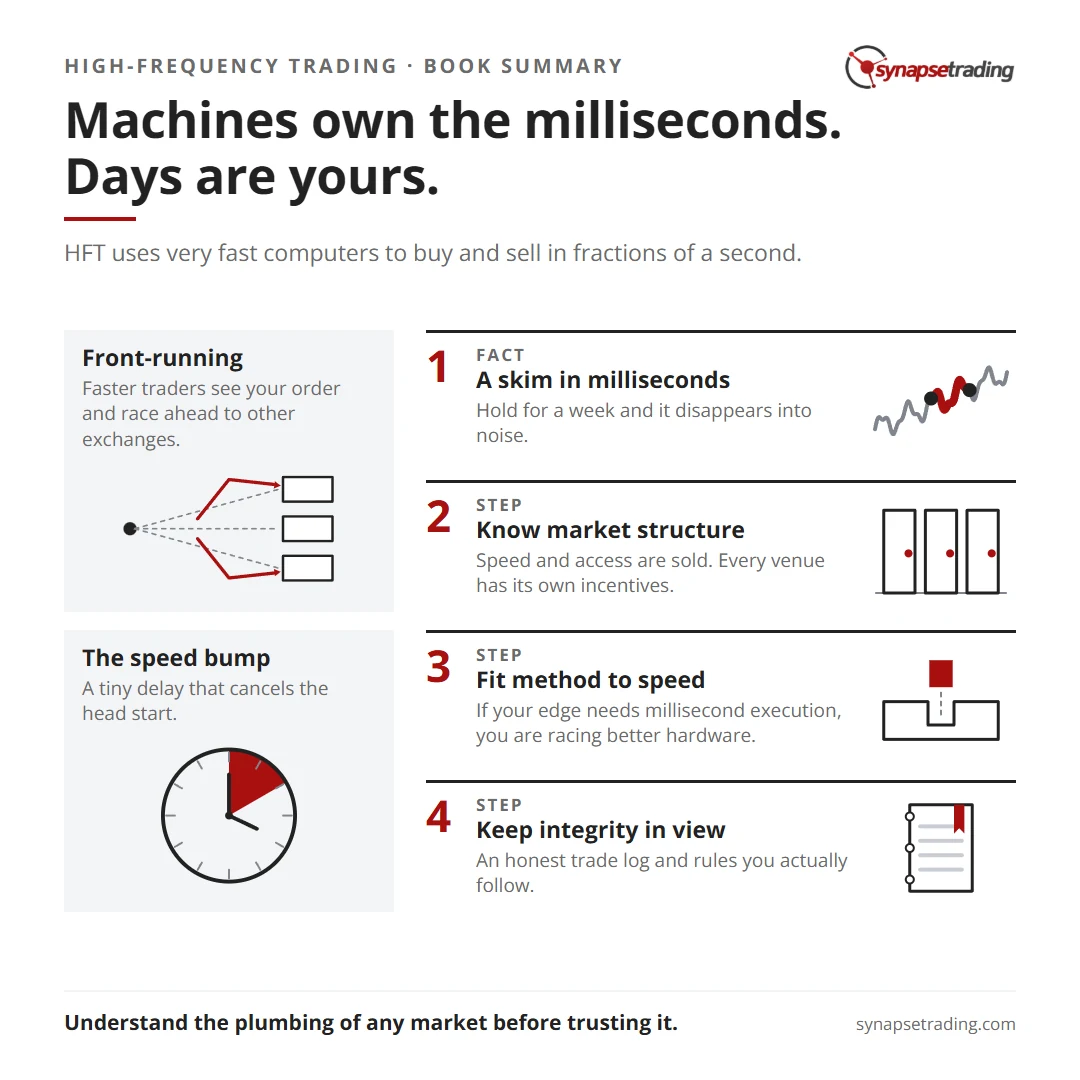
The skim Lewis describes is measured in fractions of a cent over milliseconds. If you are entering on a daily chart and holding for a week, that fraction of a cent disappears into noise. Your real risks are your entry, your stop, your position size, and your own behaviour, none of which an HFT firm touches.
So read Flash Boys for awareness. The lasting value is the reminder to understand the plumbing of any market before trusting it, not the fear that a robot is picking my pocket on a multi-day swing.
How to actually apply the book
The original “10 ways to apply” list mostly repeated the key ideas. Stripped down, there are really three uses for this book as a trader.
- Understand market structure. Know that the market is fragmented across exchanges, that speed and access are sold, and that the venue you trade on has its own incentives. You do not need to beat HFT; you need to not be naive about how the machine works.
- Calibrate your method to your speed. Flash Boys is a warning to anyone whose edge depends on being fast. If your strategy needs millisecond execution to work, you are racing people with better hardware and deeper pockets. A slower, structural edge sidesteps that race entirely.
- Keep integrity in view. The book’s quieter argument is about fairness and trust. As a trader, the version of that you control is your own discipline: an honest trade log, rules you actually follow, and no stories you tell yourself after a loss.
What the book gets right, and where it is thin
Flash Boys is well written and genuinely accessible, which is its biggest strength and the reason I recommend it. You can hand it to someone with zero finance background and they will finish it.
But it is one perspective, told as a clean good-versus-evil story, and real markets are messier than that. HFT also tightens spreads and adds liquidity in normal conditions, which the narrative underplays. And it was written in 2014, so it does not cover what has happened in market structure and regulation since. Read it as a vivid introduction and a strong argument.
Where the human edge comes in
A faster computer will always beat you to a millisecond trade. That race is lost before you start, and Flash Boys is 300 pages of proof. So do not compete there. The edge that does not depend on hardware is judgment: choosing a timeframe where speed stops mattering, sizing the trade, and following your own rules when the market is loud. The machines own the milliseconds. The days and weeks are still yours, and that is the first of the Five Edges no algorithm can trade for you.
FAQ
What is Flash Boys by Michael Lewis about?
It is a 2014 non-fiction book arguing that high-frequency trading firms have rigged the US stock market in their favour by paying for a speed advantage. It follows trader Brad Katsuyama as he uncovers the problem and builds IEX, a fairer exchange, in response.
Is Flash Boys based on a true story?
Yes. It is non-fiction. Brad Katsuyama and the IEX exchange are real, and the book reconstructs real events around the rise of high-frequency trading.
What is high-frequency trading in simple terms?
High-frequency trading (HFT) is using very fast computers and algorithms to buy and sell huge numbers of shares in fractions of a second, profiting from tiny price differences and from being faster than everyone else.
Should swing traders or long-term investors worry about HFT?
Not much. The advantage HFT firms have is measured in milliseconds, which has almost no effect on a position you hold for days, weeks, or years. It matters most for very short-term, high-speed strategies.
Is Flash Boys worth reading?
Yes, as an accessible introduction to market structure and a strong argument about fairness in finance. Just read it as one well-told perspective, written in 2014, rather than a complete or neutral account.
Now that you have the summary, would you add Flash Boys to your reading list? And if you have already read it, what stuck with you? Let me know in the comments.
If you want more like this, read the pillar: Best Investing and Trading Books of All Time.
Want a system you can run without the speed race? Grab the free 15-Minute Swing Trading Starter Kit. It is the exact routine I use to scan once a day and trade any market in 15 minutes, no fast computer required.
About the author. Spencer Li is The 15-Minute Trader and the founder of Synapse Trading. He is a Certified Financial Technician (CFTe) with 15+ years of trading, run from 70+ countries. He holds a B.Acc and B.BM from SMU. Every trade he takes is public, dated, losses left in. He teaches rules-based swing trading in 15 minutes a day, one system for any market.
Education, not financial advice. Synapse Trading is not licensed by MAS to advise on investment products. Trading carries risk of loss; past performance is not indicative of future results.
Related
Best Investing and Trading Books of All Time
Want the daily routine? Enter your email for the free 15-Minute Swing Trader's Checklist.
Free 5-page PDF, then occasional trading emails. Education only, not financial advice. Unsubscribe anytime. Kit stores your email in the US: see our privacy policy.
Want to learn the full method? The Trading Mastery Program teaches the 4 strategies I have traded since 2011. It suits beginners and experienced traders.
Rather follow the trades as they happen? Daily Trading Signals is our Telegram channel: my trade ideas with entry, stop and exit, and every trade is public.
Questions about this post? Ask in the free Telegram channel →
Educational content only, not personalised financial advice. Trading carries risk, including loss of capital. Past performance is not indicative of future results. Synapse Trading is not licensed or regulated by MAS.

