

Book Summary: Fortune’s Formula by William Poundstone
Want the daily routine? Get the free 15-Minute Swing Trader’s Checklist. Get it free →
Fortune’s Formula by William Poundstone: the Kelly Criterion, and How Traders Actually Use It
Last updated: 25 August 2026 · By Spencer Li, CFTe
Fortune’s Formula by William Poundstone is the story of the Kelly criterion, a formula that tells you how much of your money to bet on a single opportunity to grow your bankroll fastest over the long run without going broke. John Kelly, a physicist at Bell Labs, published it in 1956. The book traces how it travelled from information theory to blackjack tables (Edward Thorp), to Wall Street, and into the hands of gamblers and investors. The core idea is simple: bet a fraction of your capital that scales with your edge. The bigger your advantage and the better your odds, the more you commit. No edge, no bet.
The practical formula for an even-money bet is f = p − q, where f is the fraction of your bankroll to stake, p is your probability of winning, and q (which is 1 − p) is your probability of losing. For payouts that are not even money, it becomes f = (bp − q) / b, where b is the odds received (your reward-to-risk). For traders, the takeaway is not the algebra. It is this: size is a function of edge, and most people who blow up were not wrong about the trade, they were wrong about the size.
Here is what the book actually teaches, and how to use Kelly without it destroying your account.
What is the Kelly criterion?
The Kelly criterion is a position-sizing rule. It answers one question: given an edge, what fraction of my capital maximises the long-term growth rate of my bankroll?
Most people size by feel. They bet big when they feel confident and small when they are scared, which usually means biggest right before the loss that hurts most. Kelly replaces the feeling with a number. You feed in your win probability and your payout, and it returns the stake that grows your money fastest over a long series of bets.
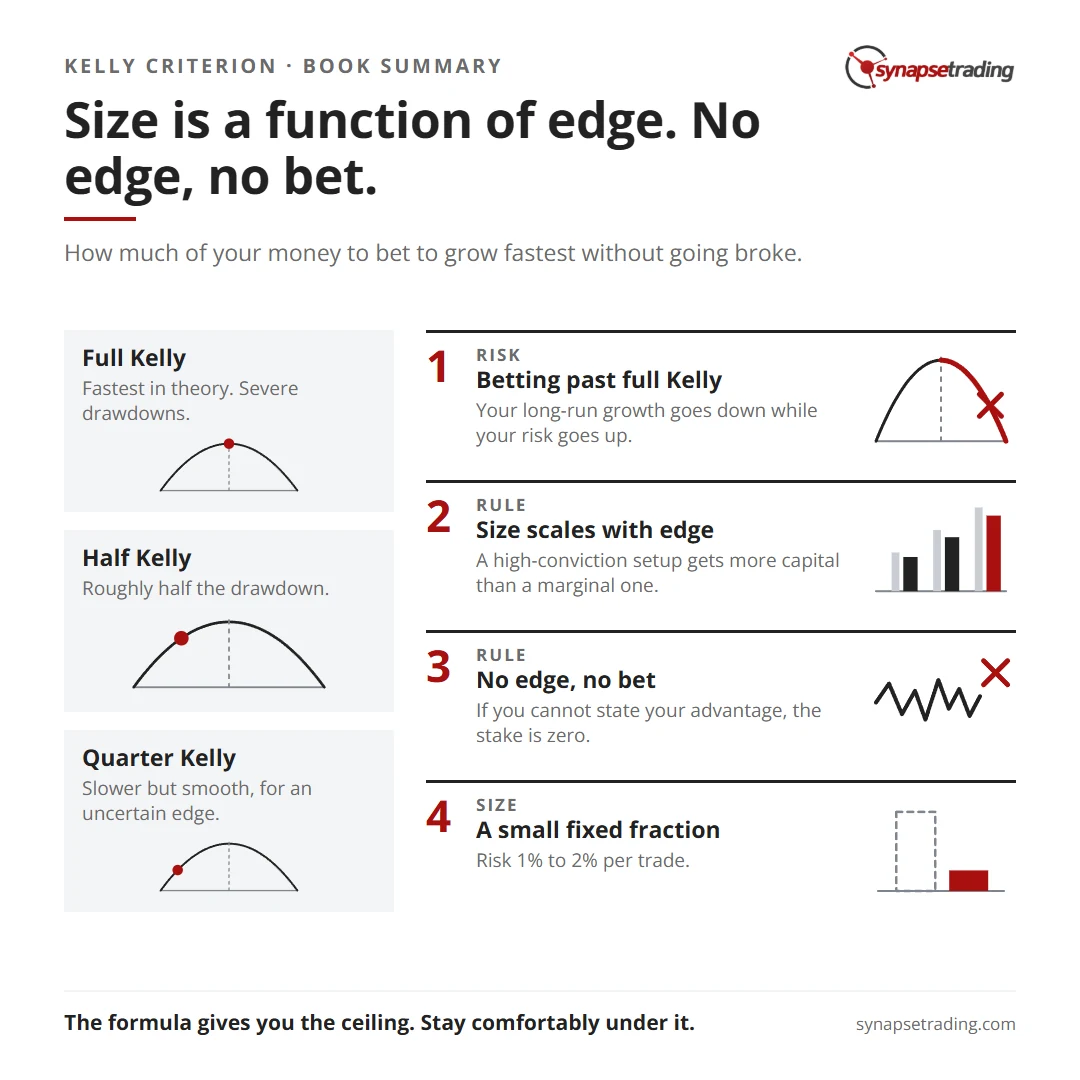
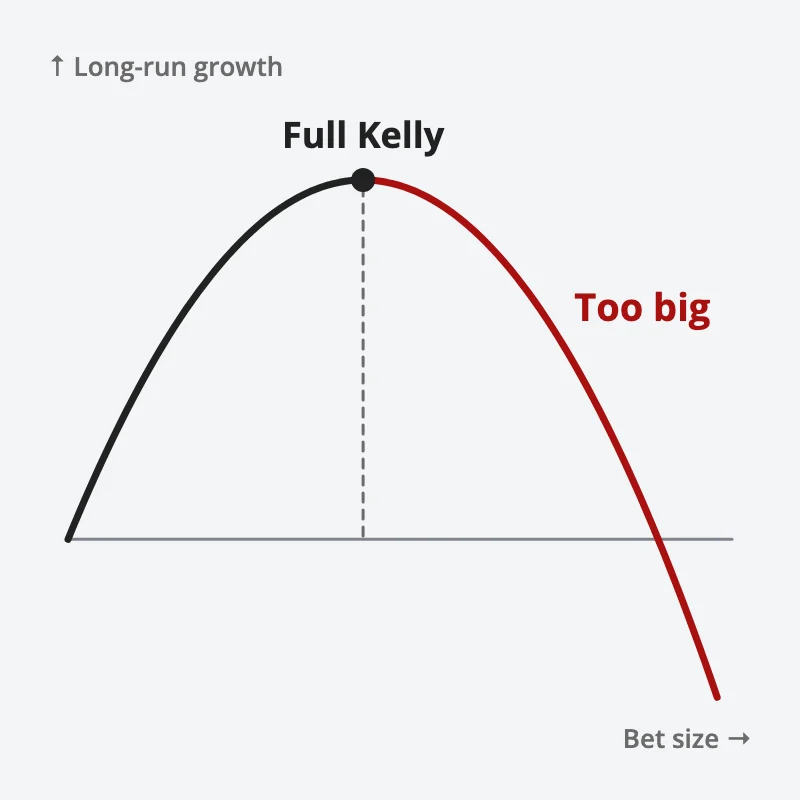
The important word is long-term growth, not expected value. You can have a positive-expectation bet and still go broke if you size it too big, because one bad streak wipes you out before the math has time to work. Kelly is the line that separates “growing as fast as possible” from “growing, but flirting with ruin.” Bet more than full Kelly and your long-run growth actually goes down while your risk goes up. That is the part most people miss.
The story behind the book
John L. Kelly Jr. published the formula in 1956 in a Bell Labs paper on information theory. He was not trying to beat casinos. He was working on the rate at which information can be transmitted over a noisy line, and the same math turned out to describe how fast a gambler with an edge should grow a bankroll.
The person who carried it into the real world was Edward Thorp, the mathematician who used it to beat blackjack (the Beat the Dealer story) and later ran a hedge fund on the same principle. Poundstone follows the formula from Bell Labs to Las Vegas to Wall Street, with a cast that includes Claude Shannon (the father of information theory), mob-connected bookmakers, and the academics who spent decades arguing about whether Kelly was genius or recklessness.
William Poundstone is a science writer and journalist who studied physics at MIT and has written for The New York Times, Harper’s and Harvard Business Review. He is also the author of Priceless: The Myth of Fair Value. Fortune’s Formula is his best-known book and Amazon’s editors named it their top nonfiction pick of 2005.
A worked example: how Kelly sizing works in practice
Say you have a setup that wins 55% of the time and pays you 1-to-1 (you risk one unit to make one unit). Plug it in:
f = (bp − q) / b = (1 × 0.55 − 0.45) / 1 = 0.10
Full Kelly says bet 10% of your bankroll on that trade. On a $10,000 account, that is $1,000 of risk. To most traders, that is a terrifyingly large number, and that reaction is correct. Full Kelly is the maximum growth size, and it comes with brutal drawdowns. A run of bad luck at 10% per trade will cut your account in half and barely register as unusual.
That is why almost nobody trades full Kelly. They trade a fraction of it.
Full Kelly vs fractional Kelly
| Sizing | Stake on the example above | Long-run growth | Drawdown / ruin risk | Who uses it |
|---|---|---|---|---|
| Full Kelly | 10% of bankroll | Fastest, in theory | Severe, swings of 50%+ are normal | Almost nobody, in practice |
| Half Kelly | 5% of bankroll | ~75% of full Kelly’s growth | Roughly half the drawdown | Many professionals |
| Quarter Kelly | 2.5% of bankroll | Slower but smooth | Low | Conservative / uncertain-edge traders |
The reason half Kelly is so popular is the trade-off it offers. You give up only about a quarter of your growth rate but you cut your drawdowns roughly in half. For a real human with a real stomach and a real career, that is a far better deal than chasing the theoretical maximum.
There is a deeper reason to size down too. Full Kelly assumes you know your edge exactly. You do not. Your “55% win rate” is an estimate from a finite sample, and it is probably optimistic. When your inputs are uncertain, betting the full Kelly fraction on a wrong number can put you above full Kelly on the real number, which is the worst place to be. Sizing down is your margin of safety against your own estimation error.
The formula gives you the ceiling. Your job is to stay comfortably under it.
How traders actually apply Kelly
You do not need to plug numbers into the equation before every trade. The useful part of Kelly is the principle, and it shows up in a few concrete habits:
- Size scales with edge. A high-conviction setup with a strong reward-to-risk gets more capital than a marginal one. Same trader, same account, different size, because the edge is different.
- No edge, no bet. If you cannot state why you have an advantage, Kelly says the optimal stake is zero. That is the formula telling you to stand aside.
- Risk a fixed small fraction of your account. Risking 1% to 2% of your account per trade is, in effect, a conservative fractional-Kelly rule. As your account grows or shrinks, your position size moves with it.
- Better odds and bigger edge both raise the size, but the size is capped. Even a great setup gets a ceiling, because a string of “great” setups can still lose in a row.
The thing Kelly protects you from is the single most common way traders die: being right about direction and wrong about size. You can have a genuine edge and still go to zero by betting too much of it on each trade. Kelly is the math that says exactly how much is too much.
Where the human edge comes in
A spreadsheet will compute the Kelly fraction in a second. What it will not do is tell you that your 55% win rate is really 51% once you stop cherry-picking your sample, or that you are about to override your own sizing rule because the last three trades won and you feel invincible. The formula is the easy part. Sizing honestly, against an edge you have not flattered, and holding that size when your gut is screaming to do otherwise, is the discipline. That is the discipline and sizing edge, one of the Five Edges no formula trades for you.
Should you read Fortune’s Formula?
Yes, if you want the story and the intuition behind position sizing. It is a narrative book. You will finish it understanding why sizing matters and where the idea came from, with a cast of memorable characters along the way. What it will not give you is a step-by-step trading manual, you have to translate the principle into your own rules yourself.
I would put it on the shelf next to the practical risk-and-sizing material. Read it for the why, then build your own fractional-Kelly rule for the how.
FAQ
What is the Kelly criterion in simple terms?
It is a formula that tells you what fraction of your money to bet on an opportunity to grow your bankroll fastest over the long run without risking ruin. The bigger your edge and the better your odds, the larger the fraction. With no edge, the optimal bet is zero.
What is the Kelly criterion formula?
For an even-money bet it is f = p − q, where p is your win probability and q is your loss probability. For non-even payouts it is f = (bp − q) / b, where b is the reward-to-risk odds. The result, f, is the fraction of your bankroll to stake.
Why do professionals use fractional Kelly instead of full Kelly?
Full Kelly gives the fastest theoretical growth but produces severe drawdowns and assumes you know your edge exactly. Half Kelly keeps about 75% of the growth while roughly halving the drawdown, and it leaves a safety margin for the fact that your edge is only an estimate.
Who wrote Fortune’s Formula and what is it about?
William Poundstone, a science writer and journalist. The book tells the history of the Kelly criterion, from John Kelly at Bell Labs through Edward Thorp’s use of it to beat blackjack and run a hedge fund, and how the same math applies to gambling and investing.
Can the Kelly criterion be used for stock trading?
Yes, as a position-sizing principle rather than a precise formula. Most traders apply it as a conservative fractional version, risking a small fixed percentage of the account per trade, and sizing up only when the edge and reward-to-risk genuinely justify it.
Now that you have the formula and the half-Kelly trade-off, the real question is the one most people skip: what is your honest edge, before you flatter it? Get that number right and the sizing takes care of itself. Let me know in the comments how you size your trades.
And if you want the wider reading list this book sits on, see the pillar: Best Investing and Trading Books of All Time.
Want the system the sizing plugs into? Grab the free 15-Minute Swing Trading Starter Kit. It is the exact routine I use to scan once a day and trade any market in 15 minutes, sizing included.
About the author. Spencer Li is The 15-Minute Trader and the founder of Synapse Trading. He is a Certified Financial Technician (CFTe) with 15+ years of trading, run from 70+ countries. He holds a B.Acc and B.BM from SMU. Every trade he takes is public, dated, losses left in. He teaches rules-based swing trading in 15 minutes a day, one system for any market.
Education, not financial advice. Synapse Trading is not licensed by MAS to advise on investment products. Trading carries risk of loss; past performance is not indicative of future results.
Related
Best Investing and Trading Books of All Time · Position sizing and risk management · The Five Edges
Want the daily routine? Enter your email for the free 15-Minute Swing Trader's Checklist.
Free 5-page PDF, then occasional trading emails. Education only, not financial advice. Unsubscribe anytime. Kit stores your email in the US: see our privacy policy.
Want to learn the full method? The Trading Mastery Program teaches the 4 strategies I have traded since 2011. It suits beginners and experienced traders.
Rather follow the trades as they happen? Daily Trading Signals is our Telegram channel: my trade ideas with entry, stop and exit, and every trade is public.
Questions about this post? Ask in the free Telegram channel →
Educational content only, not personalised financial advice. Trading carries risk, including loss of capital. Past performance is not indicative of future results. Synapse Trading is not licensed or regulated by MAS.

