• Link to Facebook
  • Link to X
  • Link to Instagram
  • Link to Youtube
  • Link to LinkedIn
  • Link to Mail
Synapse Trading
  • Home
  • About
    • My Background
    • My Trading Journey
    • My Travel Log
    • Media & Interviews
  • Mentoring
    • Trading Mastery Program
    • Results & Testimonials
  • Signals
    • Telegram (Free to join!)
    • Daily Trading Signals
    • Daily Trading Signals (Results)
  • Resources
    • Free Trading Guides
    • Tools & Resources
    • Blog & Infographics
  • Contact
    • Contact Us
    • Partnership Opportunities
  • Click to open the search input field Click to open the search input field Search
  • Menu Menu

Tag Archive for: crypto

Spencer Li

What are the Best Stablecoins and are they a Good Crypto Investment?

Blockchain & Crypto
stablecoins

Best Stablecoins to Invest In: A Trader’s Honest Guide (USDT, USDC, DAI and More)

Last updated: 3 July 2026 · By Spencer Li, CFTe


A stablecoin is a cryptocurrency pegged to an outside asset (usually the US dollar) so its price stays near a fixed value instead of swinging like Bitcoin. The best-known ones are Tether (USDT) and USD Coin (USDC), both pegged 1:1 to the dollar and used mainly as a stable place to park funds between trades, move money across exchanges cheaply, and reduce volatility. They are useful tools, but they are not “risk-free.” A stablecoin is only as stable as the asset behind it and the company holding the reserve. Personally, I do not buy stablecoins as an investment. I hold crypto for capital appreciation, and a coin designed to never go up is not that. Where they earn their place is as plumbing: cheap, fast transfers and a parking spot during volatility, not a way to grow your money.

Here is what stablecoins are, the four most cited names, the real risks, and when (and when not) to use them.

What is a stablecoin, and how does it stay stable?

A stablecoin is a non-volatile cryptocurrency pegged to an external real-world asset, most often a fiat currency (a government-issued currency like the US dollar). The idea is simple. If one token is backed 1:1 by US dollars, then one token should always be worth about $1, in cash or cash-equivalents and very short-term government securities.

That peg is what removes the wild price swings. With a normal cryptocurrency, the value can plummet at any time. With a fiat-backed stablecoin, the value is meant to stay flat by design, hence the word “stable.”

The backing is the whole point. For every stablecoin in circulation, the issuer is supposed to hold an equivalent asset in reserve. A well-run issuer has that reserve overseen by an independent custodian and audited regularly to prevent fraud. When this works, it is one of the more reliable corners of crypto. When it does not, you get the problems we cover further down.

Do note that, for now, you mostly cannot spend stablecoins on everyday purchases. They are not yet a widely accepted mode of payment. In practice, traders buy and hold them inside the crypto system, using other cryptocurrencies, as a stable base rather than as walking-around money.

What are the types of stablecoins?

Not all stablecoins are pegged to fiat. They split into a few categories based on what backs them, and the backing tells you a lot about the risk.

TypeWhat backs itCollateral ratioExample tokens
Fiat-backedCash and cash-equivalents (e.g. US dollars)1:1USDT, USDC
Metal-backedPrecious metals (gold, silver)1 token = a fixed weight (e.g. 1g gold)Tether Gold (XAUT), PAX Gold (PAXG), Digix Global (DGX)
Crypto-backedOther cryptocurrencies, over-collateralisedAbout 1:3 ($3 of crypto per $1 of coin)DAI
AlgorithmicNothing. An algorithm controls supplyNo collateral(the riskiest category)

A few notes on the trickier ones.

Metal-backed coins track a commodity instead of a currency. One token equals a fixed weight of gold, and like fiat-backed coins they keep reserves behind the tokens.

Crypto-backed coins solve the volatility problem with over-collateralisation. Because the backing (crypto) is itself volatile, the issuer holds far more than 1:1. A roughly 3:1 ratio means $3 of crypto sits in reserve for every $1 of stablecoin, giving a buffer if the collateral drops.

Algorithmic coins are backed by nothing physical. An algorithm expands and contracts the supply to push the price back toward the peg. When demand rises and the price climbs, the algorithm issues more coins to bring it down; when demand falls, it removes supply. This is the category to treat with the most caution. Several high-profile algorithmic coins have lost their peg badly, and “the maths will hold the price” is a promise that only works until it suddenly does not.

Why do traders use stablecoins?

Beyond a steady value, stablecoins carry a few practical advantages that come from living on a blockchain.

Because they are part of decentralised finance (DeFi, financial services run on blockchains instead of through banks), there is no intermediary institution sitting in the middle of a transfer. You move value directly, without a third party’s permission, and without a third party’s fee. You still pay a small network fee to use the blockchain, but not a bank’s cut on top.

Those blockchain networks are public ledgers that record every transaction for anyone to audit and inspect. That transparency is genuinely useful, and traders value it.

Most importantly for an active trader, the transfers are simple, fast, and not boxed in by geography. If you are moving funds between exchanges or in and out of positions, a stablecoin is often the cheapest and least volatile way to do it.

The four most-cited stablecoins to know

There are roughly 200 stablecoins in existence, released or in development, and most of them you will never need to think about. A handful carry almost all the real volume. Here are the four names that come up most, with what to know about each.

1. Tether (USDT)

Tether is a fiat-collateralised, blockchain-based stablecoin, pegged 1:1 to the US dollar, so 1 USDT is meant to equal $1. It launched in 2014 (originally as RealCoin, then renamed Tether) and has grown into a major source of liquidity for the entire crypto market. You can buy it on most large exchanges. It is the most-used stablecoin by a wide margin, which is also why its reserve transparency gets the most scrutiny (more on that below).

2. USD Coin (USDC)

USDC is also pegged 1:1 to the US dollar. It was created through a collaboration between Coinbase (a well-known US exchange) and Circle (a Boston-based payments technology company), and the tokens you hold are ERC-20 tokens, the standard token format on the Ethereum blockchain.

USDC’s selling point is regulatory cleanliness. It operates under US money-transmission rules, its reserves are audited regularly by a major accounting firm, and the attestation reports are published publicly. For traders who care most about reserve transparency, USDC is usually the first name mentioned.

3. Binance USD (BUSD)

BUSD was a fiat-backed stablecoin pegged 1:1 to the US dollar, issued by Paxos (a New York-regulated blockchain firm) in partnership with Binance, and approved by the New York State Department of Financial Services. It was known for fast, flexible transactions.

I am keeping it on this list because you will still see it referenced everywhere, but with an important update: issuance of new BUSD was wound down in 2023 after the New York regulator directed Paxos to stop minting it. The lesson is the useful part. Even a regulated, well-run stablecoin can be switched off by the authority that approved it. That is a centralisation risk you do not get with the assets stablecoins are meant to imitate.

4. Dai (DAI)

DAI is the odd one out, and the most interesting. It is an ERC-20 token, but instead of one company holding dollars in a bank, DAI is backed by a basket of cryptocurrencies locked in smart contracts (self-executing code on the blockchain), over-collateralised to hold a roughly 1:1 value against the US dollar.

That makes it far more decentralised than the others. There is no single company that can be fined, fail, or be told to stop. For users in countries with unstable, depreciating currencies, DAI offers a form of financial inclusion: a dollar-like store of value they can reach without a traditional bank.

What are the risks of stablecoins?

Stablecoins were built to fix volatility, but they bring their own problems. These three matter most.

1. Most are centralised. This is the big one, and it is almost the opposite of what people come to crypto for. A typical fiat-backed stablecoin is owned and issued by a single company. Tether (USDT) is issued by Tether Limited, which controls the supply and distribution of the coin. If that company fails, freezes, or is shut down, the value of its coin is at risk, and that is a real loss for holders. BUSD above is the live example of this exact risk playing out.

2. Reserves are not always transparent. You buy a stablecoin trusting that a real dollar (or real asset) is sitting in reserve behind it. There is no guarantee that it actually is. Tether is the case in point: in 2018 it was fined over its reserve disclosures, and the coin briefly slipped off its peg before recovering. “Trust us, the money is there” is not the same as “here is the audit.”

3. The underlying asset can move too. A stablecoin is only as stable as what it is pegged to. Peg it to the US dollar and you have imported the dollar’s exposure to inflation, economic downturns, and black-swan events. A sudden dollar crash is highly unlikely, but “unlikely” is not “impossible.” A stablecoin is only as stable as the external asset behind it.

Are stablecoins a good investment?

Here is my honest take. There is no such thing as a “risk-free” investment in crypto, and stablecoins do not change that. Before you put money into an entirely new digital financial system, you are taking a leap of faith, peg or no peg.

Personally, I do not buy stablecoins as an investment. When I hold crypto, I am looking for capital appreciation. A coin engineered to never move is not going to deliver that. If I want exposure to the US dollar, I would rather hold dollars directly than take on the extra company risk, reserve risk, and platform risk of a token that merely tracks them.

Where stablecoins do earn their place is as a tool, not a bet:

  • Moving funds. If you are pushing a lot of money through crypto exchanges, stablecoins cut transaction costs and reduce volatility during the transfer.
  • Storing value in a weak-currency country. If your home currency is depreciating, a dollar-pegged stablecoin can be a way to preserve purchasing power without a traditional bank.

That distinction (tool versus investment) is itself a small example of the trader’s edge. A screener can tell you a coin is pegged to the dollar in a second. It will not tell you whether parking capital in it actually fits what you are trying to do, or whether you are just storing risk in a different wrapper. That judgment, knowing what a tool is for and refusing to mistake it for an opportunity, is the part worth learning, and it is the first of the Five Edges no algorithm trades for you.

For the bigger picture on how stablecoins fit into crypto and DeFi, read the pillar: The Ultimate Guide to Blockchain and Cryptocurrencies.

FAQ

What is the safest stablecoin?
There is no perfectly “safe” stablecoin, but the ones most often cited for reserve transparency are the large fiat-backed coins whose reserves are audited regularly and published, like USDC. Safety here means clear, public proof of reserves and regulatory oversight, not a guarantee against loss.

Are stablecoins a good investment?
For capital growth, no. A stablecoin is designed to hold a fixed value, so it is not built to appreciate. It is better understood as a tool for moving funds cheaply, reducing volatility between trades, or storing dollar-value in a weak-currency country, rather than as an investment to grow your money.

What is the difference between USDT and USDC?
Both are pegged 1:1 to the US dollar. USDT (Tether) is the larger and more liquid, used widely as crypto-market plumbing. USDC (issued via Coinbase and Circle) is usually seen as the more transparent on reserves and regulatory compliance. Many traders hold both for different reasons.

Can a stablecoin lose its peg?
Yes. Stablecoins can and do slip off their peg, especially algorithmic ones with no real collateral. Even reserve-backed coins can wobble during a confidence shock or a reserve scare. A stablecoin is only as stable as the asset behind it and the trust in the issuer holding it.

Are stablecoins centralised?
Most fiat-backed ones are. Coins like USDT and USDC are issued by single companies that control supply and can freeze or stop the coin, which is a centralisation risk. DAI is the main exception, backed by a basket of crypto in smart contracts rather than by one company.


Now that you have the four names, the types, and the real risks, what is your view? Do you treat stablecoins as a useful tool, or do you skip them entirely like I mostly do? Let me know in the comments.

Want a simple system for the rest of your crypto? Grab the free 15-Minute Swing Trading Starter Kit. It is the exact routine I use to scan once a day and trade any market, crypto included, in 15 minutes.


About the author. Spencer Li is the founder of Synapse Trading and a Certified Financial Technician (CFTe) with 15 years of trading across stocks, forex, crypto, commodities, and bonds. His trade log is public, 404 trades, losses left in. He teaches low-risk swing trading in 15 minutes a day, one system for any market.

Education, not financial advice. Synapse Trading is not licensed by MAS to advise on investment products. Trading carries risk of loss; past performance is not indicative of future results.


Related

The Ultimate Guide to Blockchain and Cryptocurrencies (pillar) · What is DeFi? A beginner’s guide · How to invest in Bitcoin · Is crypto a good investment?


0 Comments/by Spencer Li
https://synapsetrading.com/wp-content/uploads/2021/08/stablecoins.png 720 1280 Spencer Li https://synapsetrading.com/wp-content/uploads/2019/10/logo.jpg Spencer Li2021-08-06 06:00:372026-07-06 00:31:57What are the Best Stablecoins and are they a Good Crypto Investment?
Spencer Li

What is Decentralised Finance (DeFi) and is it the Future of Finance?

Blockchain & Crypto
draft 2 Defi thumbnail

What Is DeFi (Decentralised Finance), and Will It Replace Banks?

Last updated: 3 July 2026 · By Spencer Li, CFTe


Decentralised finance, or DeFi, is a financial system that lets people lend, borrow, trade, and earn without a bank or any central middleman in between. Instead of a bank holding your money and approving your transactions, the rules run automatically as code on a blockchain (a public, shared digital ledger that records every transaction across many computers). The honest answer to “will it replace banks?” is: not yet, and maybe not fully. DeFi fixes two real problems with traditional banking, a lack of transparency and the risk of data breaches. But it brings its own problems, mainly crypto volatility, hacking risk, and almost no regulation. So today it works best as a parallel system for people who want full control of their money, not as a wholesale replacement for the banking system most of us still rely on.

Here is how it actually works, what it does well, where it breaks, and why I would not bet the house on it yet.

Why do we even need an alternative to banks?

We currently run on a centralised financial system, often shortened to CeFi (centralised finance), where power sits with a few central authorities. Banks, credit unions, and insurance companies control the services, and we are largely at their mercy for investing, lending, borrowing, and everyday money matters.

To be fair, this system is trusted for a reason. When you deposit money, the bank takes responsibility for it. Regulators set the standards and make everyone follow them. For most people, most of the time, that reliability is exactly what you want.

That being said, the centralised system is not without flaws. There are two big ones.

1. Lack of transparency. When you deposit money in a bank, it does not sit locked in a box only you can open. The bank lends it out to someone else, because that is how banks make money. They are responsible for getting it back, and they will return your money even if the borrower defaults. But you never really know what is happening with your money or who it was lent to.

2. Data breaches. A centralised system is a single big target. There have been many cases where people’s confidential information and money were stolen. The same centralisation also makes the system vulnerable to wider financial crises, the kind of economic downturns that rattle everything at once.

DeFi is often pitched as the cure for these two specific maladies. Let’s see how.

What is DeFi (decentralised finance), and how does it work?

A decentralised financial system is an alternative to the centralised one. It lets financial transactions happen without a third-party financial institution in the middle. Think of it as a digital ecosystem offering services much like a bank does, except the services are handled by code rather than by a person.

The key difference is what it is built on. DeFi runs on top of a blockchain network. A blockchain is a decentralised, distributed, and usually public digital ledger that records transactions across all the computers on its network.

The reason this matters is that the records are very hard to tamper with. Transactions are stored in “blocks,” and a block cannot be quietly edited after the fact without breaking every block that came after it. In plain terms, it is extremely hard to game the system.

So DeFi takes direct aim at the two CeFi flaws above. Because each transaction is recorded on a public ledger, you can see exactly where your money is and what it is doing. And because the record is so hard to fake, your money is harder to quietly mishandle.

CeFi vs DeFi: a side-by-side comparison

Here is the cleanest way to hold the two systems next to each other.

CeFi (banks)DeFi (blockchain)
Who is in controlA central authority (bank, regulator)Code (smart contracts), no single owner
TransparencyLow, you can’t see where your money goesHigh, every transaction is on a public ledger
ReliabilityHigh, established and regulatedImproving, but still young
Geographic limitsYes, restrictions on cross-border lendingNo, anyone, anywhere, peer-to-peer
Main risksData breaches, financial crisesVolatility, hacking, no regulation
What you transact inReal-world money and assetsMostly crypto assets (e.g. Bitcoin)
OversightStrong regulationLittle to none

The table makes the trade-off obvious. DeFi buys you transparency and freedom; it costs you the safety net of regulation. Which side of that trade you want depends entirely on how much control you are willing to manage yourself.

What are the advantages of DeFi?

Beyond fixing transparency, DeFi brings a few things a bank simply cannot.

1. No censorship. Unlike CeFi, DeFi does not gatekeep. Anyone can use any financial service they need. That is a big deal, especially for the underbanked, people who can’t easily get a normal bank account.

2. No geographical restrictions. You can transact with people all over the world. A centralised system usually won’t let you freely lend to or receive money from someone in another country. DeFi users can do worldwide peer-to-peer (P2P) lending and borrowing directly. Do note that, for now, this mostly works with crypto assets, the most famous being Bitcoin (BTC), rather than real-world assets like gold or property.

What are the disadvantages of DeFi?

I want to be balanced here, because the hype usually skips this part. DeFi has four real weaknesses.

1. It is reliant on technology. Because the whole thing is digital, it lives or dies by its tech. That means serious technical risk. One bad glitch and the system can come crashing down.

2. Cryptocurrencies are volatile. Major cryptocurrencies swing hard, which makes the system unpredictable. Even if you borrow a stablecoin, you usually post crypto as collateral, and that collateral’s value is not fixed. It can drop sharply at any time and trigger problems.

3. There is hacking risk. The same transparency that makes DeFi trustworthy cuts both ways. Smart contracts can be read and audited by anyone, which means hackers can study them too. The possibility of manipulation has not gone to zero.

4. There is little oversight or regulation. This is the biggest one. So much of the public depends on the centralised system that a full switch to DeFi feels unrealistic right now. No regulator also means no one to call when something goes wrong.

What is Ethereum, and what are smart contracts?

You cannot talk about DeFi without Ethereum. Ethereum is one of the most popular blockchain platforms, a decentralised public ledger that lets people run decentralised applications (dApps, apps with no central server or owner). It has its own cryptocurrency, Ether (ETH), and its own programming languages, Solidity and Vyper. After Bitcoin, Ether is the most popular cryptocurrency in the world and ranks second by market value.

Since no bank sits in the middle of a DeFi transaction, something has to enforce the rules. That something is a smart contract. A smart contract is a piece of code, not controlled by any central authority, that runs automatically when preset conditions are met. Once it is deployed on the network, it cannot be changed.

Like a traditional contract, a smart contract lays down the rules of a deal, but it enforces them by itself. For example, if a borrower fails to repay a loan from another Ethereum user, the borrower’s collateral is automatically liquidated and the loan is settled. No phone calls, no debt collector. In the world of DeFi, smart contracts stand in for all the financial institutions.

What are the most popular DeFi applications?

Three categories cover most of what people actually use.

1. Decentralised exchanges (DEXs). A DEX works like a marketplace where buyers and sellers connect and trade cryptocurrencies (and fiat, meaning government-issued money like USD) without a central authority. The whole process is non-custodial and runs through smart contracts, so no third party ever owns your assets.

2. Peer-to-peer (P2P) lending platforms. Need a loan? You can approach another user directly and skip the middleman. Because both sides rely on smart contracts, the room for fraud is very small.

3. Stablecoins. Stablecoins were created to answer crypto’s volatility problem. A stablecoin is a cryptocurrency, like Bitcoin or Ether, with one difference: it is pegged to the value of something stable, usually a fiat currency, sometimes a commodity like a precious metal. DAI is one of the most popular, with 1 DAI trading at roughly $1.

Will DeFi take over the traditional financial system?

It is fair to say DeFi has genuinely changed the financial landscape, and rightly so. It hands people control of their own money, it adds efficiency and transparency, and it has cut the room for corruption and fraud. On those terms, it looks like one of the better-designed financial systems we have.

Having said that, the system is still in its relative infancy, and the disadvantages above are real, not theoretical. Volatility, hacking, and the near-total lack of regulation are not small footnotes.

Personally, here is where I land. DeFi will keep developing fast, and if it closes the current gaps, especially around stability and oversight, there is a real chance it grows into a much larger part of the global financial system. But “replace banks entirely, soon” is a much stronger claim than the evidence supports today. I treat it as a powerful parallel system worth understanding, not as a reason to abandon the boring, regulated rails most of my own money still sits on.

And this is the part the technology cannot do for you. Blockchain can guarantee that a transaction is recorded honestly; it cannot tell you whether a given token is a real opportunity or a rug-pull dressed up in a nice whitepaper. The code removes the middleman. It does not remove the judgment. That judgment, deciding what is actually worth your capital, is the human edge no smart contract trades for you.

FAQ

What is DeFi in simple terms?
DeFi (decentralised finance) is a way to use financial services like lending, borrowing, and trading without a bank or central middleman. The rules run automatically as code (smart contracts) on a blockchain, a public ledger that records every transaction.

Is DeFi safe?
It is transparent but not risk-free. DeFi removes the bank as a single point of failure, but it adds its own risks: crypto price volatility, smart-contract hacking, and almost no regulation, which means little recourse if something goes wrong.

What is the difference between CeFi and DeFi?
CeFi (centralised finance) runs through banks and regulators who control your money and the rules. DeFi runs on a blockchain with no central owner, so transactions are transparent and borderless, but unregulated.

What is a smart contract?
A smart contract is code on a blockchain that runs automatically when preset conditions are met. It enforces the terms of a deal by itself, with no central authority. Once deployed, it cannot be changed. In DeFi, smart contracts do the job banks normally do.

Will DeFi replace banks?
Not in the near term. DeFi solves transparency and access, but volatility, hacking risk, and the lack of regulation make a full replacement unlikely soon. It is better viewed as a parallel system than a wholesale replacement.


Now that you have the full picture of DeFi, its strengths and its real weaknesses, what do you think? Will it take over the traditional financial system, or stay a parallel option? Let me know in the comments.

And if you want the bigger picture on how all of this fits together, read the pillar: The Ultimate Guide to Blockchain and Cryptocurrencies.

Want a simple system instead of the hype? Grab the free 15-Minute Swing Trading Starter Kit. It’s the exact routine I use to scan once a day and trade any market in 15 minutes.


About the author. Spencer Li is the founder of Synapse Trading and a Certified Financial Technician (CFTe) with 15 years of trading across stocks, forex, crypto, commodities, and bonds. His trade log is public, 404 trades, losses left in. He teaches low-risk swing trading in 15 minutes a day, one system for any market.

Education, not financial advice. Synapse Trading is not licensed by MAS to advise on investment products. Trading carries risk of loss; past performance is not indicative of future results.


Related

Ultimate Guide to Blockchain and Cryptocurrencies (pillar) · What is Bitcoin and how does it work · How to invest in cryptocurrency

0 Comments/by Spencer Li
https://synapsetrading.com/wp-content/uploads/2021/08/draft-2-Defi-thumbnail.png 720 1280 Spencer Li https://synapsetrading.com/wp-content/uploads/2019/10/logo.jpg Spencer Li2021-08-04 20:49:322026-07-06 01:52:10What is Decentralised Finance (DeFi) and is it the Future of Finance?
Spencer Li

How Much Profits Did You Make from the Crypto Crash?

Market Analysis
thumbnail how much profits did you make from the crypto crash

Recently, there has been a lot of volatility in the Crypto market, with many bullish and bearish factors moving the market, which resulted in a big crash.

In this post, I’m going to do an overview of the crypto and forex market, review some of our recent trades, and discuss the current trading opportunities.

If you want to get all the analysis and charts mentioned in this post ahead of time, don’t forget to join our free telegram channel! https://t.me/synapsetrading


Covid updates

Before we go into the markets, let’s take a quick look at the Covid situation, with a focus on vaccination.

Covid updates

As you can see from this chart, the developed countries have surged ahead with vaccinations, with 50-60% of their population getting at least one dose.

For many of these places, life has almost gone back to normal, and the economic recovery has started.

Unfortunately, this recovery is going to be another K-shape recovery, because if you look at the overall numbers, only 10-15% of the global population has had at least one dose.

My guess is that by Q3 or Q4 this year, travel will resume in some developed countries.

Bitcoin: Shorting the Big Crash!

In early May this year, I started calling for a short on Bitcoin, after seeing the rising wedge pattern which evolved into a head and shoulders pattern.

Bitcoin: Shorting the Big Crash

Bitcoin (BTC/USD) is starting to form a potential reversal pattern. We need to watch out in case this price movement develops. Trade according to the trend! ??


Bitcoin: Buying Opportunity Now

Following up from our Bitcoin (BTC/USD) analysis just a few days ago, we accurately predicted the sharp drop of Bitcoin before it happened!

Congrats to those who followed and shorted! ???


Bitcoin: Buying Opportunity Now?

More recently, I noticed that Bitcoin has bottomed out for the medium-term, so I issued a buy call, which is still valid now.


Bitcoin: Buying Opportunity Now

Following up on our series of uncanny accurate predictions on Bitcoin (BTC/USD), it has now formed a mini double bottom (tweezer bottom), and we could well see a medium-term swing upwards, after the huge sell-down that went into oversold territory.

Though the major trend might still be bearish, this looks like a good low-risk counter-trend buying opportunity to capture a swing up.


Bitcoin: Buying Opportunity Now 2

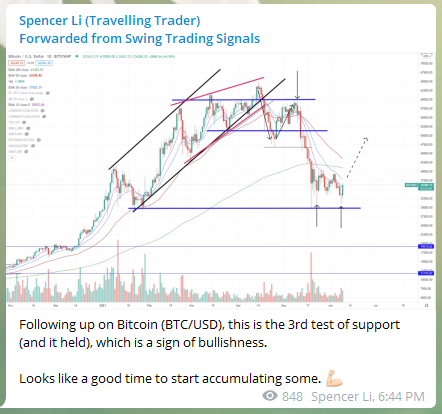
Following up on Bitcoin (BTC/USD), this is the 3rd test of support (and it held), which is a sign of bullishness.

Looks like a good time to start accumulating some. ??


Ethereum: Profits from the Crash

Ethereum: Profits from the Crash 2

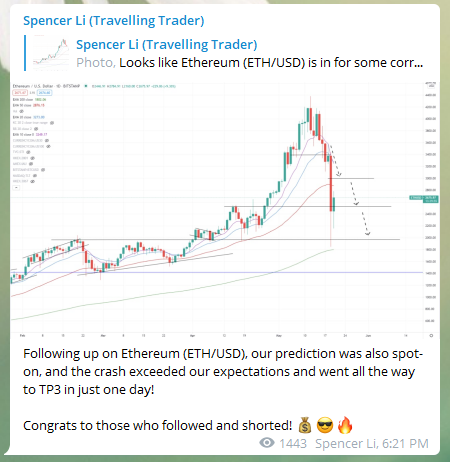
Looks like Ethereum (ETH/USD) is in for some correction as well, with the first major support at 3000. Will reevaluate when prices get there.


Ethereum: Profits from the Crash 2Following up on Ethereum (ETH/USD), our prediction was also spot-on, and the crash exceeded our expectations and went all the way to TP3 in just one day!

Congrats to those who followed and shorted! ???


Recent Forex Trades: AUD/CHF & EUR/JPY

AUD/CHF & EUR/JPY

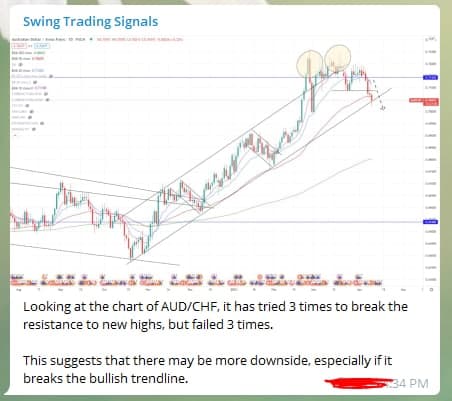
Looking at the chart of AUD/CHF, it has tried 3 times to break the resistance to new highs, but failed 3 times.

This suggests that there may be more downside, especially if it breaks the bullish trendline.


AUD/CHF & EUR/JPY 3

Following up from AUD/CHF, it has broken to new lows as predicted, and is now trending downwards.

Congrats to those who followed! ???


AUD/CHF & EUR/JPY 3EUR/JPY remains on a strong uptrend, clearing the recent resistance, and formed a bull flag after pulling back to the 10&20-EMAs.


AUD/CHF & EUR/JPY 4

Following up on EUR/JPY, it has gone up by +276 pips since our last analysis.

Congrats to those who followed! ???


I have come to the end of this market analysis.

Now that I have shared my views on the various markets, do you think it is a good time to start buying cryptocurrencies?

Let me know in the comments below!

P.S. Check out our mentoring programs if you are keen to start your trading journey today!

2 Comments/by Spencer Li
https://synapsetrading.com/wp-content/uploads/2021/06/thumbnail-how-much-profits-did-you-make-from-the-crypto-crash.png 720 1280 Spencer Li https://synapsetrading.com/wp-content/uploads/2019/10/logo.jpg Spencer Li2021-06-11 19:05:032022-03-07 18:10:53How Much Profits Did You Make from the Crypto Crash?
Spencer Li

Crypto Updates: 102% Profit on Bitcoin, Ethereum & Dogecoin!

Market Analysis
crypto updates profits

In the most recent FOMC meeting, the Fed held rates unchanged, which was no surprise, and it meant that this liquidity-driven long-term bull market in stocks and crypto will continue running.

Stocks and crypto are actually pretty correlated, and the biggest danger to the uptrend is if yields start rising.

In this post, I’m going to do an overview of the stock and crypto market, as well as review some of our recent trades.


Covid updates

Before we go into the markets, let’s take a quick look at the Covid situation, with a focus on vaccination.

vaccinations

As you can see from this chart, vaccination rollout globally is progressing slowly, with less than 10% of the world population having at least one vaccine dose.

In addition, numerous variants have been detected globally, such as Britain’s B117 strain, Brazilian P1 variant, South Africa’s B1351 and India’s “double-mutant” variant called B1617.

This does not bode well, and we can see a large disparity between the richer and less affluent countries.

Nevertheless, the financial markets seem to disjointed from the real world, as asset prices continue to climb.


Earnings & Employment (NFP)

If we look at the daily trends, the crypto market, stock market, and even the oil market are all in a strong bull trend.

vaccinations


And with the recent earnings season, a record 87% of S&P 500 companies have beat earnings estimates, and earnings look to be growing by more than 46%, according to Refinitiv.

Credit Suisse’s chief U.S. equity strategist, Jonathan Golub, has raised his forecast for the S&P 500 based on strong earnings.

He wrote, “we are raising our 2021 S&P 500 price target to 4600 from 4300, representing 9.2% upside from current levels, and 22.5% for the year.”


market-news

This coming week, we will also see the data from the NFP (non-farm payrolls), which will tell us how good the job market is amidst the US recovery from Covid.


Stock Market Targets Hit

In my previous market analysis posts, I predicted the breakout of the S&P 500 with the first target of around 4120 and the second target of 4215.

market-news

On 13 April 2021, it hit the first target of 4120, and in the Telegram screenshot above, I said that it would continue to the next price target of 4215.


SP-500


Just a few days ago, we saw that exact target being hit. Congrats! ???


Bitcoin: 24% profit in 7 days!

Bitcoin was very exciting because we traded it downwards, and then upwards, and both trades were very proftable!

bitcoin-btcusd

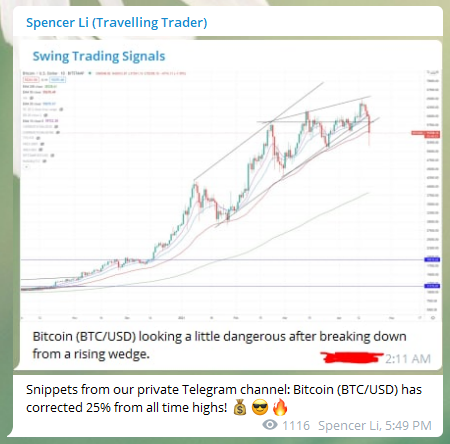
We spotted this rising wedge in Bitcoin, which was bearish, so we took a short position, and from here we saw a 25% correction from its all-time highs.


bitcoin-btcusd1

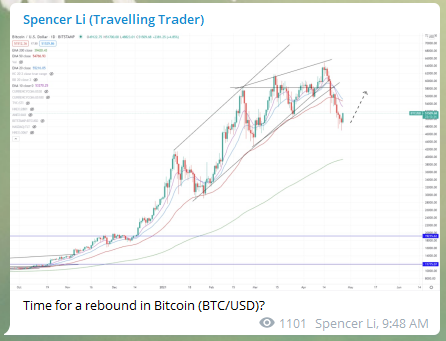
Following that, I pinpointed a rebound for Bitcoin, with uncanny precision.


bitcoin-btcusd3

Within just 2 days, we saw a sharp rebound of 17% from the lows, but we were still not done.


bitcoin-btcusd4

Finally, after 7 days, we took profit at the resistance level, netting a 24% profit in 7 days. Ka-ching! ???


Dogecoin: 38% profit in 5 days!

Dogecoin admittedly was a more volatile creature, so we had to be more careful in finding trading opportunities for this.


bitcoin-btcusd

Finally, we spotted a huge pin bar (bullish hammer candle), and this was the perfect opportunity for a long trade.


bitcoin-btcusd

From there, it went up 38% in the next 5 days, and it still looks like it can continue going up, so we are still holding on to this. ??


Ethereum: 50% Profit in 13 days!

I mentioned in my previous market analysis post that Ethereum is even more bullish than Bitcoin based on the chart, and now you can see why.


bitcoin-btcusd37

In just 13 days after hitting the support level (great place to buy), we netted a profit of 50%, and the price still looks to be heading higher.

At this point, I won’t be too greedy and will take most profits and wait for the next pullback to enter again.


bitcoin-btcusd121

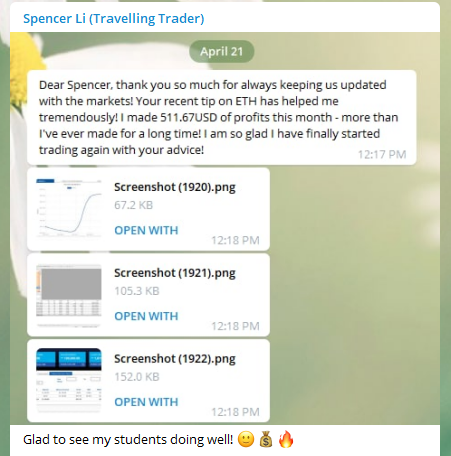
Here’s some feedback from one of my new students, and I’m glad to see they are profiting from the Crypto bull run as well.


I have come to the end of this market analysis.

Now that I have shared my views on the various markets, do you think the markets will continue going up, or will it be a case of “sell in May and go away”?

Let me know in the comments below!

0 Comments/by Spencer Li
https://synapsetrading.com/wp-content/uploads/2021/05/crypto-updates-profits.jpg 720 1280 Spencer Li https://synapsetrading.com/wp-content/uploads/2019/10/logo.jpg Spencer Li2021-05-02 11:20:002022-03-07 18:12:14Crypto Updates: 102% Profit on Bitcoin, Ethereum & Dogecoin!
Spencer Li

Bitcoin Spikes up $2500 in One Day – Any Reasons Why?

Market Analysis
usdjpy 092210

Yesterday, we saw an incredible spike in Bitcoin of close to $2500, which is 40+% move.

Even though price has corrected slightly, it is currently still up by about 30% from its recent lows.

Bitcoin Spikes

Although no one really knows the reason for such a sudden move, many people have attributed it to remarks by the Chinese President, Xi Jinping, who said the country needs to “seize the opportunity” afforded by blockchain technology.

Speaking as part of the 18th collective study of the Political Bureau of the Central Committee on Thursday in Beijing,  he said that blockchain technology has a wide array of applications within China, listing topics ranging from financing businesses to mass transit and poverty alleviation.

Although he was talking about Blockchain technology rather than cryptocurrencies, traders seem to have felt that it would still have a positive effect, at least based on what the market is reflecting.

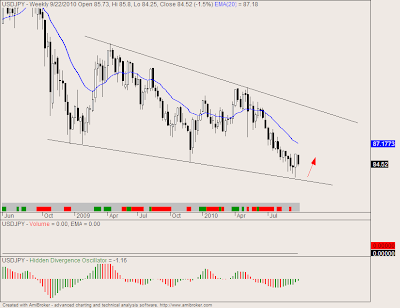
For a technical perspective, the chart is starting to look more bullish medium/long-term, with the breakout of the falling wedge pattern.

0 Comments/by Spencer Li
https://synapsetrading.com/wp-content/uploads/2010/09/usdjpy-092210.png 308 400 Spencer Li https://synapsetrading.com/wp-content/uploads/2019/10/logo.jpg Spencer Li2019-10-26 20:34:412022-03-07 13:05:53Bitcoin Spikes up $2500 in One Day – Any Reasons Why?
Page 4 of 512345

Free Trading Guides

Free Trading Guides

Blog Categories

  • Beginner's Guide
  • Blockchain & Crypto
  • Book Summaries
  • Economics & News Trading
  • Investing & Portfolio Management
  • Living Your Best Life
  • Market Analysis
  • Markets & Products
  • News & Events
  • Promotions
  • Risk & Money Management
  • Stock Trading
  • Technical Analysis & Price Action
  • Testimonials
  • Tools & Resources
  • Trading Psychology
  • Trading Strategies
  • Trading Tips
  • Travel & Lifestyle

Free Trading Guides

Free Trading Guides

Contact Us

Synapse Trading Pte Ltd
Registration No. 201316168H

Whatsapp: +65-8897-1204
Telegram: @iamrecneps
Email: info@synapsetrading.com

Links

Disclaimer
Privacy policy
Terms & Conditions
Contact us
Partnerships

© 2012-2024 Synapse Trading | All rights reserved | - powered by Enfold WordPress Theme
  • Link to Facebook
  • Link to X
  • Link to Instagram
  • Link to Youtube
  • Link to LinkedIn
  • Link to Mail
Scroll to top Scroll to top Scroll to top