• Link to Facebook
  • Link to X
  • Link to Instagram
  • Link to Youtube
  • Link to LinkedIn
  • Link to Mail
Synapse Trading
  • Home
  • About
    • My Background
    • My Trading Journey
    • My Travel Log
    • Media & Interviews
  • Mentoring
    • Trading Mastery Program
    • Results & Testimonials
  • Signals
    • Telegram (Free to join!)
    • Daily Trading Signals
    • Daily Trading Signals (Results)
  • Resources
    • Free Trading Guides
    • Tools & Resources
    • Blog & Infographics
  • Contact
    • Contact Us
    • Partnership Opportunities
  • Click to open the search input field Click to open the search input field Search
  • Menu Menu
Spencer Li

Will we see an Ethereum (ETH) ETF Soon?

Blockchain & Crypto
eth etf

What Is an Ethereum (ETH) ETF, and How Does It Work?

Last updated: 3 July 2026 · By Spencer Li, CFTe


An Ethereum ETF is an exchange-traded fund that holds Ethereum (ETH) on your behalf and trades as a single ticker on a regular stock exchange, so you can get exposure to ETH through a normal brokerage account without ever holding the crypto yourself. A spot Ethereum ETF holds actual ETH; a futures Ethereum ETF holds ETH futures contracts instead. The US Securities and Exchange Commission (SEC) approved the first spot Ethereum ETFs in mid-2024, and they began trading in July 2024, roughly six months after spot Bitcoin ETFs did the same. The appeal is simple: no private keys, no crypto exchange, no self-custody, just a line item in the same account that holds your stocks. The trade-off is just as simple: you own a fund, not the coin, so you pay a management fee and you cannot move the ETH on-chain or stake it yourself.

Here is what an Ethereum ETF actually is, how the spot and futures versions differ, and what it does and does not give you.

What is an Ethereum ETF?

An ETF (exchange-traded fund) is a fund that holds an underlying asset and trades on a stock exchange like a share. An Ethereum ETF applies that wrapper to ETH.

You buy the ticker through your normal broker. Behind the scenes, the fund holds the exposure, and the price of your shares tracks the price of Ethereum (minus fees). When ETH goes up, the fund goes up. When ETH falls, so does the fund.

The point of the wrapper is access. Buying ETH directly means opening a crypto exchange account, funding it, and then either trusting that exchange to hold your coins or moving them into a self-custody wallet and looking after the private keys yourself. An ETF removes all of that. You get the price exposure inside the same regulated, familiar account you already use for stocks.

Spot vs futures: what is the difference?

There are two kinds of crypto ETF, and the difference matters.

A spot ETH ETF holds actual Ethereum. The fund buys and stores real ETH, so the share price tracks the live spot price closely.

A futures ETH ETF holds ETH futures contracts (agreements to buy or sell ETH at a set price on a future date) rather than the coin itself. Futures funds came first, because regulators were comfortable with them earlier. They track ETH well enough for short holds, but over longer periods the cost of rolling contracts forward can cause the fund to drift away from the spot price.

Spot ETH ETFFutures ETH ETF
What it holdsActual ETHETH futures contracts
Tracks spot priceCloselyApproximately, can drift over time
Main drawbackManagement feeRoll costs over longer holds
US approvalMid-2024Earlier (futures came first)
Best forLonger-term ETH exposureShorter-term or tactical exposure

For most people who simply want ETH exposure and plan to hold it, the spot version is the cleaner instrument. The futures version exists, and it has its uses, but you should know which one you are buying.

Why did the SEC take so long to approve it?

The short version: the SEC’s job is investor protection and market integrity, and for years it treated crypto products as guilty until proven innocent.

The agency has a long, documented pattern of delaying decisions on crypto ETFs rather than rejecting them outright. It repeatedly invoked its full review windows, asked for more comment, and pushed deadlines back. The same thing happened with Bitcoin. The SEC stalled spot Bitcoin ETFs for years before approving eleven of them in January 2024, and even then the approval passed by a single vote, with then-Chair Gary Gensler stressing that approval was not an endorsement of crypto.

Ethereum carried an extra question on top of all that: is ETH a commodity or a security? That classification debate, plus Ethereum’s move to a proof-of-stake model (where the network is secured by staked ETH rather than mining), gave regulators more to scrutinise around liquidity and how the asset is treated under the law.

The resolution, when it came in mid-2024, followed the Bitcoin script almost exactly: long reluctance, then approval once the precedent and the institutional demand were impossible to ignore. That is the useful pattern to remember. With crypto products, the SEC has tended to delay, then eventually follow the precedent it set with the prior asset.

What an Ethereum ETF gives you, and what it doesn’t

This is where I want to be straight with you, because the convenience cuts both ways.

What you gain:

  • Access through a normal broker. No crypto exchange, no wallet, no seed phrase to lose.
  • Regulated, familiar custody. The fund handles storage. For a lot of people that alone is worth the fee.
  • It sits with your other assets. ETH exposure in the same account as your stocks, with normal reporting.

What you give up:

  • You own the fund, not the coin. You cannot withdraw ETH on-chain, send it, or use it in any application.
  • You pay a management fee. Small, but it is a steady drag the longer you hold.
  • Staking yield is not yours by default. Holding ETH directly can earn staking rewards. An ETF wrapper may or may not pass any of that through, so check the specific fund.

Personally, I think the ETF is the right tool for someone who wants price exposure and values simplicity over control. If you actually want to use Ethereum, stake it, or hold the keys yourself, the ETF is not that. Pick the instrument that matches what you are trying to do.

Where the human edge comes in

An ETF makes the access trivial. One click in your broker and you have ETH exposure. What it does not do is tell you how much to put on, when crypto’s volatility means a position this size is too big for your account, or whether you should be buying ETH at all right now versus sitting on your hands.

The wrapper solved the plumbing. It did nothing for the judgment, the sizing, or the discipline to wait for your spot. That part is still on you, and it is the first of the Five Edges no product can outsource for you.

FAQ

Is there a spot Ethereum ETF?
Yes. The SEC approved the first US spot Ethereum ETFs in mid-2024, and they began trading in July 2024. A spot ETH ETF holds actual Ethereum, so its price tracks the live ETH price closely.

What is the difference between a spot and a futures Ethereum ETF?
A spot ETH ETF holds real ETH; a futures ETH ETF holds ETH futures contracts. Spot funds track the live price closely, while futures funds can drift from the spot price over longer holds because of the cost of rolling contracts forward.

Do I own actual Ethereum if I buy an ETH ETF?
No. You own shares in a fund that holds the exposure. You cannot withdraw the ETH on-chain, send it, stake it yourself, or use it in any application. If you want the actual coin, you need to buy ETH directly and hold it.

Can I earn staking rewards through an Ethereum ETF?
Not by default. Holding ETH directly can earn staking rewards, but an ETF may or may not pass any staking yield through to shareholders. Check the specific fund’s structure before assuming you get it.

Why did the SEC take so long to approve an Ethereum ETF?
The SEC’s mandate is investor protection and market integrity, and it has a long pattern of delaying crypto ETF decisions rather than rejecting them. With Ethereum it also had to weigh the commodity-versus-security classification question. As with Bitcoin, it eventually approved spot ETH ETFs once the precedent and institutional demand were clear.


Now that you know what the wrapper is and is not, the real question is the same one it always is: what is your plan for the position once you own it? An ETF is just the door. The trading is still the trading.

If you want the bigger picture on crypto and DeFi, read the pillar: The Ultimate Guide to Blockchain and Cryptocurrencies.

Want a simple system for any market, crypto included? Grab the free 15-Minute Swing Trading Starter Kit. It’s the exact routine I use to scan once a day and trade in 15 minutes, on stocks, forex, or crypto.


About the author. Spencer Li is the founder of Synapse Trading and a Certified Financial Technician (CFTe) with 15 years of trading across stocks, forex, crypto, commodities, and bonds. His trade log is public, 404 trades, losses left in. He teaches low-risk swing trading in 15 minutes a day, one system for any market.

Education, not financial advice. Synapse Trading is not licensed by MAS to advise on investment products. Trading carries risk of loss; past performance is not indicative of future results.


Related

The Ultimate Guide to Blockchain and Cryptocurrencies (pillar) · Bitcoin ETF explained · How to invest in cryptocurrency · What is DeFi

0 Comments/by Spencer Li
https://synapsetrading.com/wp-content/uploads/2024/01/eth-etf.jpg 828 1447 Spencer Li https://synapsetrading.com/wp-content/uploads/2019/10/logo.jpg Spencer Li2024-02-02 08:00:012026-07-06 01:52:10Will we see an Ethereum (ETH) ETF Soon?
Spencer Li

Comparison of the new Bitcoin (BTC) ETFs: Which is the Best?

Blockchain & Crypto
btc etf

Best Bitcoin ETF: How to Compare Spot Bitcoin ETFs by Fees

Last updated: 3 July 2026 · By Spencer Li, CFTe


For most people, the best Bitcoin ETF is the cheapest credible spot fund, because every one of them holds the same asset (Bitcoin), so the fee is the main thing you actually control. Among the US spot Bitcoin ETFs, the Bitwise Bitcoin ETF (BITB) has the lowest expense ratio at 0.20%, with Ark 21Shares (ARKB) next at 0.21%, and the big-name funds, iShares (IBIT) from BlackRock, Fidelity (FBTC), and VanEck (HODL), clustered at 0.25%. The old Grayscale Trust (GBTC) sits far above the pack at 1.5%. A spot ETF (one that holds actual Bitcoin, not futures contracts) lets you buy Bitcoin exposure through an ordinary brokerage account, with no wallet, no private keys, and no exchange to trust. Personally, after weighing fees against fund size, I hold ARKB and IBIT. Here is how to compare them yourself, so you pick the one that fits you, not the one with the loudest ad.

What is a spot Bitcoin ETF?

A spot Bitcoin ETF is a fund that holds real Bitcoin and trades on a normal stock exchange. You buy it like any share, through the brokerage you already use.

That word “spot” matters. A spot ETF holds the actual coin. A futures ETF (the older kind, like the ProShares BITO that launched first) holds Bitcoin futures contracts instead, which can drift away from the real Bitcoin price over time. The spot funds track Bitcoin much more directly, which is why their approval was the bigger event.

The appeal is simple. You skip the parts of crypto that scare most people: setting up a wallet, guarding a private key (the secret code that controls your coins, lose it and the coins are gone), and trusting a crypto exchange not to collapse. The ETF issuer handles custody. You just hold a ticker.

How did we get spot Bitcoin ETFs? A short timeline

These funds did not appear overnight. The road to approval ran more than a decade.

  • 2013: The Winklevoss twins filed the first Bitcoin ETF application. It set the template, and it was rejected.
  • 2017 to 2019: A run of SEC rejections, citing market-manipulation worries. ProShares, Direxion, and Bitwise all got turned down.
  • 2020 to 2021: The tone shifted under SEC Chairman Gary Gensler. The first Bitcoin futures ETF, ProShares Bitcoin Strategy (BITO), was approved.
  • 2022 to 2023: More futures ETFs cleared, but spot funds still stalled over market-oversight concerns.
  • 2024: The first US spot Bitcoin ETFs were approved together, the regulatory shift that opened the door to the funds compared below.

So when you hold one of these today, you are holding the end of a long fight, not a brand-new experiment.

What is an expense ratio, and why does it decide the “best” ETF?

The expense ratio is the annual fee a fund charges to hold and run it, written as a percentage of your money in the fund.

A worked example. If an ETF has a 0.20% expense ratio and you put in $100, you pay about 20 cents a year in fees. The fee is taken straight from the fund’s assets, so you never write a cheque, you just earn slightly less than the raw Bitcoin price over time.

Here is why this is the lever that matters. Every spot Bitcoin ETF holds the same thing: Bitcoin. They do not pick better coins or time the market. So if Fund A and Fund B both just hold Bitcoin, the cheaper one wins by default, because the fee is the one number that reliably eats into your return. A lower expense ratio means more of Bitcoin’s move stays in your pocket.

Comparison of the spot Bitcoin ETFs by fee

Below are the US spot Bitcoin ETFs ranked from cheapest to most expensive. Do note that, issuers cut fees and run temporary waivers to win early assets, so always check the current ratio on the issuer’s page before you buy.

ETFTickerExpense ratioNotes
Bitwise Bitcoin ETFBITB0.20%Lowest fee; six-month waiver on the first $1B in assets
Ark 21Shares Bitcoin ETFARKB0.21%Partnered with 21Shares, a crypto specialist
iShares Bitcoin TrustIBIT0.25%Run by BlackRock, the largest asset manager
Fidelity Wise Origin Bitcoin FundFBTC0.25%Backed by Fidelity’s custody and platform
VanEck Bitcoin TrustHODL0.25%Established ETF issuer
Valkyrie Bitcoin ETFBRRR0.25%Started at 0.49%, cut to 0.25%; early waiver
Franklin Bitcoin ETFEZBC0.29%Franklin Templeton
WisdomTree Bitcoin FundBTCW0.30%WisdomTree
Invesco Galaxy Bitcoin ETFBTCO0.39%Invesco plus Galaxy Digital’s crypto desk
Hashdex Bitcoin ETFDEFI0.94%Converted from a futures fund
Grayscale Bitcoin TrustGBTC1.50%Highest fee; longest track record and large asset base

Two things jump out of that table.

First, the fee range is wide: 0.20% at the bottom, 1.5% at the top. That is a 7x gap for funds holding the same asset. Over years, that difference compounds against you.

Second, GBTC is the odd one out. It was the original Bitcoin trust before it converted to an ETF, and it kept the largest asset base and the longest history. Its 1.5% fee is the price of that legacy. Some long-term holders accept it for the track record. For most new money, the cheaper funds are the obvious starting point.

Why spot Bitcoin ETFs mattered for the market

Beyond your own cost, these funds changed who can buy Bitcoin and how.

They lowered the barrier. No wallet, no keys, no exchange. If you can buy a stock, you can buy Bitcoin exposure. That alone pulls in a large group of investors who were never going to set up a crypto wallet.

They added a layer of legitimacy. Regulatory approval of a spot ETF was a signal that Bitcoin is an investable asset inside the traditional system, not just an internet curiosity. That tends to reduce some of the old skepticism.

They made it easy to size small. You can buy a few shares. You do not have to commit to a whole coin or a minimum exchange order. For a beginner who just wants a small, sensible slice of Bitcoin in a diversified portfolio, that fractional access is the practical win.

None of this removes Bitcoin’s volatility. The wrapper is convenient. The asset inside is still the same swinging asset it always was.

Which Bitcoin ETF is best for you?

There is no single “best” fund, only the best fit for your goal. Here is how I would frame the choice.

  • If you are cost-conscious (and most long-term holders should be), start with the cheapest credible fund. BITB at 0.20% leads, with ARKB at 0.21% a hair behind.
  • If you want the biggest, most liquid name, IBIT (BlackRock) and FBTC (Fidelity) at 0.25% trade size and a household brand for a basis point or two of fee.
  • If track record and asset base matter more to you than fee, GBTC is the legacy option, though you pay 1.5% for it.

Personally, I went with ARKB and IBIT, weighing both the expense ratio and the fund’s market size. ARKB gives me a near-rock-bottom fee, and IBIT gives me the deepest liquidity and the BlackRock name. That is my read for my situation, not a recommendation for yours.

Where the human edge comes in

A comparison table can rank these funds by fee in a second, and you should let it. That part is now free. What the table will not do is decide how big a Bitcoin position belongs in your portfolio, or whether you can sit through a 50% drawdown without panic-selling at the bottom. The cheapest ETF in the world does not help if you size it wrong or bail at the worst moment. Picking the fund is the easy part. Sizing it and holding through the volatility is the judgment, and it is the first of the Five Edges no fund can supply for you.

FAQ

What is the best Bitcoin ETF?
For most investors, the best Bitcoin ETF is the cheapest credible spot fund, since they all hold the same asset. BITB has the lowest expense ratio at 0.20%, with ARKB at 0.21% and IBIT, FBTC, and HODL at 0.25%.

What is the cheapest Bitcoin ETF?
The Bitwise Bitcoin ETF (BITB) has the lowest expense ratio at 0.20%, and at launch it also waived fees for six months on the first $1 billion in assets. Always check the current ratio, as issuers change them.

What is the difference between a spot and a futures Bitcoin ETF?
A spot Bitcoin ETF holds actual Bitcoin, so it tracks the price closely. A futures Bitcoin ETF holds futures contracts instead, which can drift away from the real Bitcoin price over time. The spot funds are the more direct way to hold Bitcoin through a brokerage.

Why is GBTC’s fee so high?
Grayscale’s GBTC was the original Bitcoin trust before converting to an ETF, and it kept the longest track record and a large asset base. Its 1.5% expense ratio is far above its peers; it cut the fee to compete but still sits at the top of the range.

Do I still need a crypto wallet if I buy a Bitcoin ETF?
No. The whole point of a spot Bitcoin ETF is that the issuer handles custody. You buy and sell it like a stock through your brokerage, with no wallet and no private keys to manage.


Which one fits how you invest, the rock-bottom fee or the big-name liquidity? Let me know in the comments.

And if you want the bigger picture on crypto beyond the ETF wrapper, read the deeper guide: The Ultimate Guide to Blockchain and Cryptocurrencies.

Want a simple system for any market, crypto included? Grab the free 15-Minute Swing Trading Starter Kit. It’s the exact routine I use to scan once a day and trade any market in 15 minutes.


About the author. Spencer Li is the founder of Synapse Trading and a Certified Financial Technician (CFTe) with 15 years of trading across stocks, forex, crypto, commodities, and bonds. His trade log is public, 404 trades, losses left in. He teaches low-risk swing trading in 15 minutes a day, one system for any market.

Education, not financial advice. Synapse Trading is not licensed by MAS to advise on investment products. Trading carries risk of loss; past performance is not indicative of future results.


Related

The Ultimate Guide to Blockchain and Cryptocurrencies (pillar) · What is Bitcoin and how does it work · How to invest in crypto for beginners · ETF investing for beginners

0 Comments/by Spencer Li
https://synapsetrading.com/wp-content/uploads/2024/01/btc-etf.jpg 825 1449 Spencer Li https://synapsetrading.com/wp-content/uploads/2019/10/logo.jpg Spencer Li2024-01-31 04:58:092026-07-06 00:31:57Comparison of the new Bitcoin (BTC) ETFs: Which is the Best?
Spencer Li

Weekly Market Wrap: Big Tech Earnings Season Starts!

Market Analysis
Thumbnail 30 Jan 2024

Thumbnail 30 Jan 2024

Subscribe for real-time alerts and weekly videos:
👉🏻 https://synapsetrading.com/daily-trading-signals


Market Recap & Upcoming Week

The U.S. economy showed robust signs of strength last week, with the S&P PMI exceeding expectations, signaling potential stabilization in the manufacturing sector.

Services PMI also indicated continued economic vigor, especially in consumer-driven sectors. U.S. GDP growth for the fourth quarter surpassed predictions, hinting at enduring resilience in consumption despite higher interest rates.

However, some moderation is expected ahead, maintaining a soft-landing scenario.

Inflation trends also support a favorable outlook, as core PCE inflation dipped below 3% for the first time since 2021, strengthening the “Goldilocks” narrative of cooling inflation with sustained growth.

All eyes are now on the Fed’s upcoming meeting, where rates are expected to hold, but future cuts are likely, with market expectations aligning with the Fed’s cautious approach to returning to neutral rates.

Historically, markets have fared well when the Fed begins cutting rates in a non-recessionary period, suggesting potential for positive market performance ahead.

Investors are bracing for a critical week as the Federal Reserve’s interest rate decision looms, with all eyes on Fed Chair Jerome Powell for potential signals regarding future rate adjustments.

Alongside the Fed’s announcement, the job market comes under the spotlight with forthcoming data on job openings, private payroll figures, and the comprehensive monthly employment report, offering insights into the labor market’s robustness.

The earnings season hits a peak with several industry behemoths set to unveil their financial performance.

Tech leaders like Microsoft, Alphabet, Apple, Amazon, and Meta are queued up throughout the week, providing a snapshot of the tech industry’s health.

Additionally, pharmaceutical majors Pfizer, Merck, and Novo Nordisk will reveal their earnings, as will energy giants ExxonMobil and Chevron, promising a week rich in financial disclosures and market-moving news.

Daily Trading Signals (Highlights)

Trading Signals CIBR 230124

Cybersecurity ETF (CIBR) – Just broke out to new all-time highs, after a nice accumulation pattern on the weekly chart. Accumulating more of this. 💰🔥👍


trading signals NVDA 160124

trading signals NVDA 300124

Nvidia (NVDA) – Following up on our previous trade call, prices have hit our first target of $600! 💰🔥👍

Zooming out on the weekly chart, we see that the trend is still very strong, and a possible optimistic target is close to $850, which means we can look to enter on any pullbacks or consolidation.


Trading Signals ELF 260124

e.l.f. Beauty (ELF) – Strong breakout on the weekly chart to new ATHs.

On the daily chart, we saw a selldown on huge volume, but prices got pushed back up, suggesting that there are also a lot of buyers.

Can consider taking a long position with a tight stop below the pinbar (around $140), and target around $190.


Join our community for real-time alerts and weekly videos:
👉🏻 https://synapsetrading.com/daily-trading-signals


0 Comments/by Spencer Li
https://synapsetrading.com/wp-content/uploads/2024/01/Thumbnail-30-Jan-2024.jpg 407 561 Spencer Li https://synapsetrading.com/wp-content/uploads/2019/10/logo.jpg Spencer Li2024-01-30 20:11:022024-01-30 20:11:02Weekly Market Wrap: Big Tech Earnings Season Starts!
Spencer Li

Weekly Market Wrap: Tech Stocks Lead the Rally Again!

Market Analysis
thumbnail 22 Jan 2024

thumbnail 22 Jan 2024

Subscribe for real-time alerts and weekly videos:
👉🏻 https://synapsetrading.com/daily-trading-signals


Market Recap & Upcoming Week

Last week in the markets saw a gentle start to 2024 following the strong rally at the end of 2023.

While the S&P 500’s slight pullback reflects a period of consolidation, underlying market movements suggest a shift, with pressure on small-cap stocks and investment-grade bonds.

Tech and communication services sectors continue to lead, with health care and consumer staples sectors showing outperformance.

Looking ahead, important economic indicators due this month include U.S.

GDP growth data and the PCE inflation report, which will shed light on economic health and inflation trends.

The Federal Reserve’s rate decision at the end of January will also be crucial, with current market expectations leaning towards rate cuts later in the year.

These data points will guide investor strategies amidst the anticipated market volatility early in the year.

Investors should brace for an eventful week as several industry giants are poised to report their earnings, with Netflix kicking off on Tuesday, Tesla following on Wednesday, and Intel rounding out on Thursday.

Additionally, a vital glimpse into the U.S. economy’s performance in the fourth quarter will be provided with the government’s preliminary GDP report, also expected on Thursday.

The week will also be packed with a suite of economic data releases that could impact market movements, including new and pending home sales and durable-goods orders.

Market participants will closely scrutinize PMIs and the Personal Consumption Expenditures Price Index, the Fed’s favored inflation metric, to gauge economic health and inflationary pressures.


Daily Trading Signals (Highlights)

daily trading signals nasdaq2 230124

daily trading signals nasdaq 230124

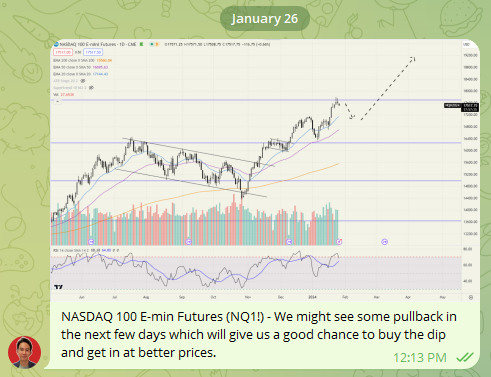
NASDAQ 100 E-mini Futures (NQ1!) – We are very close to ATHs now! 💰🔥💪


trading signals AMD 190124

Advanced Micro Devices (AMD) – Breaking to new all time highs!


daily trading signals NEE 230124

NextEra Energy (NEE) – Clean energy stocks are not doing too well in general, and this stock just broke down from a bearish rising wedge on the weekly chart, at the confluence of multiple EMA resistances.


Join our community for real-time alerts and weekly videos:
👉🏻 https://synapsetrading.com/daily-trading-signals


0 Comments/by Spencer Li
https://synapsetrading.com/wp-content/uploads/2024/01/thumbnail-22-Jan-2024.jpg 233 405 Spencer Li https://synapsetrading.com/wp-content/uploads/2019/10/logo.jpg Spencer Li2024-01-23 02:47:292024-01-23 02:47:29Weekly Market Wrap: Tech Stocks Lead the Rally Again!
Spencer Li

Weekly Market Wrap: Successful Launch of Bitcoin ETFs!

Market Analysis
image for 15 Jan 2024 thumbnail weekly market

image for 15 Jan 2024 thumbnail weekly market

Subscribe for real-time alerts and weekly videos:
👉🏻 https://synapsetrading.com/daily-trading-signals


Market Recap & Upcoming Week

Last week’s financial markets were abuzz with discussions on inflation and the Federal Reserve’s monetary policy, as well as the surge in Crypto prices due to the approval of Bitcoin ETFs.

The Consumer Price Index (CPI) indicated a slight uptick to 3.4% year-over-year in December, signaling a challenging road ahead to the Fed’s 2% inflation target. Core CPI, excluding food and energy, showed a modest decline. Notably, services costs, particularly shelter and car insurance, were significant inflation drivers.

Despite these pressures, the overall trend in inflation continues to decline, with expectations that it will normalize over the year. Moreover, positive indicators like slowing rent increases and declining job openings hint at a downward trajectory for inflation.

However, a recent surge in shipping costs due to disruptions in the Suez Canal could pose a risk, potentially impacting consumer prices if prolonged.

In response to the inflation data, expectations around the Federal Reserve’s rate cuts have become a focal point. The bond market anticipates a high likelihood of rate cuts starting as early as March, but this may be overly optimistic.

The Fed is likely to maintain a cautious approach, with more data on inflation and job reports due in the coming months. This cautious stance could introduce market volatility, but the broader expectation is a shift towards easing monetary policy in the latter half of the year.

Alongside these macroeconomic developments, the stock market has shown resilience. The rebound in forward earnings and new market highs suggest a continuing uptrend in stocks.

Opportunities are seen in buying potential pullbacks and diversifying into underperforming market segments, with an eye towards extending investment duration in anticipation of an easing Fed cycle.

This week in the financial markets starts with a pause as markets are closed on Monday, January 15th, in observance of Martin Luther King Jr. Day.

Simultaneously, the annual World Economic Forum in Davos begins, bringing together a global assembly of business and political leaders. This event could provide key insights into the global economic outlook and potentially influence market sentiment.

Upon reopening on Tuesday, the markets will shift focus to the banking sector with Morgan Stanley and Goldman Sachs releasing their earnings, which could set the tone for market performance.

Housing market data, including housing starts and existing home sales, will be closely watched as key indicators of economic health. Additionally, remarks from Federal Reserve Governor Christopher Waller and Atlanta Fed President Raphael Bostic will be pivotal in shaping expectations around monetary policy.

Updates on U.S. retail sales, industrial production, and consumer sentiment throughout the week will provide further clarity on the economic landscape.

Lastly, a critical deadline looms on Friday for Congress to fund certain U.S. government agencies, with a potential government shutdown hanging in the balance.

Daily Trading Signals (Highlights)

Trading Signals NQ1 110124

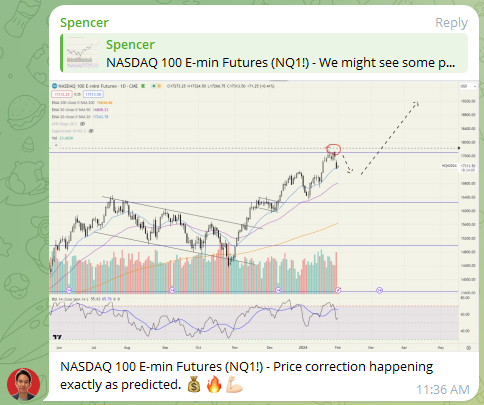
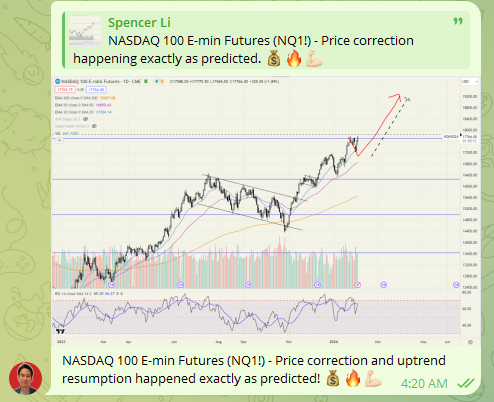
NASDAQ 100 E-mini Futures (NQ1!) – Following up, the rebound happened as predicted, and good chance the uptrend is going to resume.

Congrats to those who bought the dip! 👏🔥👍


Trading Signals ETHUSD 110124

Ethereum (ETHUSD) – Strong breakout after the news, heading to test the $2900/3000 level! 💰🔥💪


Trading Signals BTCUSD 110124

Bitcoin (BTCUSD) – Bitcoin also had a nice breakout a few days ago, high chance it is going to gun for $50/51k price level! 💰👍💪


bitcoin etf fee comparison

Doing a quick comparison, lowest fees are BITB and ARKB, but those with 0.25% are also still acceptable.

Based on volumes so far, the biggest 3 are FBTC, IBIT and GBTC (cos it’s the oldest probably).

So overall i am probably going with ARKB, FBTC or IBIT.


xrp etf speculation

Ripple (XRP) ETF a possibility?


Join our community for real-time alerts and weekly videos:
👉🏻 https://synapsetrading.com/daily-trading-signals


0 Comments/by Spencer Li
https://synapsetrading.com/wp-content/uploads/2024/01/image-for-15-Jan-2024-thumbnail-weekly-market.jpg 358 711 Spencer Li https://synapsetrading.com/wp-content/uploads/2019/10/logo.jpg Spencer Li2024-01-15 17:39:082024-01-15 17:41:50Weekly Market Wrap: Successful Launch of Bitcoin ETFs!
Page 8 of 184«‹678910›»

Free Trading Guides

Free Trading Guides

Blog Categories

  • Beginner's Guide
  • Blockchain & Crypto
  • Book Summaries
  • Candlestick Patterns
  • Economics & News Trading
  • Investing & Portfolio Management
  • Living Your Best Life
  • Market Analysis
  • News & Events
  • Price Chart Patterns
  • Promotions
  • Risk & Money Management
  • Stock Trading
  • Testimonials
  • Tools & Resources
  • Trading Psychology
  • Trading Strategies
  • Trading Tips
  • Travel & Lifestyle

Free Trading Guides

Free Trading Guides

Contact Us

Synapse Trading Pte Ltd
Registration No. 201316168H

Whatsapp: +65-8897-1204
Telegram: @iamrecneps
Email: info@synapsetrading.com

Links

Disclaimer
Privacy policy
Terms & Conditions
Contact us
Partnerships

© 2012-2024 Synapse Trading | All rights reserved | - powered by Enfold WordPress Theme
  • Link to Facebook
  • Link to X
  • Link to Instagram
  • Link to Youtube
  • Link to LinkedIn
  • Link to Mail
Scroll to top Scroll to top Scroll to top