• Link to Facebook
  • Link to X
  • Link to Instagram
  • Link to Youtube
  • Link to LinkedIn
  • Link to Mail
Synapse Trading
  • Home
  • About
    • My Background
    • My Trading Journey
    • My Travel Log
    • Media & Interviews
  • Mentoring
    • Trading Mastery Program
    • Results & Testimonials
  • Signals
    • Telegram (Free to join!)
    • Daily Trading Signals
    • Daily Trading Signals (Results)
  • Resources
    • Free Trading Guides
    • Tools & Resources
    • Blog & Infographics
  • Contact
    • Contact Us
    • Partnership Opportunities
  • Click to open the search input field Click to open the search input field Search
  • Menu Menu

Tag Archive for: Alexander Elder

Spencer Li

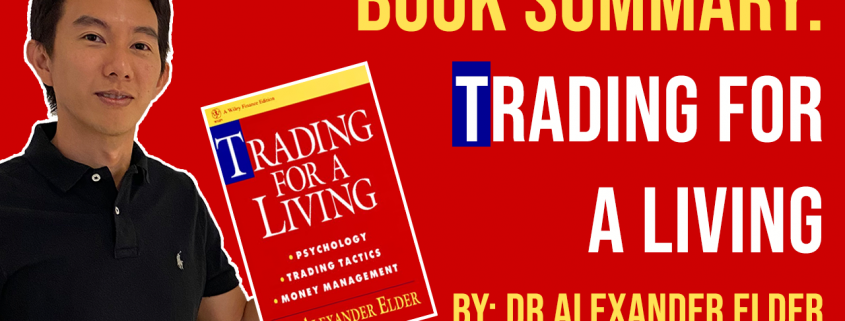
Book Summary: Trading for a Living by Dr Alexander Elder (Psychologist)

Book Summaries
thumbnail trading for a living

thumbnail trading for a living

Dr. Alexander Elder is a well-known trader and author who has written extensively on the topic of trading psychology.

He is a strong advocate for the importance of managing one’s emotions and developing a disciplined approach to trading.

In his book “Trading for a Living,” Elder emphasizes the importance of having a clear set of rules and sticking to them, as well as the need to manage risk and protect capital.

He also discusses the psychological pitfalls that traders can fall into, such as overconfidence and fear, and offers practical advice for overcoming these challenges.

This was one of the first few books I read when I started my trading journey, and it is a very good overview of everything you need to know to become a complete trader.

In this blog post, I will give a detailed summary of the book, and pull out the key learning points and strategies that Dr Elder has shared in the book.


About Dr. Alexander Elder

Before diving into the book, it is important to understand the author’s background, and why he has such a deep understanding of trading psychology.

Dr. Alexander Elder is a psychiatrist and trader who is known for his work on trading psychology and technical analysis.

Born in Leningrad (now St. Petersburg), Russia, Elder grew up in a family of scientists and engineers.

He studied medicine at the First Leningrad Medical Institute and later worked as a ship’s doctor in the Soviet merchant marine.

In 1977, Elder immigrated to the United States, where he completed his medical training and worked as a psychiatrist.

However, he also had a passion for the stock market, and he began trading and studying technical analysis in his spare time.

In the late 1980s, Elder began writing and teaching about trading, and he quickly gained a reputation as a leading expert on the psychological aspects of trading.

In 1995, he published his first book, “Trading for a Living”, which became a bestseller and established him as a leading authority on trading psychology.

He has also developed a number of technical indicators and trading tools, including the Elder-Ray indicator and the Force Index.

He has written several other books on trading, including “Come into My Trading Room,” which are considered classics in the field.

Elder also runs a trading school and offers courses and workshops on trading.

Overview of “Trading for a Living” Book

“Trading for a Living” is the flagship book written by Alexander Elder, which was first published in 1993 and has since become a classic in the field of trading.

In the book, Elder discusses his experiences as a trader and offers advice and strategies for how to successfully trade the financial markets.

He covers a range of topics, including risk management, trading psychology, and technical analysis, and provides practical advice for how to develop a successful trading plan.

The book is aimed at both novice and experienced traders, and Elder emphasizes the importance of discipline, patience, and self-awareness in achieving success in the markets.

He also offers guidance on how to avoid common pitfalls and mistakes that can undermine a trader’s performance.

The book also includes practical advice and real-life examples that can help traders develop a consistent and successful approach to the markets.

The 3 M’s of Trading

One of the key concept mentioned in the book is the importance of the 3 M’s of trading.

The 3 M’s of trading refer to three key factors that can affect the success of a trade. These factors are:

  1. Markets: A trader must have a thorough understanding of the market they are trading in, including its trends, key players, and regulatory environment. This knowledge allows the trader to make informed decisions and anticipate potential market movements.
  2. Methodology: A trader must have a clear and well-defined trading strategy, including entry and exit points, risk management techniques, and position sizing. This ensures that the trader is able to implement their strategy consistently and effectively.
  3. Mindset: A trader’s mindset is crucial to their success. A trader must be disciplined and focused, able to handle the emotional ups and downs of the market without letting them affect their decision-making. They must also be willing to continuously learn and adapt in order to stay ahead of the competition.

These 3 M’s are interdependent, and a trader must focus on all three in order to achieve success in the markets.

A trader who understands the market and has a solid trading methodology may still fail if they lack the discipline and focus to implement their strategy effectively.

Similarly, a trader with a great mindset may struggle if they do not have a deep understanding of the market or a well-defined trading plan.

The 3 M’s of trading are crucial for any trader who wants to succeed in the markets.

By focusing on markets, methodology, and mindset, traders can increase their chances of making profitable trades and achieving their financial goals.

Triple Screen System

Another popular tool created by Dr. Alexander Elder is the triple screen system, which he covered in the book.

The system is based on the idea that markets move in three distinct phases: the trend, the sideways range, and the impulse.

The first step in the triple screen system is to identify the dominant time frame for the market you are trading.

This is typically the weekly chart for long-term traders, the daily chart for intermediate-term traders, and the hourly or minute chart for short-term traders.

This dominant time frame is referred to as the “screen” in the triple screen system.

Once the dominant time frame has been identified, the trader then looks at the other two time frames to see if they are in alignment with the dominant time frame.

For example, if the dominant time frame is the daily chart and it is showing an uptrend, the trader would look at the hourly and minute charts to see if they are also showing an uptrend.

If the other time frames are in alignment with the dominant time frame, the trader can enter a trade in the direction of the dominant trend.

The triple screen system also includes a number of other elements, such as the use of oscillators to identify overbought and oversold conditions and the use of moving averages to identify support and resistance levels.

However, the core of the system is the use of multiple time frames to identify the dominant trend and to confirm trades.

Overall, the triple screen trading system is a powerful approach to technical analysis that can help traders identify and confirm trade setups.

By using multiple time frames to identify the dominant trend, traders can improve their chances of success and increase their profitability.

Trading Psychology

Another key theme of the book is the role of psychology in trading.

Trading psychology refers to the study of the psychological factors that influence the behavior of traders and investors.

This includes factors such as emotions, attitudes, beliefs, and cognitive biases, as well as the psychological effects of the market environment and the individual trader’s personal circumstances.

One of the key challenges of trading psychology is the need to manage emotions effectively.

Emotions such as fear, greed, and hope can have a powerful impact on a trader’s decision-making and can lead to impulsive and irrational behavior.

For example, fear of losing money can cause a trader to exit a trade prematurely, while greed can cause a trader to hold onto a losing trade for too long.

Another challenge of trading psychology is the need to overcome cognitive biases, which are systematic errors in thinking that can lead to poor decision-making.

For example, the confirmation bias is the tendency to seek out information that supports one’s existing beliefs, while the overconfidence bias is the tendency to overestimate one’s own ability or knowledge.

Dr. Elder argues that success in trading depends not only on technical knowledge and skills, but also on a trader’s mental and emotional state.

He provides a number of practical tools and techniques that traders can use to develop a healthy and disciplined approach to trading, including the use of daily self-assessment and journaling.

Other useful ways to improve trading psychology include developing a well-defined trading plan, using risk management techniques to protect against losses, and practicing mindfulness and meditation to improve emotional control.

Trading psychology is an important aspect of successful trading, and traders who are able to manage their emotions and overcome cognitive biases are likely to be more successful in the market.

By understanding and addressing the psychological challenges of trading, traders can improve their decision-making and increase their profitability.

Additional Trading Tips & Strategies

Here are some general tips and strategies mentioned in the book:

  1. Develop a trading plan that outlines your goals, risk management strategies, and entry and exit rules for each trade.
  2. Keep a trading journal to track your performance and identify areas for improvement.
  3. Use technical analysis to identify potential trading opportunities and set stop-loss orders to limit your potential losses.
  4. Don’t let emotions, such as fear and greed, influence your trading decisions.
  5. Be patient and disciplined, and only take trades that have a high probability of success.
  6. Manage your risk by limiting the amount of capital you expose to the markets on any given trade.
  7. Continuously educate yourself and stay up-to-date on market developments and trends.
  8. Don’t expect to get rich quick from trading; success takes time and hard work.
  9. Don’t be afraid to take a break from trading if you are feeling overwhelmed or stressed.
  10. Always have a long-term perspective and focus on developing your skills and knowledge as a trader.

Concluding Thoughts

“Trading for a Living” by Alexander Elder is an excellent book for beginners, because it is comprehensive in its coverage, and includes a clear and practical approach to tackling the markets.

In addition, the focus on psychology is a refreshing approach, especially coming from a professional psychologist, because this is one topic which is commonly overlooked in most other books.

Now that I have shared all the key lessons from this book, would you consider reading it?

And if you have already read it, what are some of your key take-aways from the book?

Let me know in the comments below!


best books on trading and investing

If you would like to find more book summaries and recommendations, also check out: “Best Investing & Trading Books of All Time”
0 Comments/by Spencer Li
https://synapsetrading.com/wp-content/uploads/2022/12/thumbnail-trading-for-a-living.png 720 1280 Spencer Li https://synapsetrading.com/wp-content/uploads/2019/10/logo.jpg Spencer Li2022-12-13 20:42:112023-02-01 18:49:28Book Summary: Trading for a Living by Dr Alexander Elder (Psychologist)
Spencer Li

Best Trading Tips & Quotes from Alexander Elder

Trading Tips
Best Trading Tips Quotes from Alexander Elder

Alexander Elder’s Best Trading Tips: The 3 Ms and the Rules from “Trading for a Living”

Last updated: 3 July 2026 · By Spencer Li, CFTe


Alexander Elder’s best-known trading principle is the “3 Ms”: Mind, Method, and Money. Get all three right and you trade like a professional; ignore any one and you blow up. Mind is your psychology, both your own emotions and the mass psychology of the crowd. Method is your system for picking trades and your firm rules for when to buy and sell. Money is how you guard your capital so a losing streak cannot end your career. Elder, a psychiatrist turned trader and the author of the 1993 classic Trading for a Living, built his whole framework on one uncomfortable idea: the market is a minus-sum game, and most traders lose because of their own emotions, not because the analysis is too hard. His core rules are simple to state and hard to live: trade well, not often; cut losses without fuss; keep a trading diary; and never risk more than a planned “businessman’s risk” on any single trade.

Below are his sharpest tips, grouped by the 3 Ms, with the original quotes kept intact.

Who is Alexander Elder?

Alexander Elder, M.D., was born in Leningrad and grew up in Estonia, where he entered medical school at the age of 16. At 23, while working as a ship’s doctor, he jumped a Soviet ship in Africa and received political asylum in the US, where he worked as a psychiatrist. That background gave him a rare lens on the psychology of trading.

He is the author of Trading for a Living, considered a modern classic among traders. First published in 1993, the book has been translated into more than a dozen languages and is still used to teach traders around the world.

Personally, this is the book I point most beginners to first, because it fixes the thing that actually breaks accounts (the mind) rather than chasing the thing beginners think breaks accounts (the entry signal).

What are the 3 Ms in trading?

The 3 Ms are Elder’s three pillars of successful trading: Mind, Method, and Money. In his words: “Successful trading depends on the 3Ms: Mind, Method and Money. Beginners focus on analysis, but professionals operate in a three dimensional space. They are aware of trading psychology, their own feelings and the mass psychology of the markets.”

He also frames them as the three legs of a stool: “Every winner needs to master three essential components of trading: a sound individual psychology, a logical trading system and good money management. These essentials are like three legs of a stool. Remove one and the stool will fall, together with the person who sits on it.”

Here is how the three break down.

PillarWhat it coversElder’s core rule
Mind (psychology)Your own emotions plus the mass psychology of the crowd“If you let the market make you feel high or low, you will lose money.”
Method (system)How you choose trades and your firm rules for entry and exit“It pays to write down your plan. You need to know exactly under what conditions you will enter and exit a trade.”
Money (risk)How you protect your trading capital“Watch your capital as carefully as a professional scuba diver watches his air supply.”

Beginners obsess over Method, the entry signal. Elder’s point is that the other two legs are where careers are actually won or lost.

Mind: the psychology tips

Elder was a psychiatrist, so this is the leg he hammers hardest. The market does not punish bad analysis nearly as often as it punishes bad emotion.

  • “The markets are unforgiving, and emotional trading always results in losses.”
  • “Many traders ride an emotional roller coaster and miss the essential element of winning: the management of their emotions.”
  • “If you let the market make you feel high or low, you will lose money.”
  • “When a beginner wins he feels brilliant and invincible, then he takes wild risk and loses everything.”
  • “The mental baggage from childhood can prevent you from succeeding in the markets. You have to identify your weaknesses and work to change. Keep a trading diary. Write down your reasons for entering and exiting every trade. Look for repetitive patterns of success and failure.”

Do note that the trading diary is the most actionable item on this whole list. It is the one tool that turns “I keep losing” into a specific, fixable pattern you can see on paper.

He is also blunt about gurus: “The public wants gurus, and new gurus will come. As an intelligent trader, you must realize that in the long run, no guru is going to make you rich. You have to work on that yourself.” I run a trading school, and I will say the same thing. A teacher can shorten your learning curve. Nobody can trade the account for you.

Method: the system tips

A system is necessary, but Elder is clear that a system alone is not enough. You still have to drive it.

  • “There are good trading systems out there, but they have to be monitored and adjusted using individual judgment. You have to stay on the ball. You cannot abdicate responsibility for your success to a mechanical system.”
  • “It is hard enough to know what the market is going to do; if you don’t know what you are going to do, the game is lost.”
  • “Remember, your goal is to trade well, not to trade often.”
  • “An astute trader aims to enter the market during quiet times and take profits during wild times.”
  • “It is essential to wait for trades with a good risk / reward ratio. Patience is a virtue for a trader.”
  • “Do not make decisions on the spur of the moment, when you are vulnerable to being sucked into the crowd. Plans are created by reasoning individuals. Impulsive trades are made by sweaty group members.”

That last line is my favourite in the whole collection. “Reasoning individuals” versus “sweaty group members” is the entire difference between a plan written the night before and a trade clicked in the heat of the open.

Money: the risk-management tips

This is the leg that keeps you in the game long enough for the other two to pay off.

  • “To help ensure success, practice defensive money management. A good trader watches his capital as carefully as a professional scuba diver watches his air supply.”
  • “The answer is to draw a line between a businessman’s risk and a loss. As traders, we always take businessman’s risks, but we may never take a loss greater than this predetermined risk.”
  • “A loser’s true problem is not account size but overtrading and sloppy money management. He takes risks that are too big for his account size, however small or big. No matter how good his system may be, a streak of bad trades is sure to put him out of business.”
  • “When the market deviates from your analysis, you have to cut losses without fuss or emotions.”
  • “Use limit orders almost exclusively, except when placing stops. Be careful what tools you spend money on: there are no magic solutions. Success cannot be bought, only earned.”

A “businessman’s risk” (the small, pre-planned amount you accept on a trade as a normal cost of doing business) is the key idea here. You decide that number before you enter. Anything bigger than it is no longer a risk you chose. It is a loss that chose you.

Hence, Elder’s advice for a losing streak is the opposite of what most traders do: “Most private traders on a losing streak keep trying to trade their way out of a hole. The sensible thing to do would be to reduce your trading size and then stop and review your system.”

Why most traders lose, in Elder’s words

Elder does not soften this. He argues the market is structurally built to take money from the majority.

  • “Markets need a fresh supply of losers just as builders of the ancient pyramids needed a fresh supply of slaves. Losers bring money into the markets.”
  • “Why do most traders lose and wash out of the markets? Emotional and mindless trading are big reasons, but there is another. Markets are actually set up so that most traders must lose money. The trading industry slowly kills traders with commissions and slippage.”
  • “Being simply better than average is not good enough. You have to be head and shoulders above the crowd to win a minus-sum game.”

That phrase, “minus-sum game,” is the one to remember. After costs, the average trader does not break even. The average trader loses slowly. To win you cannot be average; you have to be clearly better than the crowd you are trading against.

Where the human edge comes in

A mechanical system, or an AI, can now generate signals all day. That part is close to free. What it will not do is sit on its hands during a losing streak and cut your size, the way Elder tells you to. It will not feel the emotional pull at the open and override it for you. It will not write your trading diary or read it back honestly. Elder said it forty years ago: a system “has to be monitored and adjusted using individual judgment.” The signal is the cheap part. Judgment, discipline, and the management of your own psychology are the part worth learning, and they are the edges no model trades for you.

FAQ

What are the 3 Ms of trading by Alexander Elder?
The 3 Ms are Mind, Method, and Money. Mind is trading psychology (your emotions and the crowd’s), Method is your system and your firm entry and exit rules, and Money is how you manage and protect your trading capital. Elder calls them the three legs of a stool: remove one and you fall.

What is Alexander Elder’s most famous book?
Trading for a Living, first published in 1993. It is considered a modern classic among traders and has been translated into more than a dozen languages.

What is a “businessman’s risk” in trading?
It is Elder’s term for the small, pre-planned amount you accept losing on a trade as a normal cost of doing business. The rule is that you may take a businessman’s risk, but you must never take a loss greater than that predetermined amount.

Why does Elder say most traders lose?
Two reasons. First, emotional and mindless trading. Second, structure: he argues markets are a minus-sum game where costs like commissions and slippage slowly drain the average trader, so being merely “better than average” is not enough to win.

What is the single most actionable Elder tip for a beginner?
Keep a trading diary. Write down your reasons for entering and exiting every trade, then look for repeating patterns of success and failure. It turns vague frustration into a specific, fixable problem.


Now that you have Elder’s rules grouped by the 3 Ms, which tip hits hardest for how you trade right now? Let me know in the comments.

And if you want more wisdom from the legends, read the companion roundup: Best Trading Tips and Quotes from Legendary Top Traders.

Want the system behind the discipline? Grab the free 15-Minute Swing Trading Starter Kit. It’s the exact routine I use to scan once a day and trade any market in 15 minutes, with the risk rules built in.


About the author. Spencer Li is the founder of Synapse Trading and a Certified Financial Technician (CFTe) with 15 years of trading across stocks, forex, crypto, commodities, and bonds. His trade log is public, 404 trades, losses left in. He teaches low-risk swing trading in 15 minutes a day, one system for any market.

Education, not financial advice. Synapse Trading is not licensed by MAS to advise on investment products. Trading carries risk of loss; past performance is not indicative of future results.


Related

The Trader’s Mindset: Mastering Trading Psychology (pillar) · Best Trading Tips and Quotes from Legendary Top Traders · Risk Management and Position Sizing · How to Keep a Trading Journal

0 Comments/by Spencer Li
https://synapsetrading.com/wp-content/uploads/2022/07/Best-Trading-Tips-Quotes-from-Alexander-Elder.png 720 1280 Spencer Li https://synapsetrading.com/wp-content/uploads/2019/10/logo.jpg Spencer Li2022-07-24 04:16:322026-07-06 03:22:00Best Trading Tips & Quotes from Alexander Elder

Free Trading Guides

Free Trading Guides

Blog Categories

  • Beginner's Guide
  • Blockchain & Crypto
  • Book Summaries
  • Economics & News Trading
  • Investing & Portfolio Management
  • Living Your Best Life
  • Market Analysis
  • Markets & Products
  • News & Events
  • Promotions
  • Risk & Money Management
  • Stock Trading
  • Technical Analysis & Price Action
  • Testimonials
  • Tools & Resources
  • Trading Psychology
  • Trading Strategies
  • Trading Tips
  • Travel & Lifestyle

Free Trading Guides

Free Trading Guides

Contact Us

Synapse Trading Pte Ltd
Registration No. 201316168H

Whatsapp: +65-8897-1204
Telegram: @iamrecneps
Email: info@synapsetrading.com

Links

Disclaimer
Privacy policy
Terms & Conditions
Contact us
Partnerships

© 2012-2024 Synapse Trading | All rights reserved | - powered by Enfold WordPress Theme
  • Link to Facebook
  • Link to X
  • Link to Instagram
  • Link to Youtube
  • Link to LinkedIn
  • Link to Mail
Scroll to top Scroll to top Scroll to top