

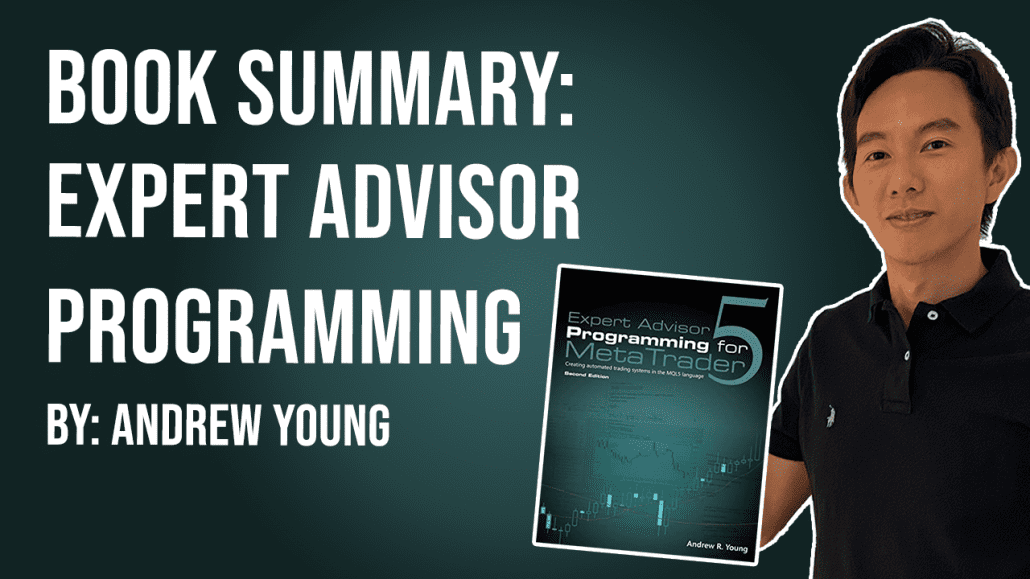
Book Summary: Expert Advisor Programming by Andrew Young
Join our Telegram channel for more market analysis & trading tips: t.me/synapsetrading
Table of Contents
Expert Advisor Programming by Andrew Young: Book Review and What It Teaches
Last updated: 3 July 2026 · By Spencer Li, CFTe
“Expert Advisor Programming” by Andrew Young is a hands-on, beginner-friendly guide to building automated trading systems (expert advisors, or EAs) on the MetaTrader 4 platform using the MQL4 programming language. It walks you from the basics of the MetaEditor environment, through writing and testing a strategy, optimizing its parameters, and adding risk management, to debugging and forward-testing the finished robot. It is best suited to traders and programmers with a basic grounding in both, though a motivated beginner can follow it. Its core message is honest and worth repeating: an EA is only a tool, and it cannot rescue a strategy that has no real edge to begin with. Note one limitation up front: the book does not cover machine learning or AI, so treat it as a foundation in classic MQL4 automation, not a modern AI-trading text.
Here is what the book actually covers, who should read it, and where it stops.
What is an expert advisor (EA)?
An expert advisor (EA) is a program that runs inside MetaTrader 4 and trades automatically on your behalf. It reads price data, applies the rules you have coded, and then places, manages, and closes orders without you clicking anything. You write it in MQL4 (MetaQuotes Language 4, the platform’s built-in programming language) using the MetaEditor (the code editor bundled with MetaTrader 4).
In plain terms, an EA is your trading plan turned into software. That is the appeal, and also the trap. If your plan has an edge, the EA executes it tirelessly and without emotion. If your plan does not, the EA loses money faster and more consistently than you ever could by hand.
What is the book about?
The book is built in three parts, and the structure tells you the intended path.
| Part | What it covers | What you walk away able to do |
|---|---|---|
| Part 1: Foundations | The MetaTrader 4 platform, the MQL4 language, and the MetaEditor environment | Read and write basic MQL4, find your way around the tools |
| Part 2: Building the EA | Creating and testing a strategy, optimizing parameters, implementing risk management | Turn a trading idea into a working, risk-managed robot |
| Part 3: Hardening it | Debugging, troubleshooting, backtesting, and forward testing | Find the bugs and pressure-test the system before it touches real money |
The main message is the one most beginners skip past: EA programming is a powerful tool, but it rewards a solid understanding of both the markets and the language. The code is the easy half. The edge is the hard half.
About the author
Andrew Young is a professional trader and programmer with over a decade in the financial markets. He has a computer-science background and has worked as a software developer for large corporations, and he has built trading strategies and automated systems for various financial institutions. He has written several books on trading and programming and speaks regularly at industry conferences. So the book comes from someone who has actually shipped both code and strategies, not a pure theorist.
The 10 key ideas from the book
These are the points the book keeps returning to. Read them as a checklist for anyone thinking about automating a strategy.
- Learn the platform first. A working knowledge of MetaTrader 4 and the MQL4 language is the price of entry for building any EA.
- The strategy comes before the code. A profitable trading strategy is the first step. The EA is just the delivery mechanism.
- Optimize with caution. Over-optimization (overfitting) tunes a system so tightly to past data that it falls apart on new data. More optimization is not more profit.
- Bake in risk management. Risk control is not a bolt-on. It belongs inside the system from the start.
- Backtest and forward-test. Backtesting (running the EA over historical data) and forward testing (running it live on small or demo capital) are both needed to judge whether it actually works.
- Budget time for debugging. Debugging and troubleshooting are slow, unglamorous, and necessary. This is most of the real work.
- Use functions and libraries. Reusable functions and libraries make an EA more efficient and far easier to maintain.
- Pull in external data where it helps. External data sources can extend what an EA reacts to.
- Add custom indicators. Custom indicators can sharpen the signals an EA trades on.
- Optimization techniques have a ceiling. Methods like parameter optimization (and, in principle, neural networks) can improve performance, but only on top of a strategy that already has an edge.
How do you apply the book to your own trading?
The book pairs each idea with a practical move. Here is the applied version, in the order you would actually do them.
- Define a real edge by hand first. Analyze the markets, find the pattern or trend you can trade, and prove it works manually before you write a line of code.
- Optimize parameters, but lightly. Test combinations and pick a robust one, not the single best-fit curve.
- Code in your risk rules. Stop loss and take profit are not optional features. They are what keep one bad run from ending the account.
- Backtest, then forward-test. Use both to surface problems the other one hides.
- Debug systematically. Expect errors, and fix them methodically rather than guessing.
- Write maintainable code. Use functions and libraries so the next change does not break three other things.
- Layer in external data where it genuinely adds signal, not noise.
- Add custom indicators to refine entries and exits.
- Apply optimization to squeeze the system, knowing it cannot manufacture an edge that was never there.
- Monitor and adjust continuously. A live EA is not “set and forget”. Markets change, and the robot needs minding.
What the book does not cover
A few honest boundaries, so you buy it for the right reasons.
- It is built around MetaTrader 4 specifically, though the concepts carry over to other platforms.
- It mostly uses forex examples, but the methods apply to other markets too.
- It assumes a basic grounding in trading and programming. A complete beginner can follow it with effort, not effortlessly.
- It does not cover machine learning or AI. If you came for an AI-trading book, this is not it. It is a classic-automation foundation.
Where the human edge comes in
Here is the part the book is quietly honest about, and the part I want to underline. An EA will execute your rules flawlessly, around the clock, with no fear and no greed. What it will never do is supply the edge. It cannot tell you that your strategy is curve-fit, that your backtest is lying to you, or that the market regime that made it work has quietly ended. Automation removes the emotion and the manual labor. It does not remove the need for judgment. The code is the cheap half now. Knowing whether the strategy underneath it is real, and pulling the plug when it stops being real, is the human edge, and it is the first of the Five Edges no robot can trade for you.
FAQ
Is “Expert Advisor Programming” by Andrew Young good for beginners?
It is suitable for traders and programmers who have a basic understanding of both. A complete beginner can follow it with effort, but it is not a no-prerequisites book. The willingness to learn matters more than prior expertise.
What is an expert advisor in MetaTrader 4?
An expert advisor (EA) is a program that runs inside MetaTrader 4 and trades automatically using rules you code in the MQL4 language. It places, manages, and closes orders without manual input.
Does the book cover AI or machine learning for trading?
No. The book covers classic MQL4 automation, strategy testing, optimization, risk management, and debugging. It does not cover machine learning or AI.
What programming language do you need to build an EA?
MQL4 (MetaQuotes Language 4), the built-in language of MetaTrader 4. You write it in the MetaEditor environment that ships with the platform.
Can an expert advisor make a losing strategy profitable?
No. An EA only executes the rules you give it. If the underlying strategy has no edge, automating it usually loses money faster and more consistently. The strategy has to work first.
Now that you have the map of what this book teaches, would you add it to your reading list? And if you have already built an EA, what tripped you up most: the code, or proving the strategy actually worked? Let me know in the comments.
For the wider reading list, see the pillar: Best Investing and Trading Books of All Time.
Want a system you can run by hand before you ever automate it? Grab the free 15-Minute Swing Trading Starter Kit. It is the exact routine I use to scan once a day and trade any market in 15 minutes, and it is the kind of edge worth proving manually before you hand it to a robot.
About the author. Spencer Li is the founder of Synapse Trading and a Certified Financial Technician (CFTe) with 15+ years of trading across stocks, forex, crypto, commodities, and bonds. His trade log is public: every trade since April 2024, dated, losses left in. He has taught a 15-minute daily trading routine since 2014, one system for any market.
Education, not financial advice. Synapse Trading is not licensed by MAS to advise on investment products. Trading carries risk of loss; past performance is not indicative of future results.
Related
Best Investing and Trading Books of All Time (pillar) · Algorithmic and automated trading guide · Backtesting a trading strategy · Risk management for traders
Want the daily routine? Enter your email for the free 15-Minute Swing Trader's Checklist.
Free, 5 pages, PDF. You get the checklist, then my occasional trading emails. Education only, not financial advice. Unsubscribe anytime.
Where your details go: Kit, our email provider, stores your email address in the United States. Our contract with Kit lets it use your address only to send our emails, and requires Kit to keep it secure. The United States has no national privacy law like Singapore's, so that contract is the main protection. More in our privacy policy.
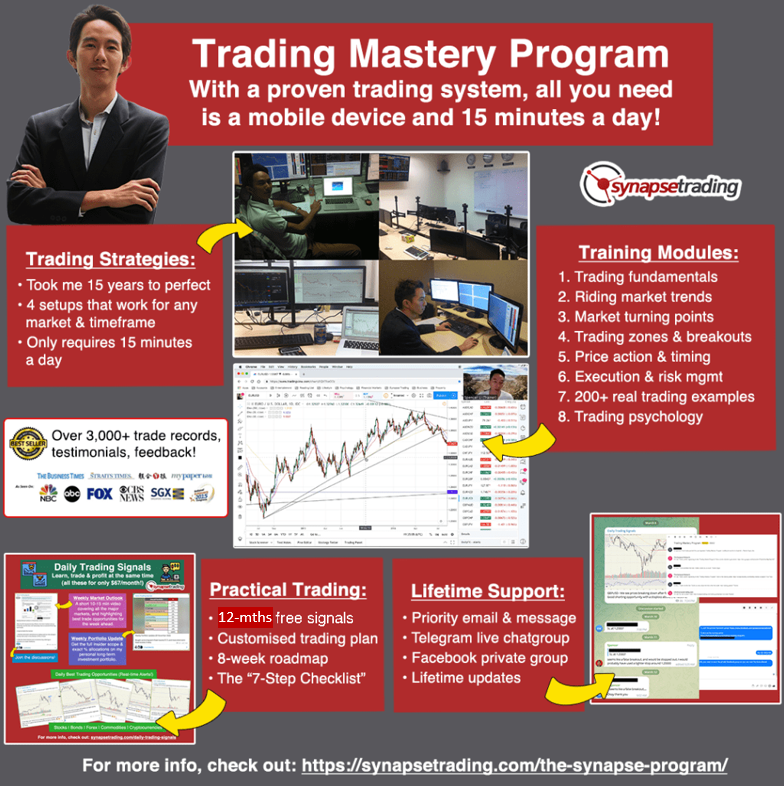 Our flagship mentoring program is suitable for both beginners and advanced traders, covering the 4 strategies which I used over the past 15 years to build up my 7-figure personal trading portfolio.
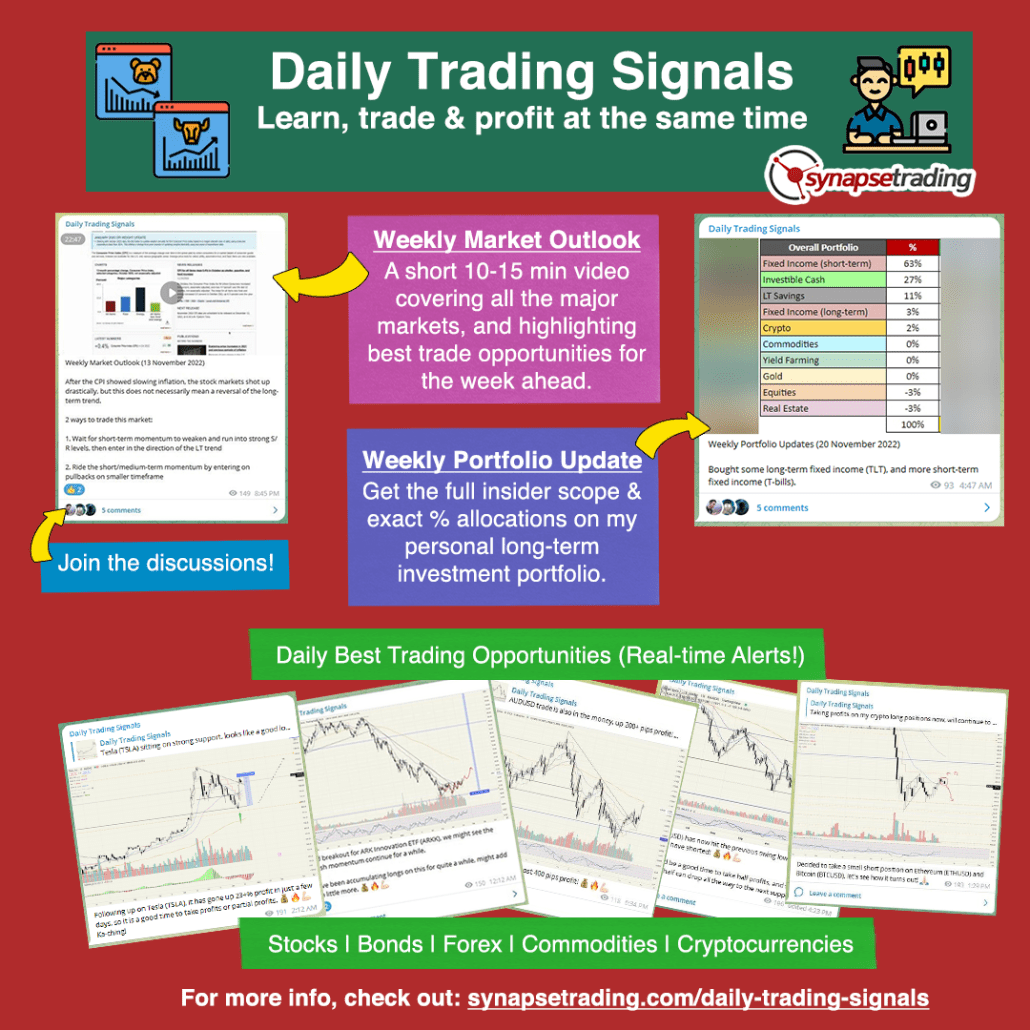 If you're looking for the best trading opportunities every day across various markets, and don't want to spend hours doing the research yourself, check out our private Telegram channel!


Leave a Reply
Want to join the discussion?Feel free to contribute!