• Link to Facebook
  • Link to X
  • Link to Instagram
  • Link to Youtube
  • Link to LinkedIn
  • Link to Mail
Synapse Trading
  • Home
  • About
    • My Background
    • My Trading Journey
    • My Travel Log
    • Media & Interviews
  • Mentoring
    • Trading Mastery Program
    • Results & Testimonials
  • Signals
    • Telegram (Free to join!)
    • Daily Trading Signals
    • Daily Trading Signals (Results)
  • Resources
    • Free Trading Guides
    • Tools & Resources
    • Blog & Infographics
  • Contact
    • Contact Us
    • Partnership Opportunities
  • Click to open the search input field Click to open the search input field Search
  • Menu Menu
Spencer Li

Shares Investment Guest Article Feature

News & Events

Shares Investment Guest Article Feature

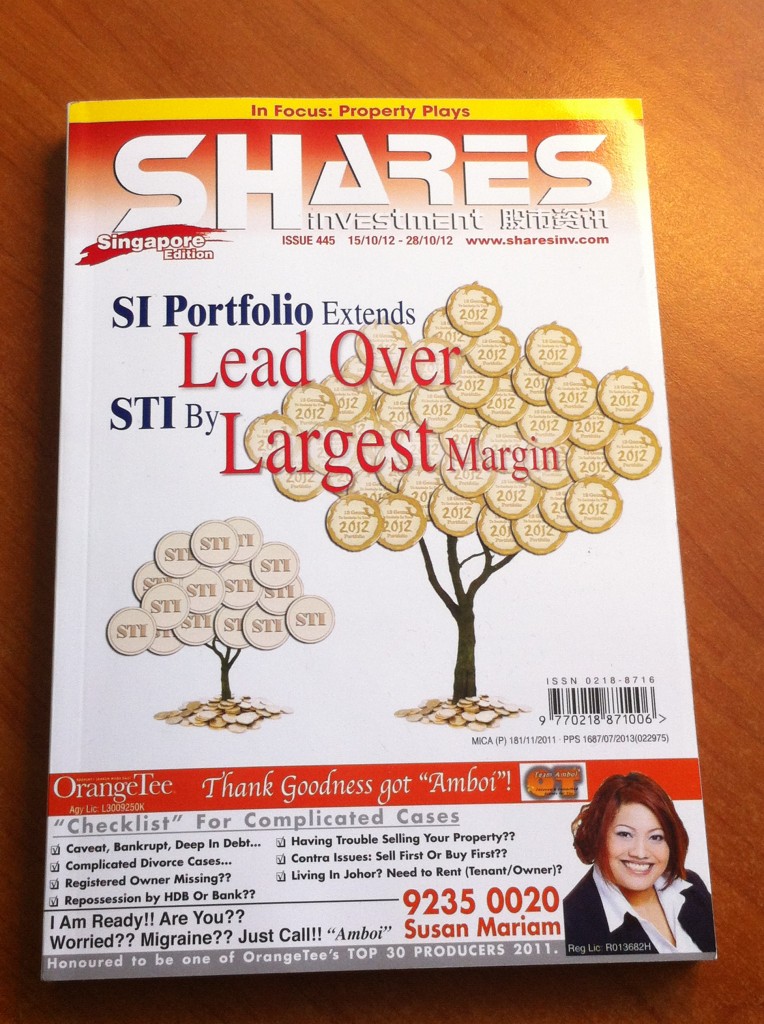
Recently, I was asked to write a feature article in the “Shares Investment” publication to give an outlook on the Singapore market. As you can briefly see from the chart in the picture, I am expecting a larger correction, which would at least see prices dip below the 3,000 round figure. To find out more, this publication is available at selected bookstores and most news stands.

Shares Investment Guest Article Feature 2


According to Investment Trends’ Singapore Broking Report 2011, Shares Investment (Singapore) is the most popular magazine among frequent stock market traders in Singapore. Since july 1995, Shares Investment has been weel-acclaimed by both the investing public and local stock brokers – boasting of more than 30,000 readers every issue.

0 Comments/by Spencer Li
https://synapsetrading.com/wp-content/uploads/2019/10/logo.jpg 0 0 Spencer Li https://synapsetrading.com/wp-content/uploads/2019/10/logo.jpg Spencer Li2012-10-20 17:03:312022-03-08 19:19:02Shares Investment Guest Article Feature
Spencer Li

SGX Exclusive Interview | StockWhiz Trader Profiling

News & Events

StockWhiz Trader Profiling


Recently, I got profiled for the SGX StockWhiz Online Investing Competition, and was asked to share some of his experiences with the participants:

  • What are some trading strategies that you would like to share?
  • What are the key elements of successful trading?
  • How do you decide which financial instruments to trade?
  • What are some educational resources you would recommend?
  • Who would you consider to be your trading mentor?

To read the full interview, click here.

0 Comments/by Spencer Li
https://synapsetrading.com/wp-content/uploads/2019/10/logo.jpg 0 0 Spencer Li https://synapsetrading.com/wp-content/uploads/2019/10/logo.jpg Spencer Li2012-10-17 04:16:212022-03-08 19:19:32SGX Exclusive Interview | StockWhiz Trader Profiling
Spencer Li

Tips for your Resume: How I Managed to Land a Job With the Big Boys

Trading Tips

Last updated: 3 July 2026 · By Spencer Li, CFTe


How to Write a Resume for a Trading or Finance Job

A resume that lands a trading or finance interview is one single-sided page, cleanly formatted, with only your best and most relevant achievements on it. A hiring manager spends a few seconds scanning each one, so your job is to make those seconds count: lead with what makes you stand out, cut everything that does not, and never let the good material get buried under filler. The point of the page is not to tell your life story. It is to earn one thing, an interview. Below is the exact checklist I used to get into the industry, and the same one I now use when I look through other people’s resumes.

Let me walk through what to keep, what to cut, and why each rule exists.

What is a resume actually for?

A resume (your one-page career summary) exists to give a future employer or headhunter a quick glimpse of your achievements and skill sets. That is the whole job. The purpose is to stand out enough to win an interview, nothing more.

That framing changes how you build it. You are not documenting everything you have ever done. You are choosing the few things that make a busy person, with a tall pile of other resumes, decide you are worth a conversation.

After looking through many resumes myself and talking to many employers, I have a pretty clear idea of what they look for and what gets a resume tossed. Here are my personal guidelines.

The rules: what to keep and what to cut

RuleDo thisAvoid this
LengthOne single-sided pageTwo pages, no one scans them
FormattingA decent, clean templateUgly formatting, it gets tossed before it is read
PhotoOptional, but if used, a professional portraitA webcam selfie
Personal dataName, address, mobile, emailBirthday, height, weight, race or religion, horoscope, next-of-kin, favourite colour
Email addressOne that resembles your namecute_boi88@gmail.com and friends
ContentOnly your best, most relevant materialAn autobiography of every experience
StructureClear categories and dated entriesA wall of undifferentiated text

Now the reasoning behind each one.

Keep it to one single-sided page

Employers have piles of resumes to look at. They will spend only a few seconds scanning yours to decide if you are worth a shot. They do not have time to scan two pages. One page forces you to choose your best material, which is exactly the discipline you want.

Use a decent template

A resume with ugly formatting may get tossed before it gets read. You do not need anything fancy. You need clean, readable, and professional. Presentation is the first signal an employer gets about how you work.

Treat the photo as optional

A photo is optional. If you include one, make sure it is a professionally taken portrait shot, not one snapped on your webcam. A bad photo hurts you more than no photo.

Provide relevant data, and nothing more

Relevant data includes your name, address, mobile number, and email address. Irrelevant data includes your birthday, height, weight, race or religion, horoscope, next-of-kin, and favourite colour. Leave the irrelevant stuff out. It eats space and signals that you do not know what matters.

Use a professional-sounding email address

School email addresses are fine. For a personal address, use one that resembles your name, for example john_tanxx@gmail.com, instead of something like cute_boi88@gmail.com. You get the idea. It is a small thing, and small things are exactly what a first impression is made of.

Put in only the best stuff

Given the space limit, and the few seconds of attention your resume will get, you want to make sure they read the good stuff. Do not dilute it and bury it under less important experiences. This is not an autobiography, so you do not need every single thing you have been through. Write only what is relevant to the job, and what might let you stand out. Hint: no one really cares about the medal you won in primary or secondary school.

Categorise your experiences

Group things so the reader’s eye can move fast. Common categories include:

  • Education
  • Awards and Honours
  • Leadership and Activities
  • Professional Certifications
  • Skills and Interests

Date everything, and elaborate briefly

Include the time periods for each work and education entry. After each work experience, add two or three bullet points describing what you did and what you achieved. Keep them short. The achievement matters more than the description, so where you can, show a result, not just a duty.

Why this matters more in trading and finance

Trading and finance desks read a lot of resumes, and they are reading for signal under time pressure. That is, in a small way, the same skill the job itself rewards: filtering a flood of information down to the few things that actually matter, and acting on them fast. A resume that buries its best line under a wall of irrelevant detail tells a hiring manager exactly how you would handle a noisy market. A clean one-pager that leads with your strongest, most relevant result tells them the opposite.

A template can make your resume look tidy in a second. It cannot supply the judgment to decide which two achievements earn a spot on the page and which ten do not. That choice is yours, and it is the part that actually gets you in the room.

If you have additional tips of your own, add them in the comments below. Good luck.

FAQ

How long should a finance or trading resume be?
One single-sided page. Hiring managers spend only seconds per resume, so a second page usually goes unread. One page also forces you to keep only your best material.

Do I need a photo on my resume?
A photo is optional. If you include one, use a professionally taken portrait, not a webcam shot. A poor photo does more harm than no photo at all.

What personal details should I leave off my resume?
Leave off your birthday, height, weight, race or religion, horoscope, next-of-kin, and favourite colour. Keep only your name, address, mobile number, and email address.

What sections should a resume have?
Common, employer-friendly categories are Education, Awards and Honours, Leadership and Activities, Professional Certifications, and Skills and Interests. Date every work and education entry, and add two or three bullet points of achievement under each role.

Does the email address on my resume matter?
Yes. Use an address that resembles your name (for example john_tanxx@gmail.com). An unprofessional handle is a small detail, but first impressions are built from small details.


Got a resume tip that earned you an interview? Share it in the comments.

And if you are eyeing the markets themselves and not just a desk job, start with the pillar: How to Start Trading: A Beginner’s Guide.

Want a system you can actually run? Grab the free 15-Minute Swing Trading Starter Kit. It is the exact routine I use to scan once a day and trade any market in 15 minutes.


About the author. Spencer Li is the founder of Synapse Trading and a Certified Financial Technician (CFTe) with 15 years of trading across stocks, forex, crypto, commodities, and bonds. His trade log is public, 404 trades, losses left in. He teaches low-risk swing trading in 15 minutes a day, one system for any market.

Education, not financial advice. Synapse Trading is not licensed by MAS to advise on investment products. Trading carries risk of loss; past performance is not indicative of future results.


Related

How to Start Trading: A Beginner’s Guide (pillar) · How I got into trading and quit my corporate job · Is a finance degree worth it for trading?

0 Comments/by Spencer Li
https://synapsetrading.com/wp-content/uploads/2019/10/logo.jpg 0 0 Spencer Li https://synapsetrading.com/wp-content/uploads/2019/10/logo.jpg Spencer Li2012-10-13 21:51:282026-07-06 03:22:00Tips for your Resume: How I Managed to Land a Job With the Big Boys
Spencer Li

The Cheetah and the Trader – How to Go for the Kill

Trading Psychology

The cheetah, while the fastest animal on the African plain can outrun any of the prey it feasts upon, always chooses to go for the young, weak, or sick. Once identified, he attacks with laser-guided focus and effectiveness. It is only then that the kill is likely. This is the epitome of a professional trader. Be the cheetah.


The Cheetah and the Trader


Here are some common questions I get from people:
“Sometimes I can’t find good setups in the market, should I trade the less optimal setups or should I look for more different stocks to trade?”
“The setup I learnt from xxx course was working fine a few months back, but it doesn’t seem to be working now. Should I continue using it?”


So, how do we go for the kill?

As cheetah, we should always go for the easy trades. But quite often, for the newbie, the easy trades are staring them right in the face but they do not see them. This is because they are only familiar with a few simple setups (with simple rules/formula) that work best only under specific market conditions.

All these questions have a common theme. Traders who learn one or two simple setups think that they can trade successfully, but when the market changes, quite often the simple setup or system that they are using cannot adapt to the market, and becomes discarded.

Hence, a good trader cannot keep relying on the one same setup. Rather, he needs to know the basic form of a setup, so that from there, he can create a wide variety of different setups that are best suited to the current market situation. That is why we teach a variety of setups (and certain proven variations), leaving them the core skills to tweak setups to adapt to any market situation.


complete guide to investing and trading psychology cover

If you would like to learn more about trading psychology, also check out: “The Complete Guide to Investing & Trading Psychology”

0 Comments/by Spencer Li
https://synapsetrading.com/wp-content/uploads/2019/10/logo.jpg 0 0 Spencer Li https://synapsetrading.com/wp-content/uploads/2019/10/logo.jpg Spencer Li2012-09-25 04:29:022022-03-09 12:20:27The Cheetah and the Trader – How to Go for the Kill
Spencer Li

Lunch with Jim Rogers

News & Events

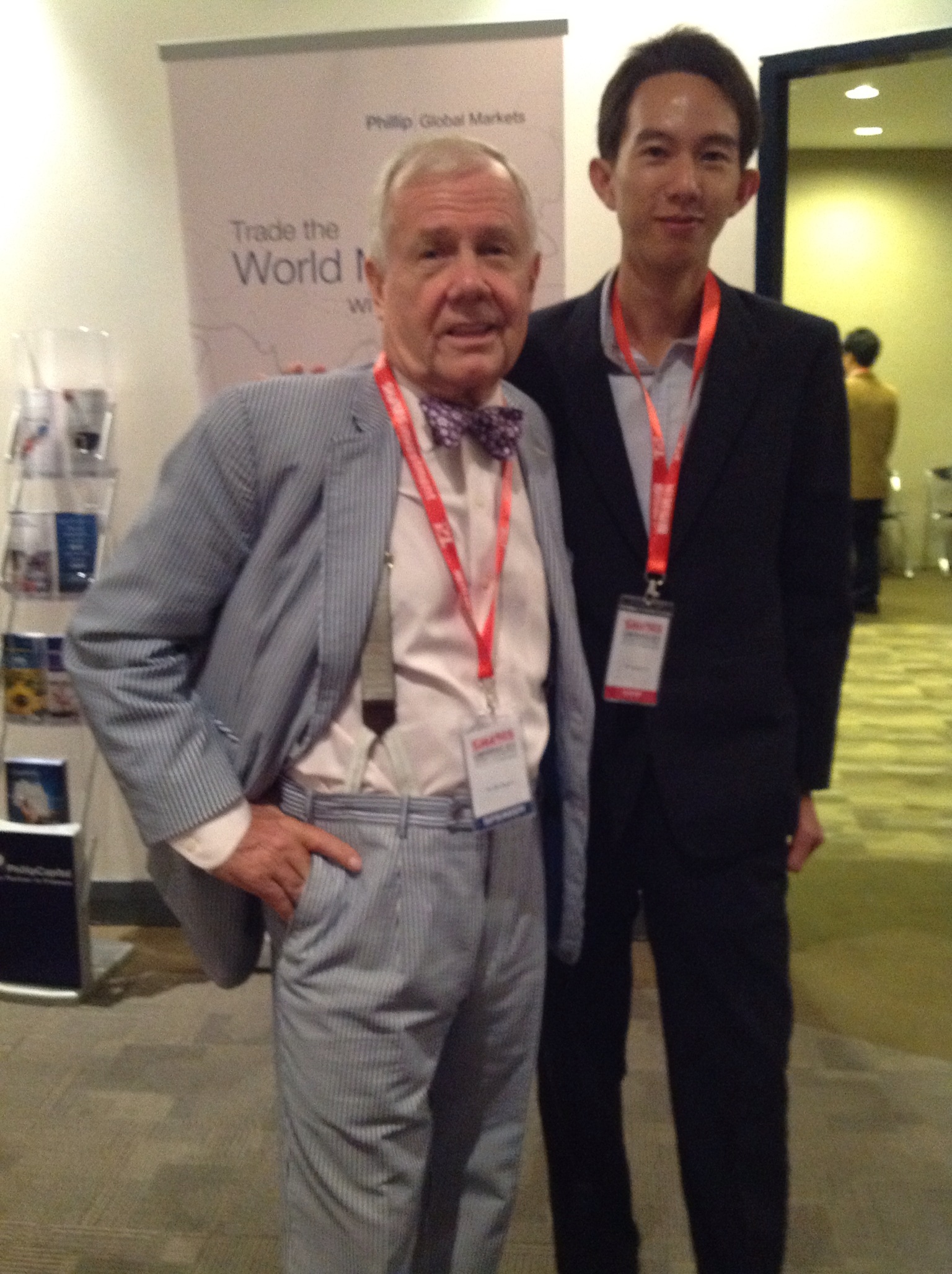
Yesterday, I attended the Shares Investment Conference, and here are some insights I got from the talks, as well as from chatting up the speakers during the private VVIP lunch session.

Lunch with Jim Rogers

Insights from Jim Rogers

Jim Rogers is a very charismatic speaker, sharing not only market wisdom, but also wisdom on living life to the fullest. He had tons of interesting travel stories to share (especially since he travelled around the world).

He is bearish on the US and European markets, for obvious reasons, at least throughout 2013 and 2014. He also talked about a possible bond bubble in the forming, especially in the longer term.

For his portfolio, he is short on US stocks, and has large holdings in Singapore stocks. He is also buying up china stocks (during a crash), expecting a long-term bull for China, at the same time also accumulating the RMB. Other up-and-coming investments include Myanmar and N. Korea, which are starting to show some signs of opening up.

His most bullish sentiments lie in the commodities sector, especially in the area of agriculture. He spoke of cycles of supply and demand for these markets, such as natural resources, land, and commodities. Hence this new cycle is expected to usher in a new era of prosperity for farmers. If one is interested to invest in US real estate, he recommends areas like Iowa and Texas.

On a non market-related note, Jim says that the most important thing is to find your passion in life and do it, then you will never have to work a single day in your life. Trust your heart, and don’t let others discourage you. He ends off by suggesting that investors study philosophy and history, the former to teach us how to think, and the latter to help us draw from the past to cope in a world that is ever-changing.

Lunch with Jim Rogers 2

Insights from Mike Bellafiore

Mike is a famous proprietary trader in New York, and the trading firm he started, SMB Capital, is now one of the top trading firms in New York. He was featured in the famous TV series, Wallstreet Warriors.

Mike started off the talk by stating upfront that there is no need to predict the market in order to make money. He said that many professional when asked will not be able to give a view on the market, simply because it is not necessary to have a view on the market to make money.

When training his new traders, he tells them not to dwell on a losing trade, and instead focus more on the winning trades. One should not celebrate a trade simply because one has made money on it. One should be asking “could I have made more on this trade? Did I manage the trade well such that I got the most out of it?”

When asked about his views on high-frequency trading (HFT), he said that it resulted in more whipsaws, and stops getting taken out more frequently, but the way to go around that was to be ready to re-enter a position upon getting stopped out, and using a time filter to aid in this decision-making.

Someone in the audience asked him what parameters he used for his indicators, to which he replied that he preferred not to use indicators at all. This got me sitting up in my seat, because I had been telling my students the same thing. He said that newbies tended to get bogged down by indicators, but professional prefer to use a blank chart to read the psychology of the market. In fact, the messier one’s chart is, the more likely he has no idea what he is doing.

Over lunch, he shared with me some useful tips on starting a trading firm, and I am very grateful that he is willing to share his experience so generously. Overall, I had a great time at this conference, and I would like to thank the speakers and organisers for the great insights and excellent lunch!

0 Comments/by Spencer Li
https://synapsetrading.com/wp-content/uploads/2019/10/logo.jpg 0 0 Spencer Li https://synapsetrading.com/wp-content/uploads/2019/10/logo.jpg Spencer Li2012-08-28 11:59:262022-03-08 19:20:08Lunch with Jim Rogers
Page 175 of 184«‹173174175176177›»

Free Trading Guides

Free Trading Guides

Blog Categories

  • Beginner's Guide
  • Blockchain & Crypto
  • Book Summaries
  • Candlestick Patterns
  • Economics & News Trading
  • Investing & Portfolio Management
  • Living Your Best Life
  • Market Analysis
  • News & Events
  • Price Chart Patterns
  • Promotions
  • Risk & Money Management
  • Stock Trading
  • Testimonials
  • Tools & Resources
  • Trading Psychology
  • Trading Strategies
  • Trading Tips
  • Travel & Lifestyle

Free Trading Guides

Free Trading Guides

Contact Us

Synapse Trading Pte Ltd
Registration No. 201316168H

Whatsapp: +65-8897-1204
Telegram: @iamrecneps
Email: info@synapsetrading.com

Links

Disclaimer
Privacy policy
Terms & Conditions
Contact us
Partnerships

© 2012-2024 Synapse Trading | All rights reserved | - powered by Enfold WordPress Theme
  • Link to Facebook
  • Link to X
  • Link to Instagram
  • Link to Youtube
  • Link to LinkedIn
  • Link to Mail
Scroll to top Scroll to top Scroll to top