

Tips for your Resume: How I Managed to Land a Job With the Big Boys
Join our Telegram channel for more market analysis & trading tips: t.me/synapsetrading
Last updated: 3 July 2026 · By Spencer Li, CFTe
Table of Contents
How to Write a Resume for a Trading or Finance Job
A resume that lands a trading or finance interview is one single-sided page, cleanly formatted, with only your best and most relevant achievements on it. A hiring manager spends a few seconds scanning each one, so your job is to make those seconds count: lead with what makes you stand out, cut everything that does not, and never let the good material get buried under filler. The point of the page is not to tell your life story. It is to earn one thing, an interview. Below is the exact checklist I used to get into the industry, and the same one I now use when I look through other people’s resumes.
Let me walk through what to keep, what to cut, and why each rule exists.
What is a resume actually for?
A resume (your one-page career summary) exists to give a future employer or headhunter a quick glimpse of your achievements and skill sets. That is the whole job. The purpose is to stand out enough to win an interview, nothing more.
That framing changes how you build it. You are not documenting everything you have ever done. You are choosing the few things that make a busy person, with a tall pile of other resumes, decide you are worth a conversation.
After looking through many resumes myself and talking to many employers, I have a pretty clear idea of what they look for and what gets a resume tossed. Here are my personal guidelines.
The rules: what to keep and what to cut
| Rule | Do this | Avoid this |
|---|---|---|
| Length | One single-sided page | Two pages, no one scans them |
| Formatting | A decent, clean template | Ugly formatting, it gets tossed before it is read |
| Photo | Optional, but if used, a professional portrait | A webcam selfie |
| Personal data | Name, address, mobile, email | Birthday, height, weight, race or religion, horoscope, next-of-kin, favourite colour |
| Email address | One that resembles your name | cute_boi88@gmail.com and friends |
| Content | Only your best, most relevant material | An autobiography of every experience |
| Structure | Clear categories and dated entries | A wall of undifferentiated text |
Now the reasoning behind each one.
Keep it to one single-sided page
Employers have piles of resumes to look at. They will spend only a few seconds scanning yours to decide if you are worth a shot. They do not have time to scan two pages. One page forces you to choose your best material, which is exactly the discipline you want.
Use a decent template
A resume with ugly formatting may get tossed before it gets read. You do not need anything fancy. You need clean, readable, and professional. Presentation is the first signal an employer gets about how you work.
Treat the photo as optional
A photo is optional. If you include one, make sure it is a professionally taken portrait shot, not one snapped on your webcam. A bad photo hurts you more than no photo.
Provide relevant data, and nothing more
Relevant data includes your name, address, mobile number, and email address. Irrelevant data includes your birthday, height, weight, race or religion, horoscope, next-of-kin, and favourite colour. Leave the irrelevant stuff out. It eats space and signals that you do not know what matters.
Use a professional-sounding email address
School email addresses are fine. For a personal address, use one that resembles your name, for example john_tanxx@gmail.com, instead of something like cute_boi88@gmail.com. You get the idea. It is a small thing, and small things are exactly what a first impression is made of.
Put in only the best stuff
Given the space limit, and the few seconds of attention your resume will get, you want to make sure they read the good stuff. Do not dilute it and bury it under less important experiences. This is not an autobiography, so you do not need every single thing you have been through. Write only what is relevant to the job, and what might let you stand out. Hint: no one really cares about the medal you won in primary or secondary school.
Categorise your experiences
Group things so the reader’s eye can move fast. Common categories include:
- Education
- Awards and Honours
- Leadership and Activities
- Professional Certifications
- Skills and Interests
Date everything, and elaborate briefly
Include the time periods for each work and education entry. After each work experience, add two or three bullet points describing what you did and what you achieved. Keep them short. The achievement matters more than the description, so where you can, show a result, not just a duty.
Why this matters more in trading and finance
Trading and finance desks read a lot of resumes, and they are reading for signal under time pressure. That is, in a small way, the same skill the job itself rewards: filtering a flood of information down to the few things that actually matter, and acting on them fast. A resume that buries its best line under a wall of irrelevant detail tells a hiring manager exactly how you would handle a noisy market. A clean one-pager that leads with your strongest, most relevant result tells them the opposite.
A template can make your resume look tidy in a second. It cannot supply the judgment to decide which two achievements earn a spot on the page and which ten do not. That choice is yours, and it is the part that actually gets you in the room.
If you have additional tips of your own, add them in the comments below. Good luck.
FAQ
How long should a finance or trading resume be?
One single-sided page. Hiring managers spend only seconds per resume, so a second page usually goes unread. One page also forces you to keep only your best material.
Do I need a photo on my resume?
A photo is optional. If you include one, use a professionally taken portrait, not a webcam shot. A poor photo does more harm than no photo at all.
What personal details should I leave off my resume?
Leave off your birthday, height, weight, race or religion, horoscope, next-of-kin, and favourite colour. Keep only your name, address, mobile number, and email address.
What sections should a resume have?
Common, employer-friendly categories are Education, Awards and Honours, Leadership and Activities, Professional Certifications, and Skills and Interests. Date every work and education entry, and add two or three bullet points of achievement under each role.
Does the email address on my resume matter?
Yes. Use an address that resembles your name (for example john_tanxx@gmail.com). An unprofessional handle is a small detail, but first impressions are built from small details.
Got a resume tip that earned you an interview? Share it in the comments.
And if you are eyeing the markets themselves and not just a desk job, start with the pillar: How to Start Trading: A Beginner’s Guide.
Want a system you can actually run? Grab the free 15-Minute Swing Trading Starter Kit. It is the exact routine I use to scan once a day and trade any market in 15 minutes.
About the author. Spencer Li is the founder of Synapse Trading and a Certified Financial Technician (CFTe) with 15+ years of trading across stocks, forex, crypto, commodities, and bonds. His trade log is public: every trade since April 2024, dated, losses left in. He has taught a 15-minute daily trading routine since 2014, one system for any market.
Education, not financial advice. Synapse Trading is not licensed by MAS to advise on investment products. Trading carries risk of loss; past performance is not indicative of future results.
Related
How to Start Trading: A Beginner’s Guide (pillar) · How I got into trading and quit my corporate job · Is a finance degree worth it for trading?
Want our free trading resources by email? Leave your address below.
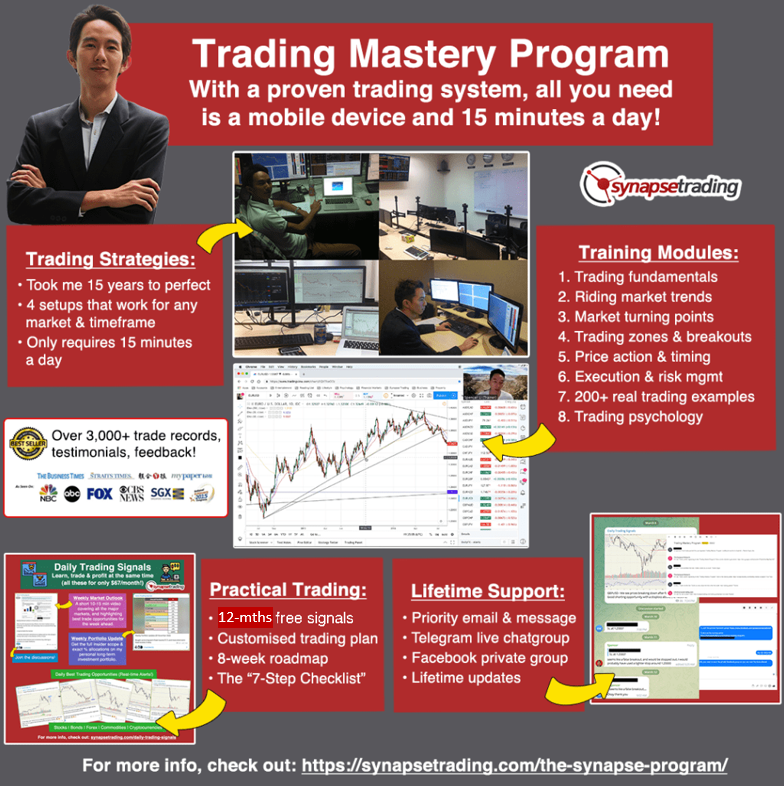 Our flagship mentoring program is suitable for both beginners and advanced traders, covering the 4 strategies which I used over the past 15 years to build up my 7-figure personal trading portfolio.
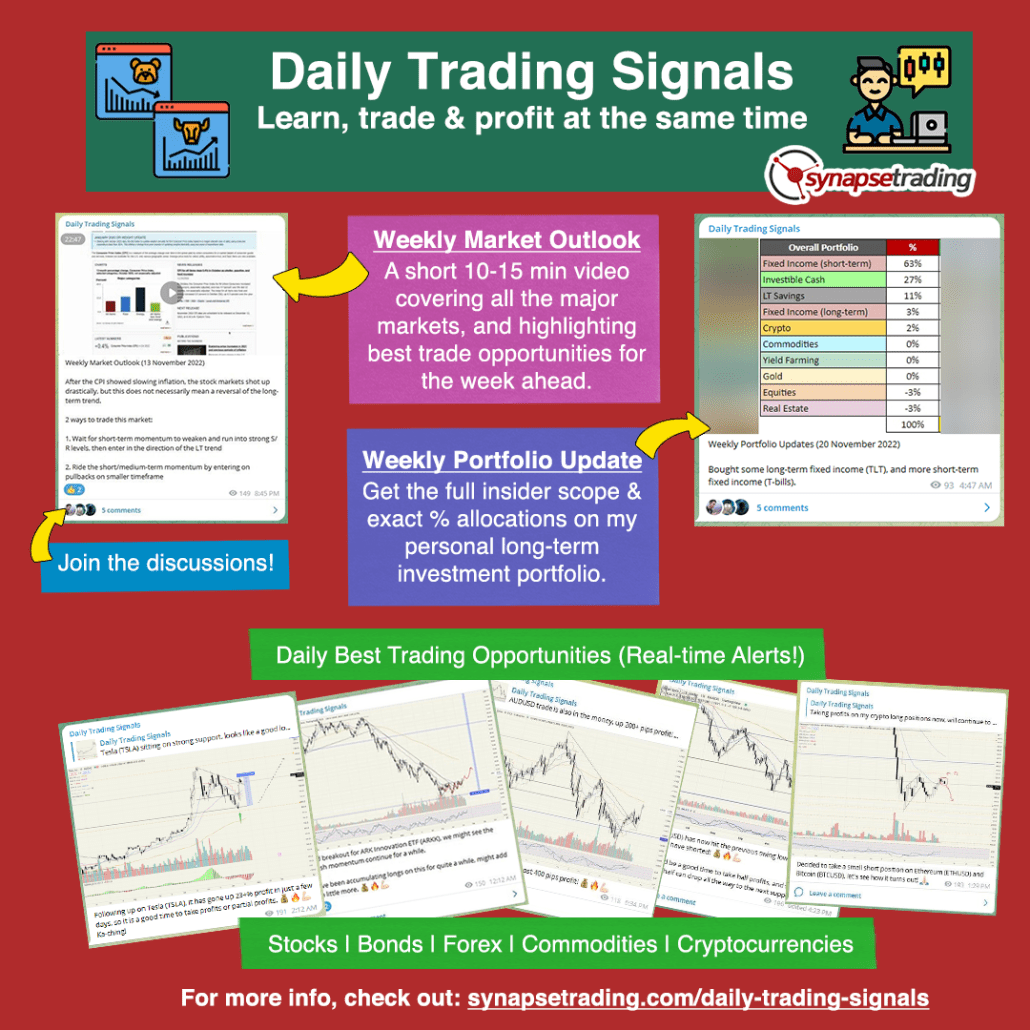 If you're looking for the best trading opportunities every day across various markets, and don't want to spend hours doing the research yourself, check out our private Telegram channel!

Leave a Reply
Want to join the discussion?Feel free to contribute!