

The Cheetah and the Trader: How to Go for the Easy Trades and Skip the Hard Ones
Want the daily routine? Get the free 15-Minute Swing Trader’s Checklist. Get it free →
By Spencer Li, CFTe · Last updated: 26 October 2026
The cheetah lesson for traders is simple. Pick the easy target, then commit to it fully. A cheetah is the fastest land animal, yet it spends almost all of its day walking and watching, and it saves its sprint for prey it has a real chance of catching. A trader should do the same, which means taking the clear setups that suit today’s market and skipping everything else. The catch is that most beginners cannot see the easy trades yet, because they only know one or two setups. So the real work is learning the basic form of a setup well enough to spot it in its many shapes.
I first wrote about this on the blog in 2012. Since then, scientists have strapped GPS collars on wild cheetahs, and the data makes the lesson both sharper and more honest.
How fast is a cheetah, really?
In 2013, a team led by the Royal Veterinary College in the UK published a study in Nature with what the authors called the first detailed data on how wild cheetahs move when they hunt. They built tracking collars with GPS and motion sensors, fitted them on five wild cheetahs in Botswana, and recorded 367 runs over 17 months.
The fastest run hit 25.9 metres a second, which is about 93 km/h. That is the famous number.
The less famous numbers are more useful. They are also much slower. The average top speed across all runs was 14.9 metres a second, around 54 km/h, and it was usually held for only 1 to 2 seconds. The cheetahs ran about 1.3 times a day and covered about 6 km a day on average, so high-speed running was only a small slice of their day. For most of their waking hours, the fastest animal on land is walking, resting and watching.
In 2012 I called this the epitome of a professional trader. I like to say trading is 99% waiting and 1% action, and the cheetah seems to have worked out the same split a long time before we did.
Does a cheetah really pick the weakest prey?
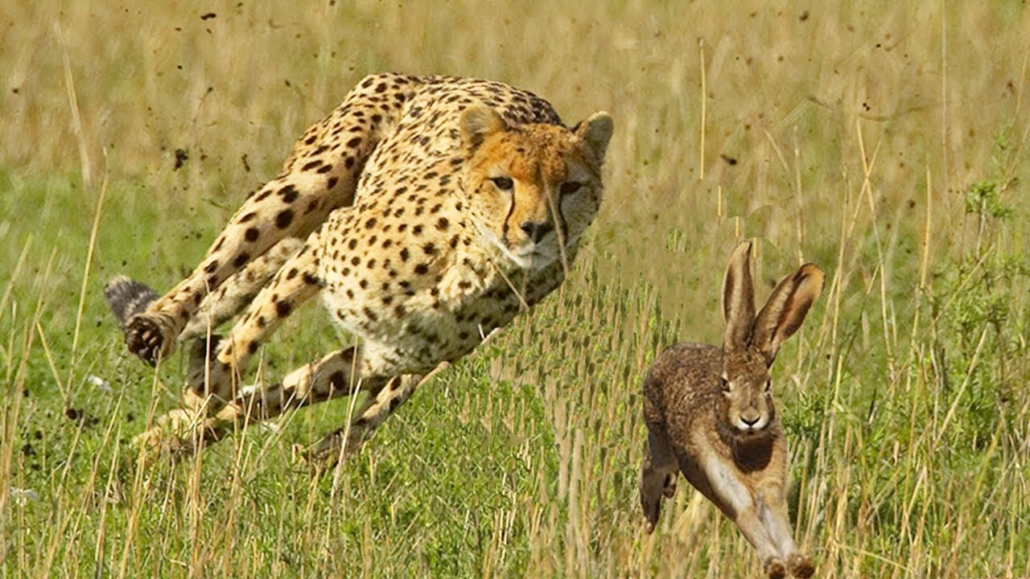
In 2012 I wrote that the cheetah “targets the young, the weak or the sick”, and only attacks once it has picked its target. That turns out to be half right, and the wrong half is worth a closer look.
In 1989, the zoologists Clare FitzGibbon and J. H. Fanshawe compared the Thomson’s gazelles killed by cheetahs with those killed by African wild dogs. They expected the wild dogs, which run their prey down over long distances, to take more of the young, old and sick animals than the cheetah, which stalks and then sprints. Measured by the marrow fat in the gazelles’ leg bones, the wild dogs did take more animals in poor condition, mostly because they preferred males, which were in worse shape. But the cheetahs did not take fewer young and old gazelles than the wild dogs did.
So the cheetah is not mainly hunting the sick. It picks the targets it can actually catch, and that depends as much on the situation as on the prey. In the Botswana study, runs in dense cover succeeded 31% of the time against 20% in open grassland, and the researchers noted that the gap was not statistically significant. Even so, cover helps a stalker get close.
Markets work the same way. An easy trade is rarely easy because the market is “weak”. It is easy because the conditions suit the setup you know, in the way thick bush suits a stalker.
If you want a short daily routine for spotting those conditions, my free 15-minute swing trader checklist walks you through one.
Should you trade weaker setups when you cannot find good ones?
Back in 2012, this was one of the most common questions I got: “Sometimes I can’t find good setups in the market, should I trade the less optimal setups or should I look for more different stocks to trade?”
Ecologists have a model for almost exactly this problem. It is called the optimal diet model, and it grew out of work by Robert MacArthur and Eric Pianka in 1966 on how an animal should choose what to chase. The model says a predator should ignore low-value prey when better prey is common enough. It should only settle for the weaker prey when the better kind takes too long to find, because the time spent searching is a cost as well.
Hence the answer depends on your search time. Most beginners get this backwards. The easy trades are often staring them right in the face, but they do not see them, because they only know a few setups with simple rules that work under specific conditions. When none of those few appear, the screen looks empty, and the weaker setup starts to look tempting.
So the fix is to shorten the search rather than lower the bar. Learn to recognise more of the good setups, and the weaker ones stop looking necessary.
Why does a setup that used to work stop working?
The second question from 2012 went like this: “The setup I learnt from xxx course was working fine a few months back, but it doesn’t seem to be working now. Should I continue using it?”
Both questions share a theme. Traders who learn one or two simple setups think that they can trade successfully, but when the market changes, the simple setup quite often cannot adapt, and it ends up discarded along with the trader’s confidence.
A setup with one fixed formula works best in one kind of market. Markets do not stay one kind. A breakout setup suits a market that has been coiling sideways, and a trend-following setup suits a market already moving. When conditions change, the formula keeps firing in the wrong weather.
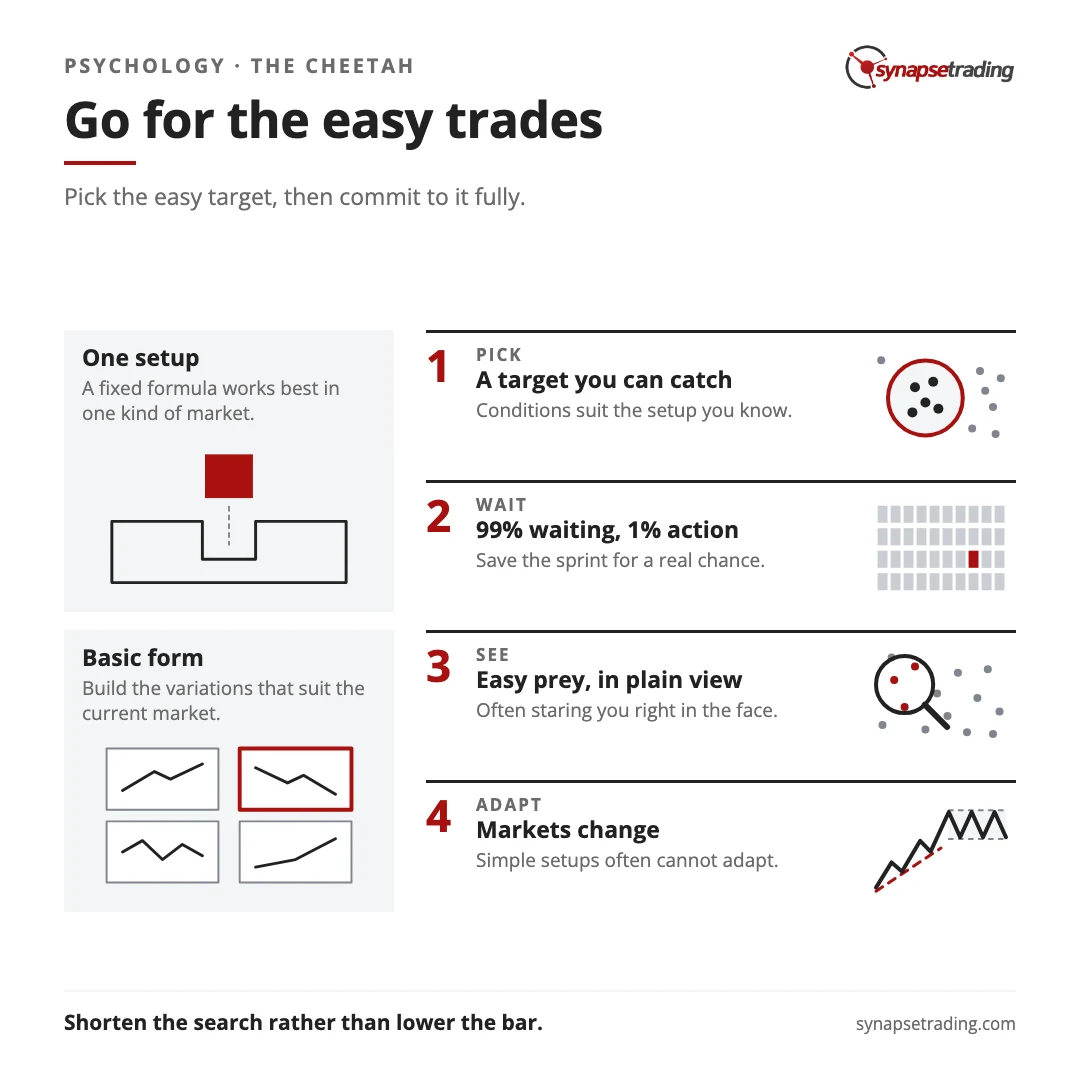
So a good trader cannot keep relying on the one same setup. He needs to know the basic form of a setup, so that from there, he can build the variations that suit the current market. That is why we teach a variety of setups and tested variations rather than one magic formula. My guide to the four types of trading strategies shows the main families and when each one works.
Here is what picking the weak target looks like in a real market. In my weekly outlook on 5 November 2025, the market was falling, and I described one of my short positions in a speculative stock as “a really kind of easy trade”. My reasoning was that when the market falls, the more speculative sectors tend to be the ones that fall first, because “they go up a lot very fast, and they also come down very fast”. That is the trading version of the young and the old in the herd. Easy prey, in plain view.
What does all the waiting cost you?
On 25 June 2024, a trader on Reddit’s r/Daytrading had gone four days without a trade, and asked the question every patient trader has asked: “What else can I do productively besides walk my dog for the umpteenth time?”
It is a fair complaint. Waiting is boring, and boredom is where bad trades come from. When you have been watching a screen for hours, a mediocre setup starts to look like a good one, simply because it is there.
That is what 99% waiting feels like from the inside. In my weekly outlook on 7 April 2026, I kept the video short, because not much had changed since the week before. As I said then, “the best strategy is to be patient and to wait for a clearer sign”, because the market did not look that strong and there were a lot of conflicting signals.
Patience is easier with a short routine than with willpower alone. The free 15-minute swing trader checklist gives you one.
I should also concede where the cheetah story breaks down. In that 2013 Botswana study, only 94 of the 367 runs ended in a kill, which is about 26%, and the success rate barely moved when the researchers added hundreds more runs. The authors also noted that cheetahs run to play and to escape bigger predators, and they could not fully separate those runs from hunts. Even so, an animal built for this still fails roughly three times out of four. Picking the easy target makes the kill more likely, as I wrote in 2012. It does not make a trade safe, which is why every trade still needs a planned exit before you take it.

If you would like to learn more about trading psychology, also check out: “The Complete Guide to Investing & Trading Psychology”
FAQ
What does the cheetah teach traders?
To wait for the targets it can actually catch, then commit fully. Wild cheetahs sprint for only a second or two at a time and spend most of the day walking and watching, which is a good model for a trader who only acts on clear setups.
How fast can a cheetah run?
The fastest run in a 2013 study of wild cheetahs in Botswana was 25.9 metres a second, about 93 km/h. The average top speed per run was much lower, around 54 km/h, held for 1 to 2 seconds.
How often does a cheetah’s hunt succeed?
In that study, 94 of 367 recorded runs, about 26%, ended in a kill. Runs in dense cover did better than runs in open grassland, 31% against 20%.
Should I trade weaker setups when I cannot find good ones?
Usually not. A weaker setup only makes sense when good ones are truly rare. Most beginners have a search problem, because they know too few setups to see the good trades that are already there.
Why did my trading setup stop working?
Most often, the market changed. A setup with a fixed formula suits one kind of market, so when the market shifts from trending to sideways, or back, the same rules stop fitting.
So, which kind of trader are you right now, the one forcing the old setup or the one waiting in the long grass? Tell me in the comments, along with what you do on the days with no trades.
If you want to see how waiting works when a whole market is falling, read how to pick a market bottom, and my free trading guides collect the rest.
And if you want a routine that finds the easy trades without hours at the screen, grab the free 15-minute swing trader checklist.
About the author. Spencer Li is The 15-Minute Trader and the founder of Synapse Trading. He is a Certified Financial Technician (CFTe) with 15+ years of trading, run from 70+ countries. He holds a B.Acc and B.BM from SMU. Every trade he takes is public, dated, losses left in. He teaches rules-based swing trading in 15 minutes a day, one system for any market.
Education, not financial advice. Synapse Trading is not licensed by MAS to advise on investment products. Trading carries risk of loss, and past performance is not indicative of future results.
Want the daily routine? Enter your email for the free 15-Minute Swing Trader's Checklist.
Free 5-page PDF, then occasional trading emails. Education only, not financial advice. Unsubscribe anytime. Kit stores your email in the US: see our privacy policy.
Want to learn the full method? The Trading Mastery Program teaches the 4 strategies I have traded since 2011. It suits beginners and experienced traders.
Rather follow the trades as they happen? Daily Trading Signals is our Telegram channel: my trade ideas with entry, stop and exit, and every trade is public.
Questions about this post? Ask in the free Telegram channel →
Educational content only, not personalised financial advice. Trading carries risk, including loss of capital. Past performance is not indicative of future results. Synapse Trading is not licensed or regulated by MAS.


Trackbacks & Pingbacks
[…] The Trading Rules Every Professional Trader Lives By (pillar) · Best Trading Tips and Quotes from Legendary Top Traders · Patience and discipline in trading · Trade like a casino, not a gambler · The cheetah and the trader […]
Comments are closed.