

The 4 Types of Trading Strategies: Break, Swing, Bounce and Turn, and When Each One Works
Want the daily routine? Get the free 15-Minute Swing Trader’s Checklist. Get it free →
By Spencer Li, CFTe · Last updated: 10 October 2026
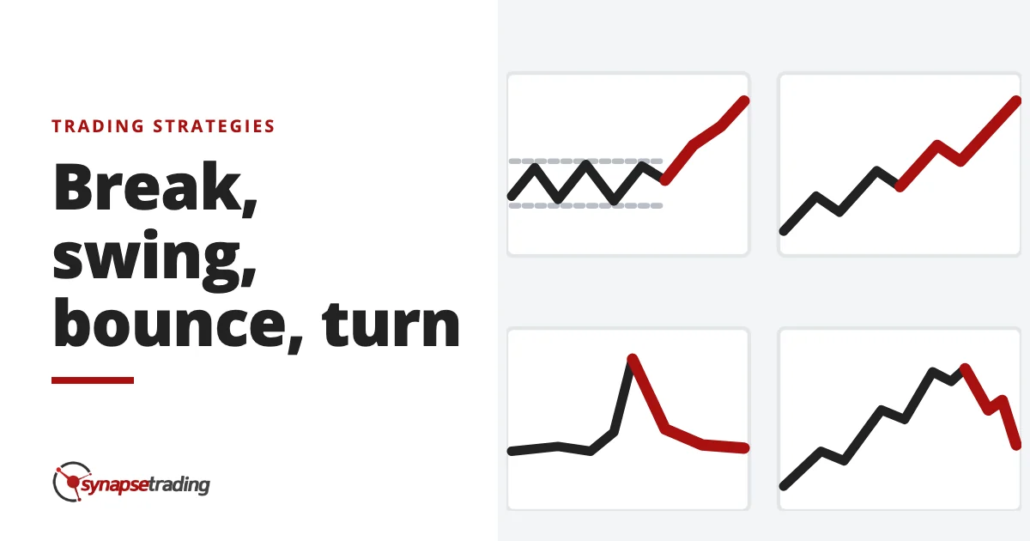
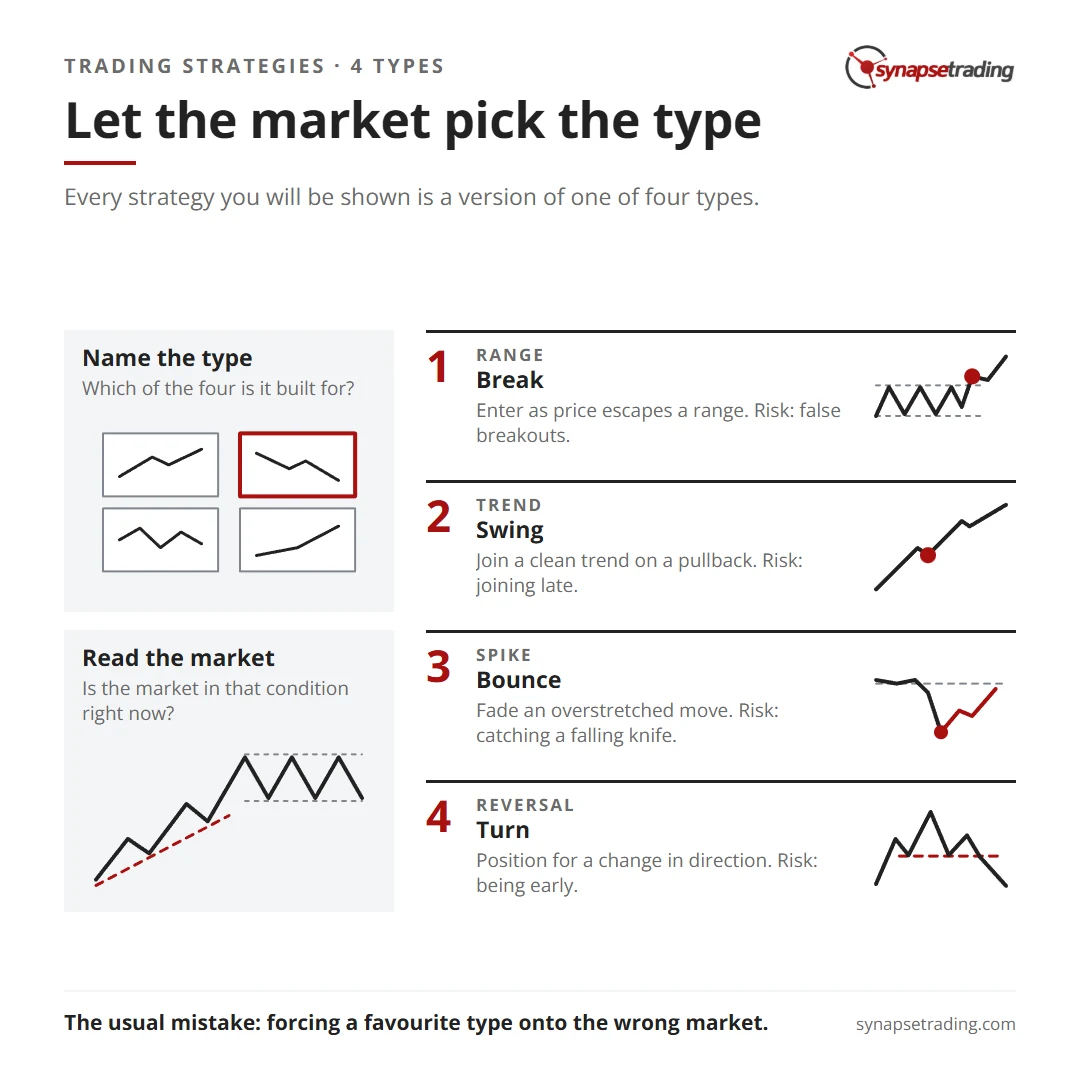
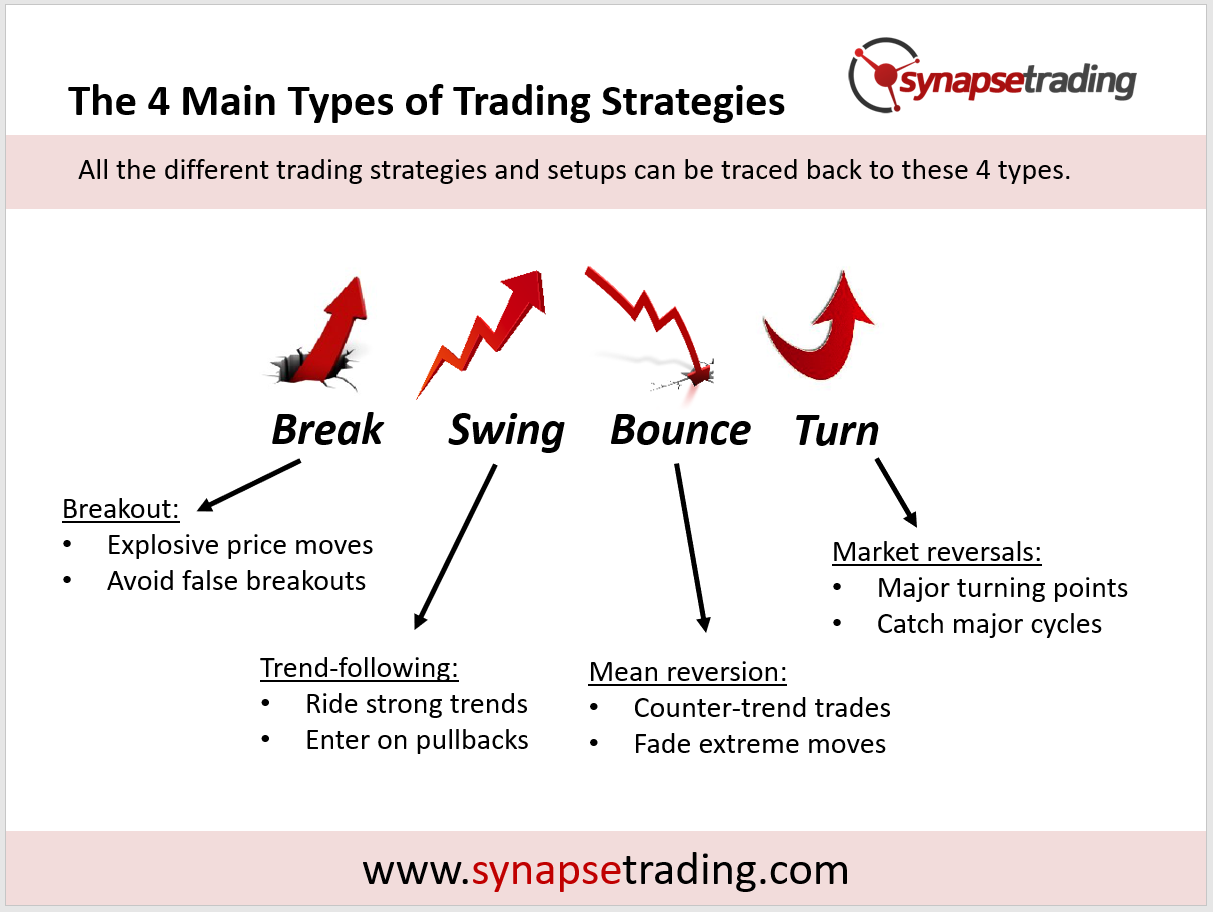
Every trading strategy you will ever be shown is a version of one of four types: Break, Swing, Bounce or Turn. Break trades a sideways range as it snaps, Swing rides a trend that is already moving, Bounce fades a move that has stretched too far, and Turn positions for the end of a big trend. What separates them is the market each one needs. So the useful question about any new strategy is which of the four it is, and whether the market in front of you is in that condition right now.
I first wrote about these four on this blog in 2021. I still tag my own trades with them today.
Why do hundreds of strategies come down to four?
Most new traders collect strategies the way some people collect sneakers. A moving average crossover from one video, a candlestick pattern from another, an indicator a friend swears by, and after a year the folder is full while the account has barely moved.
Underneath, a price can only do four things a trader can make money from. It can break out of a range, it can trend, it can overshoot and snap back, or it can run out of steam and reverse. Each type is built for one of those, so once you see which one a strategy is built for, you know when it should work and what kind of losing to expect.
It is a bit like packing for a holiday. Nobody packs the same bag for Tokyo in January and Bangkok in April, and nobody blames the winter coat when it was simply the wrong trip. The weather picks the clothes. In trading, the market picks the type.
Nearly every chart I post with a trade idea carries a hashtag for its type. When the 734 annotated charts I posted between June 2024 and May 2026 were read one by one, about 40% were Swing and about 40% were Break. Bounce and Turn took roughly 10% each.
The 4 types of trading strategies, side by side
| Type | What you do | Market it needs | Main risk |
|---|---|---|---|
| Break | Enter as price escapes a range | Sideways, pressure building | False breakouts |
| Swing | Join a trend on a pullback | A clean trend | Joining late, or a fake trend |
| Bounce | Fade an overstretched move | A sharp, climactic spike | Catching a falling knife |
| Turn | Position for a change in direction | An old trend whose structure is breaking | Being early, again and again |
How does a Break trade work?
In my weekly outlook on 9 October 2025, I said I was not keen to chase crypto, even though the bigger picture still looked bullish. Crypto has a habit of breaking to new highs and then trending lower, and it had done exactly that after its breakout in August. So I said I would wait for a pullback, or for price to reclaim the breakout level and hold above it.
That week holds the whole tension of a Break. A breakout happens when buyers and sellers have been fighting over the same prices inside a sideways range, until one side wins and price escapes, sometimes very fast, because the pressure built up inside the range gets released at once.
The catch is the false breakout. Price pokes out of the range, traps everyone who chased it, and falls straight back inside. Ranges are noisy, so they produce plenty of these. Hence a breakout trader should care less about the breakout and more about the proof.
So I want proof that buyers have really taken over, not just a wick poking through the level. Often the cleaner moment is the retest, when price comes back to the broken level and it holds as support.
You do not need to watch every breakout live to use this. My free 15-minute swing trader checklist is the daily routine I use myself.
Why is Swing the type I trade most?
The most boring of the four is the one I lean on most. A Swing trade follows a trend that already exists, so nothing needs predicting, and the job is to wait for a market that is moving, let it pull back a little, and join it as it starts moving again.
My rules here are quite mechanical. I only go long when the longer-term trend is up and the moving averages agree with it. When the lines are tangled together, there is no trend worth riding, and the answer is to wait. When they agree, I wait for a small pullback and join as price starts moving again.
Plenty of traders reach for the RSI to time that entry. I once wrote in my trading channel that “in a strong trending market, oscillator indicators (such as RSI) are not going to be much use”. A strong trend can stay overbought for weeks, and the oscillator keeps telling you to sell the whole way up.
The danger with Swing sits at both ends. Join too late and the move is mostly gone. Mistake a brief pop for a trend and you get chopped up, one small stop after another. So the skill comes down to two questions. Is this a real trend, and is it still early enough to join?
When does a Bounce trade make sense?
In early February 2026, gold had just fallen hard, and in my weekly outlook I said I had started buying a little for my long-term portfolio. For trading, I passed. As I put it in the video, “this bounce trade was kind of too fast to actually trade”.
That is a Bounce in one decision. You are judging whether a move has stretched far enough to snap back, and whether it is moving slowly enough for you to get in.
The idea underneath is mean reversion, which says price tends to come back towards its average after stretching too far from it. Panic selling or a news shock can push a market well past where it normally trades, and the Bounce fades that stretch and rides the snap-back towards normal, usually over a few days rather than weeks.
My rules want a sharp, fast drop into a level where support is strong, such as a previous swing low or a moving average. A slow drift does not qualify. Then I want signs that the selling has exhausted itself before I go near it.
Do note that this is the riskiest of the four to get wrong, because you are trading against the momentum. If the fall is not exhausted, you are catching a falling knife, and a few of those can wipe out weeks of patient Swing trades. That fear is healthy, and it is why I treat Bounce trades with more caution than the other three.
Why is a Turn trade so hard to time?
On 9 October 2025, QQQ, the fund that tracks the Nasdaq 100, had just broken to new highs again and looked very overbought. I told viewers that “you never know how long it can continue going”, and pointed to the stretch before it, when it had simply kept creeping up for a really long time.
Every Turn trader lives with that problem. All markets move in cycles, so however strong a trend is, it eventually runs out of buyers or sellers and changes direction. Catch a real top or bottom and you are in at the start of the next big move, with a stop close by. But trends almost always run longer than anyone expects, and so the chronic problem with a Turn is being early. Call the top, get stopped out, call it again, get stopped out again, and by the time the market really turns, regret has worn your conviction down to nothing.
So my Turn rules carry the highest bar of the four. I want the old trend’s structure to break first, such as a long trendline giving way, a double bottom, or a head and shoulders. My trading notes put the reason in one line: it is “easier to make money from strong up-trends than to buy reversals”.
When the conditions line up, a Turn can be surprisingly clean. In November 2025 I pointed out a double bottom in USD/SGD, the US dollar against the Singapore dollar, that I had mentioned for weeks. Price had finally broken above it.
How do you know which type to use?
In March 2026, a trader on Reddit’s r/swingtrading, new to swing trading, made a fair point about breakouts: “it’s much easier for these patterns to emerge during bull market.”
They are right. A Break or a Swing needs a market with buyers in it, which is why my rules only buy when the longer-term trend is up, and that is also the whole argument for having four types instead of one. When the market changes, the type changes with it.
- A range with no trend points to a Break.
- A clean trend points to a Swing.
- A violent, overstretched spike points to a Bounce.
- An old trend whose structure is breaking points to a Turn.
The usual mistake is forcing a favourite type onto the wrong market. That looks like hunting breakouts in a quiet drift, fading every small pop as if it were a climax, or calling a top on a trend with plenty left in it.
So which type wins? My own records cannot tell you yet, and I would rather say so. Only a small share of my logged trades carry a setup tag, and the Bounce and Turn groups are far too small to rank anything. So no type has proved itself better than the others in my own book. Each one earns its place by fitting its own market.
Reading the market every day is a habit, and habits are easier to keep with a routine. The free 15-minute swing trader checklist is the one I run.
FAQ
What are the four types of trading strategies?
Break, which trades breakouts from a range, Swing, which follows a trend, Bounce, which fades an overstretched move, and Turn, which positions for a major reversal. Almost every strategy is a version of one of these.
What is the difference between a Bounce and a Turn?
A Bounce is a short-term trade against a sharp spike, with no claim that the bigger trend has changed. A Turn bets that the bigger trend itself is reversing, so it needs the trend’s structure to break first.
Which type of trading strategy is best for beginners?
Swing is usually the most forgiving, because you follow a move that already exists. Bounce and Turn trade against momentum and punish bad timing.
What is a false breakout?
It is when price pokes out of a range and falls back inside, trapping the traders who chased it. Waiting for a candle to close beyond the level, on strong volume, filters out many of them.
Can one trader use all four types?
Yes, though rarely at once. You use the type that fits the current market and stand aside with the rest.
Which of the four do you trade most, and have you ever caught yourself forcing it onto the wrong market? Let me know in the comments.
If you are just starting out, my Beginner’s Guide to Trading and Technical Analysis puts these four in order. The patterns behind most Break and Turn trades are in my guide to trading price chart patterns, and my free trading guides collect the rest.

If you would like to learn how to get started in trading, also check out: “The Beginner’s Guide to Trading & Technical Analysis”
And if you want a routine that matches the type to the market without hours at the screen, grab the free 15-minute swing trader checklist.
About the author. Spencer Li is The 15-Minute Trader and the founder of Synapse Trading. He is a Certified Financial Technician (CFTe) with 15+ years of trading, run from 70+ countries. He holds a B.Acc and B.BM from SMU. Every trade he takes is public, dated, losses left in. He teaches rules-based swing trading in 15 minutes a day, one system for any market.
Education, not financial advice. Synapse Trading is not licensed by MAS to advise on investment products. Trading carries risk of loss, and past performance is not indicative of future results.
Want the daily routine? Enter your email for the free 15-Minute Swing Trader's Checklist.
Free 5-page PDF, then occasional trading emails. Education only, not financial advice. Unsubscribe anytime. Kit stores your email in the US: see our privacy policy.
Want to learn the full method? The Trading Mastery Program teaches the 4 strategies I have traded since 2011. It suits beginners and experienced traders.
Rather follow the trades as they happen? Daily Trading Signals is our Telegram channel: my trade ideas with entry, stop and exit, and every trade is public.
Questions about this post? Ask in the free Telegram channel →
Educational content only, not personalised financial advice. Trading carries risk, including loss of capital. Past performance is not indicative of future results. Synapse Trading is not licensed or regulated by MAS.

