

Maslow’s Hierarchy and Self-Actualization in Trading: Why Getting Better Means Doing Less

Want the daily routine? Get the free 15-Minute Swing Trader’s Checklist. Get it free →
By Spencer Li, CFTe · Last updated: 26 October 2026
Self-actualization is the top need in Abraham Maslow’s hierarchy of needs, the drive to become everything you are capable of becoming. For a trader, it means growing into the trader you picture when you imagine doing this well. For most people that takes subtraction far more than addition. You keep the small part of what you know that works, and you let go of the rest.
I first wrote about this in August 2012. The idea has aged better than most of my 2012 charts.
Did Maslow actually draw a pyramid?
Search for Maslow and you will get a pyramid, usually in rainbow colours. Yet the paper that introduced the hierarchy never uses the word pyramid at all.
Maslow set out his idea in “A Theory of Human Motivation”, published in the journal Psychological Review in 1943. It names five basic needs: physiological needs such as food and sleep, safety, love, esteem, and self-actualization. The pyramid shape came later.
The picture below goes further still. It has eight rungs, with transcendence sitting on top. The 1943 paper gives the desire to know and understand a short section of its own, outside the five, and says nothing about aesthetic needs or transcendence.

Maslow’s Hierarchy: Trading Self-Actualization
There is a second surprise. A pyramid makes the levels look like floors in a building, where you finish one before you climb to the next. Maslow wrote the opposite: “We have spoken so far as if this hierarchy were a fixed order but actually it is not nearly as rigid as we may have implied.”
He described each new need as one that appears gradually, “by slow degrees”, while the needs below it are only partly met. He even guessed that the average person might be 85% satisfied in physiological needs, 70% in safety, 50% in love, 40% in esteem and 10% in self-actualization. Then he called those “arbitrary figures for the sake of illustration”, which is an unusually honest thing to print in a paper people would still be quoting more than 80 years later.
Some later writers rejected his order outright. The psychologist Nathaniel Branden, in The Six Pillars of Self-Esteem, called the idea of placing self-esteem after survival needs “a misleading oversimplification”. His reason was that people sometimes give up life itself over matters central to their self-esteem.
What does self-actualization mean for a trader?
Maslow’s own description of the top level is short and blunt. “A musician must make music, an artist must paint, a poet must write, if he is to be ultimately happy. What a man can be, he must be. This need we may call self-actualization.”
He credited the term to Kurt Goldstein, and defined it as “the desire to become more and more what one is, to become everything that one is capable of becoming.”
In trading terms, that is the ideal trader you envision. My own picture fits a line I repeat often, that trading is 99% waiting and 1% action. Yours may look quite different. Maslow’s musician and painter were never trying to become the same person.
If you have been trading for a few years, you have collected a lot of skills on the way. There are the indicators, the patterns, the news habits, three platforms and a folder of e-books you meant to finish. So the question I asked in 2012 still stands. Are you putting all of that to good use, and how do you reach your full potential with it?
Why does getting better mean doing less?
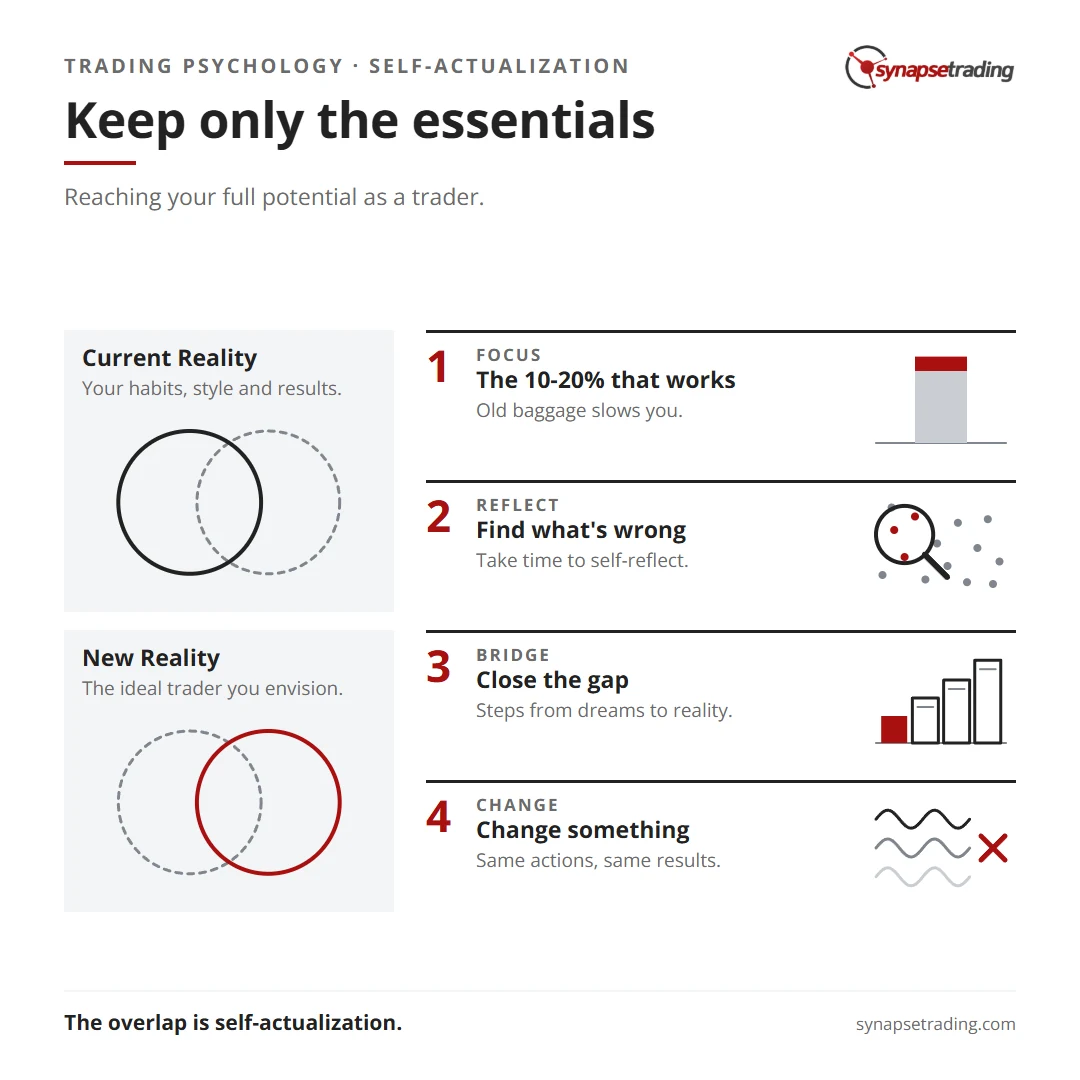
In 2012 I put the answer this way, and I still would: “The key lies not in using everything you have learnt, but rather in knowing what is not essential.”
Most traders expect growth to feel like adding. A new indicator arrives, then a new course, then a new market to watch. That works for a while, because early on you really do lack knowledge. Then the pile gets so big that every chart shows you three signals pointing three ways, and each extra tool hands you one more reason to hesitate.
In the same post I wrote: “Once you learn to think in essentials, you will realise that you will have to discard most of what you have learnt, and focus on the 10-20% that works. Clinging on to old baggage will slow your progress.”
Discarding hurts because the old knowledge cost you time, and often money. Hence the urge to keep a little of everything, just in case. Do note that this is how a trading strategy slowly turns into a museum.
So what does that leave you with? Usually a short list of things you check, in the same order, every time. Everything else is optional reading.
If you would rather look at the market for 15 minutes a day than all day, the free 15-minute swing trader checklist is the routine I use myself.
How do the two circles work?
Picture a circle and label it “Current Reality”. It holds what you are like as a trader today: your habits, your style, your results, your skill level and your attributes.
Drawing it honestly takes some self-reflection, because the aim is to find what is wrong rather than what looks good. A trading journal that finds your mistakes makes this far easier, since memory is a generous editor.
Now picture a second circle that partly overlaps the first, and label it “New Reality”. This is the blueprint of the ideal trader you envision, holding only the essential attributes of such a trader.
In 2012 I called the overlap “the zone of self-actualization”. It is where today’s habits already match the trader you want to become, and it grows each time you close part of the gap.
A fitness analogy makes it concrete. If you want to get fit, your Current Reality might be someone who never exercises and eats badly. The New Reality is the body on the cover of a health magazine. The zone of self-actualization is then simply the series of steps you take to bridge the gap between the dream and the reality.
Notice that the magazine cover is a poor guide to those steps. It shows the result and none of the dull weeks behind it, much like a screenshot of someone else’s best trade.
Where does the line about insanity come from?
My 2012 post ended with a well-known saying, that insanity is doing the same thing over and over again and expecting different results. It is almost always credited to Albert Einstein.
There is no good evidence that he ever said it. Quote Investigator, a site that traces the history of famous quotations, found no substantive evidence that Einstein wrote or spoke the line. The Ultimate Quotable Einstein, published by Princeton University Press, files it under quotes misattributed to him.
The earliest known versions date from 1981 and come from recovery groups: a Narcotics Anonymous text and a newspaper report on an Al-Anon meeting. That is rather fitting. People in recovery know better than most that the same behaviour brings the same result, however hard you hope.
The point survives the wrong name. As I put it back then, “if you want different results, something has to change.” That means taking the time to learn from your mistakes, and then changing something on purpose.
Isn’t studying more the diligent thing to do?
It certainly feels diligent. In August 2026, a trader on Reddit’s r/Daytrading wrote that 2.5 years and about 5,000 hours of study had left them totally lost. They described hopping between strategies and an “infinite study loop”. Then they named the problem themselves: “I tell myself I’m being diligent and thorough, but it’s just stalling in disguise.”
Near the end, they asked whether there was a way to start with the smallest amount of information and work up. That is the right question, and it is the one this post has been circling.
The objection still carries real weight. Study is how you find the 10-20% that works in the first place, and nobody can discard knowledge they never collected. Do note, too, that my 2012 post gave no count behind that 10-20%. As at 26 October 2026, I would read it the way Maslow asked readers to read his own percentages, as a figure for illustration rather than a measurement.
The difference lies in what the study is for. Study that ends in a decision moves you into the overlap between the two circles. Study that replaces the decision is the stalling that trader described so honestly. One quick test is to ask whether this week’s learning removed anything from your process. If it only added, it was probably collecting.
If you want the bigger frame around this, my article on the 3 Ms of trading explains how method, money and mindset fit together.

If you would like to learn more about trading psychology, also check out: “The Complete Guide to Investing & Trading Psychology”
When you are ready to trade a routine instead of a reading list, the free 15-minute swing trader checklist is a sensible place to start.
FAQ
What is self-actualization in Maslow’s hierarchy of needs?
It is the top need in the hierarchy Abraham Maslow set out in 1943, the desire to become everything you are capable of becoming. He credited the term to Kurt Goldstein and used it in a narrower sense.
What are the five levels of Maslow’s hierarchy?
Physiological needs, safety, love, esteem and self-actualization. Later versions often add more levels, such as the eight-rung pyramid shown above.
Did Maslow say you must complete each level before the next?
He said the opposite. He wrote that the hierarchy is “not nearly as rigid as we may have implied”, and he described new needs appearing gradually while lower ones are only partly met.
How does self-actualization apply to trading?
It means becoming the trader you envision. In practice that usually means keeping the small share of your methods that works and discarding the rest.
Did Einstein say insanity is doing the same thing and expecting different results?
There is no good evidence that he did. The earliest known versions date from 1981 and come from recovery groups.
Which piece of trading knowledge have you found hardest to let go of, even after you knew it was not working? Let me know in the comments.
If you want to see which style of trading suits which kind of life, read the 4 main types of trading strategies, and my free trading guides collect the rest.
And if you want a trading routine that fits into 15 minutes a day, grab the free 15-minute swing trader checklist.
About the author. Spencer Li is The 15-Minute Trader and the founder of Synapse Trading. He is a Certified Financial Technician (CFTe) with 15+ years of trading, run from 70+ countries. He holds a B.Acc and B.BM from SMU. Every trade he takes is public, dated, losses left in. He teaches rules-based swing trading in 15 minutes a day, one system for any market.
Education, not financial advice. Synapse Trading is not licensed by MAS to advise on investment products. Trading carries risk of loss, and past performance is not indicative of future results.
Want the daily routine? Enter your email for the free 15-Minute Swing Trader's Checklist.
Free 5-page PDF, then occasional trading emails. Education only, not financial advice. Unsubscribe anytime. Kit stores your email in the US: see our privacy policy.
Want to learn the full method? The Trading Mastery Program teaches the 4 strategies I have traded since 2011. It suits beginners and experienced traders.
Rather follow the trades as they happen? Daily Trading Signals is our Telegram channel: my trade ideas with entry, stop and exit, and every trade is public.
Questions about this post? Ask in the free Telegram channel →
Educational content only, not personalised financial advice. Trading carries risk, including loss of capital. Past performance is not indicative of future results. Synapse Trading is not licensed or regulated by MAS.

