

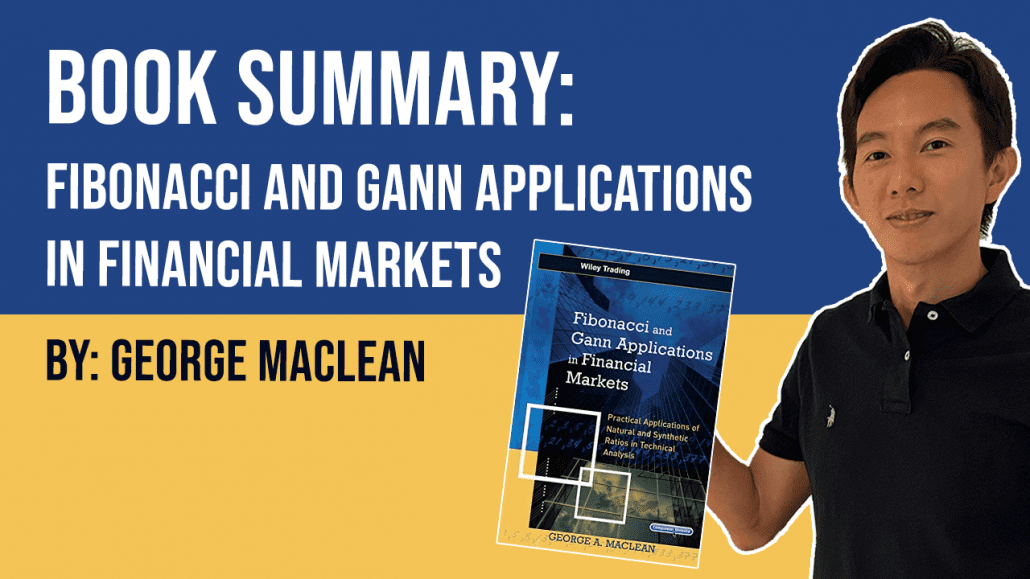
Book Summary: Fibonacci and Gann Applications in Financial Markets by George MacLean
Join our Telegram channel for more market analysis & trading tips: t.me/synapsetrading
Table of Contents
Fibonacci and Gann Applications in Financial Markets by George MacLean: Book Review and Key Lessons
Last updated: 3 July 2026 · By Spencer Li, CFTe
“Fibonacci and Gann Applications in Financial Markets” by George MacLean is a practical guide to two classic technical-analysis tools: Fibonacci ratios (price levels derived from the 0.618 Golden Ratio, used to mark support and resistance) and Gann angles (sloping trendlines that link price and time to gauge trend strength). MacLean has over 20 years in the markets, and the book is built for traders who want the mathematics explained clearly and then shown on real charts. The core message is simple and worth stating plainly: these tools are confirmation, not a crystal ball. They work best layered on top of other analysis, and they reward you for understanding the principle before you draw a single line. If you want one takeaway, it is this: use Fibonacci and Gann to confirm a level you already suspect, not to manufacture a trade out of thin air.
Here is who the book is for, the ten ideas worth keeping, and how I would actually apply them.
Who is George MacLean and what is the book about?
George MacLean is a well-known technical-analysis author with over 20 years in financial markets, and a respected voice in the trading community on Fibonacci and Gann work specifically.
The book is split into three sections that build on each other:
- The basics. The history and development of both methods, and the mathematics underneath them.
- The application. How to use them on live charts to read trend and spot potential trades.
- The advanced layer. How to combine them with other indicators for cleaner results.
The throughline across all three sections is the same. Fibonacci and Gann can deepen your read of a market, but only when you understand why they work and only when you pair them with other forms of analysis. MacLean is careful never to oversell either tool.
The 10 key ideas, in one table
I pulled the ten lessons that carried the most weight for me and laid them side by side with what each is for and a quick example. Tables like this are the fastest way to scan a book before you decide to buy it.
| # | Idea | What it is for | Example |
|---|---|---|---|
| 1 | Fibonacci ratios mark support and resistance | Finding levels where price tends to stall or turn | A stock meeting resistance at the 61.8% retracement |
| 2 | Gann angles flag trend changes | Spotting entry and exit points | A downward-sloping Gann angle hinting at a bullish-to-bearish turn |
| 3 | Combine the tools with other indicators | Raising the accuracy of any single read | Fibonacci retracement plus a momentum indicator to confirm a setup |
| 4 | Understand the principle before you apply it | Avoiding mechanical, blind use | Knowing why 0.618 matters before you trust the line |
| 5 | Both methods rest on historical price patterns | Setting realistic expectations | Best used alongside other analysis, not in isolation |
| 6 | Fibonacci retracements project price targets | Planning exits, not just entries | Using the 100% retracement level as a target |
| 7 | Gann squares and fans map support and resistance | Building a grid of key levels | A Gann fan framing where a market is likely to react |
| 8 | Gann angles guide entries and exits | Timing a position | Reading slope changes for trend shifts |
| 9 | Do not rely on these tools alone | Keeping a balanced process | Confirming a Fibonacci level with structure or volume |
| 10 | Use caution; conditions change fast | Protecting against overconfidence | Treating every level as a probability, not a promise |
If you read that table and only remember two rows, make them #3 and #9. Both say the same thing from different angles: confirmation over conviction.
How would I apply the teachings?
Reading a book is the easy part. Here is how I would turn MacLean’s ten ideas into a routine you can actually run.
- Learn the history first. Spend an hour on where these methods came from. The principle sticks better than the procedure.
- Draw the levels on charts you already know. Pull up a familiar market and mark Fibonacci retracements and Gann angles after the fact. See where they held and where they failed.
- Practice in a simulator before live capital. Paper-trade the setups until the levels feel intuitive rather than forced.
- Layer, do not isolate. Combine a Fibonacci level with a momentum read, structure, or a Gann fan before you act on it.
- Use retracements for targets, not just entries. A 100% retracement or a confluence level gives you a place to take profit.
- Write the plan down and keep a journal. Log every Fibonacci or Gann trade and review what the levels actually did. Adjust from your own data, not from the book’s promises.
Do note that MacLean is blunt about the limits. These methods are not foolproof, they will not always be accurate, and market conditions can change quickly. Treat them as one input in a larger strategy.
Where the human edge comes in
Here is the part the book hints at but does not name. Any charting platform will draw a Fibonacci retracement or a Gann fan for you in one click. The lines are free. What software will not do is tell you which level actually deserves your attention, when a “perfect” 61.8% touch is a trap because the higher-timeframe trend is against it, or when to stand aside because the level and the structure disagree. The drawing is the easy part. The judgment of which level to trust, and which to skip, is the edge worth building. That is the first of the Five Edges a tool cannot supply for you.
My take: is it worth reading?
Personally, I think this is a useful read for anyone working in technical analysis who wants Fibonacci and Gann explained properly rather than as mystical shortcuts. The strength of the book is its honesty: MacLean keeps returning to the same point, that you must understand the principle and you must combine these tools with other analysis. If you came hoping for a system that prints money on its own, you will be disappointed, and that is exactly why I trust the book. I would recommend it to traders and investors who want to deepen their technical toolkit without falling for the hype that usually surrounds Gann in particular.
FAQ
What is “Fibonacci and Gann Applications in Financial Markets” about?
It is a technical-analysis guide by George MacLean covering Fibonacci ratios and Gann angles in three sections: the basics and history, how to apply them on charts, and advanced techniques for combining them with other indicators.
Are Fibonacci and Gann methods reliable for trading?
They are useful but not foolproof. MacLean stresses that both rest on historical price patterns and work best as confirmation layered on top of other forms of analysis, not as standalone signals.
What is the 61.8% Fibonacci retracement level?
It is the level derived from the 0.618 Golden Ratio, where price often meets significant support or resistance. MacLean uses it as a classic example of a Fibonacci level traders watch.
What are Gann angles used for?
Gann angles are sloping trendlines that relate price to time. They help flag potential trend changes and possible entry and exit points, for example a downward slope hinting at a shift from bullish to bearish.
Is this book good for beginners?
It suits a motivated beginner who is willing to learn the mathematics first. MacLean insists on understanding the underlying principles before applying the methods live, so it rewards patience over shortcuts.
Now that you have the ten lessons, would you add this one to your reading list? And if you have already read it, what stuck with you? Let me know in the comments.
If you want more reviews like this, read the pillar: Best Investing and Trading Books of All Time.
Want the system, not just the theory? Grab the free 15-Minute Swing Trading Starter Kit. It is the exact routine I use to scan once a day and trade any market in 15 minutes.
About the author. Spencer Li is the founder of Synapse Trading and a Certified Financial Technician (CFTe) with 15+ years of trading across stocks, forex, crypto, commodities, and bonds. His trade log is public: every trade since April 2024, dated, losses left in. He has taught a 15-minute daily trading routine since 2014, one system for any market.
Education, not financial advice. Synapse Trading is not licensed by MAS to advise on investment products. Trading carries risk of loss; past performance is not indicative of future results.
Related
Best Investing and Trading Books of All Time (pillar) · Fibonacci retracement strategy · Technical analysis indicators
Want our free trading resources by email? Leave your address below.
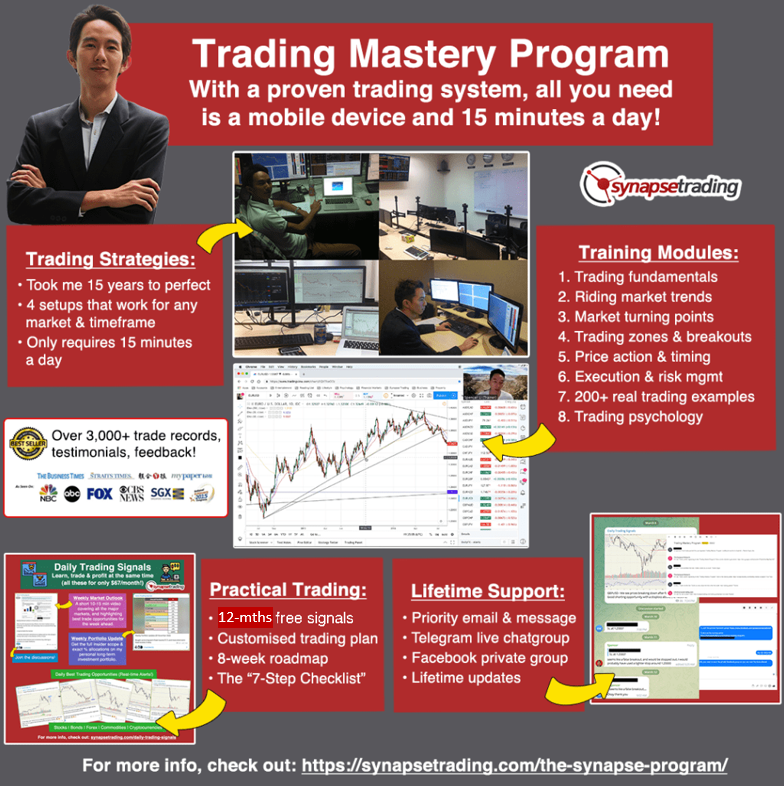 Our flagship mentoring program is suitable for both beginners and advanced traders, covering the 4 strategies which I used over the past 15 years to build up my 7-figure personal trading portfolio.
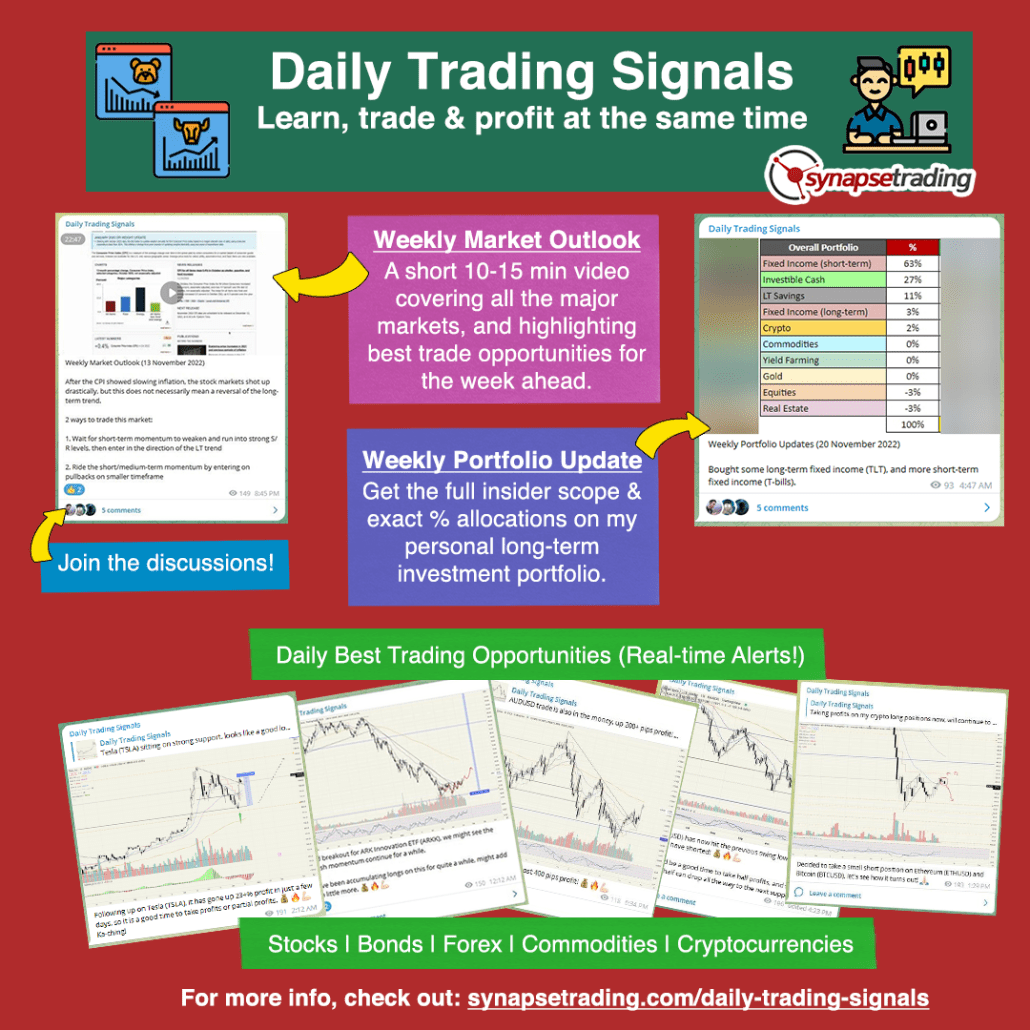 If you're looking for the best trading opportunities every day across various markets, and don't want to spend hours doing the research yourself, check out our private Telegram channel!


Leave a Reply
Want to join the discussion?Feel free to contribute!