• Link to Facebook
  • Link to X
  • Link to Instagram
  • Link to Youtube
  • Link to LinkedIn
  • Link to Mail
Synapse Trading
  • Home
  • About
    • My Background
    • My Trading Journey
    • My Travel Log
    • Media & Interviews
  • Mentoring
    • Trading Mastery Program
    • Results & Testimonials
  • Signals
    • Telegram (Free to join!)
    • Daily Trading Signals
    • Daily Trading Signals (Results)
  • Resources
    • Free Trading Guides
    • Tools & Resources
    • Blog & Infographics
  • Contact
    • Contact Us
    • Partnership Opportunities
  • Click to open the search input field Click to open the search input field Search
  • Menu Menu

Learn more about trading strategies, products, analysis, tools to help you supercharge your trading results!

Spencer Li

The Basic Principles of Trading & Investing

Trading Tips
1a Market Basics

When you work a job, you’re basically exchanging time for money: the more hours you work, the more money you make. It’s a good way to get by but a bad way to build wealth, because eventually you simply run out of hours.

That’s why if you want to grow wealth quickly, you need to make your money work for you. How? By investing and trading in the financial markets. Okay, so think of the financial markets as a garden where you grow well, just like you plant a seed and watch it grow.

In the financial markets, you can invest a small amount in companies, real estate, foreign currencies, and other securities, then share in their profits as they grow in value, and thanks to a financial principle called compound interest, your take becomes bigger and bigger every year. For instance, let’s say you invest $1,000 in Company A.

In the first year, they grow 15%, meaning you make 150 dollars, bringing your total to $1,150. Then the next year, they grow another 15%. But instead of making 15% on $1,000, you make 15% on your new total $1,150 which translates into $172.50 for the year, and $1,322.50 total.

Do this a couple more years and you will have doubled your money without lifting a finger, but if you never invested that $1,000 you wouldn’t have earned anything.

In fact, your money would have decreased in value due to the rising cost of living or inflation, even with an inflation rate of 5%, that $1000 would have lost a third of its value in ten years. So, clearly investing is the better way to go but how do you do it without taking on too much risk?

First off, you should put enough money into savings and insurance to protect yourself in the event of a downturn or adversity.

Second, if you’re just starting out, you can focus on regular investing or trading.

Regular investing allows you to accumulate wealth in the long run, while trading enables you to capture consistent short-term gains to grow your capital quickly, provided you understand behavioral analysis and market timing.

Finally, once you’ve established a large capital base, you can choose to buy and hold for the long term to generate capital gains and passive income, or use long term trading strategies to manage your portfolio effectively but those are just the basics.

There are many instruments for trading and investing, and in order to grow wealth on the market, you’ll need to understand how they work.

So next, let’s take a closer look at one of the most common types of investments: stocks.

0 Comments/by Spencer Li
https://synapsetrading.com/wp-content/uploads/2014/09/1a-Market-Basics.png 749 1280 Spencer Li https://synapsetrading.com/wp-content/uploads/2019/10/logo.jpg Spencer Li2014-09-25 10:25:172021-02-14 20:50:06The Basic Principles of Trading & Investing
Spencer Li

Overview of Stock Market Basics Course

Trading Tips
Taking the First Step to Financial Freedom

We all want to build wealth and live comfortably. The question is how do you do it.

Across the world, the cost of living is getting higher and higher making it hard to understand how anyone is able to get ahead. But for many, the answer is simple. The financial markets. Truth is the market is full of opportunities and not just for the rich, but for everyone. And you may be surprised to know that making money in the market isn’t all that hard. By learning the same strategies that professional traders use to read the market, you too, can build a strong portfolio and achieve early financial freedom.

We’ve taken the insight and knowledge from over 200 books and 10,000 hours of professional trading experience and distilled it down into a series of fun bite-sized tutorials that will teach you the trading skills necessary to start building your long-term wealth.

This series is divided into five categories.

First, the basics of trading and investing where you’ll learn the different ways you can build wealth in the market.

Second, riding the big market cycles where you’ll learn how to catch the big moves in the markets.

Third, the ABCs of stock valuation to help you select the best stocks to trade.

Fourth, behavioral analysis and market timing where you’ll learn how professional traders predict the market to earn consistent gains.

And finally, making your first trade where you’ll put all your new knowledge to use.

So, what do you say?

Ready to take your first step towards building some wealth?

Then, choose your first category and let’s begin!

0 Comments/by Spencer Li
https://synapsetrading.com/wp-content/uploads/2014/09/Taking-the-First-Step-to-Financial-Freedom.png 748 1282 Spencer Li https://synapsetrading.com/wp-content/uploads/2019/10/logo.jpg Spencer Li2014-09-25 08:43:222021-02-13 22:50:53Overview of Stock Market Basics Course
Spencer Li

Career Paths for the Trading & Fund Management Professional

Trading Tips

Trading Career Paths: 5 Jobs in the Trading and Fund Management Industry

Last updated: 3 July 2026 · By Spencer Li, CFTe


There are five main career paths in the trading and fund management industry, and each one rewards a different skill set: sales and trading at an investment bank, proprietary (prop) trading at a private fund, fund management, research analysis, and brokerage or dealing. Sales and trading and prop trading are for people who want to take and manage positions. Research analysis suits strong writers and thinkers who would rather not pull the trigger themselves. Brokerage and dealing is execution-led and sales-driven. Fund management sits at the top and usually needs experience and a track record before anyone hands you capital. Pay is structured differently in each: a salary, a commission, profit-sharing, or some blend. If you are deciding which one to aim for, the honest first question is not “which pays most”, it is “which job do I actually want to do all day”, because the day-to-day work is very different across these five.

Here is what each role is, who it suits, and how you get paid.

What are the main career paths in trading?

Most jobs in the industry fall into one of five buckets. They sit on a spectrum: at one end you are executing other people’s orders, at the other you are running your own book or someone else’s capital. The further along that spectrum you go, the more the pay shifts from a stable salary toward performance-based profit-sharing, and the more the risk shifts onto you.

RoleWhat you doWho it suitsHow you get paidBarrier to entry
Sales and Trading (S&T)Make markets and take client orders at an investment bankTop academics, bank-track candidatesSalary plus bonusVery high (degree, stellar grades, often prior bank experience)
Proprietary tradingTrade the firm’s own money, usually at a private prop fundRisk-tolerant traders who thrive under pressureSmall allowance plus profit-share (often 30 to 80 percent)High selection, high turnover
Fund managementRun a larger, often longer-horizon book against a benchmarkExperienced traders with a track recordBase (management fee) plus profit-shareHighest (needs a proven record)
Research analystAnalyse securities and write buy/sell/hold opinionsStrong analysts and writers who dislike position stressSalary, paid well at banksModerate (analytical and writing skills)
Brokerage and dealingExecute orders for clients as a dealer or remisierPeople who are sales-led and client-facingBase salary plus sales commissionLower (less analysis required)

The rest of this guide walks through each role in turn.

Sales and Trading (S&T)

Sales and trading is one of the core functions of an investment bank. It covers the buying and selling of securities and other financial instruments, both for the bank itself and on behalf of its clients.

It splits into two halves. Traders make markets: they buy and sell products mainly to facilitate clients’ activity, aiming to earn a small incremental amount on each trade. The sales side is the bank’s sales force, whose job is to call on institutional and high-net-worth investors, suggest trading ideas, and take orders. The sales desk passes those orders to the appropriate trading desk, which prices and executes them, or structures a new product to fit a specific need.

These roles are highly paid and highly coveted, which is exactly why they are hard to come by, especially when banks freeze headcount for front-office roles. The basic requirements are usually a degree plus stellar academic achievements, and previous experience working in a bank improves your chances.

Proprietary trading

Proprietary trading (often shortened to “prop trading”) is when a firm trades stocks, bonds, currencies, commodities, their derivatives, or other instruments with the firm’s own money, rather than its clients’ money, to make a profit for itself. Prop desks use a range of strategies (index arbitrage, statistical arbitrage, merger arbitrage, fundamental analysis, volatility arbitrage, global macro) much like a hedge fund.

Banks used to run this function in-house, but that number has been declining. Most of the hiring now comes from private prop funds. These funds tend to hire experienced traders to trade the firm’s capital, though many run training programs to groom new traders.

Do note that the selection is stringent and the turnover rate is high; it is not an easy environment to thrive in. Remuneration is usually profit-sharing (commonly 30 to 80 percent) with only a small allowance, so you should have at least a year of savings to live on during the learning phase. Strategies vary, but many involve shorter-timeframe trading with high-leverage products such as futures and options.

Fund management

Fund management typically requires more experience and a track record, and you are expected to have advanced knowledge of trading before anyone hands you the capital. Products vary widely, and strategies are usually flexible, depending on the discretion the fund gives you. Because the capital base is larger, strategies often lean toward longer holding periods. There is usually a benchmark and drawdown limits to work within, and pay is a combination of a base salary (the management fee) plus profit-sharing.

The classic example is a hedge fund: an investment fund that can undertake a wider range of activities than other funds, but is generally only open to certain investor types specified by regulators (institutions like pension funds, university endowments and foundations, or high-net-worth individuals). Hedge funds invest across a diverse range of assets, most commonly liquid securities on public markets, and use techniques such as short selling and leverage.

Research analyst

A research analyst (also called a financial analyst, securities analyst, equity analyst, or investment analyst) performs financial analysis for external or internal clients as the core of the job. These roles are offered by banks, brokerage firms, and some independent research houses.

They suit people with good analytical and writing skills who enjoy research and analysis but do not like the stress of executing trades and holding positions. Writing reports and notes expressing opinions is always part of a “sell-side” (brokerage) analyst’s job, and is often not required of “buy-side” (investment firm) analysts. Analysts traditionally lean on fundamental analysis, though technical chart analysis and tactical reads of the market are also routine. At the end of an assessment, an analyst usually issues a rating recommending an action: buy, sell, or hold. Depending on experience, these jobs pay quite well at banks and financial institutions.

Brokerage and dealing

Brokerage and dealing roles come in several forms: an in-house dealer for a retail brokerage, a dealer for an institutional brokerage, or an independent remisier (a self-employed broker who trades on clients’ behalf under a brokerage’s licence).

A brokerage firm is a financial institution that facilitates the buying and selling of securities between buyer and seller, serving a clientele of investors who trade public stocks and other securities through the firm’s agents. A full-service brokerage does more than carry out trades; its staff research the markets to provide recommendations.

These roles require less analysis and trading skill than the others, because you are mainly executing orders for clients, though clients may lean on your input for their decisions. Remuneration is typically a base salary plus a sales commission if you hit certain targets.

So which path should you pick?

Personally, I would not start from the salary. Start from the work. A research analyst and a prop trader can earn similar money over a career, but their days look nothing alike: one reads and writes all day with no open positions, the other is sitting in front of live risk. Pick the day you can do for ten years, not the title that sounds best at a dinner party.

One more thing worth saying plainly. A role at a fund or a bank is not the only way to trade for a living, and it is not even the most accessible one. Many people now build a trading track record on their own capital first, then use that record as the thing that opens these doors, instead of waiting for a door to open. A firm can hand you a desk and a risk limit; it cannot hand you the judgment, the discipline, or the emotional control to use them well. That part you build yourself, and it is the same part whether you trade your own account or someone else’s. That is the human edge, and no employer and no algorithm supplies it for you.

FAQ

What are the highest-paying jobs in trading?
Sales and trading at an investment bank and successful proprietary trading or fund management tend to pay the most, because pay there is tied to performance through bonuses and profit-sharing. The trade-off is that these roles also carry the highest barrier to entry and, in prop trading and fund management, the most income risk.

Do you need a degree to become a trader?
For sales and trading at an investment bank, yes, usually a degree with strong academic results, and often prior bank experience. Proprietary trading and brokerage roles can be more open to candidates who can demonstrate skill or a track record, though selection is still tough and turnover is high.

What is the difference between proprietary trading and fund management?
Prop trading means trading the firm’s own money, often on shorter timeframes with leverage, paid mostly through profit-sharing. Fund management means running a larger, often longer-horizon book of investors’ capital against a benchmark and drawdown limits, paid through a base (management fee) plus profit-sharing.

What does a research analyst do?
A research analyst studies securities and the market, writes reports expressing an opinion, and issues a rating to buy, sell, or hold. It suits strong analysts and writers who prefer analysis to the stress of taking and holding positions.

What is a remisier?
A remisier is an independent, self-employed broker who introduces clients and executes their trades under a brokerage’s licence, earning commission on the business they bring in rather than a full salary.


Whichever path you are aiming for, the foundation is the same: a method you can actually execute, and the discipline to stick to it. If you want the full picture of how I think about trading as a skill rather than a job title, read the pillar: The Beginner’s Guide to Trading.

Want a method you can run on your own capital first? Grab the free 15-Minute Swing Trading Starter Kit. It is the exact routine I use to scan once a day and trade any market in 15 minutes, the kind of track record that opens the doors above.


About the author. Spencer Li is the founder of Synapse Trading and a Certified Financial Technician (CFTe) with 15 years of trading across stocks, forex, crypto, commodities, and bonds. His trade log is public, 404 trades, losses left in. He teaches low-risk swing trading in 15 minutes a day, one system for any market.

Education, not financial advice. Synapse Trading is not licensed by MAS to advise on investment products. Trading carries risk of loss; past performance is not indicative of future results.


Related

The Beginner’s Guide to Trading (pillar) · How to become a profitable trader · Technical analysis vs fundamental analysis · How much money do you need to start trading

0 Comments/by Spencer Li
https://synapsetrading.com/wp-content/uploads/2019/10/logo.jpg 0 0 Spencer Li https://synapsetrading.com/wp-content/uploads/2019/10/logo.jpg Spencer Li2014-06-16 21:48:362026-07-06 01:03:16Career Paths for the Trading & Fund Management Professional
Spencer Li

My Reading List – Top Trading & Investing Books I have Read Over the Years (Updated 2019)

Trading Tips

The Best Trading and Investing Books: My Reading List After 200+ Books

Last updated: 3 July 2026 · By Spencer Li, CFTe


The best trading and investing books are the ones that teach you the foundations: market structure, technical analysis, fundamentals, and trading psychology. After reading 200+ of them, the short answer is that no book makes you a profitable trader, and the right ten will save you a lot of wasted years. If you are learning on your own, the highest-value categories are technical analysis (Murphy, Edwards and Magee, Nison), market psychology (Douglas, Lefevre, Schwager’s Market Wizards), and a couple of classics on price action and risk (Al Brooks, Gerald Loeb). Read the foundations before you risk real money. But here is the honest part most book lists skip: even if you finish every book on this page, it is unlikely you will trade well from books alone. The rest is paid for at the market, or learned from someone who has already done it.

Below is the full list, grouped so you can find your starting point, plus the ten I would hand a beginner first.

Do trading books actually make you profitable?

No, and I want to be honest about that before you spend a year reading.

Trading for real is very different from textbook examples. If you are new, you will feel the gap the moment you start. The chart in the book is clean, labelled, and already over. The chart in front of you is live, noisy, and asking you to act before you are sure.

Books give you the vocabulary and the map. They do not give you “market feel,” real applied price action, behavioural analysis, or trading psychology under live pressure. Those are not on any page. You pay for them in one of two ways: tuition to the market (real money, real losses, the only teacher that bills you), or time with a trader who already has the skill and will guide you.

Do note that paper trading and demo trading do not count here. They feel like practice, but they remove the one variable that matters, which is the fear of losing real money. That fear is the whole lesson.

So why read at all? Because the books are the bare minimum. Skipping them does not save you the tuition fee, it just raises it. Investing in your education is a small price to pay to avoid the expensive mistakes everyone else is making in real time.

The 10 books I would give a beginner first

If the full list below feels overwhelming, start here. These cover the four foundations (technical, fundamental, psychology, and the trader’s mindset) without drowning you.

#BookAuthorWhy it earns the spot
1Technical Analysis of the Financial MarketsJohn J. MurphyThe standard reference for charting. If you read one TA book, read this.
2Reminiscences of a Stock OperatorEdwin LefevreThe oldest trading lessons, still the truest. A story, not a manual.
3Trading in the ZoneMark DouglasThe book on probabilistic thinking and trader psychology.
4Japanese Candlesticks Charting TechniquesSteve NisonThe source on candlesticks, from the man who brought them west.
5Technical Analysis of Stock TrendsEdwards and MageeThe original chart-pattern bible. Dated, foundational, worth it.
6The New Market WizardsJack D. SchwagerInterviews with great traders. You learn there is no one right way.
7Trading for a LivingAlexander ElderMind, method, and money management, in one accessible package.
8Reading Price Charts Bar by BarAl BrooksHard going, but the deep end of applied price action.
9One Up on Wall StreetPeter LynchThe friendliest entry to fundamentals and stock picking.
10The Battle for Investment SurvivalGerald M. LoebOld, short, and brutal on the one thing that matters: keeping your capital.

Read these first. The rest of the list is where you go deeper once you know which direction pulls you.

The full reading list, grouped by what it teaches

Here are the better books among the 200+ I have read, sorted into categories so you can pick by need instead of reading top to bottom. If you are serious about self-study, work through the foundations before you put real money in. That is what I did when I started.

Economics and fundamentals

  • The Secrets of Economic Indicators, Bernard Baumohl
  • The Trader’s Guide to Key Economic Indicators, Richard Yamarone
  • The Pocketbook of Economic Indicators, Manual Jesus-Backus
  • International Economics, Paul R. Krugman
  • Freakonomics, Stephen Dubner and Steven Levitt
  • The Undercover Economist, Tim Harford
  • One Up on Wall Street, Peter Lynch and John Rothchild
  • How to Make Money in Stocks, William O’Neil
  • The Alchemy of Finance, George Soros
  • Hot Commodities, Jim Rogers
  • Investment Biker, Jim Rogers
  • Trader Vic: Methods of a Wall Street Master, Victor Sperandeo

Technical analysis (the core)

  • Technical Analysis of the Financial Markets, John J. Murphy
  • Intermarket Technical Analysis, John J. Murphy
  • Technical Analysis of Stock Trends, Robert D. Edwards and John Magee
  • Technical Analysis from A to Z, Steve Achelis
  • Technical Analysis: The Complete Resource for Financial Market Technicians, Charles Kirkpatrick and Julie Dahlquist
  • Technical Analysis Explained, Martin Pring
  • The Visual Investor, Martin Pring
  • Martin Pring on Price Patterns, Martin Pring
  • Technical Analysis Power Tools for Active Investors, Gerald Appel
  • Technical Analysis Demystified, Constance Brown
  • All About Technical Analysis, Constance Brown
  • Technical Analysis for the Trading Professional, Constance Brown
  • Fibonacci Analysis, Constance Brown
  • Breakthroughs in Technical Analysis, David Keller
  • New Concepts in Technical Trading Systems, J. Welles Wilder

Candlesticks, price, and volume

  • Japanese Candlesticks Charting Techniques, Steve Nison
  • The Candlestick Course, Steve Nison
  • Beyond Candlesticks, Steve Nison
  • Candlestick Charting Explained, Gregory L. Morris
  • The Secret Code of Japanese Candlesticks, Felipe Tudela
  • Candlestick and Pivot Point Trading Triggers, John L. Person
  • Reading Price Charts Bar by Bar, Al Brooks
  • Timing the Trade, Tom O’Brien
  • The Secret Science of Price and Volume, Timothy Ord

Indicators, systems, and quant

  • Bollinger on Bollinger Bands, John Bollinger
  • Understanding RSI, Edward Dobson and Roger Reimer
  • Mastering the Trade, John Carter
  • New Trading Systems and Methods, Perry Kaufman
  • Dynamic Trading, Robert C. Miner
  • High Probability Trading Strategies, Robert C. Miner
  • Quantitative Trading Systems, Howard B. Bandy
  • Quantitative Equity Portfolio Management, Ludwig Chincarini and Daehwan Kim
  • Pairs Trading: Quantitative Methods and Analysis, Ganapathy Vidyamurthy
  • Technical Traders Guide to Computer Analysis of Futures Markets, Charles Le Beau and David Lucas
  • Expert Advisor Programming, Andrew Young

Trend following and swing trading

  • Trend Following, Michael W. Covel
  • Trend Commandments, Michael W. Covel
  • The Complete Turtle Trader, Michael W. Covel
  • Way of the Turtle, Curtis Faith
  • Inside the Mind of the Turtles, Curtis Faith
  • How I Made $2,000,000 in the Stock Market, Nicolas Darvas
  • The Master Swing Trader, Alan Farley
  • Trend Trading, Daryl Guppy
  • Snapshot Trading, Daryl Guppy
  • Secrets for Profiting in Bull and Bear Markets, Stan Weinstein
  • Entries and Exits, Alexander Elder
  • Trading for a Living, Alexander Elder
  • Come Into My Trading Room, Alexander Elder
  • Sell and Sell Short, Alexander Elder

Elliott Wave, Gann, and cycles

  • The Elliott Wave Principle, A. J. Frost and Robert Prechter
  • R. N. Elliott’s Masterworks, R. N. Elliott and Robert Prechter
  • Truth of the Stock Tape and Wall Street Stock Selector, W. D. Gann
  • 45 Years in Wall Street, W. D. Gann
  • New Stock Trend Detector, W. D. Gann
  • How to Make Profits in Commodities, W. D. Gann
  • The W.D. Gann Method of Trading, Gerald Marisch
  • Fibonacci and Gann Applications in Financial Markets, George MacLean
  • Integrated Pitchfork Analysis, Mircea Dologa
  • Future Trend from Past Cycles, Brian Millard

Ichimoku, Market Profile, and Point and Figure

  • Ichimoku Charts: An Introduction to Ichimoku Kinko Clouds, Nicole Elliott
  • Cloud Charts: Trading Success with the Ichimoku Technique, David Linton
  • Steidlmayer on Markets: Trading with Market Profile, J. Peter Steidlmayer and Steven Hawkins
  • The Definitive Guide to Point and Figure, Jeremy Du Plessis

The Wyckoff and tape-reading classics

  • Studies in Tape Reading, Richard D. Wyckoff
  • Stock Market Technique No. 1, Richard D. Wyckoff
  • Stock Market Technique No. 2, Richard D. Wyckoff
  • Wall Street Ventures and Adventures Through 40 Years, Richard D. Wyckoff
  • How I Trade and Invest in Stocks and Bonds, Richard D. Wyckoff
  • Dow Theory for the 21st Century, Jack Schannep
  • How to Trade in Stocks, Jesse Livermore
  • Trade Like Jesse Livermore, Richard Smitten
  • Reminiscences of a Stock Operator, Edwin Lefevre

Trading psychology and behaviour

  • Trading in the Zone, Mark Douglas
  • The Disciplined Trader, Mark Douglas
  • Investment Psychology Explained, Martin Pring
  • Beyond Greed and Fear, Hersh Shefrin
  • Irrational Exuberance, Robert J. Shiller
  • Fooled by Randomness, Nassim Nicholas Taleb
  • The Black Swan, Nassim Nicholas Taleb
  • Trading Rules That Work, Jason Alan Jankovsky

Wizards, war stories, and markets at large

  • Market Wizards / The New Market Wizards / Stock Market Wizards, Jack D. Schwager
  • Millionaire Traders, Kathy Lien and Boris Schlossberg
  • The Battle for Investment Survival, Gerald M. Loeb
  • The Education of a Speculator, Victor Niederhoffer
  • Practical Speculation, Victor Niederhoffer and Laurel Kenner
  • Liar’s Poker, Michael Lewis
  • The Wall Street Waltz, Kenneth L. Fisher
  • The Lexus and the Olive Tree, Thomas L. Friedman
  • The World Is Flat, Thomas L. Friedman

Forex specific

  • Day Trading and Swing Trading the Currency Market, Kathy Lien
  • Bird Watching in Lion Country, Dirk du Toit

This list grows. I keep adding as I read, so if there is a good book that is not here, tell me in the comments.

How should a beginner read this list?

Do not read it top to bottom. That is the slow road, and most of these books overlap.

Personally, I would do it like this. Start with the ten above to build a base across all four foundations. Then pick the one category that matches how you want to trade (price action, trend following, fundamentals, or systems) and read deep in that lane. Read the psychology books last, because they only make sense once you have felt the emotions they describe. Reading Mark Douglas before you have lost real money is like reading about heartbreak before your first relationship. The words are there, the meaning is not.

And keep a journal alongside the reading. A concept you wrote down after it cost you money sticks far better than one you highlighted in a book.

Where the human edge comes in

Here is the part the reading list cannot give you. You can feed all 200 of these books to an AI tomorrow, and it will summarise every framework in seconds. What it will not do is sit in the trade with you while the position moves against you, hold your size when you want to revenge-trade, or tell you that the clean setup in the book is not the messy thing on your screen right now. The knowledge in these books is becoming free. The judgment, discipline, and psychology to apply it under live pressure is the part that stays scarce, and it is the part you pay tuition for. The books are the easy half. The trader you become while reading them is the hard half.

FAQ

What is the single best book for a beginner trader?
For pure trading, Reminiscences of a Stock Operator by Edwin Lefevre, because the lessons are timeless and it reads as a story. For technical analysis specifically, John Murphy’s Technical Analysis of the Financial Markets is the standard reference.

Can you learn to trade from books alone?
No. Books teach the foundations, the vocabulary, and the frameworks, but not market feel, applied price action, or real trading psychology under pressure. Those are learned by trading real money or by being guided by an experienced trader. Reading is necessary but not sufficient.

Is paper trading or demo trading useful for learning?
It is of limited use because it removes the fear of losing real money, which is the central emotion you need to learn to manage. It can help you learn a platform’s mechanics, but it does not build the psychological skill that real money does.

How many trading books should I read before risking real money?
Read enough to cover the four foundations: technical analysis, fundamentals, trading systems, and psychology. The ten-book shortlist above is a reasonable minimum. Treat it as the floor, not a guarantee of success.

What is the best book on trading psychology?
Trading in the Zone by Mark Douglas is the most cited for probabilistic thinking and discipline. Read it after you have some live experience, so the concepts have something real to attach to.


That is the list. If you only take one thing from this page, take this: the books are the bare minimum, and the real lessons are still waiting for you at the market. Read, then go pay your tuition with your eyes open.

If you want the structured path instead of a 100-book pile, start with the pillar: The Beginner’s Guide to Trading and Investing.

Want a shortcut past the 200-book pile? Grab the free 15-Minute Swing Trading Starter Kit. It is the exact routine I use to scan once a day and trade any market in 15 minutes, distilled from everything on this list.


About the author. Spencer Li is the founder of Synapse Trading and a Certified Financial Technician (CFTe) with 15 years of trading across stocks, forex, crypto, commodities, and bonds. His trade log is public, 404 trades, losses left in. He teaches low-risk swing trading in 15 minutes a day, one system for any market.

Education, not financial advice. Synapse Trading is not licensed by MAS to advise on investment products. Trading carries risk of loss; past performance is not indicative of future results.


Related

The Beginner’s Guide to Trading and Investing (pillar) · How I learned to trade · Trading psychology: how to master your mind · The Definitive Guide to Trading Price Chart Patterns

9 Comments/by Spencer Li
https://synapsetrading.com/wp-content/uploads/2019/10/logo.jpg 0 0 Spencer Li https://synapsetrading.com/wp-content/uploads/2019/10/logo.jpg Spencer Li2012-12-05 06:19:462026-07-06 02:43:34My Reading List – Top Trading & Investing Books I have Read Over the Years (Updated 2019)
Spencer Li

Understanding Trend vs. Range Market State Transitions

Trading Tips
Understanding Trend vs Range Market State Transitions

This is an essential skill required by every aspiring trader. All professional traders definitely know this, for it forms the basis of many setups, and can mean the difference between breezing on the right side of the market, or clenching your fists in anger as the market goes against you.

I am referring to the ability to tell the state of the market.

Besides behavioral analysis, there are some simple price action guidelines that we can use to accurately determine the state of the market. This is important for obvious reasons.

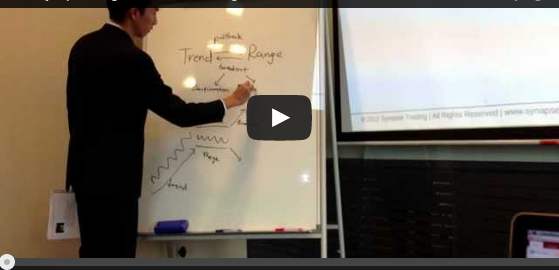
There are 2 basic states of the market – trend or range. As the market shifts between these 2 states, it creates many trading opportunities in the form of setups.

Newbies who attempt to trade by memorising setups while ignoring the underlying structure of the market are heading for the proverbial iceberg. That said, this is just the tip of the iceberg.

This video should provide you an idea of how prices move, and if I have a chance to share more in upcoming seminars next year, I will show how these transitions give rise to the different trading setups that we teach during our training programs.

0 Comments/by Spencer Li
https://synapsetrading.com/wp-content/uploads/2012/12/Understanding-Trend-vs-Range-Market-State-Transitions.png 314 559 Spencer Li https://synapsetrading.com/wp-content/uploads/2019/10/logo.jpg Spencer Li2012-12-04 22:45:072019-12-26 04:15:04Understanding Trend vs. Range Market State Transitions
Page 11 of 12«‹9101112›

Free Trading Guides

Free Trading Guides

Blog Categories

  • Beginner's Guide
  • Blockchain & Crypto
  • Book Summaries
  • Candlestick Patterns
  • Economics & News Trading
  • Investing & Portfolio Management
  • Living Your Best Life
  • Market Analysis
  • News & Events
  • Price Chart Patterns
  • Promotions
  • Risk & Money Management
  • Stock Trading
  • Testimonials
  • Tools & Resources
  • Trading Psychology
  • Trading Strategies
  • Trading Tips
  • Travel & Lifestyle

Free Trading Guides

Free Trading Guides

Contact Us

Synapse Trading Pte Ltd
Registration No. 201316168H

Whatsapp: +65-8897-1204
Telegram: @iamrecneps
Email: info@synapsetrading.com

Links

Disclaimer
Privacy policy
Terms & Conditions
Contact us
Partnerships

© 2012-2024 Synapse Trading | All rights reserved | - powered by Enfold WordPress Theme
  • Link to Facebook
  • Link to X
  • Link to Instagram
  • Link to Youtube
  • Link to LinkedIn
  • Link to Mail
Scroll to top Scroll to top Scroll to top