
My Reading List – Top Trading & Investing Books I have Read Over the Years (Updated 2019)
Want the daily routine? Get the free 15-Minute Swing Trader’s Checklist. Get it free →
The Best Trading and Investing Books: My Reading List After 200+ Books
Last updated: 29 August 2026 · By Spencer Li, CFTe
The best trading and investing books are the ones that teach you the foundations: market structure, technical analysis, fundamentals, and trading psychology. After reading 200+ of them, the short answer is that no book makes you a profitable trader, and the right ten will save you a lot of wasted years. If you are learning on your own, the highest-value categories are technical analysis (Murphy, Edwards and Magee, Nison), market psychology (Douglas, Lefevre, Schwager’s Market Wizards), and a couple of classics on price action and risk (Al Brooks, Gerald Loeb). Read the foundations before you risk real money. But here is the honest part most book lists skip: even if you finish every book on this page, it is unlikely you will trade well from books alone. The rest is paid for at the market, or learned from someone who has already done it.
Below is the full list, grouped so you can find your starting point, plus the ten I would hand a beginner first.
Do trading books actually make you profitable?
No, and I want to be honest about that before you spend a year reading.
Trading for real is very different from textbook examples. If you are new, you will feel the gap the moment you start. The chart in the book is clean, labelled, and already over. The chart in front of you is live, noisy, and asking you to act before you are sure.
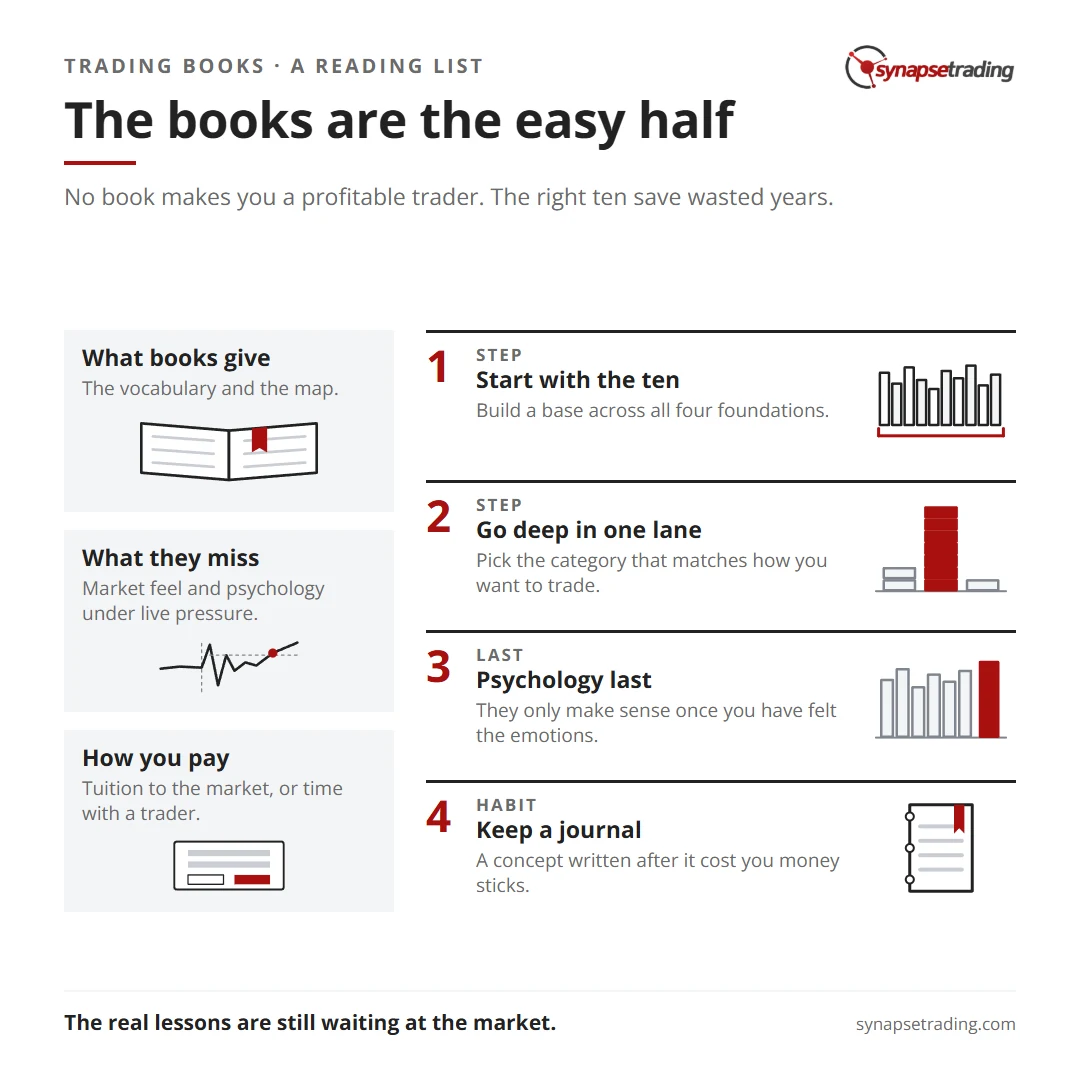
Books give you the vocabulary and the map. They do not give you “market feel,” real applied price action, behavioural analysis, or trading psychology under live pressure. Those are not on any page. You pay for them in one of two ways: tuition to the market (real money, real losses, the only teacher that bills you), or time with a trader who already has the skill and will guide you.
Do note that paper trading and demo trading do not count here. They feel like practice, but they remove the one variable that matters, which is the fear of losing real money. That fear is the whole lesson.
So why read at all? Because the books are the bare minimum. Skipping them does not save you the tuition fee, it just raises it. Investing in your education is a small price to pay to avoid the expensive mistakes everyone else is making in real time.
The 10 books I would give a beginner first
If the full list below feels overwhelming, start here. These cover the four foundations (technical, fundamental, psychology, and the trader’s mindset) without drowning you.
| # | Book | Author | Why it earns the spot |
|---|---|---|---|
| 1 | Technical Analysis of the Financial Markets | John J. Murphy | The standard reference for charting. If you read one TA book, read this. |
| 2 | Reminiscences of a Stock Operator | Edwin Lefevre | The oldest trading lessons, still the truest. A story, not a manual. |
| 3 | Trading in the Zone | Mark Douglas | The book on probabilistic thinking and trader psychology. |
| 4 | Japanese Candlesticks Charting Techniques | Steve Nison | The source on candlesticks, from the man who brought them west. |
| 5 | Technical Analysis of Stock Trends | Edwards and Magee | The original chart-pattern bible. Dated, foundational, worth it. |
| 6 | The New Market Wizards | Jack D. Schwager | Interviews with great traders. You learn there is no one right way. |
| 7 | Trading for a Living | Alexander Elder | Mind, method, and money management, in one accessible package. |
| 8 | Reading Price Charts Bar by Bar | Al Brooks | Hard going, but the deep end of applied price action. |
| 9 | One Up on Wall Street | Peter Lynch | The friendliest entry to fundamentals and stock picking. |
| 10 | The Battle for Investment Survival | Gerald M. Loeb | Old, short, and brutal on the one thing that matters: keeping your capital. |
Read these first. The rest of the list is where you go deeper once you know which direction pulls you.
The full reading list, grouped by what it teaches
Here are the better books among the 200+ I have read, sorted into categories so you can pick by need instead of reading top to bottom. If you are serious about self-study, work through the foundations before you put real money in. That is what I did when I started.
Economics and fundamentals
- The Secrets of Economic Indicators, Bernard Baumohl
- The Trader’s Guide to Key Economic Indicators, Richard Yamarone
- The Pocketbook of Economic Indicators, Manual Jesus-Backus
- International Economics, Paul R. Krugman
- Freakonomics, Stephen Dubner and Steven Levitt
- The Undercover Economist, Tim Harford
- One Up on Wall Street, Peter Lynch and John Rothchild
- How to Make Money in Stocks, William O’Neil
- The Alchemy of Finance, George Soros
- Hot Commodities, Jim Rogers
- Investment Biker, Jim Rogers
- Trader Vic: Methods of a Wall Street Master, Victor Sperandeo
Technical analysis (the core)
- Technical Analysis of the Financial Markets, John J. Murphy
- Intermarket Technical Analysis, John J. Murphy
- Technical Analysis of Stock Trends, Robert D. Edwards and John Magee
- Technical Analysis from A to Z, Steve Achelis
- Technical Analysis: The Complete Resource for Financial Market Technicians, Charles Kirkpatrick and Julie Dahlquist
- Technical Analysis Explained, Martin Pring
- The Visual Investor, Martin Pring
- Martin Pring on Price Patterns, Martin Pring
- Technical Analysis Power Tools for Active Investors, Gerald Appel
- Technical Analysis Demystified, Constance Brown
- All About Technical Analysis, Constance Brown
- Technical Analysis for the Trading Professional, Constance Brown
- Fibonacci Analysis, Constance Brown
- Breakthroughs in Technical Analysis, David Keller
- New Concepts in Technical Trading Systems, J. Welles Wilder
Candlesticks, price, and volume
- Japanese Candlesticks Charting Techniques, Steve Nison
- The Candlestick Course, Steve Nison
- Beyond Candlesticks, Steve Nison
- Candlestick Charting Explained, Gregory L. Morris
- The Secret Code of Japanese Candlesticks, Felipe Tudela
- Candlestick and Pivot Point Trading Triggers, John L. Person
- Reading Price Charts Bar by Bar, Al Brooks
- Timing the Trade, Tom O’Brien
- The Secret Science of Price and Volume, Timothy Ord
Indicators, systems, and quant
- Bollinger on Bollinger Bands, John Bollinger
- Understanding RSI, Edward Dobson and Roger Reimer
- Mastering the Trade, John Carter
- New Trading Systems and Methods, Perry Kaufman
- Dynamic Trading, Robert C. Miner
- High Probability Trading Strategies, Robert C. Miner
- Quantitative Trading Systems, Howard B. Bandy
- Quantitative Equity Portfolio Management, Ludwig Chincarini and Daehwan Kim
- Pairs Trading: Quantitative Methods and Analysis, Ganapathy Vidyamurthy
- Technical Traders Guide to Computer Analysis of Futures Markets, Charles Le Beau and David Lucas
- Expert Advisor Programming, Andrew Young
Trend following and swing trading
- Trend Following, Michael W. Covel
- Trend Commandments, Michael W. Covel
- The Complete Turtle Trader, Michael W. Covel
- Way of the Turtle, Curtis Faith
- Inside the Mind of the Turtles, Curtis Faith
- How I Made $2,000,000 in the Stock Market, Nicolas Darvas
- The Master Swing Trader, Alan Farley
- Trend Trading, Daryl Guppy
- Snapshot Trading, Daryl Guppy
- Secrets for Profiting in Bull and Bear Markets, Stan Weinstein
- Entries and Exits, Alexander Elder
- Trading for a Living, Alexander Elder
- Come Into My Trading Room, Alexander Elder
- Sell and Sell Short, Alexander Elder
Elliott Wave, Gann, and cycles
- The Elliott Wave Principle, A. J. Frost and Robert Prechter
- R. N. Elliott’s Masterworks, R. N. Elliott and Robert Prechter
- Truth of the Stock Tape and Wall Street Stock Selector, W. D. Gann
- 45 Years in Wall Street, W. D. Gann
- New Stock Trend Detector, W. D. Gann
- How to Make Profits in Commodities, W. D. Gann
- The W.D. Gann Method of Trading, Gerald Marisch
- Fibonacci and Gann Applications in Financial Markets, George MacLean
- Integrated Pitchfork Analysis, Mircea Dologa
- Future Trend from Past Cycles, Brian Millard
Ichimoku, Market Profile, and Point and Figure
- Ichimoku Charts: An Introduction to Ichimoku Kinko Clouds, Nicole Elliott
- Cloud Charts: Trading Success with the Ichimoku Technique, David Linton
- Steidlmayer on Markets: Trading with Market Profile, J. Peter Steidlmayer and Steven Hawkins
- The Definitive Guide to Point and Figure, Jeremy Du Plessis
The Wyckoff and tape-reading classics
- Studies in Tape Reading, Richard D. Wyckoff
- Stock Market Technique No. 1, Richard D. Wyckoff
- Stock Market Technique No. 2, Richard D. Wyckoff
- Wall Street Ventures and Adventures Through 40 Years, Richard D. Wyckoff
- How I Trade and Invest in Stocks and Bonds, Richard D. Wyckoff
- Dow Theory for the 21st Century, Jack Schannep
- How to Trade in Stocks, Jesse Livermore
- Trade Like Jesse Livermore, Richard Smitten
- Reminiscences of a Stock Operator, Edwin Lefevre
Trading psychology and behaviour
- Trading in the Zone, Mark Douglas
- The Disciplined Trader, Mark Douglas
- Investment Psychology Explained, Martin Pring
- Beyond Greed and Fear, Hersh Shefrin
- Irrational Exuberance, Robert J. Shiller
- Fooled by Randomness, Nassim Nicholas Taleb
- The Black Swan, Nassim Nicholas Taleb
- Trading Rules That Work, Jason Alan Jankovsky
Wizards, war stories, and markets at large
- Market Wizards / The New Market Wizards / Stock Market Wizards, Jack D. Schwager
- Millionaire Traders, Kathy Lien and Boris Schlossberg
- The Battle for Investment Survival, Gerald M. Loeb
- The Education of a Speculator, Victor Niederhoffer
- Practical Speculation, Victor Niederhoffer and Laurel Kenner
- Liar’s Poker, Michael Lewis
- The Wall Street Waltz, Kenneth L. Fisher
- The Lexus and the Olive Tree, Thomas L. Friedman
- The World Is Flat, Thomas L. Friedman
Forex specific
- Day Trading and Swing Trading the Currency Market, Kathy Lien
- Bird Watching in Lion Country, Dirk du Toit
This list grows. I keep adding as I read, so if there is a good book that is not here, tell me in the comments.
How should a beginner read this list?
Do not read it top to bottom. That is the slow road, and most of these books overlap.
Personally, I would do it like this. Start with the ten above to build a base across all four foundations. Then pick the one category that matches how you want to trade (price action, trend following, fundamentals, or systems) and read deep in that lane. Read the psychology books last, because they only make sense once you have felt the emotions they describe. Reading Mark Douglas before you have lost real money is like reading about heartbreak before your first relationship. The words are there, the meaning is not.
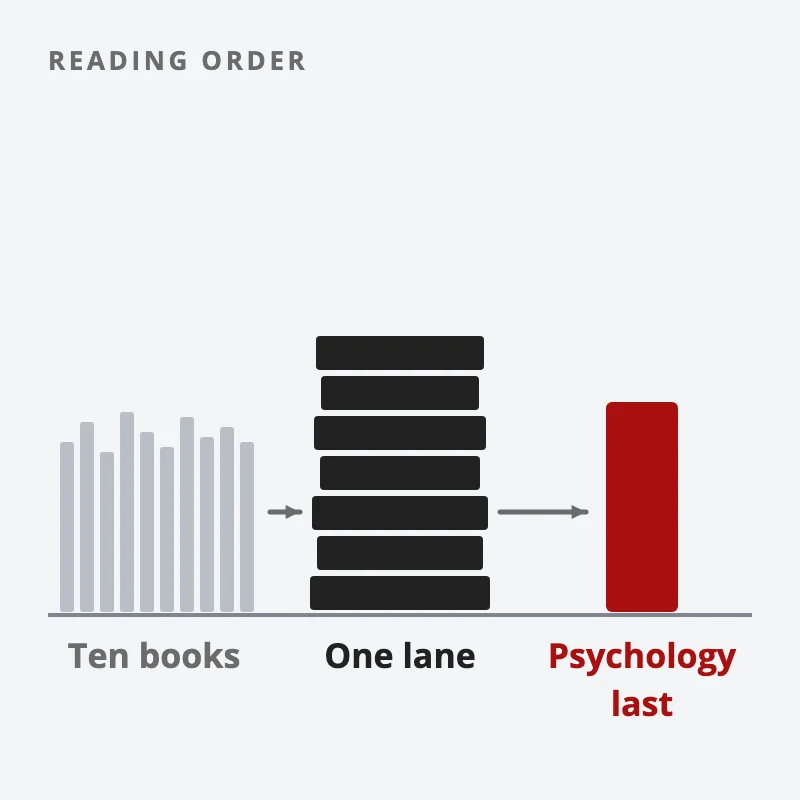
And keep a journal alongside the reading. A concept you wrote down after it cost you money sticks far better than one you highlighted in a book.
Where the human edge comes in
Here is the part the reading list cannot give you. You can feed all 200 of these books to an AI tomorrow, and it will summarise every framework in seconds. What it will not do is sit in the trade with you while the position moves against you, hold your size when you want to revenge-trade, or tell you that the clean setup in the book is not the messy thing on your screen right now. The knowledge in these books is becoming free. The judgment, discipline, and psychology to apply it under live pressure is the part that stays scarce, and it is the part you pay tuition for. The books are the easy half. The trader you become while reading them is the hard half.
FAQ
What is the single best book for a beginner trader?
For pure trading, Reminiscences of a Stock Operator by Edwin Lefevre, because the lessons are timeless and it reads as a story. For technical analysis specifically, John Murphy’s Technical Analysis of the Financial Markets is the standard reference.
Can you learn to trade from books alone?
No. Books teach the foundations, the vocabulary, and the frameworks, but not market feel, applied price action, or real trading psychology under pressure. Those are learned by trading real money or by being guided by an experienced trader. Reading is necessary but not sufficient.
Is paper trading or demo trading useful for learning?
It is of limited use because it removes the fear of losing real money, which is the central emotion you need to learn to manage. It can help you learn a platform’s mechanics, but it does not build the psychological skill that real money does.
How many trading books should I read before risking real money?
Read enough to cover the four foundations: technical analysis, fundamentals, trading systems, and psychology. The ten-book shortlist above is a reasonable minimum. Treat it as the floor, not a guarantee of success.
What is the best book on trading psychology?
Trading in the Zone by Mark Douglas is the most cited for probabilistic thinking and discipline. Read it after you have some live experience, so the concepts have something real to attach to.
That is the list. If you only take one thing from this page, take this: the books are the bare minimum, and the real lessons are still waiting for you at the market. Read, then go pay your tuition with your eyes open.
If you want the structured path instead of a 100-book pile, start with the pillar: The Beginner’s Guide to Trading and Investing.
Want a shortcut past the 200-book pile? Grab the free 15-Minute Swing Trading Starter Kit. It is the exact routine I use to scan once a day and trade any market in 15 minutes, distilled from everything on this list.
About the author. Spencer Li is The 15-Minute Trader and the founder of Synapse Trading. He is a Certified Financial Technician (CFTe) with 15+ years of trading, run from 70+ countries. He holds a B.Acc and B.BM from SMU. Every trade he takes is public, dated, losses left in. He teaches low-risk swing trading in 15 minutes a day, one system for any market.
Education, not financial advice. Synapse Trading is not licensed by MAS to advise on investment products. Trading carries risk of loss; past performance is not indicative of future results.
Related
The Beginner’s Guide to Trading and Investing (pillar) · How I learned to trade · Trading psychology: how to master your mind · The Definitive Guide to Trading Price Chart Patterns
Want the daily routine? Enter your email for the free 15-Minute Swing Trader's Checklist.
Free 5-page PDF, then occasional trading emails. Education only, not financial advice. Unsubscribe anytime. Kit stores your email in the US: see our privacy policy.
Want to learn the full method? The Trading Mastery Program teaches the 4 strategies I have traded since 2011. It suits beginners and experienced traders.
Rather follow the trades as they happen? Daily Trading Signals is our Telegram channel: my trade ideas with entry, stop and exit, and every trade is public.
Questions about this post? Ask in the free Telegram channel →
Educational content only, not personalised financial advice. Trading carries risk, including loss of capital. Past performance is not indicative of future results. Synapse Trading is not licensed or regulated by MAS.


The list of books you read is very impressive! I probably have 3-4 books in your list, but didn’t even start or finished reading. Thanks for the idea that I need to go back and read again.
You’re welcome! 😀 Haven’t had time to update the list in a while, but I still read at least 1 book a week, though not always on trading or investing. However, do not forget that “reading gives you knowledge, but practical application gives you experience!” Good luck!
what is the smallest subset of books that lead to a valid strategy?
in the secrets pdf you tell us to forget about indicators but many books are about this exactly. should we toss these out the window as well?
Hi Joe, there is no answer to your first question, because books provide you knowledge and ideas, but it is up to you to use your experience to piece these tools together to form a valid strategy. In my private forum, I have narrowed down this list to a handful of my favourite books.
That is my personal opinion, after learning all the different indicators, that most are not necessary, and many professionals also choose not to use them. Books and courses tend to gravitate towards indicators, because they are easy to explain and teach, and generally sell better to retail traders.
where link download book your recomend thanks
https://synapsetrading.com/resources/the-7-best-kept-secrets-of-professional-traders/