

Trend vs Range: How to Tell Which State the Market Is In Before You Trade
Want the daily routine? Get the free 15-Minute Swing Trader’s Checklist. Get it free →
By Spencer Li, CFTe · Last updated: 26 October 2026
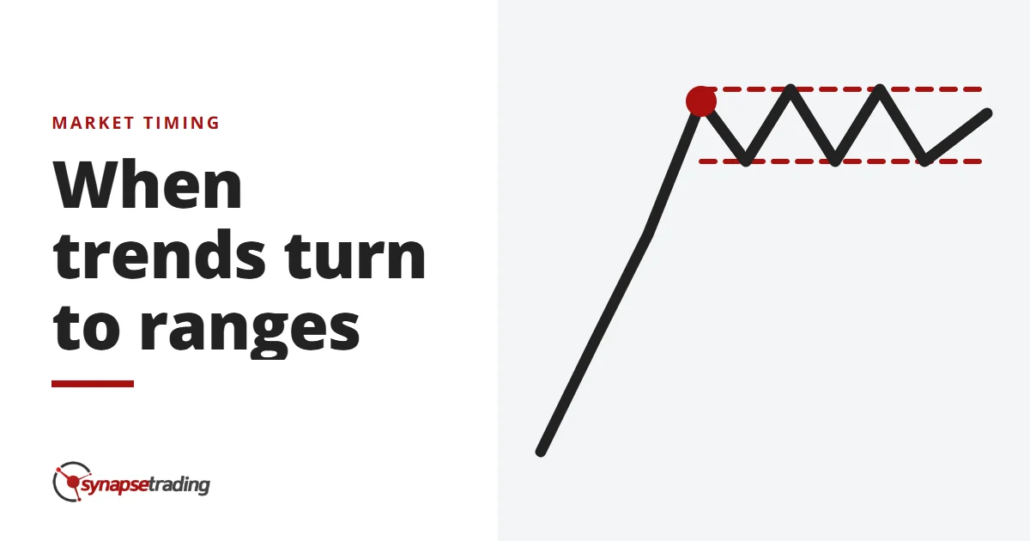
A market is always in one of two states. In a trend, price keeps making progress in one direction, and most attempts to turn it fail. In a range, price moves sideways between a ceiling and a floor, and most attempts to break out fail. Telling the two apart is the first read I make on any chart, because the same move can mean opposite things depending on which state the market is in. A push to a new high is follow-through in a trend. Inside a range, it is often a trap.
I shared the video below on the blog in 2012. The idea in it has not changed. What has changed is how much weight I give to one plain fact. Ranges are where most of the time goes, and they are where most of the frustration comes from.
What is the difference between a trending and a ranging market?
A trend is a run of higher highs and higher lows, or of lower highs and lower lows. A range is price swinging back and forth inside a band, with neither side winning for long. That sounds simple until you notice that the two sit inside each other.
Al Brooks spends a whole book on this, Trading Price Action: Trends (2012). His line is the one I keep coming back to: “All trends contain smaller trading ranges, and all trading ranges contain smaller trends.” Zoom in on a strong trend and you will find pauses that look like small ranges. Zoom out on a dull range and the swings inside it can look like small trends.
So the real question is never just “trend or range?” It is “trend or range, on the chart I am actually trading?” A swing trader cares about the state of the chart they hold trades on. The wiggles inside one afternoon belong to someone else’s game.
Brooks also gives the reason the call matters so much. “When a market is trending, most attempts to reverse fail. When it is in a trading range, most attempts to break out fail.” Markets have inertia. Whatever state they are in tends to carry on, until it doesn’t.
Why does the market spend so much of its time going sideways?
It is easy to picture markets as mostly trending, because the charts that get shared, screenshotted and remembered are almost always the ones with a big, clean move in them. The books I trust say the opposite.
In Reading Price Charts Bar by Bar (2009), Brooks writes that markets are in a trading range “the vast majority of the time.” Alexander Elder says much the same about futures in Come Into My Trading Room (2002). They “spend a lot of time in flat trading ranges, punctuated by relatively brief but fast trends.”
Put those two together and you get the shape of most charts. Long stretches of sideways drift. Short bursts of real direction. Then more drift.
That has a cost. If you treat every chart as a trend waiting to happen, you will spend most of your time buying moves that stall. So the state comes first in my routine, before any setup. A setup only makes sense once you know what kind of market it sits in. If you want that read built into a short daily routine, my free 15-minute swing trader checklist puts it near the top.
What does a range feel like when you are inside one?
On paper a range looks tidy. Living through one is another matter.
In my weekly outlook on 23 October 2025, the stock market was still “trading within this range”, the same as the week before, and QQQ looked the same. After the spike down on Friday 10 October, price spent two days trying to break down. That “didn’t happen.” Then it tried to break out to the upside, which “also didn’t happen.” Then it drifted back to test the middle.
Long or short, you could have been caught. I said at the time that “you might have been whipsawed”. In that kind of tape, I said, it was “usually better to wait… for the actual breakout”.
Later in the same session I admitted the harder part. The market was “so choppy” that “even in the cases where we were right on some trades”, a gap of “one or two days of timing” was enough to get whipsawed or stopped out. “That is the reality when the market is more choppy,” I said. “It actually makes it a lot harder to trade.”
My answer that week was to do less. When good trades are scarce, “it also makes sense to trade less… to be defensive”. Sitting out felt dull. It also kept the damage small while the market made up its mind. I wrote more about why waiting is part of the job in patience and discipline in trading.
Can you tell the state of the market while it is happening?
This is the fair objection, and one trader put it well on r/Daytrading on 3 September 2026. They said that after a session, it is really clear what kind of day the market had. Their question was “how can you determine it while IN the session?”
They have a point. My own October 2025 notes prove it. I was right about the range and still took whipsaws, because the state only became obvious once it had played out for a while. Anyone who claims to call every switch from trend to range as it happens is selling hindsight.
What helps is changing the question. Certainty about the state is out of reach on most days, so what you need is a default for the days you are unsure. Brooks gives one: “Whenever you are uncertain, assume that the market is in a trading range.” Ranges are the more common state, so the odds favour that guess. A range guess also makes you more careful, and that is the cheaper mistake.
The other help is to keep score. In Evidence-Based Technical Analysis (2007), David Aronson cites a study of two kinds of forecaster who avoid overconfidence: weather forecasters and horse-race handicappers. They face similar problems every day. They make clear forecasts that can be proved wrong. And they get fast, precise feedback on how they did.
A trader can copy that. Write down “trend” or “range” for each market you follow, with the date, and come back a few weeks later to see which calls held up and which ones the market quietly proved wrong. Your hit rate tells you how far to trust your next call.
How should your trading change when the state changes?
The state of the market does not tell you which button to press. It tells you how hard to press it.
On 12 February 2026, the S&P 500 futures had been forming what looked like an ascending triangle. Price had been flat since the October before and kept failing to break decisively to a new high. The ETF told the same story. It broke above at the start of the year, slipped back, and then hovered sideways for about a month and a half.
My read that week was simple. “As long as it’s trading in the range, it’s going to be… more challenging to trade,” I said. “If it’s a clear trend… we can try to be as aggressive as possible, take on many positions.” When the market goes sideways, “certain sectors are going up while certain sectors are going down”. So “we need to be more tactical”, and trade the right sectors instead of the whole market.
In practice, a trend is a time to press and to hold, while a range is a time to trade less, pick your spots and accept that the index itself may go nowhere for weeks. If you want to see how the triangle shape fits in, my guide to ascending and descending triangle patterns covers it.
A checklist is the simplest way I know to make the state call every day, before the setup call. Mine is the free 15-minute swing trader checklist.
The state also shapes which style suits you. Trend-following and range trading are different jobs that ask for different temperaments. The four main types of trading strategies lays out where each one fits. And if you wonder whether any of this beats a coin toss, I looked at the evidence in random walk theory vs practice.
FAQ
What is the difference between a trending and a ranging market?
A trending market makes steady progress in one direction, with higher highs and higher lows in an uptrend, or the reverse in a downtrend. A ranging market moves sideways between a ceiling and a floor. In a trend most reversal attempts fail, and in a range most breakout attempts fail.
Is the market more often trending or ranging?
Ranging, according to the books I trust. Al Brooks writes that markets are in a trading range “the vast majority of the time”. Alexander Elder describes futures as spending a lot of time in flat ranges, broken by brief and fast trends.
How do I know if the market is trending or ranging?
Look at the chart you actually trade. Ask whether price is making clear progress or keeps coming back to the middle. When you cannot tell, Brooks’s advice is to assume a range, because it is the more common state.
Why do I keep getting stopped out in a choppy market?
In a range, moves in both directions tend to fail. Even a right idea can be shaken out by a day or two of bad timing. Trading less during a range is often a better answer than trying harder.
Can a market be trending and ranging at the same time?
Yes, on different charts. Brooks’s point is that every trend contains smaller ranges and every range contains smaller trends. A long uptrend can hold a sideways stretch inside it, which is why you settle the state on the chart you trade.
Has a choppy market ever whipsawed you out of a trade you were right about? Let me know in the comments.
If you are just starting out, my free trading guides cover the basics of reading a chart.
And if you want the state call built into a daily routine that takes 15 minutes, grab the free 15-minute swing trader checklist.
About the author. Spencer Li is The 15-Minute Trader and the founder of Synapse Trading. He is a Certified Financial Technician (CFTe) with 15+ years of trading, run from 70+ countries. He holds a B.Acc and B.BM from SMU. Every trade he takes is public, dated, losses left in. He teaches rules-based swing trading in 15 minutes a day, one system for any market.
Education, not financial advice. Synapse Trading is not licensed by MAS to advise on investment products. Trading carries risk of loss, and past performance is not indicative of future results.
Want the daily routine? Enter your email for the free 15-Minute Swing Trader's Checklist.
Free 5-page PDF, then occasional trading emails. Education only, not financial advice. Unsubscribe anytime. Kit stores your email in the US: see our privacy policy.
Want to learn the full method? The Trading Mastery Program teaches the 4 strategies I have traded since 2011. It suits beginners and experienced traders.
Rather follow the trades as they happen? Daily Trading Signals is our Telegram channel: my trade ideas with entry, stop and exit, and every trade is public.
Questions about this post? Ask in the free Telegram channel →
Educational content only, not personalised financial advice. Trading carries risk, including loss of capital. Past performance is not indicative of future results. Synapse Trading is not licensed or regulated by MAS.


Trackbacks & Pingbacks
[…] If the highs and lows are overlapping, the honest answer is “range”, and our post on trend versus range transitions covers how one turns into the other. When it gets messy, read how to trade a choppy […]
[…] choppy is not the exception. It is close to half the time. Our post on trend versus range covers how to read the difference on a chart, and the ADX is one common indicator for […]
Comments are closed.