

5 Biggest Day Trading Mistakes that Beginners Make

Join our Telegram channel for more market analysis & trading tips: t.me/synapsetrading
Table of Contents
Day Trading for Beginners: The 5 Mistakes That Blow Up New Traders
Last updated: 3 July 2026 · By Spencer Li, CFTe
New day traders lose to professionals for five repeatable reasons, and none of them is a lack of talent. They trade without a written plan, they skip the practice reps, they hold losers and overtrade and revenge-trade, they scale up their size too fast out of greed, and they go it alone with no mentor or community. Fix those five and you remove most of the ways a beginner blows up an account. The pros I sat next to in a private equity fund, traders moving millions with 20 and 30 years behind them, were not faster or smarter on any single trade. They were just disciplined on all five of these at once, every day, without drama. That consistency is the entire edge.
Here is each mistake, why it kills accounts, and the specific fix I teach.
Why do beginners lose to professional traders?
Back when I was trading professionally in a private equity fund, I sat next to veteran traders with decades of experience moving millions of dollars. I also watched a lot of new traders come and go. The losers were not unlucky. They made the same handful of mistakes, in the same order, over and over.
The difference was never one brilliant trade. The professionals had a plan before the open, took only their best setups, cut losses without arguing, sized up slowly, and shared ideas in a team. The beginners did the opposite on all five counts. So the question is not “how do I find the perfect strategy.” It is “which of these five am I still doing, and can I stop.”
Mistake #1: trading with no solid trading plan
The trading plan is the foundation of everything else. Once the market opens and prices are moving and the charts are flashing, it gets emotional fast. In that state you should be doing one thing only: executing. All your focus and energy goes into clean execution, not deciding what to do.
That only works if the deciding is already done. Before the market opens, before your first trade, your plan should already answer four questions:
- What you are going to trade (the instrument and the strategy).
- Where you enter (your trading style and entry trigger).
- Where you exit (both your stop and your target).
- How much you risk per trade.
Write those down before the open. Then the moment a trade sets up, there is no fresh decision to make under pressure. You are just executing a plan you wrote when you were calm.
Mistake #2: not enough practice before going live
Think back to learning to drive. You did not get in the car and pull onto the highway. You first learned what each button and lever does, because you cannot steer through traffic and figure out the controls at the same time.
Trading is the same. When the market is in session you want full attention on executing the plan, not on “how do I key in this order” or “which button submits.” If you are fumbling the mechanics, you will fumble the trade.
So get the reps in before real money is at risk. Paper trade or use a virtual account until the whole process, scanning, entering, setting the stop, exiting, is automatic. You are buying familiarity without paying for it in losses. The market will still be there when you are ready.
Mistake #3: the wrong psychology
This is the big one, and it has three faces.
You cannot cut losses. Most of us carry loss aversion, a cognitive bias where losing money hurts more than the equivalent gain feels good. So new traders hold a losing trade even when they know they are wrong. Your plan already has a stop loss level. If you honour it, a loss is small and survivable. If you do not, the loss snowballs and one position can take the account.
You overtrade. Beginners see an opportunity in every wiggle. They are afraid of missing out, so they take everything. Professionals do the opposite: they deliberately filter out as many bad trades as possible and zoom in on only the very best ones. Fewer trades, higher quality, is the professional mentality.
You revenge-trade. You take a loss, and instead of stopping for the day, you try to win it straight back. Now you are not executing a plan, you are trying to “teach the market a lesson.” Every decision after that gets worse. The market does not know you exist, and it will happily take the rest of your account while you are angry at it.
Here is the amateur-versus-professional split laid out plainly:
| Situation | Amateur reaction | Professional reaction |
|---|---|---|
| Trade goes against you | Hold and hope, move the stop | Cut at the planned stop, no debate |
| Many setups on the screen | Take most of them (FOMO) | Filter hard, take only the best few |
| Just took a loss | Trade bigger to win it back | Stop, rest, fight another day |
| A winning streak | Feel like a genius, size up fast | Stay the same size, trust the process |
Notice that none of the professional reactions require a better forecast. They require holding your rules when emotion says break them.
Mistake #4: being too greedy and scaling up too fast
Every skill in life is learned step by step. You learn to swim in the shallow end, not by jumping into the deep end. Trading is no different, but greed pushes people to skip the steps.
The pattern is familiar. A new trader makes a little money and starts to feel like a genius. Every trade turns to gold, so they think: if I can make $50 a day, why not size up and make $500, then $5,000? So they keep scaling aggressively.
A veteran trader once told me the thing that stuck with me most: all it takes is one bad trade. It does not matter if you have traded for 10, 20, or 30 years. Break your rules on one oversized position and that single trade can blow up the whole account. You hear these stories all the time, someone makes a fortune, ignores their rules once, and gives it all back.
Do not let greed run the show. You stay in control of the size, not the other way around.
The fix is to scale gradually. A simple rule: scale up by 1.5 times only after a full month of consistency. Trading a $10,000 account and consistent for a month? Move to $15,000. Consistent for another month? Scale by 1.5 again. If your consistency drops, scale back down (say to $10,000) until your confidence returns. The point is gradual, earned increases, not arbitrarily multiplying your size because you had a good week.
Mistake #5: the lone wolf mentality
The last one is going it completely alone. Movies sell you the solo genius trader who ignores everyone, trades alone, makes a fortune, and makes a lot of enemies. It looks great on screen.
Nature tells a different story. Watch any wildlife documentary and wolves hunt in a pack, because that is when they are most effective. The lone wolf, in reality, gets eaten.
Trading in a community works the same way. If you have a mentor and a group of traders, there is no reason to be selfish about it. If you spot a good opportunity and share it, you do not earn less, everyone can take the same trade, and when others find a setup they share it back. When I traded on a professional team, we shared ideas constantly and everyone ended up with more good trades, not fewer. You also learn from each other’s mistakes, which means you avoid making them yourself.
Think in terms of abundance, not scarcity. The market is big enough for everyone at your table.
Where the human edge comes in
A scanner will flag setups for you all day, and these days an AI can summarize any strategy you like in seconds. What none of that supplies is the discipline to cut the loser at your stop, the restraint to skip the trade you want to take, or the patience to scale up over months instead of weeks. The information was never the hard part. Sizing, psychology, and discipline are, and that is the part of trading no tool can do for you. It is why I frame trading around the Five Edges a machine cannot trade on your behalf.
The 5 mistakes, summed up
- Trade with a solid plan written before the open.
- Practice (paper trade) until the mechanics are automatic.
- Build the right psychology: cut losses, do not overtrade, never revenge-trade.
- Scale up gradually (1.5x per consistent month), never out of greed.
- Trade in a pack, not as a lone wolf. Use a mentor and a community.
FAQ
Why do most beginner day traders lose money?
Not from bad luck or low intelligence. They lose for five repeatable reasons: no written trading plan, too little practice before going live, poor psychology (holding losers, overtrading, revenge-trading), scaling up size too fast out of greed, and trading alone with no mentor or community.
What is the single biggest day trading mistake?
The inability to cut losses. Loss aversion makes new traders hold a losing trade even when they know they are wrong, and an uncut loss can snowball until it takes the whole account. Honour the stop loss in your plan, every time.
Should beginners paper trade before using real money?
Yes. Paper trading or a virtual account lets you make the process, scanning, entering, setting stops, exiting, automatic without risking money. Like learning the car’s controls before driving in traffic, you do not want to learn the mechanics and manage a live trade at the same time.
How fast should I scale up my trading account?
Slowly. A practical rule is to increase your account or position size by 1.5 times only after a full month of consistency, then repeat. If your consistency drops, scale back down until your confidence returns. One oversized trade that breaks your rules can blow up an account no matter how experienced you are.
Do I need a trading community or mentor to succeed?
You do not strictly need one, but going it alone is the harder road. A mentor and a community give you more ideas, faster feedback, and a way to learn from other people’s mistakes instead of paying for every lesson yourself. Sharing a setup does not mean you earn less; everyone can take the same trade.
So those are the five mistakes that take out most beginners before they get going. Which one were you still making? Let me know in the comments.
And if you want the full starting roadmap, read the pillar: The Beginner’s Guide to Trading and Technical Analysis.
Want the system, not just the warnings? Grab the free 15-Minute Swing Trading Starter Kit. It is the exact routine I use to scan once a day and trade any market in 15 minutes, with the plan and risk rules built in.
About the author. Spencer Li is the founder of Synapse Trading and a Certified Financial Technician (CFTe) with 15+ years of trading across stocks, forex, crypto, commodities, and bonds. His trade log is public: every trade since April 2024, dated, losses left in. He has taught a 15-minute daily trading routine since 2014, one system for any market.
Education, not financial advice. Synapse Trading is not licensed by MAS to advise on investment products. Trading carries risk of loss; past performance is not indicative of future results.
Related
The Beginner’s Guide to Trading and Technical Analysis (pillar) · Trading psychology and discipline · How to build a trading plan · Risk management and position sizing
Want the daily routine? Enter your email for the free 15-Minute Swing Trader's Checklist.
Free, 5 pages, PDF. You get the checklist, then my occasional trading emails. Education only, not financial advice. Unsubscribe anytime.
Where your details go: Kit, our email provider, stores your email address in the United States. Our contract with Kit lets it use your address only to send our emails, and requires Kit to keep it secure. The United States has no national privacy law like Singapore's, so that contract is the main protection. More in our privacy policy.
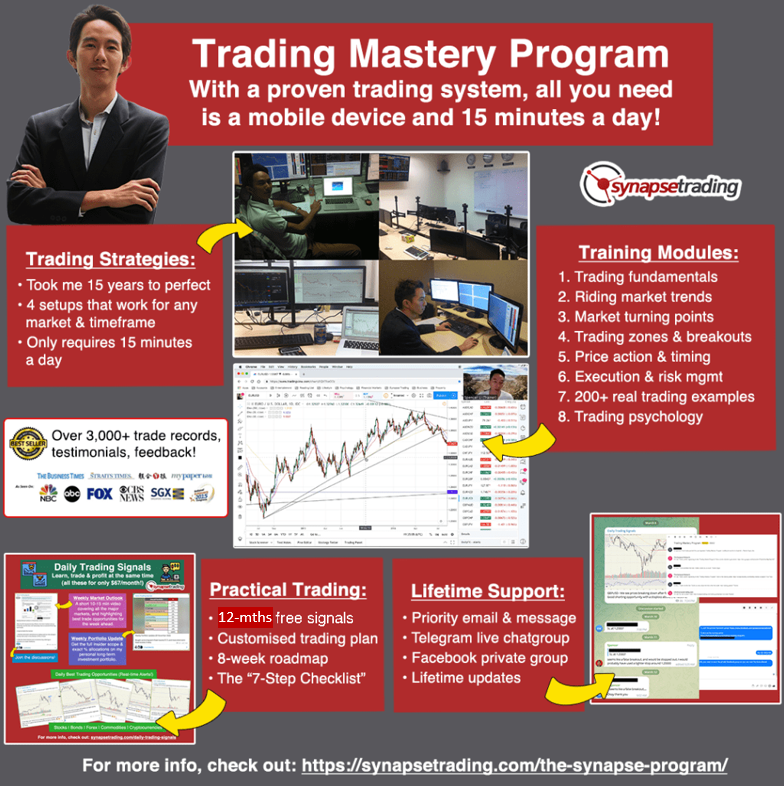 Our flagship mentoring program is suitable for both beginners and advanced traders, covering the 4 strategies which I used over the past 15 years to build up my 7-figure personal trading portfolio.
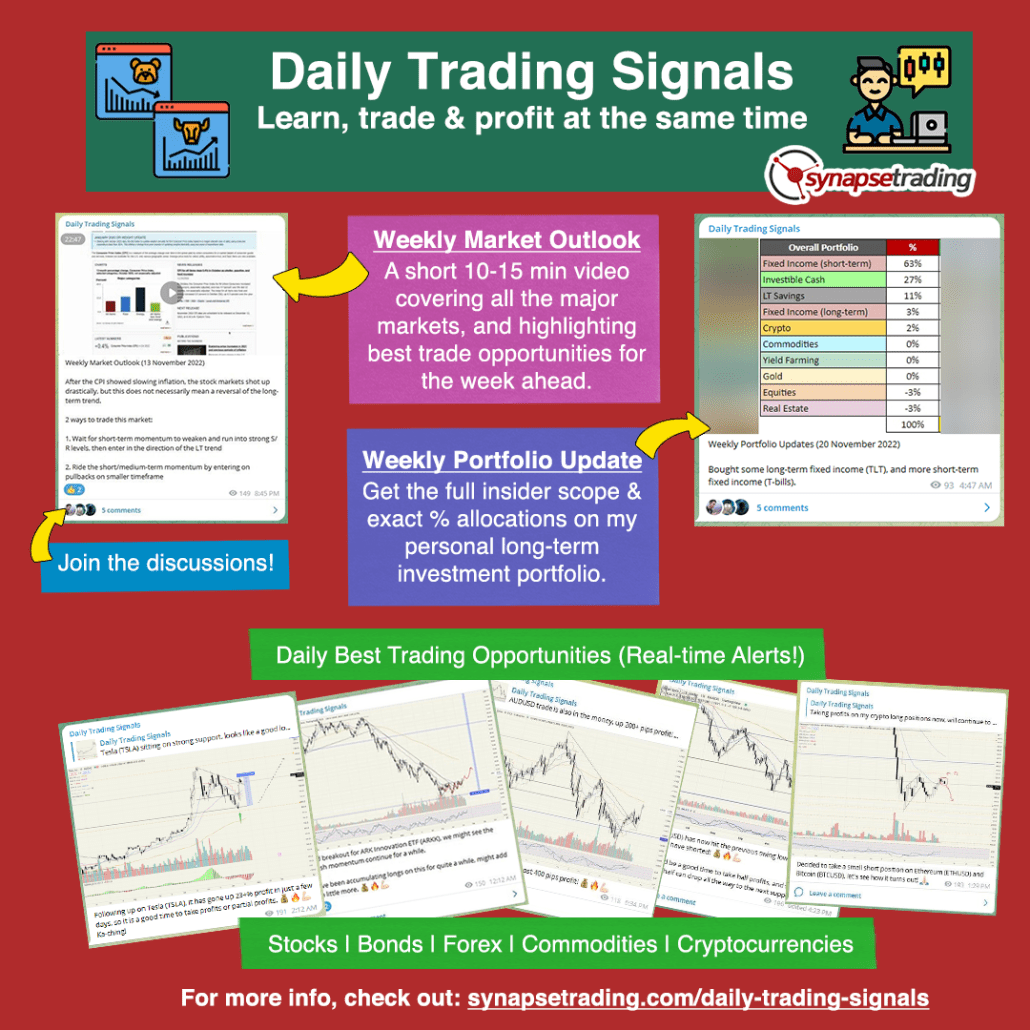 If you're looking for the best trading opportunities every day across various markets, and don't want to spend hours doing the research yourself, check out our private Telegram channel!



Leave a Reply
Want to join the discussion?Feel free to contribute!