

10 Essential Trading Rules of Professional Traders

Join our Telegram channel for more market analysis & trading tips: t.me/synapsetrading
Table of Contents
Trading Rules of Professional Traders: 10 Rules That Separate Pros From Retail
Last updated: 3 July 2026 · By Spencer Li, CFTe
Professional traders win mainly because they follow a fixed set of trading rules, and retail traders lose mainly because they don’t. The pros are not seeing a different market. They are reacting to the same market with discipline you can copy. After more than 10,000 hours of trading professionally, the 10 rules I keep coming back to are: be disciplined, plan the trade and trade the plan, expect losses, manage your emotions, focus on trading well rather than on money, do not overtrade, trade what you see rather than what you think, follow the trend, do not repeat your mistakes, and keep your expectations realistic. None of these are about predicting the market. Every one is about controlling yourself while you trade it. That is the real gap between a beginner and a professional: not a better forecast, but a better-followed rulebook.
Here is each rule, why it matters, and how to actually apply it.
Why do professional traders use trading rules at all?
Because rules separate the planning from the doing. When you trade without rules, you are deciding everything in the heat of the moment, with money on the line and your emotions screaming. You second-guess the entry, then regret the exit, then carry the anguish into the next trade.
Rules fix that by splitting trading into two phases. You write the rules in a calm planning phase, away from the screen. Then in the execution phase you just follow them. The hard thinking is already done. That is why a professional looks unbothered while a beginner looks tortured over the same chart.
There is a second payoff. Rules make success repeatable. Once you know which rules work, you apply them again and again and get the same kind of result. Without rules, you can have a great month and still not know what you did right, so you cannot do it again.
The 10 trading rules at a glance
| # | Rule | The one-line discipline | The mistake it prevents |
|---|---|---|---|
| 1 | Always be disciplined | Follow your plan, every time | Talking yourself into “this time is different” |
| 2 | Plan the trade, trade the plan | Decide before you enter, not during | Improvising entries and exits live |
| 3 | Expect losses | Accept the risk before you click buy | Getting stubborn and bending your rules |
| 4 | Manage your emotions | When in doubt, get out | Acting on greed or fear |
| 5 | Focus on trading well | Chase good trades, not money | Letting profit-pressure ruin your execution |
| 6 | Do not overtrade | Wait for the setup, or go fishing | Forcing trades when there is no edge |
| 7 | Trade what you see, not what you think | Act on price, ignore the noise | Trading your opinion over the market |
| 8 | The trend is your friend | Trade with the trend, stack your edges | Catching a falling knife |
| 9 | Do not repeat your mistakes | Keep records, review, improve | Paying for the same lesson twice |
| 10 | Have realistic expectations | Aim for small, consistent gains | Expecting to get rich overnight |
Notice what is not on this list: no indicator, no signal, no forecast. The whole rulebook is behavioural. Now let’s take each one properly.
1. Always be disciplined
Follow your plan and your rules. Do not let your emotions sway you into acting otherwise. And do not create excuses to break the rules. The excuse is almost always some version of “this time is different.” It isn’t. Discipline is just the willingness to keep your own promises after the market has tried to talk you out of them.
2. Plan the trade, trade the plan
Always cut your losses according to plan. Always let your profits run according to plan. The key word in both is “plan.” Separate your planning from your execution, so that by the time you are in a live trade, every decision has already been made in advance, when you were calm.
3. Expect losses
Losses are part of trading. Accept them in advance, and you remove most of the emotional resistance that hits when it is time to cut one. Do not take a trade unless you are willing to accept the risk, meaning the real possibility of loss, that comes with it. You will lose money on some trades. Take those losses easily when they come, and do not get stubborn and bend your rules to avoid booking one.
4. Manage your emotions
When in doubt or unsure, get out. Always analyse objectively. Sometimes the fastest way back to a clear head is to clear all your positions and return to a neutral frame of mind, because it is very hard to think straight while you are exposed. Above all, do not act on greed or fear. Those two emotions are responsible for most blown accounts.
5. Focus on trading well
The goal of a trader is to make the best trades. The money follows naturally from that. Flip the priority and you sabotage yourself: if you focus on the money, emotions get in the way and you stop making good decisions. Process first, profit second. The score takes care of itself when the swing is right.
6. Do not overtrade
Be patient. Do not rush into a trade, and do not trade when there are no good setups. You do not need to be in the market all the time. As the saying goes, it is better to miss a boat than to leave on one full of holes. One good trade beats three bad ones. Or, in Jesse Livermore’s words: “There is a time to go long, a time to go short, and a time to go fishing.”
7. Trade what you see, not what you think
Don’t concern yourself with why things are happening. Observe what is actually happening, and act on that. Ignore the noise: tips, rumours, news, speculation. Anticipate the future if you like, but trade in the present. Markets are never wrong; opinions are. When your view and the price disagree, the price is the one with your money in it.
8. The trend is your friend
Don’t enter just because something looks “overbought” or “oversold,” and don’t try to catch a falling knife. The easiest money is made trading with the trend, not against it. Before you enter, make sure you actually have an edge, and put as many factors in your favour as you can. Stacking the odds is not optional; it is the job.
9. Do not repeat your mistakes
Keep good records of your trades and your thought process. Analyse your mistakes, then move on. The point is not to feel bad; it is to not make the same mistake twice. Continuous, honest review is how a decent trader slowly turns into a good one.
10. Have realistic expectations
Do not try to make stellar returns overnight. Aim for small, consistent returns over a long period. You will not become an expert overnight either; trading takes time to build real experience. The traders who last are the ones who expected a slow climb and got one.
Where the human edge comes in
Read these 10 rules again and notice something: an algorithm could enforce every single one of them mechanically, yet almost no human can. A bot will cut the loss at the planned level without flinching. You will hesitate. The rules are simple to write and brutal to follow, because following them means overriding greed, fear, and ego in real time. That gap, between knowing the rule and obeying it under pressure, is exactly where discipline and psychology live. It is the part no scanner trades for you, and it is why two people can run the identical system and get opposite results.
How do these rules actually help your results?
The difference between a beginner and a successful trader is how good their rules are, and how faithfully they follow them.
Trade without rules and you will always be second-guessing your decisions, then regretting them when they go wrong. That creates a lot of unnecessary mental anguish.
Trade with rules and you lower the stress of every decision, because you have separated the planning phase (where you make the rules) from the execution phase (where you simply follow them). And rules make success repeatable. Once you know what works, you apply it again and again for the same result. Without them, you never really learn what worked, so you cannot do it twice.
FAQ
What are the most important trading rules for beginners?
Start with discipline (rule 1), planning the trade and trading the plan (rule 2), and expecting losses (rule 3). Most beginner blow-ups come from breaking exactly these three: improvising live, and refusing to take a planned loss.
Why do 90% of retail traders lose money?
Mostly behaviour, not analysis. They overtrade, chase, trade their opinion instead of the price, refuse to cut losses, and have no written rules to fall back on. The market is the same for everyone; the discipline is not.
Do professional traders actually follow strict rules?
Yes. The professional edge is less about a special indicator and more about consistently applying a fixed rulebook while managing emotion. Process over prediction.
What is the single best trading rule?
If forced to pick one, “plan the trade, trade the plan.” It is the rule that contains the others: it forces discipline, pre-accepts losses, and removes most emotional, in-the-moment decisions.
How long does it take to become a consistently profitable trader?
Longer than most beginners hope. Rule 10 exists for a reason: trading takes time to build experience, and the realistic path is small, consistent gains compounded over years, not overnight returns.
Now that I have shared all my best trading rules, which one do you think will make the biggest difference in your trading? Let me know in the comments.
And if you are just getting started, read the pillar first: The Beginner’s Guide to Trading and Technical Analysis.
Want the system these rules sit inside? Grab the free 15-Minute Swing Trading Starter Kit. It is the exact once-a-day routine I use to trade any market in 15 minutes, rules and all.
About the author. Spencer Li is the founder of Synapse Trading and a Certified Financial Technician (CFTe) with 15 years of trading across stocks, forex, crypto, commodities, and bonds. His trade log is public, 404 trades, losses left in. He teaches low-risk swing trading in 15 minutes a day, one system for any market.
Education, not financial advice. Synapse Trading is not licensed by MAS to advise on investment products. Trading carries risk of loss; past performance is not indicative of future results.
Related
The Beginner’s Guide to Trading and Technical Analysis (pillar) · Trading psychology: how to master your mind · How to create a trading plan · Risk management for traders · The trend is your friend: trading with the trend
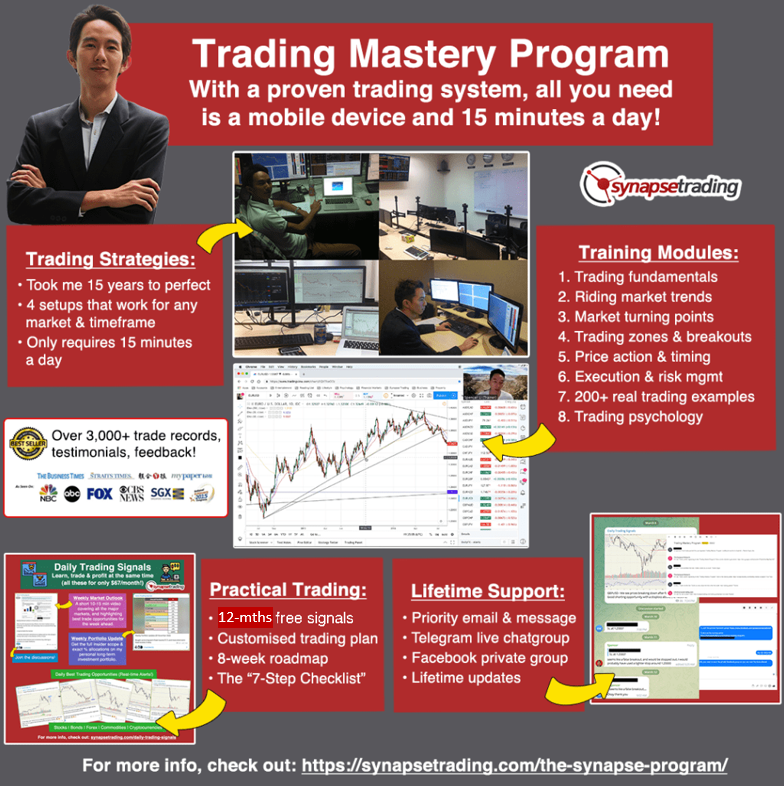 Our flagship mentoring program is suitable for both beginners and advanced traders, covering the 4 strategies which I used over the past 15 years to build up my 7-figure personal trading portfolio.
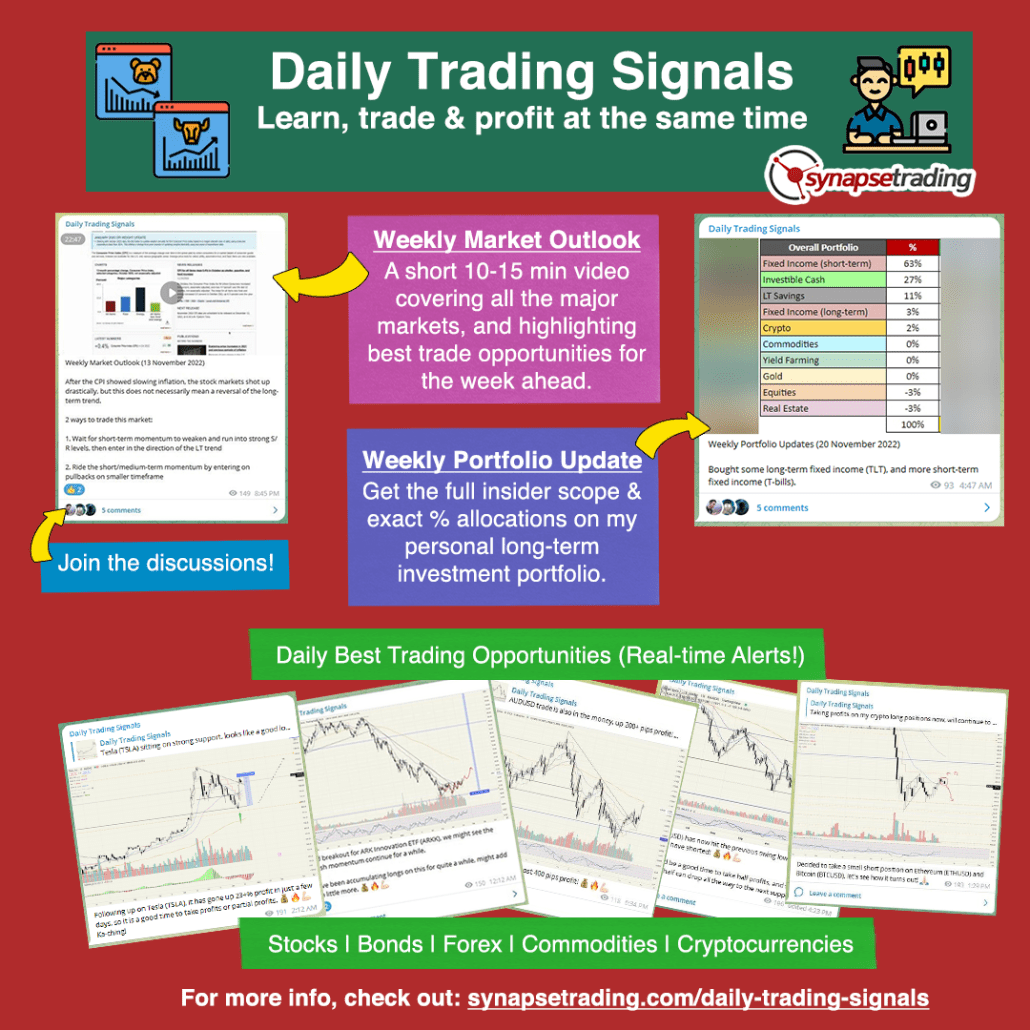 If you're looking for the best trading opportunities every day across various markets, and don't want to spend hours doing the research yourself, check out our private Telegram channel!








Leave a Reply
Want to join the discussion?Feel free to contribute!