• Link to Facebook
  • Link to X
  • Link to Instagram
  • Link to Youtube
  • Link to LinkedIn
  • Link to Mail
Synapse Trading
  • Home
  • About
    • My Background
    • My Trading Journey
    • My Travel Log
    • Media & Interviews
  • Mentoring
    • Trading Mastery Program
    • Results & Testimonials
  • Signals
    • Telegram (Free to join!)
    • Daily Trading Signals
    • Daily Trading Signals (Results)
  • Resources
    • Free Trading Guides
    • Tools & Resources
    • Blog & Infographics
  • Contact
    • Contact Us
    • Partnership Opportunities
  • Click to open the search input field Click to open the search input field Search
  • Menu Menu

Tag Archive for: portfolio

Spencer Li

Is Your Portfolio Anti-Fragile? (Does it Fare Well During a Market Crash?)

Investing & Portfolio Management
does your portfolio fare well in crisis

In a bull market, everyone is a genius because it does not take any skill to get great returns.

However, the real test of your portfolio is during a market crash or crisis. How will it fare if the stock market drops 50%?

If your portfolio is anti-fragile, it will actually benefit from such market volatility, and give you opportunities to buy assets on discount.

Enjoy the video, and remember to “like” and “subscribe”!

0 Comments/by Spencer Li
https://synapsetrading.com/wp-content/uploads/2020/02/does-your-portfolio-fare-well-in-crisis.png 521 1014 Spencer Li https://synapsetrading.com/wp-content/uploads/2019/10/logo.jpg Spencer Li2020-02-25 13:04:342022-12-21 03:15:01Is Your Portfolio Anti-Fragile? (Does it Fare Well During a Market Crash?)
Spencer Li

How to Build a $1M Dollar Portfolio by 30 (The Practical Stuff)

Trading Tips
monthly portfolio updates October 2016 1

How to Build a $1M Portfolio by 30: The Practical Stuff

Last updated: 3 July 2026 · By Spencer Li, CFTe


You build a million-dollar portfolio by 30 with three boring steps repeated for years, not by finding one perfect stock. First, build multiple sources of cashflow so you have capital to invest. Second, buy long-term assets only when market cycles say they are cheap, never all at once. Third, reinvest the passive income those assets throw off, so compounding does the heavy lifting. That is the whole machine. Cashflow fills the tank, patient buying gets you a good entry price, and reinvested dividends and yield turn a steady saver into a snowball. None of it is fast, and none of it is clever. The edge is that most people quit at step one or skip step two and overpay for everything at the top of the cycle.

When I was in my 20s, this was my dream too. So I read over 2,000 books across investing, trading, psychology, philosophy, business, and finance, and I kept arriving at the same three principles below. Here is how each one works, in the order you actually do them.

The 3 principles, side by side

What you doWhy it mattersEasy to skip?
1. Multiple sources of cashflowSave hard from your job, then add side income (a side job, an online business, trading)No capital means nothing to compound. This is your ammunitionMost people stall here
2. Time your portfolio purchasesBuy long-term assets only when cycles say they are cheap, not all at onceA good entry price does years of the work for youMost people overpay at the top
3. Reinvest the passive incomePlough dividends and yield back in, on top of your monthly contributionsThis is where compounding turns steady saving into a snowballThe patient win, so it gets skipped

How do you get the capital to start investing?

The first thing you need is a solid base of capital. At the start, if you do not have much, almost all of your time and resources should go into generating as much cashflow (the money coming in each month) as possible, to build up your ammunition.

If you have a well-paying job, you can start by saving aggressively. To speed things up, most people add multiple sources of income on top: a side job, an online business, and so on.

For me, I chose forex trading (trading currencies). It did not need much capital to start, and I did not have much spare time, so I could only afford 15 to 30 minutes a day. It now gives me a steady monthly cashflow, which is what let me move on to step 2.

Personally, I would not overthink which side income to pick. Pick the one that fits the time and capital you actually have, and start. The point of step one is simply to have something to invest with.

When should you buy your long-term investments?

Once you have enough capital and consistent cashflow, you start building your long-term portfolio.

Start with a rough picture of your ideal portfolio and the risk and return you are after. Look for assets with a good chance of capital appreciation (the price going up over time) plus passive returns in the form of dividends or rental yield. Over the years I have leaned more and more toward the passive-income type of holdings.

Do not be in a hurry to buy everything at once. Watch and study the market cycles, and aim to buy only when something is cheap or undervalued. You can get a feel for this just by looking at the chart of any product over the past 50 to 100 years of history. There is no need to spend hours on financial reports or analyst notes. Remember, the goal is to get the most out of limited time.

A scanner will tell you the price. It will not tell you to wait two more years for a better one. That patience, the discipline to sit on cash through an expensive market and only buy when the cycle hands you a good price, is judgment, and it is the part no tool buys for you.

How does compounding actually grow the portfolio?

As your portfolio grows, and you keep adding to it from your monthly cashflow, the real kicker is when compounding kicks in.

The best move is to also reinvest the passive income the portfolio itself pays you. That creates a snowball effect, where your gains start earning their own gains, and the portfolio grows exponentially rather than in a straight line.

Once you have assembled your ideal portfolio, the maintenance is light. Check on it once every three months or so and do some rebalancing (selling a bit of what has grown too large, topping up what has shrunk, to keep your target mix). The rest of the time you can enjoy the fruits of your labour and focus on living your life instead of worrying about money.

For me, that has meant travelling to 50+ countries to date, and sharing what I have learned to help others do the same.

Tips from the desk

  • Front-load the boring years. Steps one and two feel slow because they are. The compounding in step three only shows up after you have done the unglamorous work for a while.
  • A good entry price is worth more than a good forecast. Buying cheap in a down-cycle does more for your long-term return than picking the “right” asset at the wrong price.
  • Reinvest by default. Set dividends and yield to reinvest so the snowball runs without you having to decide each time.
  • Keep maintenance light. A quarterly check and a rebalance is enough. Over-tinkering is how people talk themselves out of compounding.

FAQ

Is it realistic to build a $1M portfolio by 30?
It is realistic for some, but it depends entirely on your cashflow and how early you start. The framework is the same regardless of the deadline: build income, buy patiently into market cycles, and reinvest the passive returns. If 30 is not achievable on your numbers, the same three steps still get you there later.

What is the first step to building a portfolio with little money?
Cashflow. With little capital, your time is better spent generating more income (saving hard from a job, plus a side income like a side job, an online business, or trading) than on picking investments. You cannot compound money you do not have yet.

Do I need to read financial reports to invest well?
For long-term timing, not really. Studying the long-run price chart of an asset over 50 to 100 years tells you a lot about where you are in the cycle and whether it is cheap. The goal is to make good decisions with limited time, not to do equity-analyst work.

How often should I check my portfolio?
About once every three months. Check in, rebalance back toward your target mix, and otherwise leave it alone. Frequent tinkering tends to interrupt the compounding you are trying to capture.

Why reinvest the passive income instead of spending it?
Reinvesting dividends and yield is what turns steady saving into a snowball. The income you reinvest starts earning its own income, which is what makes the portfolio grow exponentially rather than in a straight line.


So, are you ready to start building your own portfolio? Tell me which of the three steps you are stuck on in the comments.

And if you want the bigger picture on building wealth from trading and investing, read the pillar: The Complete Guide to Trading and Investing for Beginners.

Want the system behind step one? Grab the free 15-Minute Swing Trading Starter Kit. It is the exact routine I use to scan once a day and trade any market in 15 minutes, the same cashflow engine I leaned on to fund my own portfolio.


About the author. Spencer Li is the founder of Synapse Trading and a Certified Financial Technician (CFTe) with 15 years of trading across stocks, forex, crypto, commodities, and bonds. His trade log is public, 404 trades, losses left in. He teaches low-risk swing trading in 15 minutes a day, one system for any market.

Education, not financial advice. Synapse Trading is not licensed by MAS to advise on investment products. Trading carries risk of loss; past performance is not indicative of future results.


Related

Complete Guide to Trading and Investing for Beginners (pillar) · How to trade forex with 15 minutes a day · How to build passive income from dividends · Understanding market cycles

0 Comments/by Spencer Li
https://synapsetrading.com/wp-content/uploads/2016/11/monthly-portfolio-updates-October-2016-1.jpg 373 927 Spencer Li https://synapsetrading.com/wp-content/uploads/2019/10/logo.jpg Spencer Li2018-05-30 18:50:372026-07-06 01:59:36How to Build a $1M Dollar Portfolio by 30 (The Practical Stuff)
Spencer Li

Interview: If You Had $250,000, How Would You Allocate it?

Market Analysis
cover 2

Recently, during an interview, I was asked this question, to suggest a possible portfolio allocation for people in their early 30s, with $250k of investible cash to start with. Here is my answer in full:

If you only have $250k to start with, I would suggest a diversified approach of various asset classses to maximise returns:

  • 25% allocated to cash (war chest)
  • 10% to wild bets
  • 20% to trading account
  • 20% to commodities
  • 20% to businesses, startups, angel investments
  • 5% to stocks, REITs, ETFs

Currently, the bulk of the holdings is in cash, since the market is pretty “risk-on” at the moment with much political and economic uncertainty about trade wars and real wars. Hence, I only included minimal stock holdings, as the stock markets (S&P 500)are at 10-year highs, so I will wait to buy in at a lower price should the opportunity arise.

One important factor is the 20% allocation to trading account, as this generate monthly cashflow from stocks/forex trading to continue growing the total portfolio size aggressively, which can then be allocated to other asset classes within the portfolio.

10% to cryptocurrencies and startups is considered a “wild bet” which could be a zero or hero; lastly 20% to businesses is for people who have some prior experience to invest directly in businesses, or start their own. Personally, my portfolio includes several businesses, including a cafe and pub.

I have allocated 20% to commodities, as commodities are likely at their cycle low. The GSCI (Goldman Sachs Commodity Index) is one of the main benchmark for commodity prices, and the (GSCI/S&P 500) is used to measure the prices of commodities relative to stock prices. Currently, this measure is at a 50-year low, which suggests cheap commodities as a potential investment.

GSCI

I have excluded real estate from this sample portfolio, as I do not include “own stay” property as an investment asset, and $250k is too small for any major property investment. For my own portfolio, i have invested in several properties as I feel that the Singapore property market will continue to rise for the next 5-10 years.

I have also excluded fixed income, as for Singaporeans, the CPF (SA account at 4%) is pretty much similar to a “risk-free” high-yield bond, hence it serves well as the fixed income component of the portfolio. For my own portfolio, i have hit the minimum sum, which will provide a good safety net for retirement. For non-Singaporeans, any pension/retirement scheme which offers a fixed payout would serve the same purpose.

I hope this has provided you a good template to start building your portfolio, but do keep in mind that ideally you should be looking to rebalance your portfolio every 1-3 months.

0 Comments/by Spencer Li
https://synapsetrading.com/wp-content/uploads/2014/06/cover-2.png 683 1178 Spencer Li https://synapsetrading.com/wp-content/uploads/2019/10/logo.jpg Spencer Li2018-04-20 06:10:312022-03-07 16:20:53Interview: If You Had $250,000, How Would You Allocate it?
Spencer Li

Why I am Planning to Liquidate my Full Portfolio of Singapore Stocks

Market Analysis
straits times index sti 140517


It has been a while since my last update on the Singapore markets (as well as my SG portfolio holdings), largely because the market doesn’t move much, so I only check on them once in a while.

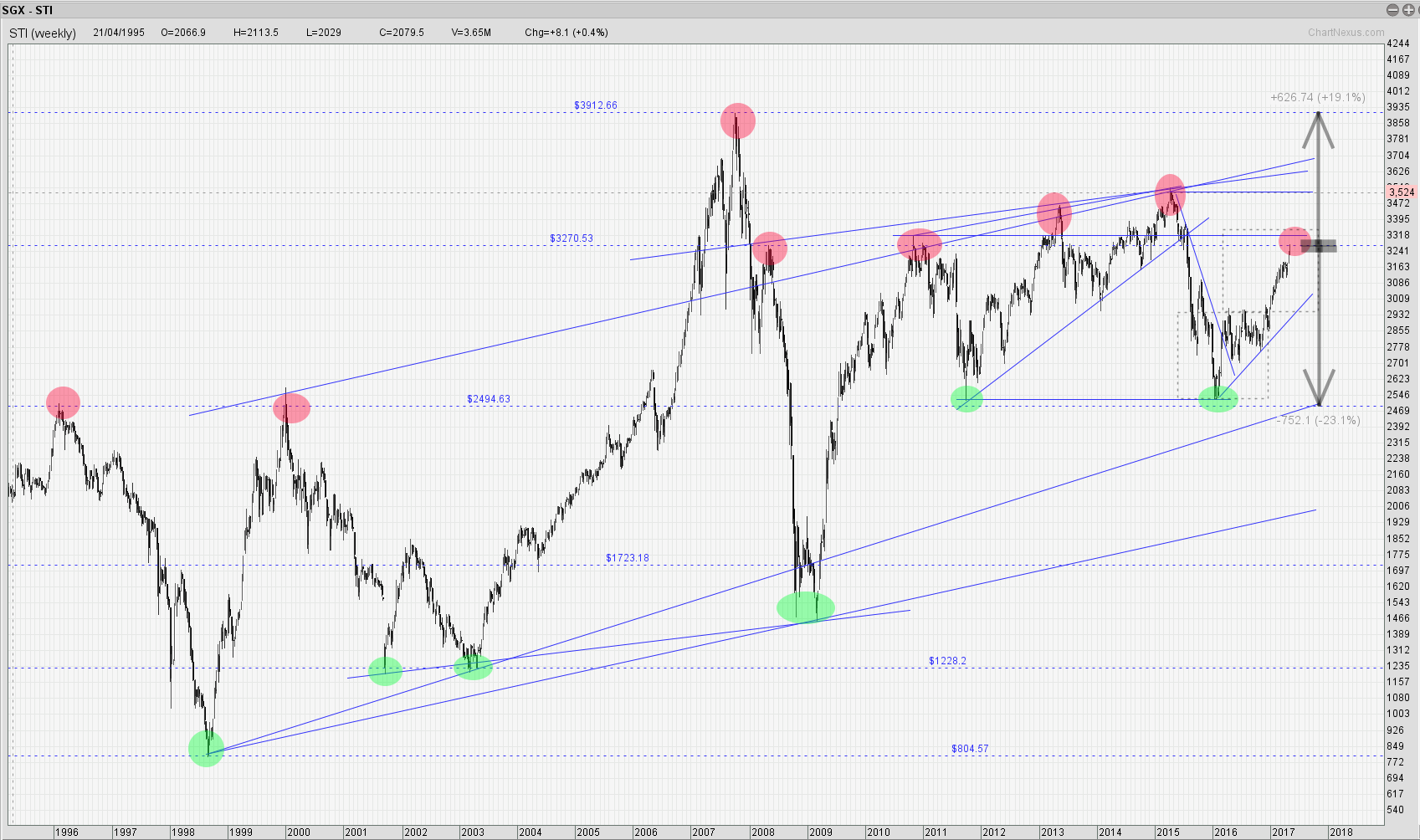
Interestingly, I noticed that the STI has had an impressive run, coming off a low of 25xx to break past the 3000 level in the past few months. However, is this move sustainable?

Full Portfolio of Singapore Stocks

Taking a closer look at this weekly chart which shows the historical prices over the last 20 years or so, one thing which stands out is that the market has been in a 7 YEAR sideways stagnation.

If we look back at the whole history of the index, this is somewhat unprecedented.

Which could explain why popularity in this market (as well as trading volumes) has been waning. In short, it does seem like a dying market.

Not to mention that during this same time period, the US stock markets have been steadily creeping up.

If we look at the most recent red shaded circle, that is where the current price is, and it seems to be running into massive headwinds. This means that the potential upside could be quite limited.

If we observe the large sideways range that prices have been moving in, the price is now at the top of the range. And we know that the best strategy in a range is to “buy low, sell high”, which means that the odds do not favour much more upside, unless there is some new strong positive price catalyst.

However, a cursory glance at recent news headlines seems to be painting a rather gloomy picture, with muted growth forecasts and ominous employment statistics. This tell me that downside catalysts are more likely that upside ones. In other words, there is more chance of a negative shock rather than a positive shock for prices.

In light of all these factors, I am planning to cash out most or all of my profits, and wait for more favourable odds to redeploy my capital. As a trader and investor, timing is always key.

Good luck, and trade wisely! 😀

0 Comments/by Spencer Li
https://synapsetrading.com/wp-content/uploads/2017/05/straits-times-index-sti-140517.png 1004 1697 Spencer Li https://synapsetrading.com/wp-content/uploads/2019/10/logo.jpg Spencer Li2017-05-14 06:57:272022-03-07 16:51:55Why I am Planning to Liquidate my Full Portfolio of Singapore Stocks
Spencer Li

Warren Buffett’s 7 Secrets to Dividend Investing

Investing & Portfolio Management
warren buffett

Warren Buffett’s Dividend Investing Strategy: 7 Rules He Actually Uses

Last updated: 3 July 2026 · By Spencer Li, CFTe


Warren Buffett’s dividend investing strategy comes down to buying a handful of simple, durable businesses cheaply and holding them for years while they compound. He is not chasing high yields. He is buying companies with long track records, wide competitive moats (advantages competitors cannot easily copy), at a sensible price, then letting time and reinvested cash flow do the heavy lifting. In practice that is seven rules: buy businesses with long histories, with durable competitive advantages, while they are undervalued; keep a focused portfolio of your best ideas; hold for the long run; favour shareholder-friendly management; and keep everything inside your circle of competence (the area you genuinely understand). The dividends are a by-product of owning great businesses, not the reason to own them.

Here is each rule, why it works, and where most people get it wrong.

What is Warren Buffett’s approach to dividend stocks?

Buffett does not buy a stock because it pays a fat dividend. He buys a wonderful business at a fair price, and a growing dividend tends to come with the territory. The order matters. Quality of the business first, valuation second, the yield last. Get that order backwards and you end up holding a high-yield trap, a company paying you out of borrowed money while the business quietly rots.

Below are the seven rules, side by side, before we go through each one.

#The ruleWhat you are really looking forThe common mistake
1Long corporate historyA business that has survived decades, so fewer surprises aheadBuying an unproven story stock and calling it “the next big thing”
2Durable competitive advantageA moat rivals cannot match, defended for yearsMistaking a hot product for a lasting edge
3Undervalued priceBeaten-down, unloved, low price-to-earnings quality namesPaying any price for a “great” company
4Focused portfolio12 to 20 high-conviction positionsOwning hundreds of stocks and guaranteeing mediocrity
5Long holding periodCompounding plus low turnover and low costsTrading in and out, bleeding fees and tax
6Shareholder-friendly managementBuybacks when cheap, dividends when no better use existsIgnoring how management actually spends the cash
7Keep it simpleEasy-to-understand businesses in your circle of competenceBuying complex things you cannot explain

Rule 1: Buy businesses with long corporate histories

Companies with long histories give you fewer surprises. They know exactly what they do, and they do it well.

Very few businesses stay successful for decades. Technology moves, industries shift, and what people want to buy changes too. For a business to thrive across that long a stretch, it either reinvents itself again and again, or it lives in an industry that barely changes. Either way, a long history is evidence.

The longer a business has been around, and the slower its industry changes, the more likely it has a real competitive advantage that survives into the future. This is the conservative way to invest. Buffett wants far more than a few good years before he believes a company has genuine staying power.

Rule 2: Look for a durable competitive advantage (a moat)

To do well in stocks, think like a business owner. As an owner, you would want your business to beat the competition. More than that, you would want something that stops competitors from ever matching you. That something is a durable competitive advantage, the moat.

Here is the hard part. Finding a competitive advantage that lasts a few years is easy. Finding one that lasts decades is rare. Only a handful of businesses earn above-average returns on capital year after year, then reinvest that capital to grow or hand it back to shareholders. Those are the ones worth owning.

Rule 3: Look for undervalued businesses

Value usually hides where nobody wants to look. The most beaten-down and unloved stocks are where it lives, not the glamorous high-flyers everyone is already crowding into.

A couple of practical places to start. Stocks with low price-to-earnings ratios (the share price divided by annual earnings per share, a rough gauge of how cheap a stock is relative to its profits) are a good hunting ground. So are quality businesses hit by a one-off bad event that does not actually threaten the company’s future. The market overreacts to the headline, and you buy the recovery.

Personally, this is the rule people skip most. They find a wonderful business, then pay any price for it, and wonder why the returns disappoint for a decade.

Rule 4: Keep a focused portfolio

The higher your conviction in a stock, the larger the slice of your portfolio it should get. If you are genuinely confident that a stock is undervalued, the business has a strong moat, growth should persist, and management is shareholder-friendly, then you should put more into it than into a merely okay idea.

A portfolio of 12 to 20 positions is the sweet spot. You get to back your best ideas, the ones with a real shot at standout returns, while still capturing most of the benefit of diversification. Owning hundreds of stocks does the opposite. It all but guarantees mediocre, index-like results, so you may as well buy the index.

Rule 5: Invest for the long run

Holding good businesses for years does several things at once.

First, it lets a genuinely exceptional business compound your wealth while you do nothing. Second, rarely buying and selling keeps your portfolio turnover low. Low turnover means lower frictional costs: brokerage fees, slippage, and the rest. The less you pay in costs, the more money stays invested and working.

Hence the simple maths. Holding for the long run lets your money compound in your best ideas, it is tax-efficient, and it cuts costs. That is a win on three fronts at once for an individual investor.

Rule 6: Favour shareholder-friendly management

From a shareholder’s seat, a great management team is one that creates real value for you, the owner. The best managers buy back shares when the price is low and hold off when it is high. And when the business has no great way to reinvest its profits, good management pays the excess out as dividends instead of empire-building.

Watching what managers actually do tells you their motives. As a rule of thumb, businesses with a long dividend history and a record of sensible buybacks are shareholder-friendly, and they tend to make good investments. Finding the truly exceptional manager, the next Buffett, is very hard. Reading the moves management has already made is the first step.

Rule 7: Keep things simple

Buffett is an investing genius, and he still looks for simplicity. Think of the complicated blow-ups, Enron, Long-Term Capital Management. Complexity is where portfolios go to die. It is far better to own easy-to-understand, high-quality businesses inside your circle of competence.

Your circle of competence is the part of the market you actually understand. If you are a doctor working with health-care companies every day, you may be unusually well placed to judge the best of them. Most of us know consumer products well enough to judge those. Sticking to businesses whose products you understand cuts your risk of a foolish call.

Do note that, the point is not to invest because everyone else is. Invest because you understand why a company has been successful, and why it is likely to stay successful for years.

Where the human edge comes in

A screener will hand you a list of low price-to-earnings dividend stocks in seconds. That part is now free. What it will not do is tell you which “cheap” stock is a value trap, how much conviction a position actually deserves, or whether you genuinely understand the business or just think you do. The list is the easy part. The judgment to size it, hold it through three scary years, and skip the ones outside your circle is the work. That is the first of the Five Edges, and no tool trades it for you.

A note for traders

This is a buy-and-hold investing framework, not a swing-trading method, and the two are not in conflict. Many people run a long-term Buffett-style core (the businesses they hold for years) alongside a separate tactical book they trade with a defined system. If you do both, just keep them in separate buckets with separate rules, so a long-term conviction never quietly becomes an excuse to ignore a stop on a trade.

FAQ

What is Warren Buffett’s dividend investing strategy?
Buy simple, durable businesses with long track records and wide moats at a sensible price, keep a focused portfolio of your best ideas, and hold for years. The growing dividend is a by-product of owning great businesses, not the reason to buy them.

Does Warren Buffett actually like dividends?
He likes businesses that generate so much cash they can pay growing dividends, but he prizes management that reinvests well first and only pays out excess cash when there is no better use for it. Quality of the business comes before the size of the yield.

How many stocks should a focused portfolio hold?
Around 12 to 20 high-conviction positions. That lets you back your best ideas while still getting most of the benefit of diversification. Owning hundreds of stocks tends to lock in mediocre, index-like results.

What is a “circle of competence”?
It is the part of the market you genuinely understand, the industries and businesses whose economics you can explain. Staying inside it lowers your risk of a foolish investment, because you are judging on understanding rather than hype.

How do you spot an undervalued dividend stock?
Look where others are not: beaten-down, unloved, quality names, often with a low price-to-earnings ratio, or good businesses hit by a one-off event that does not threaten their future. The market overreacts to the headline, and the recovery is the opportunity.


Which of these seven rules is hardest for you to follow in practice? For most people it is Rule 3, paying the right price, or Rule 5, actually sitting still for years. Let me know in the comments.

If you want the bigger picture on how investing styles fit together, read the pillar: The Beginner’s Guide to Investing and Trading.

Want a repeatable system instead of guesswork? Grab the free 15-Minute Swing Trading Starter Kit. It is the exact routine I use to scan once a day and trade any market in 15 minutes. Long-term investing and short-term trading are different jobs, and a clear system keeps them from blurring.


About the author. Spencer Li is the founder of Synapse Trading and a Certified Financial Technician (CFTe) with 15 years of trading across stocks, forex, crypto, commodities, and bonds. His trade log is public, 404 trades, losses left in. He teaches low-risk swing trading in 15 minutes a day, one system for any market.

Education, not financial advice. Synapse Trading is not licensed by MAS to advise on investment products. Trading carries risk of loss; past performance is not indicative of future results.


Related

Beginner’s Guide to Investing and Trading (pillar) · How to build a stock portfolio · Value investing for beginners · Dividend investing for beginners

0 Comments/by Spencer Li
https://synapsetrading.com/wp-content/uploads/2015/07/warren-buffett.jpg 427 623 Spencer Li https://synapsetrading.com/wp-content/uploads/2019/10/logo.jpg Spencer Li2015-08-08 08:30:092026-07-06 03:23:43Warren Buffett’s 7 Secrets to Dividend Investing

Free Trading Guides

Free Trading Guides

Blog Categories

  • Beginner's Guide
  • Blockchain & Crypto
  • Book Summaries
  • Economics & News Trading
  • Investing & Portfolio Management
  • Living Your Best Life
  • Market Analysis
  • Markets & Products
  • News & Events
  • Promotions
  • Risk & Money Management
  • Stock Trading
  • Technical Analysis & Price Action
  • Testimonials
  • Tools & Resources
  • Trading Psychology
  • Trading Strategies
  • Trading Tips
  • Travel & Lifestyle

Free Trading Guides

Free Trading Guides

Contact Us

Synapse Trading Pte Ltd
Registration No. 201316168H

Whatsapp: +65-8897-1204
Telegram: @iamrecneps
Email: info@synapsetrading.com

Links

Disclaimer
Privacy policy
Terms & Conditions
Contact us
Partnerships

© 2012-2024 Synapse Trading | All rights reserved | - powered by Enfold WordPress Theme
  • Link to Facebook
  • Link to X
  • Link to Instagram
  • Link to Youtube
  • Link to LinkedIn
  • Link to Mail
Scroll to top Scroll to top Scroll to top