

How to Build a $1M Dollar Portfolio by 30 (The Practical Stuff)

Join our Telegram channel for more market analysis & trading tips: t.me/synapsetrading
Table of Contents
How to Build a $1M Portfolio by 30: The Practical Stuff
Last updated: 3 July 2026 · By Spencer Li, CFTe
You build a million-dollar portfolio by 30 with three boring steps repeated for years, not by finding one perfect stock. First, build multiple sources of cashflow so you have capital to invest. Second, buy long-term assets only when market cycles say they are cheap, never all at once. Third, reinvest the passive income those assets throw off, so compounding does the heavy lifting. That is the whole machine. Cashflow fills the tank, patient buying gets you a good entry price, and reinvested dividends and yield turn a steady saver into a snowball. None of it is fast, and none of it is clever. The edge is that most people quit at step one or skip step two and overpay for everything at the top of the cycle.
When I was in my 20s, this was my dream too. So I read over 2,000 books across investing, trading, psychology, philosophy, business, and finance, and I kept arriving at the same three principles below. Here is how each one works, in the order you actually do them.
The 3 principles, side by side
| What you do | Why it matters | Easy to skip? | |
|---|---|---|---|
| 1. Multiple sources of cashflow | Save hard from your job, then add side income (a side job, an online business, trading) | No capital means nothing to compound. This is your ammunition | Most people stall here |
| 2. Time your portfolio purchases | Buy long-term assets only when cycles say they are cheap, not all at once | A good entry price does years of the work for you | Most people overpay at the top |
| 3. Reinvest the passive income | Plough dividends and yield back in, on top of your monthly contributions | This is where compounding turns steady saving into a snowball | The patient win, so it gets skipped |
How do you get the capital to start investing?
The first thing you need is a solid base of capital. At the start, if you do not have much, almost all of your time and resources should go into generating as much cashflow (the money coming in each month) as possible, to build up your ammunition.
If you have a well-paying job, you can start by saving aggressively. To speed things up, most people add multiple sources of income on top: a side job, an online business, and so on.
For me, I chose forex trading (trading currencies). It did not need much capital to start, and I did not have much spare time, so I could only afford 15 to 30 minutes a day. It now gives me a steady monthly cashflow, which is what let me move on to step 2.
Personally, I would not overthink which side income to pick. Pick the one that fits the time and capital you actually have, and start. The point of step one is simply to have something to invest with.
When should you buy your long-term investments?
Once you have enough capital and consistent cashflow, you start building your long-term portfolio.
Start with a rough picture of your ideal portfolio and the risk and return you are after. Look for assets with a good chance of capital appreciation (the price going up over time) plus passive returns in the form of dividends or rental yield. Over the years I have leaned more and more toward the passive-income type of holdings.
Do not be in a hurry to buy everything at once. Watch and study the market cycles, and aim to buy only when something is cheap or undervalued. You can get a feel for this just by looking at the chart of any product over the past 50 to 100 years of history. There is no need to spend hours on financial reports or analyst notes. Remember, the goal is to get the most out of limited time.
A scanner will tell you the price. It will not tell you to wait two more years for a better one. That patience, the discipline to sit on cash through an expensive market and only buy when the cycle hands you a good price, is judgment, and it is the part no tool buys for you.
How does compounding actually grow the portfolio?
As your portfolio grows, and you keep adding to it from your monthly cashflow, the real kicker is when compounding kicks in.
The best move is to also reinvest the passive income the portfolio itself pays you. That creates a snowball effect, where your gains start earning their own gains, and the portfolio grows exponentially rather than in a straight line.
Once you have assembled your ideal portfolio, the maintenance is light. Check on it once every three months or so and do some rebalancing (selling a bit of what has grown too large, topping up what has shrunk, to keep your target mix). The rest of the time you can enjoy the fruits of your labour and focus on living your life instead of worrying about money.
For me, that has meant travelling to 50+ countries to date, and sharing what I have learned to help others do the same.
Tips from the desk
- Front-load the boring years. Steps one and two feel slow because they are. The compounding in step three only shows up after you have done the unglamorous work for a while.
- A good entry price is worth more than a good forecast. Buying cheap in a down-cycle does more for your long-term return than picking the “right” asset at the wrong price.
- Reinvest by default. Set dividends and yield to reinvest so the snowball runs without you having to decide each time.
- Keep maintenance light. A quarterly check and a rebalance is enough. Over-tinkering is how people talk themselves out of compounding.
FAQ
Is it realistic to build a $1M portfolio by 30?
It is realistic for some, but it depends entirely on your cashflow and how early you start. The framework is the same regardless of the deadline: build income, buy patiently into market cycles, and reinvest the passive returns. If 30 is not achievable on your numbers, the same three steps still get you there later.
What is the first step to building a portfolio with little money?
Cashflow. With little capital, your time is better spent generating more income (saving hard from a job, plus a side income like a side job, an online business, or trading) than on picking investments. You cannot compound money you do not have yet.
Do I need to read financial reports to invest well?
For long-term timing, not really. Studying the long-run price chart of an asset over 50 to 100 years tells you a lot about where you are in the cycle and whether it is cheap. The goal is to make good decisions with limited time, not to do equity-analyst work.
How often should I check my portfolio?
About once every three months. Check in, rebalance back toward your target mix, and otherwise leave it alone. Frequent tinkering tends to interrupt the compounding you are trying to capture.
Why reinvest the passive income instead of spending it?
Reinvesting dividends and yield is what turns steady saving into a snowball. The income you reinvest starts earning its own income, which is what makes the portfolio grow exponentially rather than in a straight line.
So, are you ready to start building your own portfolio? Tell me which of the three steps you are stuck on in the comments.
And if you want the bigger picture on building wealth from trading and investing, read the pillar: The Complete Guide to Trading and Investing for Beginners.
Want the system behind step one? Grab the free 15-Minute Swing Trading Starter Kit. It is the exact routine I use to scan once a day and trade any market in 15 minutes, the same cashflow engine I leaned on to fund my own portfolio.
About the author. Spencer Li is the founder of Synapse Trading and a Certified Financial Technician (CFTe) with 15+ years of trading across stocks, forex, crypto, commodities, and bonds. His trade log is public: every trade since April 2024, dated, losses left in. He has taught a 15-minute daily trading routine since 2014, one system for any market.
Education, not financial advice. Synapse Trading is not licensed by MAS to advise on investment products. Trading carries risk of loss; past performance is not indicative of future results.
Related
Complete Guide to Trading and Investing for Beginners (pillar) · How to trade forex with 15 minutes a day · How to build passive income from dividends · Understanding market cycles
Want our free trading resources by email? Leave your address below.
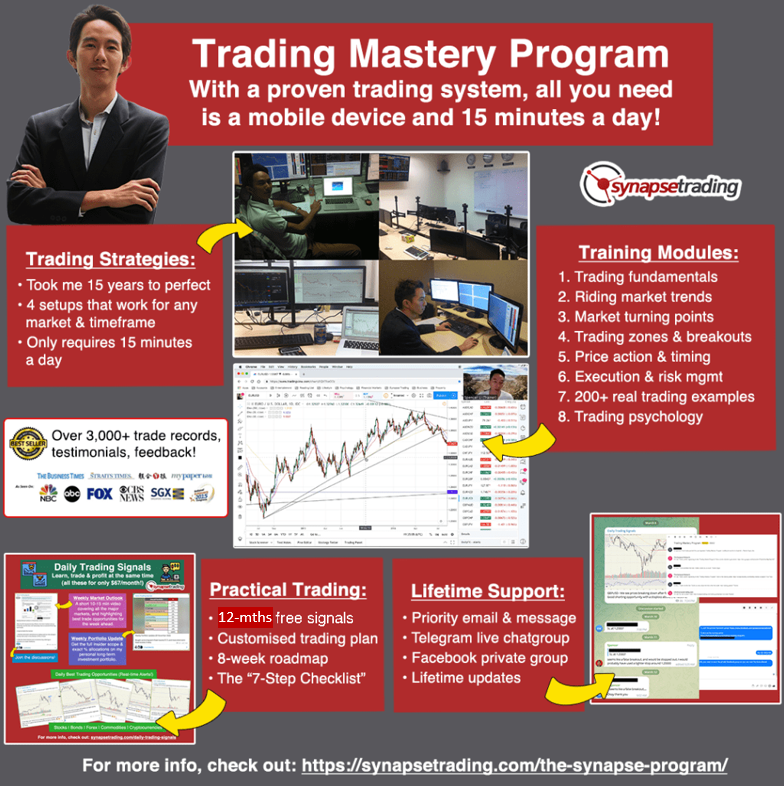 Our flagship mentoring program is suitable for both beginners and advanced traders, covering the 4 strategies which I used over the past 15 years to build up my 7-figure personal trading portfolio.
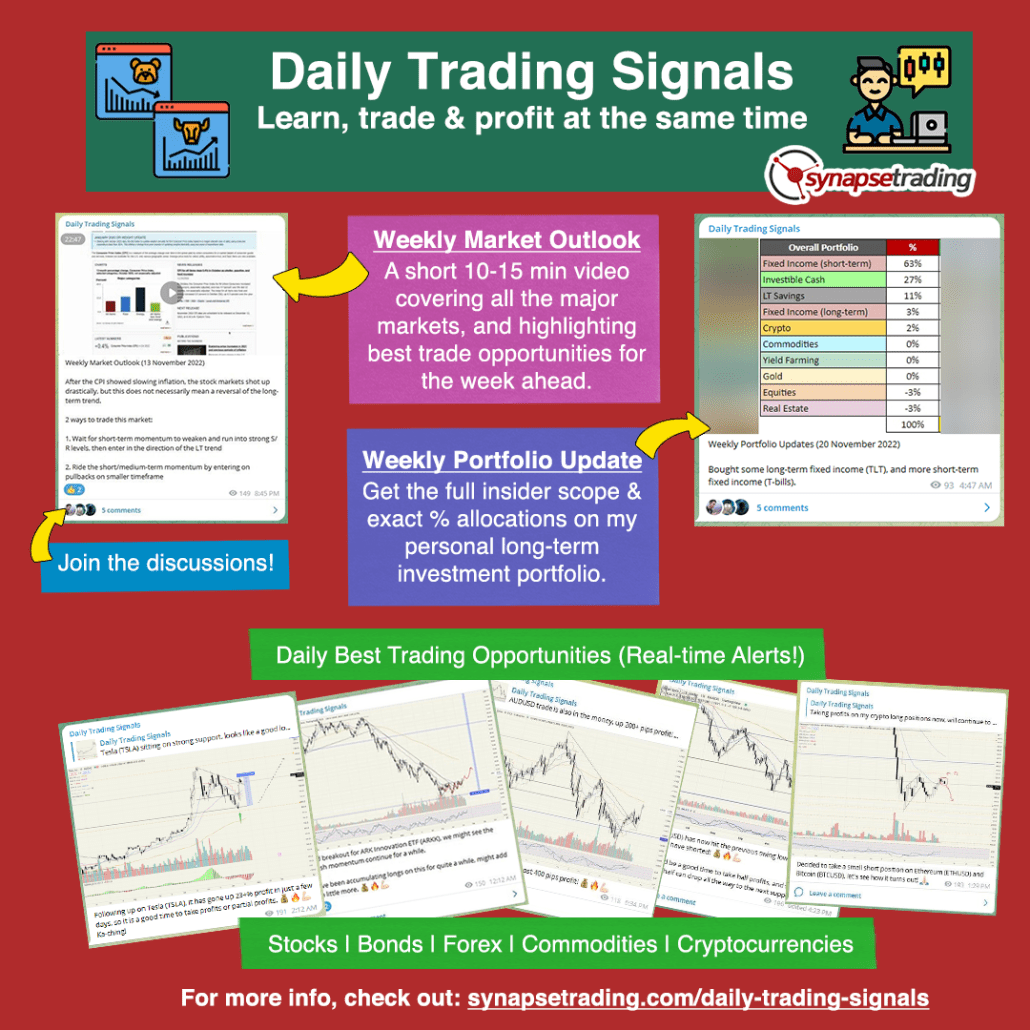 If you're looking for the best trading opportunities every day across various markets, and don't want to spend hours doing the research yourself, check out our private Telegram channel!




Leave a Reply
Want to join the discussion?Feel free to contribute!