

Swing Trading vs Intraday Trading: Which Is Better If You Have a Day Job?
Want the daily routine? Get the free 15-Minute Swing Trader’s Checklist. Get it free →
By Spencer Li, CFTe · Last updated: 26 October 2026
For most people who trade around a job, swing trading is the better choice. Intraday trading means opening and closing every position within the same day, so it needs you at the screen for the whole session. Swing trading means holding a position for days to weeks to catch a medium-term move, which you can run in about 15 minutes a day. Neither style is more profitable by default. But the best study I know of on people who tried to day trade for a living makes for grim reading, and I tried it myself for a couple of years before it started to cost me my health.
I first wrote about this in June 2018. Everything I have seen since has pushed me further the same way.
What is the difference between swing trading and intraday trading?
Ask most people what trading looks like and they describe a scene from a film. Someone sits in front of six screens, prices flashing, shouting orders and firing off trades at lightning speed. It is very much dramatised, but the person in that scene does exist, and he is a day trader.
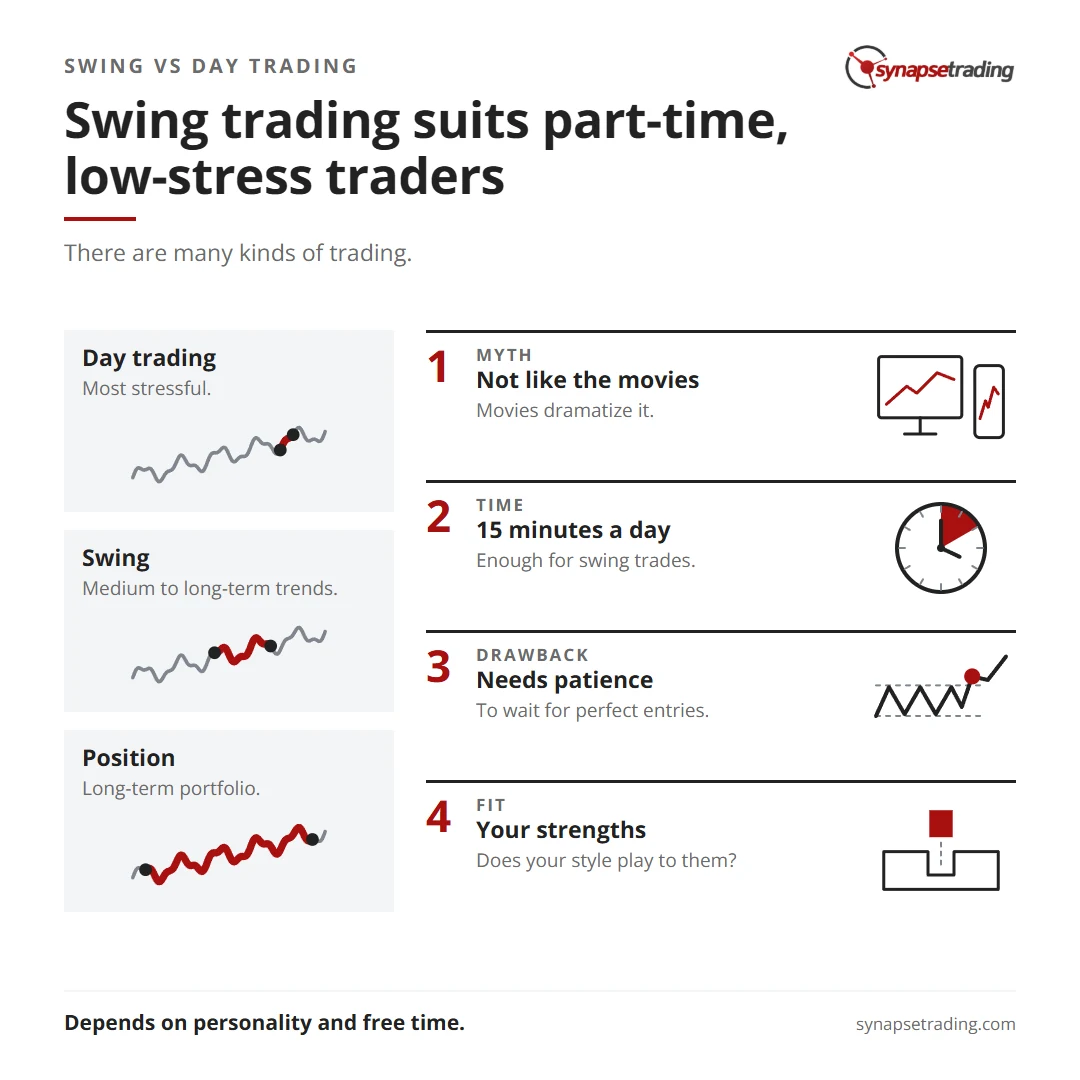
The real difference between the styles is how long you hold a position, and everything else follows from that. Scalpers hold for seconds to minutes. Day traders hold for minutes to hours and close everything before the market shuts, so they carry nothing overnight. Swing traders take tactical positions to capture the medium-term trend and hold them for days to weeks. Position traders hold for months or years, which is closer to timing the market to build a long-term portfolio, as I described in how to build a $1M portfolio by 30.
| Intraday trading | Swing trading | |
|---|---|---|
| Holding period | Seconds to hours, nothing overnight | Days to weeks |
| Screen time | The whole session | About 15 minutes a day |
| Decisions | Many, fast, under pressure | Few, made when the market is closed or quiet |
| Income pattern | Smoother, more frequent | Lumpier, from fewer and larger moves |
| Fits a full-time job? | Rarely | Yes |
| Main risk | Burnout, costs and fast mistakes | Overnight gaps, and impatience |
The table hands neither side a profit edge, because the holding period does not create one. What it changes is how much of your time and nerve each trade asks for.
Why did I stop day trading?
The honest reason had nothing to do with strategy. I tried day trading for a couple of years, and the money was actually pretty good. But it started to take a toll on my health, and I decided that was a trade I did not want to keep making.
The only time in my career I was glued to the screen was when I was trading for a fund, and that was very early on. Being switched on for the whole session, every session, suits some people, and it did not suit me. Once I moved to swing trading, 15 minutes a day turned out to be more than enough to place and manage my trades, which left the rest of the day for the things that matter more.
The slower style also changed what I was trying to do. In my weekly outlook on 4 December 2025, I told viewers I had been deliberately taking fewer positions, because “the purpose is not really to take a lot of trades in a short amount of time. That will be more like day trading.” The aim with swing trading is to find a few good-quality positions and hold them.
If you want that routine without the screen time, my free 15-minute swing trader checklist is the one I run each day.
What happens to most people who try to day trade for a living?
Three economists in Brazil had something most researchers never get, which is the full record of every trader in a market. They looked at every individual who started day trading Brazilian equity futures between 2013 and 2015 and kept at it for at least 300 days. In their working paper, published in February 2020 as “Day trading for a living?”, Fernando Chague, Rodrigo De-Losso and Bruno Giovannetti report that 97% of them lost money.
The rest of the abstract does not cheer things up. Only 0.4% earned more than a bank teller. Even the best individual in the whole group earned a small daily sum, and the day-to-day swings around it, measured as a standard deviation, were about eight times larger, which is a lot of risk for that pay. And they found no evidence that people got better by day trading for longer.
They also wrote that day trading for a living is virtually impossible, “contrary to what course providers claim”. As a course provider, I read that line with some discomfort, and then agreed with it.
Do note the limits. This is one market, one product and one period, and nobody has run the same full census on swing traders, so I cannot show you an equivalent number for the slower style. What the study does show is how the fast game treats the typical person who plays it with real money.
Why do fast decisions go wrong more often?
I played a lot of competitive chess in school, and anyone who has played blitz knows the feeling. You can see the right idea, but the clock does not let you check it, so you play the move that looks right and find out a few seconds later that it was not.
The psychologists Christopher Chabris and Eliot Hearst measured this with the best players in the world. They took games from the Monaco tournaments, where top grandmasters played rapid games at under 30 seconds a move and classical games at about 3 minutes a move, and had a strong chess program flag every blunder. In their 2003 paper in Cognitive Science, the same grandmasters made 6.85 blunders per 1,000 moves in rapid games and 5.02 in classical games.
So less time meant about 36% more blunders. The psychologist Fernand Gobet, replying to the paper, made a fair point that the gap is small next to the total number of moves, and grandmasters do not turn into beginners when the clock speeds up. I agree with him. The blunder rate creeps up rather than explodes.
Now carry that over to trading, where the count matters. Suppose a day trader makes 20 decisions a day and a swing trader makes 20 a month. Even if each fast decision were only slightly worse, the day trader takes about 20 times as many chances to make one, and every mistake is paid for in money and in fees, with no draw on offer. Time pressure does not make you a bad trader. It just hands you more chances to be one.
Isn’t swing trading stressful too?
On 28 August 2025, a trader on Reddit’s r/swingtrading posted that they were quitting swing trading altogether. Their complaint was a fair one: “Even swing trading, you have to constantly monitor your stocks and stressing out daily.”
Reading their post, two things stood out. They described spending 4+ hours on research, and the final straw was two stocks that beat earnings and then fell. Both are choices about the routine, more than about the style. A swing routine that takes four hours a day has turned into day trading with longer holds. And earnings are where a swing trader is most exposed, because a stock can gap overnight on the result and skip straight past your stop. The only news rule in my own daily checklist is to not hold through earnings, for exactly that reason.
But I will concede the point that swing trading is not calm in every market. In my weekly outlook on 24 March 2026, with the market nervous, I said it gets “a bit harder to hold on to positions” at times like that. You might shorten the holding period, maybe do a bit of day trading, or wait for the trend to be clear. Some weeks, the slow style is uncomfortable too, and the honest answer is that waiting is part of the job.
That waiting is the real cost of swing trading. Your income is lumpier than a day trader’s, because it comes from fewer and larger moves. You need a ton of patience, first to wait for a clean setup, then to sit on your hands while the trade plays out. If watching a position do nothing for a week drives you up the wall, that is worth knowing about yourself early. A free 15-minute swing trader checklist helps here, because it gives the waiting a shape.
So which one should you choose?
The best style depends on your personality and how much free time you really have, and there is no universal winner. Two plain questions settle most of it.
- How much time can you give the market every day, on a normal week rather than your best one?
- Do fast decisions sharpen you or fray you? Be honest here, because most of us picture the calm version of ourselves, and the one who actually turns up is the one who slept badly.
If you can sit through the whole session and fast decisions energise you, intraday trading can suit you, and you go in knowing what the Brazil numbers say about the typical outcome. If you trade around a job, a business or a family, swing trading fits the life you already have, which is the reason I use it. Personally, I prefer the swing trading approach because it gives me the best return on my time and effort, and I have yet to meet anyone who regrets getting their afternoons back.
If you are still sorting out which kind of trade you even want to take, the 4 types of trading strategies is a good next read. And if the fast end still tempts you, read what 0DTE options are before you try them.
FAQ
Is swing trading or day trading more profitable?
Neither is more profitable by default. A day trader takes more, smaller trades and a swing trader takes fewer, larger ones. A full census of Brazilian day traders who kept going for at least 300 days found that 97% lost money, published in a working paper in February 2020.
Is swing trading better for beginners?
For most beginners, yes. It needs about 15 minutes a day, fits around a job, and the slower pace gives you time to think through each decision rather than react under a clock.
Can I swing trade with a full-time job?
Yes. Swing trades are held for days to weeks and can be managed outside office hours, so you never need to watch the market while you work.
What are the drawbacks of swing trading?
Your income is lumpier, because it comes from fewer and larger moves. You hold positions overnight, so a gap on news or earnings can skip past your stop. And it asks for a lot of patience.
What is the difference between scalping and day trading?
Both close every position within the same day. Scalpers hold for seconds to minutes and take many tiny profits, while day traders hold for minutes to hours.
Which style do you trade now, and if you have tried both, which one did your health and your evenings prefer? Let me know in the comments.
If you are new to all of this, my free trading guides walk you through the basics in order.
And if you want a routine that fits around a full-time job, grab the free 15-minute swing trader checklist.
About the author. Spencer Li is The 15-Minute Trader and the founder of Synapse Trading. He is a Certified Financial Technician (CFTe) with 15+ years of trading, run from 70+ countries. He holds a B.Acc and B.BM from SMU. Every trade he takes is public, dated, losses left in. He teaches rules-based swing trading in 15 minutes a day, one system for any market.
Education, not financial advice. Synapse Trading is not licensed by MAS to advise on investment products. Trading carries risk of loss, and past performance is not indicative of future results.
Want the daily routine? Enter your email for the free 15-Minute Swing Trader's Checklist.
Free 5-page PDF, then occasional trading emails. Education only, not financial advice. Unsubscribe anytime. Kit stores your email in the US: see our privacy policy.
Want to learn the full method? The Trading Mastery Program teaches the 4 strategies I have traded since 2011. It suits beginners and experienced traders.
Rather follow the trades as they happen? Daily Trading Signals is our Telegram channel: my trade ideas with entry, stop and exit, and every trade is public.
Questions about this post? Ask in the free Telegram channel →
Educational content only, not personalised financial advice. Trading carries risk, including loss of capital. Past performance is not indicative of future results. Synapse Trading is not licensed or regulated by MAS.

