

How to Build Confidence in Trading

Join our Telegram channel for more market analysis & trading tips: t.me/synapsetrading
Table of Contents
How to Build Confidence in Trading (Without Faking It)
Last updated: 3 July 2026 · By Spencer Li, CFTe
You build confidence in trading the same way you build it anywhere else: by stacking small wins until the evidence outweighs the fear. It does not come from a motivational speech, a bigger account, or convincing yourself you are good. It comes from a track record. You take small, low-risk trades, you follow your system exactly, and you let the results pile up. Real confidence in trading has two separate parts: confidence in your ability (you can read the chart and pull the trigger) and confidence in your system (the rules make money over many trades). You need both, and they are built differently. Ability is built by repetition. System confidence is built by sample size. The fastest way to get unstuck after a loss is not analysis, it is one good trade taken cleanly by the rules, win or lose.
Here is how that works, bullet by bullet, and how to break the two habits that quietly kill most traders’ confidence.
Why does success breed confidence (and how do you start)?
Confidence follows results, not the other way round. You cannot think your way into feeling confident before you have done the thing. So the order matters: take the small win first, and the feeling shows up after.
This is why “baby steps to giant strides” is not a cliche here, it is the actual mechanism. If you size up before you have a track record, one normal losing streak wipes out a fragile confidence you had not earned yet. Start small enough that a loss does not hurt and a win does not go to your head. Then let the wins compound, and let your size grow only as the evidence grows.
Personally, I would rather a trader take fifty tiny trades and build a real base than take five big ones and build a story.
The two kinds of confidence: ability vs system
Most traders lump confidence into one feeling. It is actually two, and mixing them up is where the trouble starts.
| Confidence in your ability | Confidence in your system | |
|---|---|---|
| What it means | You can read the chart, spot the setup, and pull the trigger | The rules produce a positive result over many trades |
| Built by | Repetition, screen time, reps on the same setups | Sample size, a track record of following the rules |
| What breaks it | A run of hesitation or sloppy execution | A losing streak that feels like the system is broken |
| The fix | Take more small reps until the action is automatic | Zoom out to the full sample, not the last three trades |
The reason this split matters: when you lose a trade, you need to know which confidence took the hit. If your execution was clean and the rules just did not work this time, that is normal variance, your system confidence is fine, do nothing. If you froze, second-guessed, or broke your own rule, that is an ability problem, and the answer is more reps, not a new system.
Do note that, a string of losses taken correctly is not evidence your system is broken. Losing trades are a cost of doing business, not a verdict on you.
“Hesitation to pull the trigger” and one more bar syndrome
Here is the most common confidence leak I see. The setup is there, the rules say enter, and you wait. You tell yourself you want “just one more bar” of confirmation. The bar prints, the trade is gone, and you watch it run without you.
That is one more bar syndrome, and it is almost never about the chart. It is about fear of being wrong. The cruel part is that waiting for more confirmation does not make you more right, it just makes your entry worse and your stop wider, which makes the trade scarier, which makes you hesitate more next time. The hesitation feeds itself.
The cure is mechanical, not emotional. Define the exact trigger in advance (this candle closes here, I enter). When it triggers, you enter, no debate. You are not trying to feel ready. You are executing a pre-made decision. Confidence in the moment is unreliable. A written rule is not.
“Burnt finger anxiety”: trading scared after a loss
The other big leak is the opposite problem. You took a loss, it stung, and now you are gun-shy. You skip the next valid setup because the last one burned you, and of course the one you skip is the one that would have paid for the loss. That is burnt finger anxiety.
This one is dangerous because you will call it discipline and stop checking it. Sitting out feels prudent. But you are not sitting out the bad trades, you are sitting out the next trade purely because of the last one, and those two trades have nothing to do with each other. The market does not remember your last loss, and your edge only shows up if you take the whole sample.
The fix is the same idea from the other direction: trust the rules over the feeling. If the setup is valid by your system, the recent loss is irrelevant to whether you take it.
The mental reset: one good trade
So how do you get unstuck, whether you are frozen by hesitation or shaken by a loss? Not with more screen time, more journaling, or a weekend of soul-searching. The fastest reset is one good trade.
By a good trade, I do not mean a winner. I mean a trade you took cleanly, exactly by your rules, sized correctly, exit and all. The outcome does not matter for the reset. What matters is that you proved to yourself you can still execute. One clean trade breaks the spell. It replaces the story in your head (“I keep messing up”) with a fresh piece of evidence (“I just did it right”). That single rep is worth more than hours of analysis, because confidence is built from doing, and you just did.
Hence, when you feel the confidence draining, do not size up to win it back and do not step away to “clear your head.” Take the smallest valid trade you can find and execute it perfectly. Let that be the first brick in the next stack.
Where the human edge comes in
A backtest can hand you a profitable system on a plate. It cannot make you pull the trigger when the setup is live, sit out the trade that the last loss made scary, or stop you from sizing up to chase your money back. The rules are the easy part to write down. Following them under fear is the hard part, and that is discipline, the part of trading no tool can do for you. Confidence is just the byproduct of doing it correctly enough times.
FAQ
How long does it take to become a confident trader?
There is no fixed timeline, because confidence tracks your track record, not the calendar. It is built by stacking small wins taken correctly, so the more reps you take (and the smaller you keep them early), the faster the evidence accumulates. Trading scared or oversizing both slow it down.
Why do I hesitate to enter trades even when the setup is good?
Usually the real reason is fear of being wrong. The stated reason is wanting “one more bar” of confirmation. Waiting does not make you more right, it just worsens your entry. The fix is to define the exact entry trigger in advance and execute it mechanically, with no in-the-moment debate.
How do I get my confidence back after a big loss?
Take one good trade, meaning one you execute cleanly and correctly by your rules, regardless of whether it wins. The clean rep proves you can still follow your process and breaks the “I keep messing up” story. Avoid sizing up to win the money back, which is how a loss becomes a losing streak.
Is confidence in my ability the same as confidence in my system?
No, and treating them as one thing causes problems. Ability confidence (you can execute) is built by repetition. System confidence (the rules make money over many trades) is built by sample size. When a trade loses, figure out which one took the hit before you react.
Should I trade bigger to feel more confident?
No. Real confidence comes before the size increase, not from it. Size up only as your track record grows, so a normal losing streak cannot wipe out confidence you have not earned yet.
Confidence is not a feeling you summon before you trade. It is the residue of trades taken correctly. Start small, follow the rules, and let the evidence do the convincing.
For the full picture on the mental side of the game, read the pillar: The Complete Guide to Trading Psychology.
Want the routine that makes confidence easier to build? Grab the free 15-Minute Swing Trading Starter Kit. It is the exact once-a-day process I use to scan, decide, and execute any market in 15 minutes, with the rules written down so you are not relying on how you feel in the moment.
About the author. Spencer Li is the founder of Synapse Trading and a Certified Financial Technician (CFTe) with 15+ years of trading across stocks, forex, crypto, commodities, and bonds. His trade log is public: every trade since April 2024, dated, losses left in. He has taught a 15-minute daily trading routine since 2014, one system for any market.
Education, not financial advice. Synapse Trading is not licensed by MAS to advise on investment products. Trading carries risk of loss; past performance is not indicative of future results.
Related
The Complete Guide to Trading Psychology (pillar) · Patience and discipline in trading · How to manage losing trades · New insights on trading psychology
Want the daily routine? Enter your email for the free 15-Minute Swing Trader's Checklist.
Free, 5 pages, PDF. You get the checklist, then my occasional trading emails. Education only, not financial advice. Unsubscribe anytime.
Where your details go: Kit, our email provider, stores your email address in the United States. Our contract with Kit lets it use your address only to send our emails, and requires Kit to keep it secure. The United States has no national privacy law like Singapore's, so that contract is the main protection. More in our privacy policy.
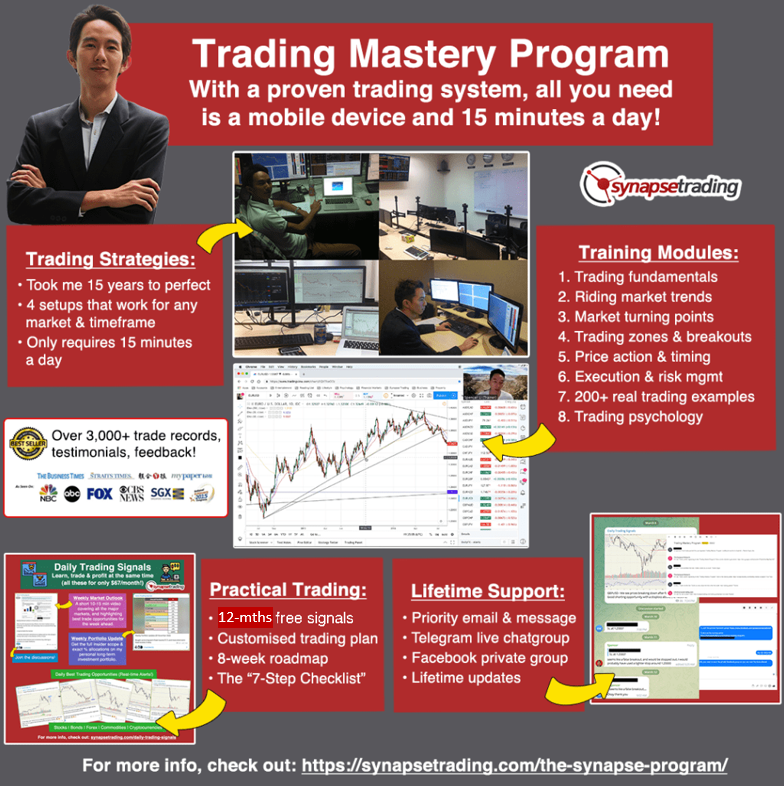 Our flagship mentoring program is suitable for both beginners and advanced traders, covering the 4 strategies which I used over the past 15 years to build up my 7-figure personal trading portfolio.
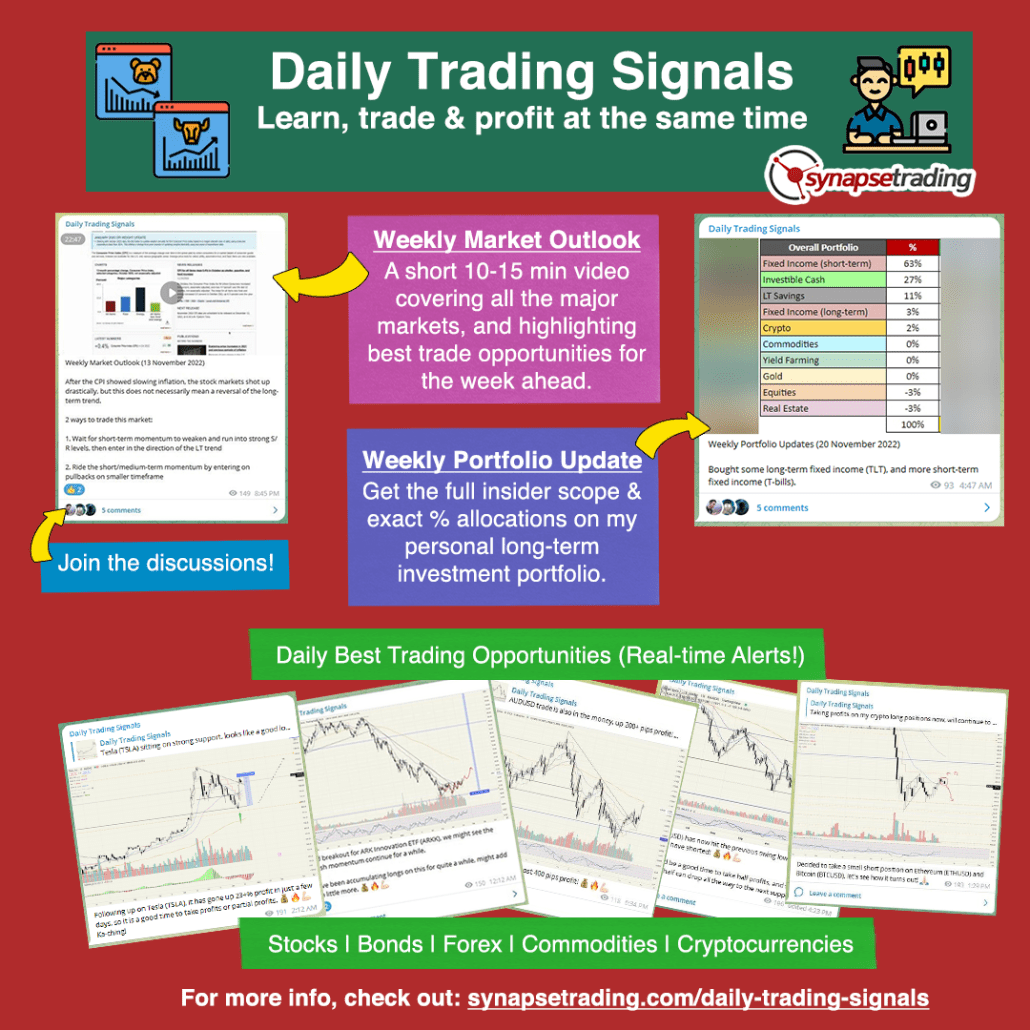 If you're looking for the best trading opportunities every day across various markets, and don't want to spend hours doing the research yourself, check out our private Telegram channel!


Leave a Reply
Want to join the discussion?Feel free to contribute!