

What is Your Circle of Control in Trading?
Join our Telegram channel for more market analysis & trading tips: t.me/synapsetrading
Table of Contents
The Circle of Control in Trading: Focus on Your Actions, Not the Outcome
Last updated: 2026-06-14 · By Spencer Li, CFTe
The circle of control in trading means spending your energy only on the things you can actually control, your process and your behaviour, and letting go of the one thing you cannot, the outcome of any single trade. You do not control whether a position wins or loses. You do not control where the market goes tomorrow. What you control is your entry rules, your position size, your stop, and how you react when the screen turns red. So that is where your attention belongs. Judge yourself on whether you followed your plan, not on whether the trade made money, because a good decision can lose and a bad decision can win. Do that consistently, and the P&L (profit and loss) takes care of itself over a large enough sample. Chase the P&L directly, and you start breaking your own rules to force it.
Here is what falls inside the circle, what falls outside, and how to keep your focus on the right side of the line.
What is the circle of control?
Picture two circles. The inner one holds everything you control. The outer one holds everything you do not. Most traders spend their day staring at the outer circle, the price, the P&L, the news, and almost no time on the inner one, where all their actual power sits.
The idea is old. The Stoics called it the dichotomy of control. In trading it lands hard, because the market gives you constant, vivid feedback on the one thing you cannot steer, and almost none on the things you can.
| Inside your control (your job) | Outside your control (let it go) |
|---|---|
| Your entry and exit rules | Whether any single trade wins or loses |
| Your position size and risk per trade | Where the market goes next |
| Where you place your stop | Today’s news, gaps, and surprises |
| Whether you follow your plan | Your short-term P&L swings |
| How you react to a loss | What other traders are doing |
Read the table left to right. Everything on the left is a decision you make before and during the trade. Everything on the right happens to you. The whole skill is keeping your attention, and your self-judgement, on the left column.
Why you should let go of the outcome
A single trade tells you almost nothing. You can follow your plan perfectly and still lose, because the market handed that trade to the other side. You can break every rule, get lucky, and win. If you judge yourself by the result, you will learn the wrong lesson both times. You punish the good trade that lost and reward the reckless one that won.
So separate the decision from the outcome. Ask one question after every trade: did I follow my process? If yes, it was a good trade, win or lose. If no, it was a bad trade, even if it made money. Grade the decision, not the dice roll.
This is why I tell traders to stop watching the dollar figure tick up and down. The P&L fluctuation on an open position is the loudest, least useful number on your screen. It pulls you toward cutting winners early out of fear and holding losers too long out of hope, the exact opposite of what your plan told you to do. Watch your rules instead. Let the number be the byproduct.
The sports analogy: do not watch the scoreboard
Here is the homely version. A tennis player who stares at the scoreboard between every point plays worse, not better. The score is the outcome. It is already decided by the points that are done. The only thing the player controls is the next shot, the footwork, the toss, the follow-through. Watch the scoreboard and you tighten up. Watch the ball and you play.
Trading is the same. The P&L is your scoreboard. It is the result of trades that are already on or already closed. Glancing at it every few minutes does not change a single thing on the right side of that table above. It only feeds the anxiety that makes you abandon your plan. Keep your eyes on the next decision, on the ball, and the score moves on its own.
Why individual trades do not matter
Zoom out. Your edge does not live in any one trade. It lives in a large sample of trades, taken the same disciplined way, where a positive expectancy plays out over dozens or hundreds of repetitions. (Expectancy is your average profit per trade across many trades, factoring in both your win rate and your reward-to-risk.)
In a casino, the house does not care about any single spin of the wheel. It can lose the next spin badly. It cares about the edge holding across ten thousand spins. You want to think the same way. (I wrote a whole piece on this, Is trading really risky like gambling?, on how to flip from being the gambler to being the house.)
Once you genuinely believe the next trade does not matter, two things change. You stop oversizing, because no single bet is worth blowing up the account. And you stop revenge trading, because a loss is just one data point in a long series, not a verdict on you.
How to keep your focus inside the circle
A few habits that move your attention to the left column:
- Pre-decide everything you can. Set your entry, stop, size, and target before you click buy. Once the trade is on, your job is only to execute the plan, not to renegotiate it while the P&L swings.
- Grade the process, not the result. Keep a journal that asks “did I follow my rules?” before it asks “did I make money?” Over time you want a clean record of good decisions, regardless of how each one paid out.
- Hide the open P&L if it is hijacking you. If the live dollar figure makes you exit early or freeze, take it off the screen. Trade the chart and your rules, check the number at the end of the day.
- Size so no single trade can hurt you. When the worst case on any trade is small and survivable, it is far easier to let go of the outcome. Risk control is what makes detachment possible.
Where the human edge comes in
A scanner or an AI can find the setup and even place the order. What it cannot do for you is sit calmly through an open loss without breaking the plan, or refuse to revenge trade after a bad day. The circle of control is, in the end, a psychology problem, the discipline to act on your process while the outcome is still uncertain. That self-management is one of the Five Edges no tool can trade for you, and it is the one that separates the traders who survive from the ones who do not.
FAQ
What does the circle of control mean in trading?
It means focusing only on what you can control, your entry rules, position size, stop placement, and your own behaviour, and letting go of what you cannot control, the outcome of any single trade and where the market goes next.
Should I stop looking at my P&L while trading?
Watch your rules, not the live P&L. The open profit-and-loss figure on a position is the loudest and least useful number on your screen, and staring at it tends to push you into cutting winners early and holding losers too long.
How do I judge a trade if I ignore the outcome?
Ask whether you followed your process. A trade that follows your plan is a good trade even if it loses, and a trade that breaks your plan is a bad trade even if it wins. Grade the decision, not the result.
Why do individual trades not matter?
Your edge plays out over a large sample, not any single trade. Like a casino, you want your positive expectancy to hold across hundreds of repetitions, so no one result, good or bad, should change how you behave.
Is the circle of control the same as the Stoic dichotomy of control?
Yes, it is the same idea applied to markets. The Stoics taught focusing on what is within your power and accepting what is not, which maps directly onto controlling your process while letting go of outcomes.
So here is the honest question to sit with: when you look at your screen, are your eyes on the ball or on the scoreboard? Be specific with yourself about it, that answer tells you a lot.
If you want to go deeper on the mindset side, read the pillar: The Complete Guide to Investing and Trading Psychology.
Want the system that makes detachment easy? Grab the free 15-Minute Swing Trading Starter Kit. It is the exact routine I use to scan once a day and trade any market in 15 minutes, with the rules pre-decided so you are not fighting the P&L in the moment.
About the author. Spencer Li is The 15-Minute Trader and the founder of Synapse Trading. He is a Certified Financial Technician (CFTe) with 15+ years of trading, run from 70+ countries. Every trade he takes is public, dated, losses left in. He teaches low-risk swing trading in 15 minutes a day, one system for any market.
Education, not financial advice. Synapse Trading is not licensed by MAS to advise on investment products. Trading carries risk of loss; past performance is not indicative of future results.
Related
The Complete Guide to Investing and Trading Psychology (pillar) · Is trading really risky like gambling? (Trade like a casino) · Trading discipline and process
Want the daily routine? Enter your email for the free 15-Minute Swing Trader's Checklist.
Free, 5 pages, PDF. You get the checklist, then my occasional trading emails. Education only, not financial advice. Unsubscribe anytime.
Where your details go: Kit, our email provider, stores your email address in the United States. Our contract with Kit lets it use your address only to send our emails, and requires Kit to keep it secure. The United States has no national privacy law like Singapore's, so that contract is the main protection. More in our privacy policy.
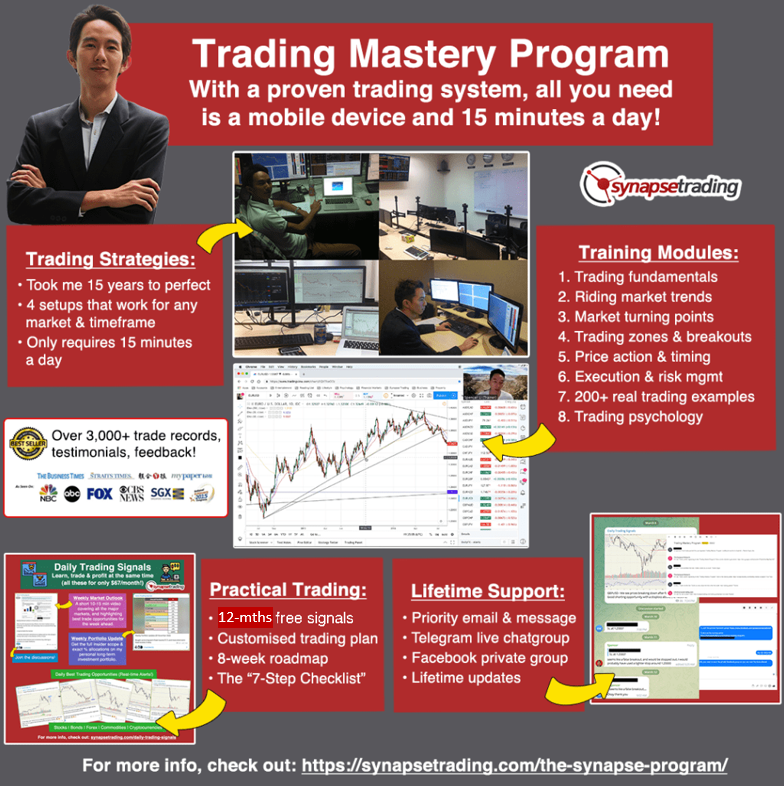 Our flagship mentoring program is suitable for both beginners and advanced traders, covering the 4 strategies which I used over the past 15 years to build up my 7-figure personal trading portfolio.
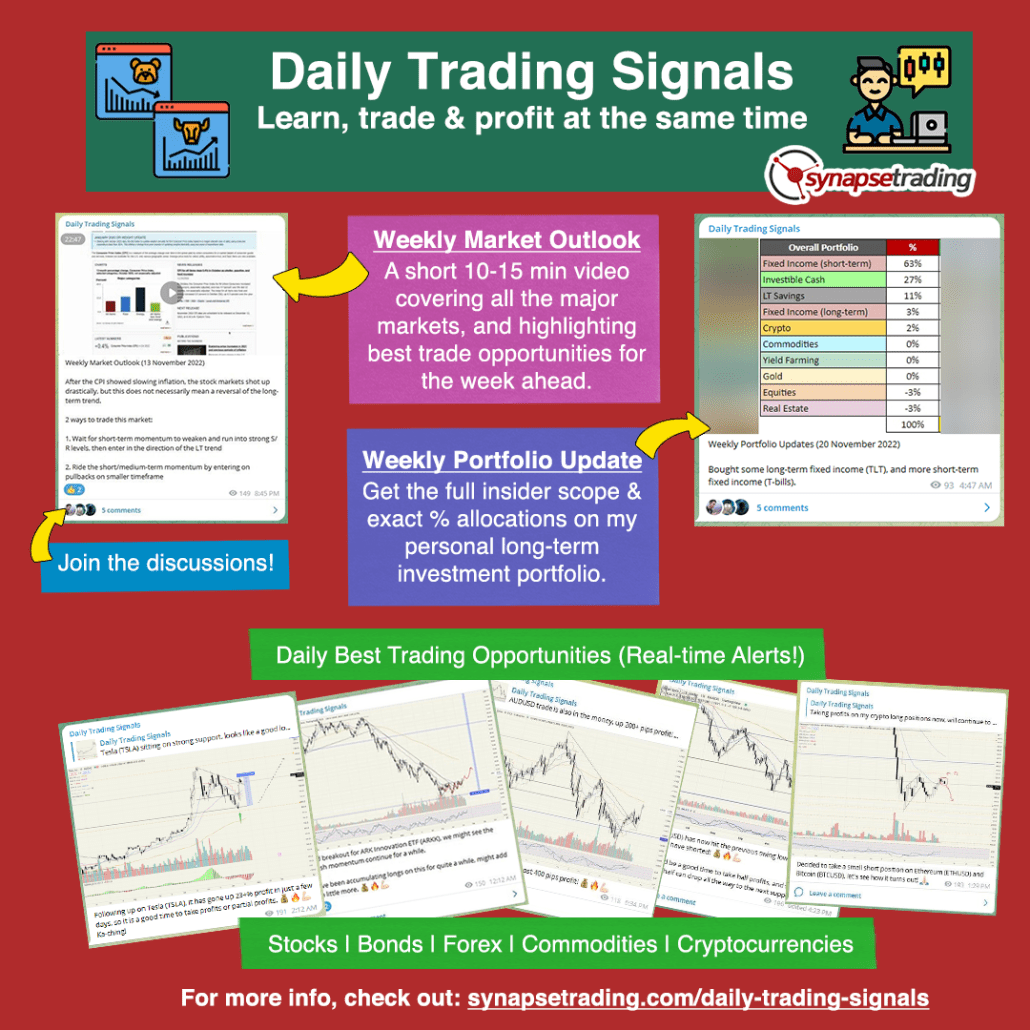 If you're looking for the best trading opportunities every day across various markets, and don't want to spend hours doing the research yourself, check out our private Telegram channel!


Leave a Reply
Want to join the discussion?Feel free to contribute!