

How to Trade While Travelling: A 15-Minute Routine That Lets You Enjoy the Trip
Want the daily routine? Get the free 15-Minute Swing Trader’s Checklist. Get it free →
By Spencer Li, CFTe · Last updated: 26 October 2026
To trade while travelling, you shrink your trading down to what fits on a phone in an airport lounge. That means swing trading off the daily chart, deciding every entry and exit before you leave, putting a stop-loss order on every position and letting price alerts do the watching. You check in for about 15 minutes a day, act only when an alert fires, and spend the rest of the day on the trip you actually paid for.
I have traded for more than 15 years from 70+ countries, and the hard part was never the Wi-Fi. It was the urge to keep looking.
What does a trading routine for the road look like?
Most people pack for a holiday and then try to run their normal trading week from a hotel desk. It rarely goes well. The screen is smaller, the connection is worse and their brain is rightly half on the beach. A method that needs you watching the market breaks on the road, and you end up missing the trades you wanted or forcing the ones you did not, out of a vague guilt that you should be “doing something”.
So the fix is to change the method before you go.
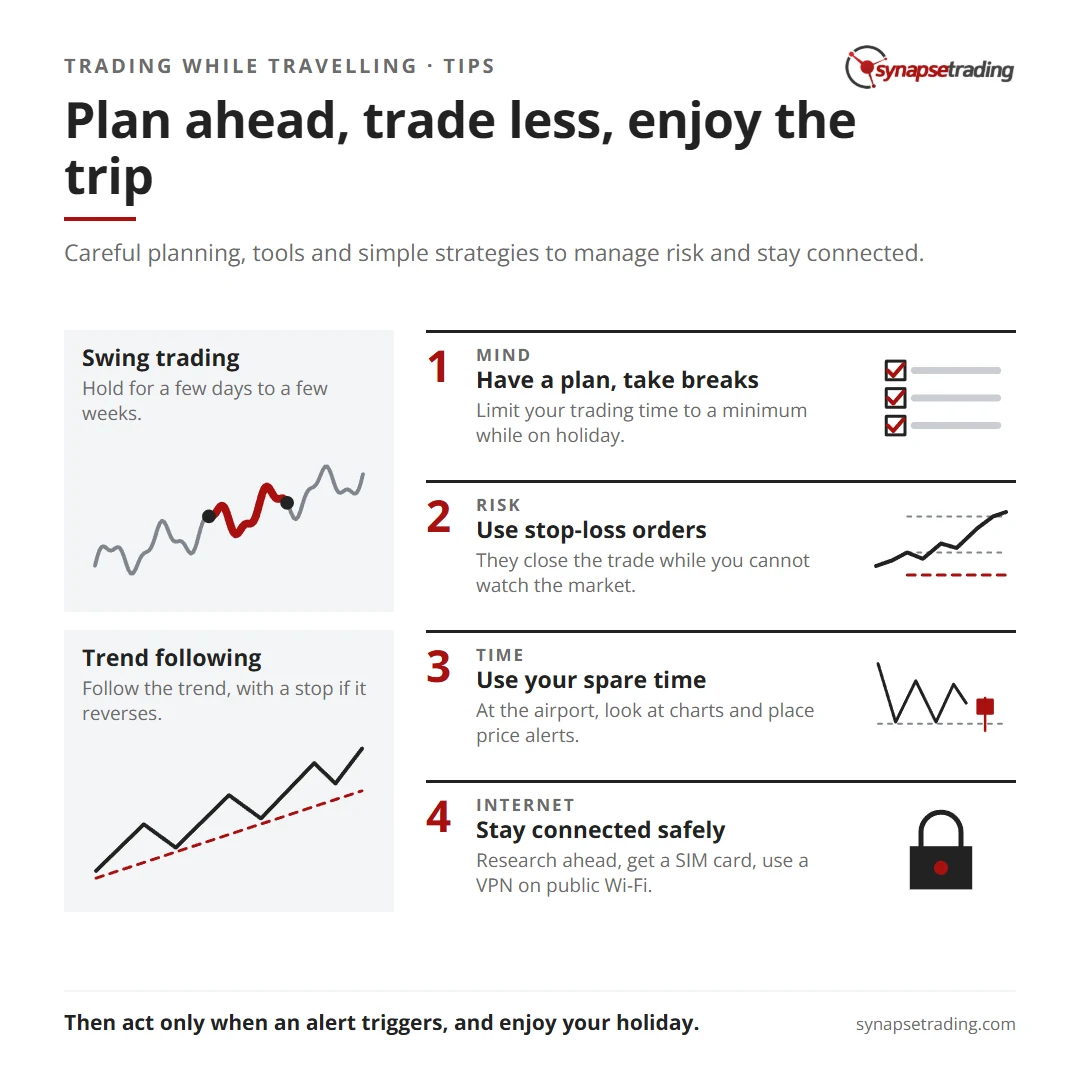
The routine has three parts. Before the trip, you do all the thinking at home, with a proper screen and a clear head. During the trip, the orders and alerts carry the load, and you open the app only when one of them asks you to. And every day there is one short check-in at a fixed time, such as with your morning coffee before the day’s plans start.
Hence the whole job on holiday is to answer an alert, which takes minutes, and then put the phone away.
Why does a phone on the dinner table cost you more than you think?
In 2017, four researchers published a study with a slightly alarming title, “Brain Drain”, in which people did tests that need focus while their own smartphone sat nearby, sometimes face down and silent. Even when they resisted the urge to check it, the mere presence of the phone reduced the mental capacity they had left for the task, and the cost was highest for the people who depended on their phones the most.
Now imagine that phone also holds your open trades.
A position you have not fully decided about keeps a corner of your mind busy all day. You are at a temple, or on a boat, or at a dinner your partner booked weeks ago, and part of you is still wondering what the market is doing. That is the real price of trading on holiday, and it never shows up on your account statement.
So the goal is to make your trades boring enough that your mind lets go of them. Every decision made in advance is one less thing for that corner of your brain to hold.
How do you get your head right before you leave?
My own trading plan has a line I lean on whenever I travel. It says to lock the size and the stop while charting, and never to change them mid-trade. It matters twice as much on the road, because the moments when you are tired, jet-lagged or sleepy after a long dinner are exactly when a stop starts to feel negotiable.
Three habits keep your head clear.
- Decide the trade before it exists. Know your entry, your exit and how much you are willing to lose before you place anything. A decided trade needs no babysitting. An undecided one will eat your whole afternoon.
- Cap your screen time, and mean it. On holiday that means one fixed check-in, rather than “just checking” every hour. The market will still be there tomorrow.
- Stay where you are. Mindfulness sounds grand, but it is really the habit of being in the moment instead of replaying the last trade. It also stops you refreshing a chart while your family waits for you to order.
The same plan says to close or reduce positions before major news. So before a trip, I check the economic calendar and go in lighter when a big release falls in the middle of it.
If you want a routine that runs in a few minutes a day, wherever you are, my free 15-minute swing trader checklist is the one I use myself.
What do you need to trade while travelling?
Surprisingly little. Here is the working kit, and what each piece is for.
| Tool | What it does | Why it matters on the road |
|---|---|---|
| Mobile trading app | Lets you read charts and place orders from a phone | Your whole desk fits in your pocket |
| Price alerts | Notify you when price reaches a level you set | Set them, then walk away |
| Stop-loss order | Closes a trade at a preset loss without you watching | Caps the damage while you are offline or asleep |
| A news app | Shows what is moving the market | Context, rather than a reason to trade more |
| VPN | Encrypts your connection | Essential on café or airport Wi-Fi |
| A trade journal | Records every trade for review later | Keeps you honest when your routine is disrupted |
Notice what is missing: a second monitor, a scalping setup, a dozen indicators. Less really is more.
Use your dead time as desk time. Waiting at the gate or sitting on a long bus ride is when you scan charts and set alerts, so the holiday time stays free. Keep the plan simple, because a plain plan you follow beats a clever one you abandon at 11pm in a strange city. And keep a trading journal, since a disrupted routine is exactly when sloppy record-keeping creeps in.
Which trading styles survive a holiday?
Of the four types of trading strategies, two travel well. Swing trading and trend-following both work off higher timeframes, so neither needs you glued to a screen.
Swing trading means holding a position for a few days to a few weeks, to catch a medium-term move. It sits between long-term investing and day trading, which makes it the natural fit for a trip. You look for markets that are already moving, wait for a sensible place to join, and let the stop and the alerts handle the rest.
Trend-following is simpler still. You buy what is rising and sell what is falling, on the idea that prices tend to keep going in one direction for a while. Trend followers lean on tools like moving averages to see the trend, and use a stop to step aside when it turns. It is the more passive of the two, which is exactly why it suits someone who is meant to be on a beach.
Day trading is the one to leave at home. It asks for hours of attention, a fast connection and a calm mind, and a holiday offers none of the three.
Is every month a good month to be away?
Markets take holidays too. In my weekly outlook on 4 December 2025, I said that “usually December is quite a quiet month” for the market, because so many people go on holiday towards the year end. Thinner volume tends to mean fewer big moves, which suits a light, alert-driven routine.
Time zones are the other thing to plan for. Cross a few and the US open might land at breakfast or at midnight. Plan your check-in around the clock where you are, and let the alerts cover the hours you are asleep.
How do you find internet you can trust abroad?
A swing routine needs a connection only a few times a day, but it has to work when it counts.
- Check before you go. Read reviews of the connectivity where you are headed, or ask people who live there.
- Buy a local SIM card. Many countries sell prepaid SIMs with data, usually cheap and quick to set up.
- Carry a personal hotspot. It creates your own wireless network from a SIM, so you are not sharing one with strangers.
- Use public Wi-Fi carefully. Cafés and airports often have it free, and it is fine with a VPN running.
- Run a VPN. It encrypts your connection and can also reach sites that are blocked where you are.
Personally, I would trust a local SIM plus a hotspot well before a hotel’s Wi-Fi for anything that involves placing an order.
The free 15-minute swing trader checklist is built around that kind of short daily check-in.
Doesn’t stepping away mean missing good trades?
In January 2024, a trader on Reddit’s r/Daytrading put the worry plainly: “There is clearly an opportunity cost to any day spent not watching the markets.”
For a day trader, that is fair. For a swing trader, I would push back. A setup on the daily chart takes days to form, so a missed one is followed by another. The bigger cost usually runs the other way, because the trades people force from a departure lounge are the ones they later wish they had skipped.
I will concede one thing, though, and it is a real one. A stop-loss caps the damage, but it does not promise you a price. On Monday 5 August 2024, Japan’s Nikkei 225 closed at 31,458, down 12.4% from the Friday before, as the yen carry trade unwound. The next day it closed at 34,675, up 10.2%.
Suppose you were asleep on a long-haul flight that day. A stop in a fall that fast fills at the next price available, so you could be stopped out near the low and then watch the rebound from the arrivals hall.
So a stop protects your account from ruin, rather than from every bad fill. That is why going lighter before a trip belongs in the plan alongside the stops. I wrote more about that week in the yen carry trade unwinding.
FAQ
Can you really trade while travelling?
Yes, if you trade on a longer timeframe. Swing trading and trend-following off the daily chart let you do your analysis in a few minutes, set alerts and stops, and enjoy the trip until an alert fires.
What is the best trading style for travelling?
Swing trading and simple trend-following need the least screen time. Both work off higher timeframes and use stop-loss orders while you are away.
How do I manage risk if I cannot watch the market?
Put a stop-loss order on every position and decide its level before the trip. Trade smaller than usual and reduce before major news. Do note that a stop can fill at a worse price in a very fast market.
Do I need a VPN to trade abroad?
If you ever log in over public Wi-Fi, yes. It keeps your login details off a shared network.
How do time zones affect trading while travelling?
They move your market’s hours against your day. Plan the check-in around the local clock and let alerts cover the night.
Should I skip trading on holiday altogether?
That is a fair choice too. If your positions keep pulling your attention from the trip, closing or cutting them before you leave is a perfectly good plan.
Have you ever traded from an airport lounge or a hotel bed, and did it go the way you planned? Which of these habits would you try first, and do you have a travel tip of your own? Let me know in the comments.
If you are building the method itself, my free trading guides cover it step by step, and my guide to money and risk management goes deeper on stops and sizing.
And if you want a routine that fits in your carry-on, grab the free 15-minute swing trader checklist.
About the author. Spencer Li is The 15-Minute Trader and the founder of Synapse Trading. He is a Certified Financial Technician (CFTe) with 15+ years of trading, run from 70+ countries. He holds a B.Acc and B.BM from SMU. Every trade he takes is public, dated, losses left in. He teaches rules-based swing trading in 15 minutes a day, one system for any market.
Education, not financial advice. Synapse Trading is not licensed by MAS to advise on investment products. Trading carries risk of loss, and past performance is not indicative of future results.
Want the daily routine? Enter your email for the free 15-Minute Swing Trader's Checklist.
Free 5-page PDF, then occasional trading emails. Education only, not financial advice. Unsubscribe anytime. Kit stores your email in the US: see our privacy policy.
Want to learn the full method? The Trading Mastery Program teaches the 4 strategies I have traded since 2011. It suits beginners and experienced traders.
Rather follow the trades as they happen? Daily Trading Signals is our Telegram channel: my trade ideas with entry, stop and exit, and every trade is public.
Questions about this post? Ask in the free Telegram channel →
Educational content only, not personalised financial advice. Trading carries risk, including loss of capital. Past performance is not indicative of future results. Synapse Trading is not licensed or regulated by MAS.

