• Link to Facebook
  • Link to X
  • Link to Instagram
  • Link to Youtube
  • Link to LinkedIn
  • Link to Mail
Synapse Trading
  • Home
  • About
    • My Background
    • My Trading Journey
    • My Travel Log
    • Media & Interviews
  • Mentoring
    • Trading Mastery Program
    • Results & Testimonials
  • Signals
    • Telegram (Free to join!)
    • Daily Trading Signals
    • Daily Trading Signals (Results)
  • Resources
    • Free Trading Guides
    • Tools & Resources
    • Blog & Infographics
  • Contact
    • Contact Us
    • Partnership Opportunities
  • Click to open the search input field Click to open the search input field Search
  • Menu Menu

Tag Archive for: cryptocurrencies

Spencer Li

Will we see an Ethereum (ETH) ETF Soon?

Blockchain & Crypto
eth etf

What Is an Ethereum (ETH) ETF, and How Does It Work?

Last updated: 3 July 2026 · By Spencer Li, CFTe


An Ethereum ETF is an exchange-traded fund that holds Ethereum (ETH) on your behalf and trades as a single ticker on a regular stock exchange, so you can get exposure to ETH through a normal brokerage account without ever holding the crypto yourself. A spot Ethereum ETF holds actual ETH; a futures Ethereum ETF holds ETH futures contracts instead. The US Securities and Exchange Commission (SEC) approved the first spot Ethereum ETFs in mid-2024, and they began trading in July 2024, roughly six months after spot Bitcoin ETFs did the same. The appeal is simple: no private keys, no crypto exchange, no self-custody, just a line item in the same account that holds your stocks. The trade-off is just as simple: you own a fund, not the coin, so you pay a management fee and you cannot move the ETH on-chain or stake it yourself.

Here is what an Ethereum ETF actually is, how the spot and futures versions differ, and what it does and does not give you.

What is an Ethereum ETF?

An ETF (exchange-traded fund) is a fund that holds an underlying asset and trades on a stock exchange like a share. An Ethereum ETF applies that wrapper to ETH.

You buy the ticker through your normal broker. Behind the scenes, the fund holds the exposure, and the price of your shares tracks the price of Ethereum (minus fees). When ETH goes up, the fund goes up. When ETH falls, so does the fund.

The point of the wrapper is access. Buying ETH directly means opening a crypto exchange account, funding it, and then either trusting that exchange to hold your coins or moving them into a self-custody wallet and looking after the private keys yourself. An ETF removes all of that. You get the price exposure inside the same regulated, familiar account you already use for stocks.

Spot vs futures: what is the difference?

There are two kinds of crypto ETF, and the difference matters.

A spot ETH ETF holds actual Ethereum. The fund buys and stores real ETH, so the share price tracks the live spot price closely.

A futures ETH ETF holds ETH futures contracts (agreements to buy or sell ETH at a set price on a future date) rather than the coin itself. Futures funds came first, because regulators were comfortable with them earlier. They track ETH well enough for short holds, but over longer periods the cost of rolling contracts forward can cause the fund to drift away from the spot price.

Spot ETH ETFFutures ETH ETF
What it holdsActual ETHETH futures contracts
Tracks spot priceCloselyApproximately, can drift over time
Main drawbackManagement feeRoll costs over longer holds
US approvalMid-2024Earlier (futures came first)
Best forLonger-term ETH exposureShorter-term or tactical exposure

For most people who simply want ETH exposure and plan to hold it, the spot version is the cleaner instrument. The futures version exists, and it has its uses, but you should know which one you are buying.

Why did the SEC take so long to approve it?

The short version: the SEC’s job is investor protection and market integrity, and for years it treated crypto products as guilty until proven innocent.

The agency has a long, documented pattern of delaying decisions on crypto ETFs rather than rejecting them outright. It repeatedly invoked its full review windows, asked for more comment, and pushed deadlines back. The same thing happened with Bitcoin. The SEC stalled spot Bitcoin ETFs for years before approving eleven of them in January 2024, and even then the approval passed by a single vote, with then-Chair Gary Gensler stressing that approval was not an endorsement of crypto.

Ethereum carried an extra question on top of all that: is ETH a commodity or a security? That classification debate, plus Ethereum’s move to a proof-of-stake model (where the network is secured by staked ETH rather than mining), gave regulators more to scrutinise around liquidity and how the asset is treated under the law.

The resolution, when it came in mid-2024, followed the Bitcoin script almost exactly: long reluctance, then approval once the precedent and the institutional demand were impossible to ignore. That is the useful pattern to remember. With crypto products, the SEC has tended to delay, then eventually follow the precedent it set with the prior asset.

What an Ethereum ETF gives you, and what it doesn’t

This is where I want to be straight with you, because the convenience cuts both ways.

What you gain:

  • Access through a normal broker. No crypto exchange, no wallet, no seed phrase to lose.
  • Regulated, familiar custody. The fund handles storage. For a lot of people that alone is worth the fee.
  • It sits with your other assets. ETH exposure in the same account as your stocks, with normal reporting.

What you give up:

  • You own the fund, not the coin. You cannot withdraw ETH on-chain, send it, or use it in any application.
  • You pay a management fee. Small, but it is a steady drag the longer you hold.
  • Staking yield is not yours by default. Holding ETH directly can earn staking rewards. An ETF wrapper may or may not pass any of that through, so check the specific fund.

Personally, I think the ETF is the right tool for someone who wants price exposure and values simplicity over control. If you actually want to use Ethereum, stake it, or hold the keys yourself, the ETF is not that. Pick the instrument that matches what you are trying to do.

Where the human edge comes in

An ETF makes the access trivial. One click in your broker and you have ETH exposure. What it does not do is tell you how much to put on, when crypto’s volatility means a position this size is too big for your account, or whether you should be buying ETH at all right now versus sitting on your hands.

The wrapper solved the plumbing. It did nothing for the judgment, the sizing, or the discipline to wait for your spot. That part is still on you, and it is the first of the Five Edges no product can outsource for you.

FAQ

Is there a spot Ethereum ETF?
Yes. The SEC approved the first US spot Ethereum ETFs in mid-2024, and they began trading in July 2024. A spot ETH ETF holds actual Ethereum, so its price tracks the live ETH price closely.

What is the difference between a spot and a futures Ethereum ETF?
A spot ETH ETF holds real ETH; a futures ETH ETF holds ETH futures contracts. Spot funds track the live price closely, while futures funds can drift from the spot price over longer holds because of the cost of rolling contracts forward.

Do I own actual Ethereum if I buy an ETH ETF?
No. You own shares in a fund that holds the exposure. You cannot withdraw the ETH on-chain, send it, stake it yourself, or use it in any application. If you want the actual coin, you need to buy ETH directly and hold it.

Can I earn staking rewards through an Ethereum ETF?
Not by default. Holding ETH directly can earn staking rewards, but an ETF may or may not pass any staking yield through to shareholders. Check the specific fund’s structure before assuming you get it.

Why did the SEC take so long to approve an Ethereum ETF?
The SEC’s mandate is investor protection and market integrity, and it has a long pattern of delaying crypto ETF decisions rather than rejecting them. With Ethereum it also had to weigh the commodity-versus-security classification question. As with Bitcoin, it eventually approved spot ETH ETFs once the precedent and institutional demand were clear.


Now that you know what the wrapper is and is not, the real question is the same one it always is: what is your plan for the position once you own it? An ETF is just the door. The trading is still the trading.

If you want the bigger picture on crypto and DeFi, read the pillar: The Ultimate Guide to Blockchain and Cryptocurrencies.

Want a simple system for any market, crypto included? Grab the free 15-Minute Swing Trading Starter Kit. It’s the exact routine I use to scan once a day and trade in 15 minutes, on stocks, forex, or crypto.


About the author. Spencer Li is the founder of Synapse Trading and a Certified Financial Technician (CFTe) with 15 years of trading across stocks, forex, crypto, commodities, and bonds. His trade log is public, 404 trades, losses left in. He teaches low-risk swing trading in 15 minutes a day, one system for any market.

Education, not financial advice. Synapse Trading is not licensed by MAS to advise on investment products. Trading carries risk of loss; past performance is not indicative of future results.


Related

The Ultimate Guide to Blockchain and Cryptocurrencies (pillar) · Bitcoin ETF explained · How to invest in cryptocurrency · What is DeFi

0 Comments/by Spencer Li
https://synapsetrading.com/wp-content/uploads/2024/01/eth-etf.jpg 828 1447 Spencer Li https://synapsetrading.com/wp-content/uploads/2019/10/logo.jpg Spencer Li2024-02-02 08:00:012026-07-06 01:52:10Will we see an Ethereum (ETH) ETF Soon?
Spencer Li

Comparison of the new Bitcoin (BTC) ETFs: Which is the Best?

Blockchain & Crypto
btc etf

Best Bitcoin ETF: How to Compare Spot Bitcoin ETFs by Fees

Last updated: 3 July 2026 · By Spencer Li, CFTe


For most people, the best Bitcoin ETF is the cheapest credible spot fund, because every one of them holds the same asset (Bitcoin), so the fee is the main thing you actually control. Among the US spot Bitcoin ETFs, the Bitwise Bitcoin ETF (BITB) has the lowest expense ratio at 0.20%, with Ark 21Shares (ARKB) next at 0.21%, and the big-name funds, iShares (IBIT) from BlackRock, Fidelity (FBTC), and VanEck (HODL), clustered at 0.25%. The old Grayscale Trust (GBTC) sits far above the pack at 1.5%. A spot ETF (one that holds actual Bitcoin, not futures contracts) lets you buy Bitcoin exposure through an ordinary brokerage account, with no wallet, no private keys, and no exchange to trust. Personally, after weighing fees against fund size, I hold ARKB and IBIT. Here is how to compare them yourself, so you pick the one that fits you, not the one with the loudest ad.

What is a spot Bitcoin ETF?

A spot Bitcoin ETF is a fund that holds real Bitcoin and trades on a normal stock exchange. You buy it like any share, through the brokerage you already use.

That word “spot” matters. A spot ETF holds the actual coin. A futures ETF (the older kind, like the ProShares BITO that launched first) holds Bitcoin futures contracts instead, which can drift away from the real Bitcoin price over time. The spot funds track Bitcoin much more directly, which is why their approval was the bigger event.

The appeal is simple. You skip the parts of crypto that scare most people: setting up a wallet, guarding a private key (the secret code that controls your coins, lose it and the coins are gone), and trusting a crypto exchange not to collapse. The ETF issuer handles custody. You just hold a ticker.

How did we get spot Bitcoin ETFs? A short timeline

These funds did not appear overnight. The road to approval ran more than a decade.

  • 2013: The Winklevoss twins filed the first Bitcoin ETF application. It set the template, and it was rejected.
  • 2017 to 2019: A run of SEC rejections, citing market-manipulation worries. ProShares, Direxion, and Bitwise all got turned down.
  • 2020 to 2021: The tone shifted under SEC Chairman Gary Gensler. The first Bitcoin futures ETF, ProShares Bitcoin Strategy (BITO), was approved.
  • 2022 to 2023: More futures ETFs cleared, but spot funds still stalled over market-oversight concerns.
  • 2024: The first US spot Bitcoin ETFs were approved together, the regulatory shift that opened the door to the funds compared below.

So when you hold one of these today, you are holding the end of a long fight, not a brand-new experiment.

What is an expense ratio, and why does it decide the “best” ETF?

The expense ratio is the annual fee a fund charges to hold and run it, written as a percentage of your money in the fund.

A worked example. If an ETF has a 0.20% expense ratio and you put in $100, you pay about 20 cents a year in fees. The fee is taken straight from the fund’s assets, so you never write a cheque, you just earn slightly less than the raw Bitcoin price over time.

Here is why this is the lever that matters. Every spot Bitcoin ETF holds the same thing: Bitcoin. They do not pick better coins or time the market. So if Fund A and Fund B both just hold Bitcoin, the cheaper one wins by default, because the fee is the one number that reliably eats into your return. A lower expense ratio means more of Bitcoin’s move stays in your pocket.

Comparison of the spot Bitcoin ETFs by fee

Below are the US spot Bitcoin ETFs ranked from cheapest to most expensive. Do note that, issuers cut fees and run temporary waivers to win early assets, so always check the current ratio on the issuer’s page before you buy.

ETFTickerExpense ratioNotes
Bitwise Bitcoin ETFBITB0.20%Lowest fee; six-month waiver on the first $1B in assets
Ark 21Shares Bitcoin ETFARKB0.21%Partnered with 21Shares, a crypto specialist
iShares Bitcoin TrustIBIT0.25%Run by BlackRock, the largest asset manager
Fidelity Wise Origin Bitcoin FundFBTC0.25%Backed by Fidelity’s custody and platform
VanEck Bitcoin TrustHODL0.25%Established ETF issuer
Valkyrie Bitcoin ETFBRRR0.25%Started at 0.49%, cut to 0.25%; early waiver
Franklin Bitcoin ETFEZBC0.29%Franklin Templeton
WisdomTree Bitcoin FundBTCW0.30%WisdomTree
Invesco Galaxy Bitcoin ETFBTCO0.39%Invesco plus Galaxy Digital’s crypto desk
Hashdex Bitcoin ETFDEFI0.94%Converted from a futures fund
Grayscale Bitcoin TrustGBTC1.50%Highest fee; longest track record and large asset base

Two things jump out of that table.

First, the fee range is wide: 0.20% at the bottom, 1.5% at the top. That is a 7x gap for funds holding the same asset. Over years, that difference compounds against you.

Second, GBTC is the odd one out. It was the original Bitcoin trust before it converted to an ETF, and it kept the largest asset base and the longest history. Its 1.5% fee is the price of that legacy. Some long-term holders accept it for the track record. For most new money, the cheaper funds are the obvious starting point.

Why spot Bitcoin ETFs mattered for the market

Beyond your own cost, these funds changed who can buy Bitcoin and how.

They lowered the barrier. No wallet, no keys, no exchange. If you can buy a stock, you can buy Bitcoin exposure. That alone pulls in a large group of investors who were never going to set up a crypto wallet.

They added a layer of legitimacy. Regulatory approval of a spot ETF was a signal that Bitcoin is an investable asset inside the traditional system, not just an internet curiosity. That tends to reduce some of the old skepticism.

They made it easy to size small. You can buy a few shares. You do not have to commit to a whole coin or a minimum exchange order. For a beginner who just wants a small, sensible slice of Bitcoin in a diversified portfolio, that fractional access is the practical win.

None of this removes Bitcoin’s volatility. The wrapper is convenient. The asset inside is still the same swinging asset it always was.

Which Bitcoin ETF is best for you?

There is no single “best” fund, only the best fit for your goal. Here is how I would frame the choice.

  • If you are cost-conscious (and most long-term holders should be), start with the cheapest credible fund. BITB at 0.20% leads, with ARKB at 0.21% a hair behind.
  • If you want the biggest, most liquid name, IBIT (BlackRock) and FBTC (Fidelity) at 0.25% trade size and a household brand for a basis point or two of fee.
  • If track record and asset base matter more to you than fee, GBTC is the legacy option, though you pay 1.5% for it.

Personally, I went with ARKB and IBIT, weighing both the expense ratio and the fund’s market size. ARKB gives me a near-rock-bottom fee, and IBIT gives me the deepest liquidity and the BlackRock name. That is my read for my situation, not a recommendation for yours.

Where the human edge comes in

A comparison table can rank these funds by fee in a second, and you should let it. That part is now free. What the table will not do is decide how big a Bitcoin position belongs in your portfolio, or whether you can sit through a 50% drawdown without panic-selling at the bottom. The cheapest ETF in the world does not help if you size it wrong or bail at the worst moment. Picking the fund is the easy part. Sizing it and holding through the volatility is the judgment, and it is the first of the Five Edges no fund can supply for you.

FAQ

What is the best Bitcoin ETF?
For most investors, the best Bitcoin ETF is the cheapest credible spot fund, since they all hold the same asset. BITB has the lowest expense ratio at 0.20%, with ARKB at 0.21% and IBIT, FBTC, and HODL at 0.25%.

What is the cheapest Bitcoin ETF?
The Bitwise Bitcoin ETF (BITB) has the lowest expense ratio at 0.20%, and at launch it also waived fees for six months on the first $1 billion in assets. Always check the current ratio, as issuers change them.

What is the difference between a spot and a futures Bitcoin ETF?
A spot Bitcoin ETF holds actual Bitcoin, so it tracks the price closely. A futures Bitcoin ETF holds futures contracts instead, which can drift away from the real Bitcoin price over time. The spot funds are the more direct way to hold Bitcoin through a brokerage.

Why is GBTC’s fee so high?
Grayscale’s GBTC was the original Bitcoin trust before converting to an ETF, and it kept the longest track record and a large asset base. Its 1.5% expense ratio is far above its peers; it cut the fee to compete but still sits at the top of the range.

Do I still need a crypto wallet if I buy a Bitcoin ETF?
No. The whole point of a spot Bitcoin ETF is that the issuer handles custody. You buy and sell it like a stock through your brokerage, with no wallet and no private keys to manage.


Which one fits how you invest, the rock-bottom fee or the big-name liquidity? Let me know in the comments.

And if you want the bigger picture on crypto beyond the ETF wrapper, read the deeper guide: The Ultimate Guide to Blockchain and Cryptocurrencies.

Want a simple system for any market, crypto included? Grab the free 15-Minute Swing Trading Starter Kit. It’s the exact routine I use to scan once a day and trade any market in 15 minutes.


About the author. Spencer Li is the founder of Synapse Trading and a Certified Financial Technician (CFTe) with 15 years of trading across stocks, forex, crypto, commodities, and bonds. His trade log is public, 404 trades, losses left in. He teaches low-risk swing trading in 15 minutes a day, one system for any market.

Education, not financial advice. Synapse Trading is not licensed by MAS to advise on investment products. Trading carries risk of loss; past performance is not indicative of future results.


Related

The Ultimate Guide to Blockchain and Cryptocurrencies (pillar) · What is Bitcoin and how does it work · How to invest in crypto for beginners · ETF investing for beginners

0 Comments/by Spencer Li
https://synapsetrading.com/wp-content/uploads/2024/01/btc-etf.jpg 825 1449 Spencer Li https://synapsetrading.com/wp-content/uploads/2019/10/logo.jpg Spencer Li2024-01-31 04:58:092026-07-06 00:31:57Comparison of the new Bitcoin (BTC) ETFs: Which is the Best?
Spencer Li

What is Avalanche (AVAX) Cryptocurrency, and is it a Good Investment?

Blockchain & Crypto
Thumbnail What is Avalanche AVAX cryptocurrency and is it a good investment


Avalanche (AVAX) has been touted a potential Ethereum-killer, meaning it has the potential to outperform and replace Ethereum as the dominant smart contract token.

This token aims to change the way people send money around the world by providing both speed and security that other cryptocurrencies don’t have.

Avalanche has been around for a much shorter period of time compared to Bitcoin and Ethereum, but it already has millions of users across the world.

In addition, it is highly secure, fast, and easily scalable.

But will it be good enough to emerge the winner?

In this blog post, I’m going to cover everything you need to know about Avalanche, including how it works, why it’s so popular, and whether or not it’s worth investing in right now.


Infographic What is Avalanche AVAX stablecoin and is it a good investment


What is Avalanche (AVAX)?

Avalanche is basically a next-generation blockchain platform that enables rapid and secure transactions.

The platform is based on a unique consensus algorithm that allows for the instant finality of transactions.

The project has a team of experienced developers, computer scientists, and business professionals that are aiming to bring blockchain technology into the mainstream by creating an easy-to-use platform that anyone can use.

How Does Avalanche (AVAX) Work?

The project was built on the Ethereum blockchain and uses the ERC-20 token standard.

This means that all transactions are recorded on the public ledger and are freely available for anyone to view.

You can use AVAX (the native token of the Avalanche platform) to send or receive payments or to mine various cryptocurrencies.

There are two ways you can use AVAX tokens: You can send them in transactions with other users, or you can use them to mine various cryptocurrencies.

Users will be able to purchase AVAX tokens through a variety of methods, including credit cards, bank transfers, and cryptocurrency wallets.

What Makes Avalanche (AVAX) Different?

Avalanche is a cryptocurrency that is different from other cryptocurrencies in several ways.

1. High Scalability

AVAX is designed to be more scalable than other cryptocurrencies.

It can handle a larger volume of transactions compared to other cryptocurrencies, and it can also support a much larger number of users.

Furthermore, Avalanche is more decentralized than other forms of cryptocurrencies.

The transaction speed on Avalanche is much faster than mainstream cryptocurrencies like bitcoin, which means that you can send money instantly without having to wait for confirmations.

2. New Consensus Algorithmn

It uses a new consensus algorithm called Avalanche that is different from the proof-of-work algorithm used by Bitcoin and Ethereum.

The idea behind Avalanche is to come up with a way for nodes to reach a consensus on transactions without having to rely on expensive computations like those required by proof-of-work algorithms.

3. Built-in Governance System

Avalanche has a built-in governance system that allows users to vote on proposals to improve the network.

This means that developers can implement changes by changing how nodes validate transactions without having to hard fork.

4. Built-in Privacy

It also has a built-in mechanism for privacy.

This built-in mechanism helps to protect the identities of users and prevent censorship by governments or other entities.

In addition, Avalanche is compatible with Ethereum’s ERC-20 token standard, meaning that it can be simply continued as a base layer for other applications to build on.

5. Proof of Capacity

Finally, Avalanche is built on “Proof of Capacity” instead of “Proof of Work.”

This means that miners don’t have to use expensive, power-hungry computers to verify transactions, which makes it quick for anyone with a computer to be able to participate in the network.

In addition, Avalanche uses a “delegated proof of stake” consensus mechanism, which means that token holders can vote for delegates to maintain the network.

Reasons to Invest in Avalanche (AVAX)

Avalanche is a cryptocurrency that was created in 2020 and is well-known among investors.

Even though it is relatively new compared to Ethereum and Bitcoin, it has managed to grow to a large market cap within a short period of time.

So, let’s check out the reasons why investors think it is a good choice:

1. Smart Contracts

One important reason is its support for smart contracts, which allows developers to create applications on top of the Avalanche platform.

So, this means that Avalanche has a huge potential for growth.

In addition, it is also capable of creating decentralized applications (DApps) on top of the Avalanche platform, which opens up many possibilities for developers to build and deploy their own DApps.

2. High Liquidity & Security

Next to all of this, Avalanche is also a great investment option because it offers high liquidity.

This means that you can easily convert your tokens into cash whenever you want to sell them or transfer them to another wallet.

Furthermore, Avalanche also offers a lot of security.

This is because it uses blockchain technology to store all data, which makes it hard for hackers to access your information and steal your funds.

3. Easy to Use & Scale

Another advantage of the Avalanche platform is that it’s easy to use.

This means that developers can build DApps on top of the Avalanche blockchain without any need of technical knowledge about coding or software development.

This will make it more accessible for a wider range of people and companies to create and use their own DApps.

In addition, the Avalanche platform is also easy to scale, which means that it can compass a high transaction volume without slowing down or crashing.

4. Proof of Stake

Finally, the Avalanche consensus protocol is secure.

It uses a proof-of-stake model, which means that the Avalanche network depends on its users to verify the transactions and add new blocks to the blockchain.

As long as you have some tokens in your wallet, you can help maintain this network by staking them and earning more coins in return.

How to Buy & Store Avalanche (AVAX)?

Here’s a quick summary on how to buy and store cryptocurrencies safely:

  • Choose a reputable cryptocurrency exchange that supports AVAX, like Binance or Coinbase.
  • Open an account with the crypto brokerage.
  • Deposit fiat currency into your exchange account.
  • Buy needed AVAX with your fiat currency.
  • Store AVAX in a secure and offline wallet.

The Future of Avalanche (AVAX)

AVAX is a good potential long-term play because the company has a strong team and is making significant strides in its development plans.

In. addition, the AVAX token has a lot of potential.

As the company focuses on its technology, it will need to expand its user base and increase the adoption of the platform.

The more people who use it, the higher demand there will be for AVAX tokens.

Furthermore, the company plans to integrate its technology into other areas, such as e-commerce and biometrics.

If it succeeds in these pursuits, the demand for AVAX tokens could increase dramatically.

Concluding Thoughts

Overall, Avalanche (AVAX) is a very promising company that is well-positioned to capitalize on the growing demand for cybersecurity solutions.

It has a strong team and an impressive list of partners, which will help drive the adoption of its technology and increase the value of its token in the long term.

So, if you’re looking for a cryptocurrency that has a lot of potentials and could be an excellent investment for the long term, then AVAX is definitely one to consider.

Now that you know all about the Avalanche (AVAX) token, would you consider investing in it?

Do you think it has the potential to emerge as the dominant token for smart contracts?

Let me know in the comments below.


thumbnail the ultimate guide to blockchain and crypto assets

If you would like to learn more about crypto & DeFi, also check out: “The Ultimate Guide to Blockchain & Cryptocurrencies”

0 Comments/by Spencer Li
https://synapsetrading.com/wp-content/uploads/2022/10/Thumbnail-What-is-Avalanche-AVAX-cryptocurrency-and-is-it-a-good-investment.png 720 1280 Spencer Li https://synapsetrading.com/wp-content/uploads/2019/10/logo.jpg Spencer Li2022-12-01 05:12:542022-12-29 03:15:19What is Avalanche (AVAX) Cryptocurrency, and is it a Good Investment?
Spencer Li

What is Cryptocurrency, and is it a Good Investment?

Blockchain & Crypto
What is a Cryptocurrency and is it a Good Investment thumbnail

Is Cryptocurrency a Good Investment? An Honest Answer for Beginners

Last updated: 3 July 2026 · By Spencer Li, CFTe


Cryptocurrency can be a good investment, but only as a small, high-risk, high-reward slice of a portfolio, never the bulk of it. Crypto is a peer-to-peer digital currency that runs on a blockchain instead of a bank, and the same things that make it exciting (no middleman, fast cross-border transfers, the potential for large gains) also make it dangerous (extreme volatility, exchange hacks, outright fraud). Personally, I hold some, and I treat it as a speculative position I am fully prepared to lose. The honest answer to “is it a good investment for you?” is: yes, if you have an emergency fund, you start small, and you accept that the same coin that can multiply your money can also take all of it. The investors who blow up are the ones who skip those three conditions. The rest of this post explains what crypto actually is, why it swings so hard, and the exact steps I would use to start.

So, is crypto the biggest innovation of our generation, or a scam? Here is how I think about it.

What is cryptocurrency?

A cryptocurrency (or “crypto”) is any peer-to-peer digital currency that uses cryptography (math-based encryption) to create and manage its money supply and confirm transactions.

Bitcoin (BTC) was the first and is still the most well-known, but there are thousands of others. A few you will see often:

  • Ethereum (ETH)
  • Ripple (XRP)
  • Cardano (ADA)
  • Solana (SOL)
  • Tether (USDT), a stablecoin (a token designed to hold a fixed value, usually pegged to the US dollar)

Most cryptocurrencies are decentralized systems built on blockchain technology. The network itself verifies transactions, so there is no central authority like a bank or a government sitting in the middle. In plain terms, no single institution controls it.

It is more mainstream than people assume. Over 30% of all US adults now own crypto, yet despite the headlines and the gains, many still cannot explain what they actually bought.

What is the difference between real money and cryptocurrency?

Real money, like the US dollar, is fiat currency (money that has value because a government says it does). It is not backed by a physical commodity like gold or silver. It is backed by the full faith and credit of the issuing government.

Cryptocurrencies are different. They are decentralized digital assets, not subject to government control or regulation. Bitcoin was created in 2009 as a peer-to-peer electronic cash system designed to work without any central authority.

Because crypto settles on public blockchains rather than through banks, transaction fees can be lower, which lets you send funds across borders cheaply and quickly.

Blockchain explained: proof of work vs proof of stake

Most cryptocurrencies, including Bitcoin, run on a method called proof-of-work.

Proof-of-work asks “miners” (computers competing to validate transactions) to solve complex math problems to find blocks (a group of transactions), and the winner gets a reward, usually the coin itself. The difficulty varies by coin. Common proof-of-work algorithms include SHA-256, Scrypt, X11, Ethash, Equihash, and Lyra2REv2.

The catch is cost. Proof-of-work eats a huge amount of computing power and electricity. After paying for power and hardware, miners can barely break even on what they earn.

To cut that energy use, many coins moved to proof-of-stake instead. With proof-of-stake, how much you can verify is limited by how much crypto you are willing to “stake” (lock up as a deposit) for the chance to participate. It is far more efficient because it removes the energy-intensive math-solving and allows faster verification.

This is why Ethereum completed “the Merge” in September 2022, switching from proof-of-work to proof-of-stake.

Is cryptocurrency a good investment?

Since crypto arrived, people have argued about whether it belongs in a portfolio. Some experts call it a global phenomenon in the making. Others call it a bubble waiting to pop.

Here is the honest pros-and-cons view before I give you my own take.

Potential benefitsReal risks
ControlYour wallet gives you direct control of your assets, no third party can intervene, no intermediary clips a fee on every transferLose your keys and you lose the coins, with no bank to call
TransparencyEvery transaction sits on a public ledger anyone can inspect (parties stay pseudonymous, but the flows are visible)Pseudonymity also attracts scams and bad actors
UpsidePotential for very large growth, fast processing, fraud protection, international acceptanceThe same volatility that gives the upside can wipe you out
SecurityThe consensus mechanism (e.g. proof-of-work) makes it an open system no single party controlsExchanges and projects still get hacked, see below

The risks are not theoretical

Investing in any cryptocurrency carries real risk, from outright fraud to exchange hacks. You can lose all of your investment, and in some setups even more.

Two cases worth remembering:

  • Mt. Gox was once the most popular exchange for trading Bitcoin into dollars and euros, until hackers stole roughly $450 million worth of Bitcoin from users’ wallets. It shut down soon after and filed for bankruptcy protection.
  • CoinDash lost about $7 million in investor money when its site was hacked shortly before its token sale went live.

Then there is volatility. Crypto can swing hard in both directions, sometimes more than once in a single day. That makes it unreliable for long-term savings and unsuitable as everyday spending money. It is far better understood as speculative trading, much like stocks and commodities.

So even with the wild swings and the overnight-millionaire (and overnight-zero) stories, would a prudent investor still put money in?

My answer: crypto might be a good investment for you, provided you treat it as a risky, high-reward gamble that can pay well but can also go to zero. Plenty of people have lost thousands, even millions. Make sure you can manage your risk before committing any meaningful amount of your wealth.

How do I start investing in crypto?

Many would-be investors respond to crypto ads or DMs pushing “get rich quick” schemes. Do not. Instead of an impulsive buy, vet the coin first.

1. Research the currency. Confirm it is legitimate and secure before you hand over any personal or financial information. Read the project’s white paper (the founding document that explains what the coin does). Check security ratings with the Crypto Rating Council and CertiK, and use a price tracker like CoinMarketCap to see how it has performed.

2. Choose a platform. The right exchange depends on how you will use the coin. Will you buy and hold, or trade and cash out regularly? Each platform charges different fees and some limit which transactions you can do. Review the fees, the limits, and the exchange’s security ranking before you commit. I would stick to the top few established players (the ones I list under the tools and resources tab) rather than an obscure exchange.

What should I consider before investing in crypto?

Three rules, in order. Get the first two right before you even think about the third.

1. Build a six-month emergency fund first. Decide what your emergency fund covers, six months of expenses (food, transport, the essentials), or six months of income. Sorry if this sounds boring, but with risk comes caution. You have heard about the one person who turned $1,000 into a fortune overnight. You never hear about the many who watched $1,000 become $0.10. Do not put money into something you do not fully understand.

2. Start small, in blue chips, and dollar-cost average. Passive investing in “blue chip” coins like BTC and ETH is the safer entry. Because crypto is so volatile, the sensible way in is DCA (dollar-cost averaging, buying a fixed amount on a regular schedule so you average your price up and down instead of betting on one entry). A monthly budget of $50 to $100 is a fine place to start. You can also balance crypto against steadier holdings like ETFs (exchange-traded funds) and bonds. As your earning power grows, you can allocate more.

3. Only then, consider active investing. Once your emergency fund and passive portfolio are in place, you can look at active strategies. Again, start small. Allocate no more than 10% of your risk capital to active trading. Earning a yield through staking or yield farming, or using leverage (borrowed money to size up a position), are all mid-to-high-risk plays. Only do them with money you can fully afford to lose.

Notice that none of those three rules are about picking the right coin. The hard part of crypto was never finding the asset, an app will surface the trending token in a second. The hard part is the discipline to size it small, sit through the volatility, and not let a green week talk you out of your own rules. That judgment is the one edge no exchange app supplies, and it is the first of the Five Edges that survive any market.

My take: a small slice, not the bulk

Some people see crypto as an investment opportunity. Others see a volatile gamble. It depends on what you want from the market, and the industry is still so young that no project is guaranteed to survive.

Personally, I think crypto is an exciting opportunity, but it should be treated as a high-risk, high-reward asset. That means it can have a place in your portfolio to boost returns, but it should not form the bulk of it.

If you are already invested, the question I would ask yourself is the one that actually matters: what percentage of your portfolio is in crypto, and could you sleep at night if that slice went to zero tomorrow? If the answer is no, your position is too big.

FAQ

Is cryptocurrency a good investment for beginners?
It can be, as a small, high-risk slice of a diversified portfolio. For most beginners the safer entry is dollar-cost averaging a small monthly amount into blue-chip coins like Bitcoin and Ethereum, only after building a six-month emergency fund.

How much of my portfolio should be in crypto?
There is no single right number, but the principle is that crypto should boost returns at the margin, not form the bulk of your portfolio. Size it so that a total loss of your crypto position would be uncomfortable but not life-changing.

Is cryptocurrency safe?
The blockchain itself is hard to tamper with, but the surrounding ecosystem is not “safe” in the everyday sense. Exchanges get hacked (Mt. Gox lost roughly $450 million in Bitcoin) and projects get defrauded (CoinDash lost about $7 million). The asset is also highly volatile, so you can lose a large part of your money quickly.

What is the difference between proof of work and proof of stake?
Proof-of-work has miners solve energy-intensive math problems to validate transactions and earn coins. Proof-of-stake instead lets holders lock up (“stake”) their coins for the right to validate, which is far more energy-efficient. Ethereum switched from proof-of-work to proof-of-stake in its 2022 Merge.

How do I start investing in crypto step by step?
Research the coin (read its white paper, check ratings on the Crypto Rating Council and CertiK), choose a reputable exchange after comparing fees, limits, and security, build a six-month emergency fund, then start small with dollar-cost averaging into blue chips before ever considering active trading.


Now that you have the honest version, is crypto something you would add to your portfolio, and at what percentage? Let me know in the comments.

And if you want the deeper dive on how the technology actually works, read the companion guide: The Ultimate Guide to Blockchain and Cryptocurrencies.

Want a system for the speculative side? Grab the free 15-Minute Swing Trading Starter Kit. It is the exact routine I use to scan once a day and trade any market, stocks, forex, or crypto, in 15 minutes.


About the author. Spencer Li is the founder of Synapse Trading and a Certified Financial Technician (CFTe) with 15 years of trading across stocks, forex, crypto, commodities, and bonds. His trade log is public, 404 trades, losses left in. He teaches low-risk swing trading in 15 minutes a day, one system for any market.

Education, not financial advice. Synapse Trading is not licensed by MAS to advise on investment products. Trading carries risk of loss; past performance is not indicative of future results.


Related

The Ultimate Guide to Blockchain and Cryptocurrencies (pillar) · What is dollar-cost averaging? · How to build a diversified portfolio · Risk management for traders

0 Comments/by Spencer Li
https://synapsetrading.com/wp-content/uploads/2022/08/What-is-a-Cryptocurrency-and-is-it-a-Good-Investment-thumbnail.png 720 1280 Spencer Li https://synapsetrading.com/wp-content/uploads/2019/10/logo.jpg Spencer Li2022-08-22 19:54:582026-07-06 01:52:09What is Cryptocurrency, and is it a Good Investment?
Spencer Li

What are Blockchains & Cryptocurrencies?

Blockchain & Crypto
what are blockchains and cryptocurrencies thumbnail

Why are blockchains touted as the next big thing in the financial industry and potentially a major game-changer?

If you have heard of blockchain technology, chances are you know it has something to do with bitcoin, decentralised finance or cryptocurrency.

And while those two things have become inextricably linked, they are not the same.

That’s why it is crucial to understand how they work now so that you can take advantage of that potential — both as an entrepreneur and a consumer.

In this blog post, I will tell you everything you should know about how blockchain technology works and what its impact could be going forward.


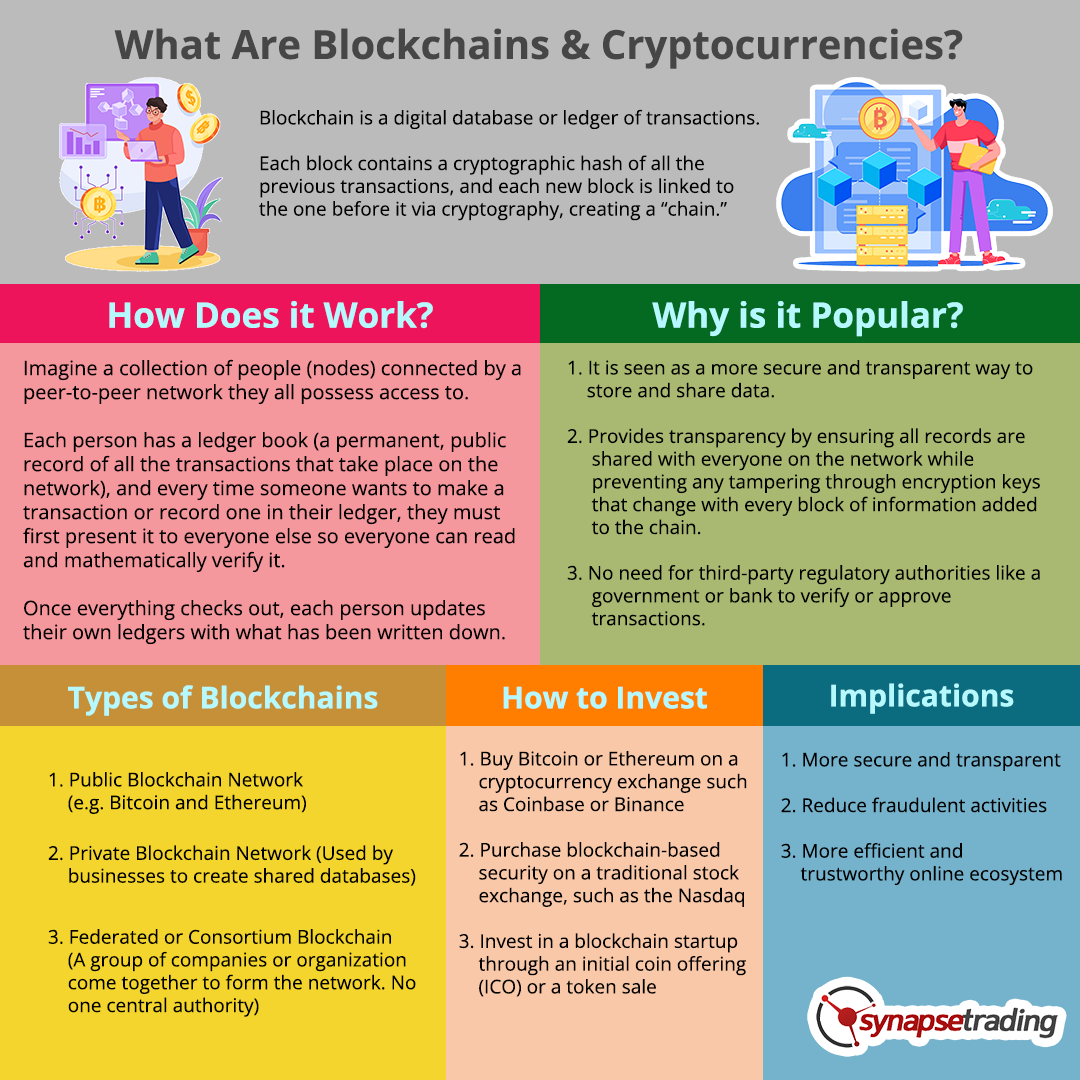
what are blockchains and cryptocurrencies infographic


History of Blockchains

Blockchain technology has a long and complicated history.

It was first conceptualized in 1991 by a group of researchers trying to create a system for timestamping digital documents so they could not be tampered with.

But it was not until 2008 that blockchain really came into its own when Satoshi Nakamoto first introduced the concept of blockchains in a white paper entitled Bitcoin: A Peer-to-Peer Electronic Cash System.

In this paper, Nakamoto described how a decentralized ledger could be used to record and verify transactions instead of the unstable traditional banking system.

Since then, blockchain has been hailed as a revolutionary new way of handling data.

What is a Blockchain?

At its simplest, blockchain is a digital database or ledger of transactions.

When someone uses cryptocurrency to buy something, they broadcast their transaction to the entire network of computers running the software.

These computers then race to verify the transaction, and the first one to do so adds it to the chain of past transactions or “block.”

The new block is then broadcast to the network and verified by more computers, and so on.

Each block contains a cryptographic hash of all the previous transactions, and each new block is linked to the one before it via cryptography, creating a “chain.”

How Does Blockchain Technology Work?

It can be difficult to understand how blockchain works by looking at its front-end alone.

The best way to describe blockchain technology is via an analogy…

Imagine a collection of people (nodes) connected by a peer-to-peer network they all possess access to.

Each person has a ledger book (a permanent, public record of all the transactions that take place on the network), and every time someone wants to make a transaction or record one in their ledger, they must first present it to everyone else so everyone can read and mathematically verify it.

Once everything checks out, each person updates their own ledgers with what has been written down.

As soon as this happens, each node checks to see if anyone has rejected the entry — if no one did, it is complete!

If someone did, this entire process starts over again until there is consensus across all nodes.

How is a Blockchain Different from a Typical Database?

A typical database is more vulnerable to data breaches and hacking because it is centralized, meaning all the data is stored in one place.

On the other hand, a blockchain is decentralized, meaning the data is spread across multiple computers across the decentralized network.

This makes it much more difficult for hackers to access and tamper with the data.

Why is Blockchain Technology Popular?

Blockchain technology is popular because it is seen as a more secure and transparent way to store and share data.

In theory, blockchain technology is highly secure as it is impossible to hack into multiple nodes at once without significant resources.

It also provides transparency by ensuring all records are shared with everyone on the network while preventing any tampering through encryption keys that change with every block of information added to the chain.

This makes it ideal for storing sensitive information like financial transactions.

Plus, since blockchain is decentralized, there is no need for third-party regulatory authorities like a government or bank to verify or approve transactions.

This makes the process faster and more efficient.

As we make our way to ‘Web 3.0’, one of the most popular applications of blockchain technology today is in the form of non-fungible tokens (NFTs).

NFTs are digital assets that are unique and cannot be replicated. They can be used to represent anything from art and collectibles to digital experiences and gaming items.

Because of their unique nature, NFTs have become extremely popular in recent years. In 2021 alone, the market for NFTs surpassed USD 40 Billion.

How to Process Transactions on a Blockchain?

Blockchain-based systems use what is called a hash function to encrypt transaction data. A hash function is a mathematical algorithm that takes input data of any size and converts it into output data of a fixed size.

The output of a hash function is commonly referred to as a hash or hash value.

In a blockchain, every transaction is stored in a block.

Each block has its own cryptographic hash and timestamp, as well as other data that may be specific to that block.

The blocks are stacked on top of each other, creating a digital ledger or chain of blocks.

This process is done through cryptography, which provides security and tamper-proofing for every block in the chain.

The hash from each block is used to create another cryptographic hash for each subsequent block, forming an unbroken chain and linking it all together.

For a new block to be added to the chain, miners must solve a complex mathematical problem.

This problem is known as the proof of work. Once a miner solves the proof of work, they can add the new block to the chain and they are rewarded in cryptocurrency for doing so.

The pieces of data stored in one block cannot be changed without changing all subsequent blocks; doing so would invalidate all following hashes and require massive amounts of computing power just to make a single change.

Types of Blockchains

Blockchain networks can be either public or private.

A public blockchain network is a decentralized network that anyone can join.

Bitcoin and Ethereum are examples of public blockchain networks.

A private blockchain network is a permissioned network where only approved participants can join.

Private blockchain networks are often used by businesses to create shared databases.

There is also a federated or consortium blockchain. In this type of blockchain, there is no one central authority.

Instead, a group of companies or organizations (known as a consortium) come together to form the network.

Each member of the consortium operates a node and has a vote in decision-making.

This type of blockchain is often used in industries where multiple parties must securely share data or conduct transactions, such as banking or supply chain management.

How to Invest in Blockchains?

There are several ways to make your first blockchain investment.

The most common way is to buy Bitcoin or Ethereum on a cryptocurrency exchange such as Coinbase or Binance.

Alternatively, you can purchase blockchain-based security on a traditional stock exchange, such as the Nasdaq.

Finally, you can invest in a blockchain startup through an initial coin offering (ICO) or a token sale.

When it comes to investing in blockchain technology, there are a few things you should keep in mind:

  • The cryptocurrency market is highly volatile. This means that prices can fluctuate wildly from day to day, and you could lose a significant amount of money if you are not careful.
  • You should only invest as much money as you are comfortable losing. Remember, there is always a risk of losing your entire investment when dealing with cryptocurrencies.
  • Finally, make sure you do your research before investing in any blockchain-based project. There are a lot of scams out there, and it is important to know what you are getting yourself into before putting any money down.


What are the Implications of Blockchain Technology?

As the technology behind Bitcoin and other cryptocurrencies, blockchain has the potential to revolutionize the way we interact with the digital world.

With its distributed ledger system, blockchain offers a new way of storing and verifying data that is more secure and transparent than traditional methods.

In addition, blockchain could help reduce fraudulent activities, such as identity theft and money laundering.

Ultimately, this could lead to a more efficient and trustworthy online ecosystem.

Concluding Thoughts on Blockchain

Overall, blockchain technology is a way to store and transmit information in a secure, decentralized manner.

Blockchain technology can provide greater transparency and security for online transactions by using a distributed database.

Additionally, blockchain technology has the potential to streamline many business processes and reduce costs.

However, the full potential of blockchain technology has yet to be realized.

As the technology continues to evolve, we can expect to see even more innovative applications of blockchain technology in the future.

Now that you know a little more about how blockchain technology works, what do you think of it?

Do you think it has the potential to revolutionize our financial ecosystem?

And besides the finance world, what other real-world applications do you foresee it being used for?

Let me know in the comments below!


thumbnail the ultimate guide to blockchain and crypto assets

If you would like to learn more about crypto & DeFi, also check out: “The Ultimate Guide to Blockchain & Cryptocurrencies”

0 Comments/by Spencer Li
https://synapsetrading.com/wp-content/uploads/2022/08/what-are-blockchains-and-cryptocurrencies-thumbnail.png 720 1280 Spencer Li https://synapsetrading.com/wp-content/uploads/2019/10/logo.jpg Spencer Li2022-08-17 06:11:302022-12-19 01:42:33What are Blockchains & Cryptocurrencies?
Page 1 of 41234

Free Trading Guides

Free Trading Guides

Blog Categories

  • Beginner's Guide
  • Blockchain & Crypto
  • Book Summaries
  • Economics & News Trading
  • Investing & Portfolio Management
  • Living Your Best Life
  • Market Analysis
  • Markets & Products
  • News & Events
  • Promotions
  • Risk & Money Management
  • Stock Trading
  • Technical Analysis & Price Action
  • Testimonials
  • Tools & Resources
  • Trading Psychology
  • Trading Strategies
  • Trading Tips
  • Travel & Lifestyle

Free Trading Guides

Free Trading Guides

Contact Us

Synapse Trading Pte Ltd
Registration No. 201316168H

Whatsapp: +65-8897-1204
Telegram: @iamrecneps
Email: info@synapsetrading.com

Links

Disclaimer
Privacy policy
Terms & Conditions
Contact us
Partnerships

© 2012-2024 Synapse Trading | All rights reserved | - powered by Enfold WordPress Theme
  • Link to Facebook
  • Link to X
  • Link to Instagram
  • Link to Youtube
  • Link to LinkedIn
  • Link to Mail
Scroll to top Scroll to top Scroll to top