

What Is Avalanche (AVAX)? How It Works, and What to Check Before You Buy
Want the daily routine? Get the free 15-Minute Swing Trader’s Checklist. Get it free →
By Spencer Li, CFTe · Last updated: 26 October 2026
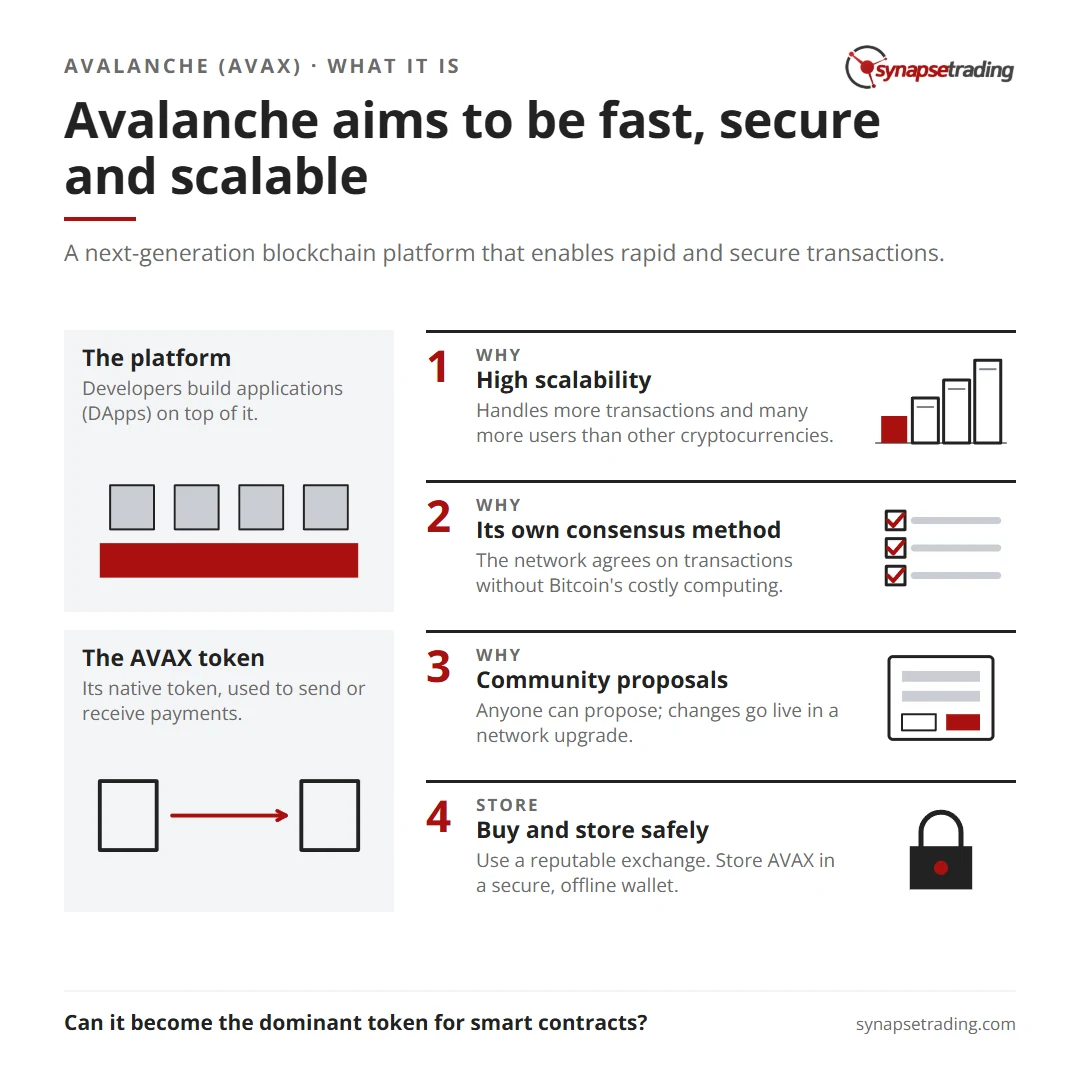
Avalanche is a blockchain that runs on its own network, built for fast and cheap smart contracts, and AVAX is the token that pays its fees and secures it through staking. It launched in September 2020, it runs its own consensus method rather than sitting on top of Ethereum, and its contract chain can run apps written for Ethereum. Whether AVAX is worth buying is a different question from whether the network works. On Coinbase Exchange, AVAX traded as high as US$147.50 on 21 November 2021. At 09:03 UTC on 26 October 2026, it was US$8.90, about 94% lower, while the network kept running and kept shipping upgrades the whole time.
So this post covers both halves, how the machine works and what has happened to the price of its fuel.
What is Avalanche (AVAX)?
Avalanche started life as a paper written under a pseudonym. In May 2018, an author calling themselves “Team Rocket” described a new way for computers to agree with each other. Researchers at Cornell University, including the computer scientist Emin Gün Sirer, then expanded the idea, and Sirer and two PhD students went on to found Ava Labs to build it. The main network went live in September 2020.
Today the core of Avalanche, which it calls the Primary Network, runs three blockchains, each with one job.
- The X-Chain creates and trades assets, AVAX included.
- The P-Chain keeps track of the validators, the computers that secure the network, and lets anyone create new chains.
- The C-Chain runs the Ethereum Virtual Machine, so smart contracts written for Ethereum can run on Avalanche with little change.
That third chain is why people kept calling Avalanche an “Ethereum-killer”. It is its own network with its own consensus, and AVAX is its native token rather than an Ethereum token, but it speaks Ethereum’s language.
AVAX itself does two main jobs. Every transaction pays a fee in AVAX, and that fee is burned, which means it is removed from the supply for good. Validators also have to lock up AVAX to take part. The supply is capped at 720 million tokens, of which 360 million were created when the network started, and the rest are released slowly as rewards to validators.
How does Avalanche agree on anything?
Imagine a room full of people trying to decide on lunch, pizza or barbecue. Nobody calls a vote. Each person simply asks a few random people in the room what they want, and if most of them say pizza, they switch to pizza too. Then everyone does it again, and again.
That is the example Avalanche’s own documentation uses, and it is close to how the network works. Each round, the more popular choice becomes a little more popular, because more people hear it from the people they happen to ask. After enough rounds, the whole room has settled on one answer and nobody needs to ask any more.
Computers are no different. A validator asks a small random sample of other validators which version they prefer, adopts the majority answer, and repeats until the same answer comes back enough times in a row. There is no leader, and any validator can vote on every transaction.
To stop someone flooding the room with fake people, each validator has to stake at least 2,000 AVAX. The more AVAX a validator stakes, the more often others ask for its opinion. That is proof of stake, and it replaces the energy-hungry mining that secures Bitcoin. I explain how Ethereum made the same switch in my post on the Ethereum Merge.
Speed was the selling point. In the paper’s own test, the system handled about 3,400 transactions per second, with transactions confirmed in about 1.35 seconds. Ava Labs now describes finality as “sub-second”. A lab test is not a busy Tuesday on a live network.
What interests me more than the speed is the rule at the heart of it. That rule is “ask a few neighbours, copy the majority, repeat”. In a room of computers that is designed to agree, it is a brilliant way to reach one answer quickly. It is also, almost word for word, how herding works in people. Copying the majority is the fast route to agreement, and it is a terrible route to a fair price, because a crowd polling itself can talk a coin up to almost any number and back down again. Engineers built a machine around the useful half of that rule. Markets run on the dangerous half.
If you want a daily routine that keeps the crowd out of your own decisions, my free 15-minute swing trader checklist is the one I use myself.
What is Avalanche actually used for?
The pitch is that busy apps should not all queue on one shared chain. So Avalanche lets anyone launch their own chain, which it now calls an Avalanche L1, with its own validators and rules, connected to the rest of the network. A game, an exchange and a bank’s settlement system can each run on their own chain and still talk to each other.
The C-Chain is where most everyday activity happens, because Ethereum’s tools work there. It hosts the same kinds of dApps you find on Ethereum, such as lending, trading and token issuance.
The network is still being rebuilt as it runs. Its latest upgrade, called Helicon, went live on 22 September 2026 and changed how the C-Chain executes blocks, with further changes on the P-Chain. Whatever you think of the token, the engineering has not stood still.
Is AVAX just another faded “Ethereum-killer”?
On 30 December 2025, a trader on Reddit’s r/CryptoCurrency asked a blunt question: “Which altcoin has been your biggest disappointment?” Their list of usual suspects included the “ETH killer” that faded into obscurity, and it is fair to ask whether AVAX belongs on it.
Here are the numbers, all from Coinbase Exchange’s daily price data.
- 21 November 2021: AVAX traded as high as US$147.50.
- 1 December 2022: the day the first version of this post went up, AVAX closed at US$12.90.
- 26 October 2026, 09:03 UTC: AVAX was at US$8.90.
So from the 2021 high, the token is down about 94%. And from the day this post first appeared, it is down about 31%, which is worth admitting, because that first version ended by calling AVAX “definitely one to consider”.
The honest concession is that the network and the token are two different things. The network has kept running and upgrading through all of it, and the price has gone the other way. A good machine does not guarantee a good price for its fuel, especially when dozens of other chains are selling the same promise of speed.
Crypto also has a habit that makes this worse. In my weekly outlook on 9 October 2025, I pointed out that crypto tends to “break new highs and then trend lower”, over and over, with sharp corrections right after each breakout. That same week, I decided to take profits on crypto rather than ride the next correction. Which is a good reason to treat any single coin as a trade with a plan, and never as a belief to defend.
How do you buy and store AVAX safely?
Most people lose money on crypto in quite boring ways, through a hacked account, a lost recovery phrase or an exchange that goes bust. So the order of the steps matters more than the coin. Boring wins here.
- Decide the size first. Work out how much you can lose completely without it hurting your life, and keep the position inside that number. This is the step that protects you from risk of ruin, and it comes before you open any app.
- Use an exchange that is licensed where you live. In Singapore, you can check a firm’s licence in the Monetary Authority of Singapore’s Financial Institutions Directory.
- Buy the amount you decided on, and resist topping it up because the chart looks exciting that day.
- Move anything you plan to hold into a wallet you control. I cover the trade-offs between hot and cold wallets in how to store crypto safely.
Self-custody means you are the bank. Lose your recovery phrase and the coins are gone for good, with no helpline to call, so write it down, keep it offline and never type it into a website.
If you would rather spend 15 minutes a day on a plan than hours on a price chart, grab the free 15-minute swing trader checklist.
FAQ
Is Avalanche built on Ethereum?
No. Avalanche is its own blockchain with its own consensus. Its C-Chain runs the Ethereum Virtual Machine, so Ethereum apps and tokens can run on it.
What is AVAX used for?
It pays transaction fees, which are burned, and validators stake it to secure the network. The supply is capped at 720 million tokens.
Is Avalanche proof of work or proof of stake?
Proof of stake. A validator must stake at least 2,000 AVAX, and the more it stakes, the more often other validators ask for its vote.
How fast is Avalanche?
The original paper measured about 3,400 transactions per second with about 1.35 seconds to confirm, in a test network. Ava Labs describes finality on the live network as sub-second.
Is AVAX a good investment?
That depends on your own plan and how much you can afford to lose. As at 26 October 2026, AVAX was about 94% below its November 2021 high on Coinbase Exchange, so size any position as money you could lose entirely.
What happened in the Helicon upgrade?
Helicon went live on 22 September 2026. It changed how the C-Chain executes blocks and made further changes on the P-Chain.
Think of a coin you bought because it was sold to you as the next big thing. Did you decide the size before you bought, or after the price moved? Let me know in the comments.

If you would like to learn more about crypto & DeFi, also check out: “The Ultimate Guide to Blockchain & Cryptocurrencies”
For the wider picture beyond crypto, start with my free trading guides.
And if you want a routine that does not ask you to watch prices all day, grab the free 15-minute swing trader checklist.
About the author. Spencer Li is The 15-Minute Trader and the founder of Synapse Trading. He is a Certified Financial Technician (CFTe) with 15+ years of trading, run from 70+ countries. He holds a B.Acc and B.BM from SMU. Every trade he takes is public, dated, losses left in. He teaches rules-based swing trading in 15 minutes a day, one system for any market.
Education, not financial advice. Synapse Trading is not licensed by MAS to advise on investment products. Trading carries risk of loss, and past performance is not indicative of future results.
Want the daily routine? Enter your email for the free 15-Minute Swing Trader's Checklist.
Free 5-page PDF, then occasional trading emails. Education only, not financial advice. Unsubscribe anytime. Kit stores your email in the US: see our privacy policy.
Want to learn the full method? The Trading Mastery Program teaches the 4 strategies I have traded since 2011. It suits beginners and experienced traders.
Rather follow the trades as they happen? Daily Trading Signals is our Telegram channel: my trade ideas with entry, stop and exit, and every trade is public.
Questions about this post? Ask in the free Telegram channel →
Educational content only, not personalised financial advice. Trading carries risk, including loss of capital. Past performance is not indicative of future results. Synapse Trading is not licensed or regulated by MAS.

