• Link to Facebook
  • Link to X
  • Link to Instagram
  • Link to Youtube
  • Link to LinkedIn
  • Link to Mail
Synapse Trading
  • Home
  • About
    • My Background
    • My Trading Journey
    • My Travel Log
    • Media & Interviews
  • Mentoring
    • Trading Mastery Program
    • Results & Testimonials
  • Signals
    • Telegram (Free to join!)
    • Daily Trading Signals
    • Daily Trading Signals (Results)
  • Resources
    • Free Trading Guides
    • Tools & Resources
    • Blog & Infographics
  • Contact
    • Contact Us
    • Partnership Opportunities
  • Click to open the search input field Click to open the search input field Search
  • Menu Menu

Tag Archive for: blockchain

Spencer Li

Pepecoin: The Meme Coin Craze That’s Making Waves in the Crypto World

Blockchain & Crypto
Thumbnail Pepecoin The Meme Coin Craze Thats Making Waves in the Crypto World

What Are Meme Coins, and Is Pepecoin (PEPE) a Good Investment?

Last updated: 3 July 2026 · By Spencer Li, CFTe


A meme coin is a cryptocurrency built around an internet joke or mascot, with little or no underlying utility, that trades almost entirely on community hype and social-media momentum. Pepecoin (PEPE), based on the Pepe the Frog meme, is one of the best-known examples. Is it a good investment? Honestly, no, not in the sense most people mean by “investment.” Pepecoin has no cash flow, no product, and no intrinsic value to anchor a price. It rose more than 1,500% in 14 days in 2023, then dropped over 42% from its all-time high almost immediately. That is a trading vehicle, not a store of value. You can trade a meme coin if you size it as pure speculation and accept you may lose all of it. You should not park money you need in one. The rest of this post explains what meme coins actually are, what drove Pepecoin’s rise and crash, and how to think about the risk before you touch one.

What are meme coins?

Meme coins are cryptocurrencies built around comical, animated imagery and enthusiastic online trading communities. They are high-risk by design. Most have little or no intrinsic value (no product, no revenue, no real-world use), so they function as trading instruments, not utility currencies.

You will have seen the regulars: Dogecoin, Shiba Inu, Baby Doge, Dogelon Mars, and now Pepecoin. Major cryptocurrencies like Bitcoin and Ethereum are not meme coins; they have actual networks and use cases behind them.

The thing that defines meme coins is volatility. Only a handful, such as Dogecoin and Shiba Inu, even carry the daily trading volume (over $1 million) to move size in and out without slippage wrecking you. The rest are thin, and thin markets are where you get hurt.

What is Pepecoin (PEPE)?

Pepecoin is a meme-based cryptocurrency that draws on the Pepe the Frog meme. Note this clearly: it uses the character’s likeness, but there is no official connection to Matt Furie, the cartoonist who created Pepe the Frog. That alone tells you something about the foundations.

A few facts on the coin itself:

  • Maximum supply: 420,690,000,000,000 coins (yes, that many; the number itself is a meme).
  • Rank: it climbed into the top 50 largest cryptocurrencies, and at its peak sat at #45 by overall valuation.
  • Market cap: crossed $1 billion.
  • The catalyst: trading volume jumped 425% on the Friday it was listed in Binance’s “innovation zone.”

Here is my concern, and it is the one that matters most. Whales (a few holders sitting on enormous quantities of the coin) own a large share of the supply. Concentrated ownership like that makes the market easy to manipulate and leaves it open to a rug pull (where insiders dump their holdings and crater the price for everyone else). When a handful of wallets can decide your exit price, you are not really in control of the trade.

Why did Pepecoin’s price suddenly jump?

A few things lined up at once.

First, the so-called “crypto winter” was ending, and risk appetite was coming back. When the broad market thaws, meme coins are usually the first thing to run, because they are the purest expression of speculative mood.

Second, the Binance “innovation zone” listing gave it a layer of mainstream validation. A listing on a major exchange is not an endorsement of value, but it makes a coin far easier to buy, and easier-to-buy plus rising-mood is rocket fuel for a meme coin.

Put together, Pepecoin’s value rose roughly 500% in two weeks, and the headline figure was a 1,503.9% surge within just 14 days. That is the power of social media and community-driven enthusiasm, and it is also exactly why these moves are so dangerous. Nothing changed about the coin’s fundamentals (there were none). Only the crowd’s mood changed.

The crash: a $600,000 lesson

The flip side showed up fast. Shortly after hitting its all-time high on May 6th, Pepecoin dropped more than 42%.

One crypto whale had bought 962.3 billion Pepe tokens just days before the plunge, and was left sitting on an unrealized loss of roughly $600,000. That is the part to sit with. Even a “smart money” buyer with size got caught, because in a market this driven by momentum, the timing of the crowd matters more than the quality of the asset.

To be fair, even after the drop, Pepecoin held a market cap above $1 billion and stayed the 45th largest cryptocurrency. So meme coins can keep real market presence despite the risk. But “it survived the crash” and “it was a good investment” are not the same statement.

Meme coin vs. a real asset: the honest comparison

Here is how a meme coin like Pepecoin stacks up against the kind of asset you would actually invest in.

Meme coin (e.g. Pepecoin)Established crypto (e.g. Bitcoin/Ethereum)Traditional investment (e.g. an index fund)
Intrinsic valueNoneNetwork and use caseCash flows, earnings, assets
Main price driverSocial-media hype, community moodAdoption, network use, macroFundamentals plus sentiment
VolatilityExtreme (1,500% up, 42% down in days)HighModerate
Ownership concentrationOften heavy whale concentrationMore distributedRegulated, disclosed
Rug-pull / manipulation riskHighLowVery low
Honest labelSpeculationInvestment with high riskInvestment

The point of the table is not that meme coins are evil. It is that they belong in the “speculation” column, and you should treat the money you put in like money you are prepared to lose entirely.

Is Pepecoin a good investment?

With any investment, especially in crypto, there are no guarantees. Pepecoin has seen impressive growth, but meme coins have historically struggled to hold their value. Some people characterize them, fairly, as pump-and-dump schemes. Add the concentrated ownership and the insider-trading risk, and the case for “investment” gets thin.

So my honest answer: meme coins like Pepecoin and Dogecoin are an extremely risky speculation, not an investment, because they lack fundamentals and carry extreme price volatility. If you choose to trade one anyway, do it with money you can afford to lose, size it tiny, and have an exit plan before you enter, not after the crowd turns.

Where the human edge comes in

A screener will tell you Pepecoin is up 1,500% in a second. It will not tell you to stay out. Spotting the runner is the easy, now-free part. The judgment to recognise that a thing with no fundamentals, heavy whale concentration, and a parabolic chart is a trade to size tiny or skip entirely, and the discipline to set your exit before you are emotionally in the position, is the part no tool supplies for you. That judgment is the first of the Five Edges an algorithm cannot trade for you.

FAQ

What is a meme coin?
A meme coin is a cryptocurrency built around an internet joke, mascot, or community (like a frog or a dog) rather than a product or technology. It usually has little or no intrinsic value and trades mostly on social-media hype. Examples include Dogecoin, Shiba Inu, and Pepecoin.

What is Pepecoin (PEPE)?
Pepecoin is a meme-based cryptocurrency inspired by the Pepe the Frog meme, with a maximum supply of 420,690,000,000,000 coins. It has no official connection to Pepe’s original creator, Matt Furie, and at its peak ranked among the top 50 cryptocurrencies with a market cap over $1 billion.

Is Pepecoin a good investment?
Pepecoin has no fundamentals, cash flow, or intrinsic value, so it is better described as a speculation than an investment. It rose over 1,500% in 14 days and then fell more than 42% from its all-time high soon after, which shows the extreme volatility involved. Only risk money you can afford to lose entirely.

Why did Pepecoin’s price rise so fast?
Three things combined: the end of the 2023 “crypto winter” revived risk appetite, a listing in Binance’s “innovation zone” gave it mainstream access and validation, and social-media community hype did the rest. None of it reflected any change in fundamentals.

What is a rug pull, and is Pepecoin at risk of one?
A rug pull is when insiders or large holders suddenly dump their coins and collapse the price for everyone else. Pepecoin carries elevated risk here because a small number of whales hold large quantities of the supply, which makes the market easier to manipulate.


So, before you buy a meme coin: are you prepared for the volatility and the risk, and given the concentrated ownership, how will you make sure you are deciding with your head and not the crowd’s hype? Let me know in the comments.

If you want the bigger picture on how this asset class actually works, read the pillar: The Ultimate Guide to Blockchain and Cryptocurrencies.

Want a system that keeps you out of trades like this? Grab the free 15-Minute Swing Trading Starter Kit. It is the exact routine I use to scan once a day and trade any market in 15 minutes, with the risk rules that stop a hype trade from blowing up an account.


About the author. Spencer Li is the founder of Synapse Trading and a Certified Financial Technician (CFTe) with 15 years of trading across stocks, forex, crypto, commodities, and bonds. His trade log is public, 404 trades, losses left in. He teaches low-risk swing trading in 15 minutes a day, one system for any market.

Education, not financial advice. Synapse Trading is not licensed by MAS to advise on investment products. Trading carries risk of loss; past performance is not indicative of future results.


Related

The Ultimate Guide to Blockchain and Cryptocurrencies (pillar) · What is Bitcoin and how does it work? · How to spot a pump-and-dump scheme · Risk management for traders

0 Comments/by Spencer Li
https://synapsetrading.com/wp-content/uploads/2023/05/Thumbnail-Pepecoin-The-Meme-Coin-Craze-Thats-Making-Waves-in-the-Crypto-World.png 720 1280 Spencer Li https://synapsetrading.com/wp-content/uploads/2019/10/logo.jpg Spencer Li2023-05-09 05:28:382026-07-06 02:47:51Pepecoin: The Meme Coin Craze That’s Making Waves in the Crypto World
Spencer Li

What is Avalanche (AVAX) Cryptocurrency, and is it a Good Investment?

Blockchain & Crypto
Thumbnail What is Avalanche AVAX cryptocurrency and is it a good investment


Avalanche (AVAX) has been touted a potential Ethereum-killer, meaning it has the potential to outperform and replace Ethereum as the dominant smart contract token.

This token aims to change the way people send money around the world by providing both speed and security that other cryptocurrencies don’t have.

Avalanche has been around for a much shorter period of time compared to Bitcoin and Ethereum, but it already has millions of users across the world.

In addition, it is highly secure, fast, and easily scalable.

But will it be good enough to emerge the winner?

In this blog post, I’m going to cover everything you need to know about Avalanche, including how it works, why it’s so popular, and whether or not it’s worth investing in right now.


Infographic What is Avalanche AVAX stablecoin and is it a good investment


What is Avalanche (AVAX)?

Avalanche is basically a next-generation blockchain platform that enables rapid and secure transactions.

The platform is based on a unique consensus algorithm that allows for the instant finality of transactions.

The project has a team of experienced developers, computer scientists, and business professionals that are aiming to bring blockchain technology into the mainstream by creating an easy-to-use platform that anyone can use.

How Does Avalanche (AVAX) Work?

The project was built on the Ethereum blockchain and uses the ERC-20 token standard.

This means that all transactions are recorded on the public ledger and are freely available for anyone to view.

You can use AVAX (the native token of the Avalanche platform) to send or receive payments or to mine various cryptocurrencies.

There are two ways you can use AVAX tokens: You can send them in transactions with other users, or you can use them to mine various cryptocurrencies.

Users will be able to purchase AVAX tokens through a variety of methods, including credit cards, bank transfers, and cryptocurrency wallets.

What Makes Avalanche (AVAX) Different?

Avalanche is a cryptocurrency that is different from other cryptocurrencies in several ways.

1. High Scalability

AVAX is designed to be more scalable than other cryptocurrencies.

It can handle a larger volume of transactions compared to other cryptocurrencies, and it can also support a much larger number of users.

Furthermore, Avalanche is more decentralized than other forms of cryptocurrencies.

The transaction speed on Avalanche is much faster than mainstream cryptocurrencies like bitcoin, which means that you can send money instantly without having to wait for confirmations.

2. New Consensus Algorithmn

It uses a new consensus algorithm called Avalanche that is different from the proof-of-work algorithm used by Bitcoin and Ethereum.

The idea behind Avalanche is to come up with a way for nodes to reach a consensus on transactions without having to rely on expensive computations like those required by proof-of-work algorithms.

3. Built-in Governance System

Avalanche has a built-in governance system that allows users to vote on proposals to improve the network.

This means that developers can implement changes by changing how nodes validate transactions without having to hard fork.

4. Built-in Privacy

It also has a built-in mechanism for privacy.

This built-in mechanism helps to protect the identities of users and prevent censorship by governments or other entities.

In addition, Avalanche is compatible with Ethereum’s ERC-20 token standard, meaning that it can be simply continued as a base layer for other applications to build on.

5. Proof of Capacity

Finally, Avalanche is built on “Proof of Capacity” instead of “Proof of Work.”

This means that miners don’t have to use expensive, power-hungry computers to verify transactions, which makes it quick for anyone with a computer to be able to participate in the network.

In addition, Avalanche uses a “delegated proof of stake” consensus mechanism, which means that token holders can vote for delegates to maintain the network.

Reasons to Invest in Avalanche (AVAX)

Avalanche is a cryptocurrency that was created in 2020 and is well-known among investors.

Even though it is relatively new compared to Ethereum and Bitcoin, it has managed to grow to a large market cap within a short period of time.

So, let’s check out the reasons why investors think it is a good choice:

1. Smart Contracts

One important reason is its support for smart contracts, which allows developers to create applications on top of the Avalanche platform.

So, this means that Avalanche has a huge potential for growth.

In addition, it is also capable of creating decentralized applications (DApps) on top of the Avalanche platform, which opens up many possibilities for developers to build and deploy their own DApps.

2. High Liquidity & Security

Next to all of this, Avalanche is also a great investment option because it offers high liquidity.

This means that you can easily convert your tokens into cash whenever you want to sell them or transfer them to another wallet.

Furthermore, Avalanche also offers a lot of security.

This is because it uses blockchain technology to store all data, which makes it hard for hackers to access your information and steal your funds.

3. Easy to Use & Scale

Another advantage of the Avalanche platform is that it’s easy to use.

This means that developers can build DApps on top of the Avalanche blockchain without any need of technical knowledge about coding or software development.

This will make it more accessible for a wider range of people and companies to create and use their own DApps.

In addition, the Avalanche platform is also easy to scale, which means that it can compass a high transaction volume without slowing down or crashing.

4. Proof of Stake

Finally, the Avalanche consensus protocol is secure.

It uses a proof-of-stake model, which means that the Avalanche network depends on its users to verify the transactions and add new blocks to the blockchain.

As long as you have some tokens in your wallet, you can help maintain this network by staking them and earning more coins in return.

How to Buy & Store Avalanche (AVAX)?

Here’s a quick summary on how to buy and store cryptocurrencies safely:

  • Choose a reputable cryptocurrency exchange that supports AVAX, like Binance or Coinbase.
  • Open an account with the crypto brokerage.
  • Deposit fiat currency into your exchange account.
  • Buy needed AVAX with your fiat currency.
  • Store AVAX in a secure and offline wallet.

The Future of Avalanche (AVAX)

AVAX is a good potential long-term play because the company has a strong team and is making significant strides in its development plans.

In. addition, the AVAX token has a lot of potential.

As the company focuses on its technology, it will need to expand its user base and increase the adoption of the platform.

The more people who use it, the higher demand there will be for AVAX tokens.

Furthermore, the company plans to integrate its technology into other areas, such as e-commerce and biometrics.

If it succeeds in these pursuits, the demand for AVAX tokens could increase dramatically.

Concluding Thoughts

Overall, Avalanche (AVAX) is a very promising company that is well-positioned to capitalize on the growing demand for cybersecurity solutions.

It has a strong team and an impressive list of partners, which will help drive the adoption of its technology and increase the value of its token in the long term.

So, if you’re looking for a cryptocurrency that has a lot of potentials and could be an excellent investment for the long term, then AVAX is definitely one to consider.

Now that you know all about the Avalanche (AVAX) token, would you consider investing in it?

Do you think it has the potential to emerge as the dominant token for smart contracts?

Let me know in the comments below.


thumbnail the ultimate guide to blockchain and crypto assets

If you would like to learn more about crypto & DeFi, also check out: “The Ultimate Guide to Blockchain & Cryptocurrencies”

0 Comments/by Spencer Li
https://synapsetrading.com/wp-content/uploads/2022/10/Thumbnail-What-is-Avalanche-AVAX-cryptocurrency-and-is-it-a-good-investment.png 720 1280 Spencer Li https://synapsetrading.com/wp-content/uploads/2019/10/logo.jpg Spencer Li2022-12-01 05:12:542022-12-29 03:15:19What is Avalanche (AVAX) Cryptocurrency, and is it a Good Investment?
Spencer Li

What is Tether (USDT) Stablecoin, and is it a Good Investment?

Blockchain & Crypto
Thumbnail What is Tether USDT and is it a good investment

What Is Tether (USDT)? A Plain-English Guide to the Biggest Stablecoin

Last updated: 3 July 2026 · By Spencer Li, CFTe


Tether (USDT) is the largest stablecoin in the world, a cryptocurrency designed so that one USDT is always worth about one US dollar. A stablecoin is a crypto token pegged to a stable asset (here, the US dollar), so it does not swing in price the way Bitcoin or Ethereum do. Tether holds it near one dollar by claiming to back every coin in circulation with reserves of roughly equal value. In practice, traders use USDT as a place to park money between trades, to move dollars between exchanges quickly, and to buy other cryptocurrencies. It is the most widely accepted stablecoin and the most liquid. Is it a good investment? Honestly, that is the wrong question. A stablecoin is not built to go up. It is built to stay put. You hold USDT to avoid volatility and stay flexible, not to grow your money. The real things to weigh are whether the peg holds and whether the reserves are really there.

Here is the full picture: what a stablecoin is, how Tether works, the case for using it, and the risks nobody likes to mention.

What is a stablecoin?

A stablecoin is a digital asset pegged to something with a stable value, usually the US dollar. The whole point is to avoid the wild price swings of the crypto market while keeping the convenience of blockchain (the shared, tamper-resistant ledger that records every transaction).

Think of it as a dollar that lives on the blockchain. Bitcoin can move 10% in a day. A stablecoin is supposed to sit at one dollar and stay there.

That stability is what makes it useful. A currency that swings around is hard to spend, save, or settle a trade in. A stablecoin is meant to be boring on purpose, which is exactly what you want when you are using it to hold value, move money, or settle a transaction.

What is Tether (USDT), and how does it work?

Tether is a stablecoin pegged to the US dollar, so one USDT is meant to equal one US dollar. It was first issued in 2014 and is run by a company called Tether Limited. The token is now issued across several blockchains, including Ethereum and Tron, not just the original Omni Layer it launched on.

It works like any other crypto token. You can send USDT to another person, use it to pay for goods or services, or store it in a digital wallet (software that holds your crypto, a bit like an online bank account). Every transaction is recorded on the blockchain.

The model is simple in theory. Tether Limited says each USDT in circulation is backed by reserves it holds, mostly cash and US Treasury bills. So in principle every coin is matched by about a dollar of real assets somewhere. That backing is what is supposed to keep the price glued to one dollar: if USDT ever drifts below a dollar, arbitrageurs (traders who profit from price gaps) buy it cheap and redeem it for the full dollar, which pushes the price back up.

Do note that the redemption process is not as frictionless as the original pitch suggests. Direct redemption with Tether is mainly for large, verified accounts and carries minimums and fees. Most ordinary users never redeem with Tether at all. They just sell USDT for dollars on an exchange. That distinction matters more than it sounds, and we will come back to it under risks.

Why traders use Tether

Tether is the default stablecoin for most of the crypto market, and the reasons are practical rather than exciting. Here is the honest case for it.

ReasonWhat it means for youThe honest caveat
StabilitySits near one dollar, so you can step out of a volatile trade without leaving crypto“Near” one dollar, not exactly. It has wobbled before
LiquidityThe most traded stablecoin, so you can move in and out fastLiquidity can dry up in a panic, which is the worst time
Accepted everywhereMost exchanges take USDT, so it is the easiest bridge to buy Bitcoin, Ethereum and the restWide acceptance is not the same as safety
TransparencyTether publishes regular reserve attestationsAttestations are snapshots, not full independent audits. Read the difference
Speed and easeAll you need is a wallet and an internet connection. No mining, no complexitySpeed cuts both ways. A bad transfer is irreversible

A few of these deserve a closer look, because the original pitch around stablecoins tends to oversell them.

On transparency, be precise. Tether publishes attestations: a third party confirms what the reserves looked like at a single point in time. That is genuinely more than nothing, and Tether’s reporting has improved over the years. But an attestation is not a full audit, where an auditor stands behind the numbers over a whole period. If someone tells you Tether is “fully audited”, they are overstating it. Know what you are actually getting.

On liquidity, USDT really is deep and easy to trade in normal conditions. The catch is that liquidity is highest exactly when you do not need it and thinnest in a crisis, when everyone wants out at once. Plan for the bad day, not the good one.

One correction worth making plainly: USDT is not decentralized. Tether Limited issues it, controls the supply, and can freeze tokens at specific addresses when asked by law enforcement. That centralization is a feature for compliance and a risk for anyone who assumed crypto means “no one can touch my coins”. Both things are true at once.

The risks nobody likes to mention

Every stablecoin carries risk, and pretending otherwise is how people get hurt.

The first is hacking, the standard crypto risk. Tether itself has not suffered a major blockchain-level breach, which is a point in its favour, but the exchanges and wallets where you hold USDT absolutely have been hacked. Where you keep it matters as much as what it is.

The second, and the big one, is depegging. Because USDT is pegged to the dollar, the whole thing rests on that peg holding. If confidence cracks and the peg breaks, a stablecoin can fall fast. We saw the worst version of this with Terra USD (UST) in 2022, which spiralled toward zero in days. Tether is a very different design from UST, and it has defended its peg through several scares, briefly dipping below a dollar and recovering. But “it held last time” is a hope, not a guarantee.

The third is reserve risk, which is really the depeg risk underneath the depeg risk. The peg is only as good as the assets behind it. If you cannot fully verify the reserves, you are trusting Tether Limited. That trust has mostly been rewarded, and it has also been questioned, including a past settlement with regulators over how reserves were once represented. None of this means avoid it. It means size it like a position with counterparty risk, not like cash in a bank.

Where the human edge comes in

A screen will tell you USDT is sitting at one dollar in a tenth of a second. What it will not tell you is when “one dollar” has quietly become a crowded exit. The data is free. The judgment to not park your whole stack in a single stablecoin, to spread counterparty risk, and to treat a peg as a promise rather than a law, that is the part no tool supplies for you. That judgment is the first of the Five Edges that AI cannot trade for you.

So is Tether a good investment?

Reframe it. Tether is not really an investment, because it is not designed to go up. It is the blue-chip parking spot of the crypto world, a way to hold value in dollars without leaving the blockchain. Used for what it is good at, holding, moving, and settling, it does the job better than any rival. If you are reaching for a stablecoin specifically to chase high yields, understand that the higher the advertised yield, the higher the risk you are taking on, and the peg you are leaning on may be flimsier than Tether’s.

Hold USDT to stay nimble, not to get rich. Keep an eye on the peg, do not concentrate everything in one issuer, and you have used the tool correctly.

FAQ

Is Tether (USDT) safe?
It is the most established and most liquid stablecoin, and it has defended its dollar peg through multiple scares. But it is not risk-free: the main risks are depegging and reserve quality, and you are trusting Tether Limited to back every coin. Treat it as a low-volatility holding with counterparty risk, not as guaranteed cash.

Is one USDT always worth one US dollar?
That is the goal, and it usually trades very close to one dollar. It has briefly slipped below the peg during market panics and then recovered. “Pegged” means “designed to stay at a dollar”, not “legally fixed at a dollar”.

Is Tether decentralized?
No. Tether Limited issues USDT, controls its supply, and can freeze tokens at specific wallet addresses. It runs on decentralized blockchains, but the token itself is centrally controlled.

Is Tether fully audited?
Not in the strict sense. Tether publishes regular reserve attestations, which are third-party snapshots of the reserves at a point in time. That is more disclosure than some rivals provide, but it is not the same as a continuous independent audit. Know the difference before you rely on the word “transparent”.

How do I buy Tether (USDT)?
Register and verify an account on an exchange that supports USDT, such as Binance or other major exchanges, then buy USDT with fiat currency or by swapping another cryptocurrency. Most people then hold it in an exchange or self-custody wallet rather than redeeming directly with Tether.


Now that you know what Tether is and where its risks sit, how do you use stablecoins in your own setup? Let me know in the comments.

If you want the bigger picture on crypto and DeFi, read the pillar: The Ultimate Guide to Blockchain and Cryptocurrencies.

Want a system, not just another coin to watch? Grab the free 15-Minute Swing Trading Starter Kit. It is the exact routine I use to scan once a day and trade any market in 15 minutes.


About the author. Spencer Li is the founder of Synapse Trading and a Certified Financial Technician (CFTe) with 15 years of trading across stocks, forex, crypto, commodities, and bonds. His trade log is public, 404 trades, losses left in. He teaches low-risk swing trading in 15 minutes a day, one system for any market.

Education, not financial advice. Synapse Trading is not licensed by MAS to advise on investment products. Trading and crypto carry risk of loss; past performance is not indicative of future results.


Related

The Ultimate Guide to Blockchain and Cryptocurrencies (pillar) · What is DeFi and how does it work · Bitcoin vs Ethereum · How to store crypto safely

0 Comments/by Spencer Li
https://synapsetrading.com/wp-content/uploads/2022/10/Thumbnail-What-is-Tether-USDT-and-is-it-a-good-investment.png 720 1280 Spencer Li https://synapsetrading.com/wp-content/uploads/2019/10/logo.jpg Spencer Li2022-10-22 18:25:092026-07-06 03:04:33What is Tether (USDT) Stablecoin, and is it a Good Investment?
Spencer Li

Proof of Work vs. Proof of Stake: Which One is Better?

Blockchain & Crypto
proof of work vs proof of stake thumbnail

Proof of Work vs Proof of Stake: What’s the Difference?

Last updated: 3 July 2026 · By Spencer Li, CFTe


Proof of work (PoW) and proof of stake (PoS) are the two main ways a blockchain verifies transactions and adds new blocks without a middleman. The core difference is what you have to spend to earn the right to validate. In proof of work, computers compete to solve a hard math puzzle, and the winner spends real energy and hardware to add the next block. In proof of stake, there is no race. The network picks one validator at random, weighted by how many coins that validator has locked up (staked), and they confirm the block instead. PoW is older, more battle-tested, and harder to attack, but it burns a lot of electricity. PoS is newer, far more energy efficient, and cheaper to join, but it is less proven at scale. Bitcoin (BTC) still runs on PoW. Ethereum (ETH) moved from PoW to PoS in 2022, and newer coins like Cardano (ADA) and Solana (SOL) launched on PoS from the start.

Here is how each system works, what it costs, and where each one is strong or weak.

What is proof of work (PoW)?

In a proof of work system, a group of computers compete to solve complex mathematical problems to validate transactions and add new blocks to the blockchain. The first one to solve the problem receives a reward in the form of cryptocurrency.

Because the energy and computing resources needed to solve the puzzle are often compared to the real-world effort of digging precious metals out of the ground, this process is called mining (using computing power to solve the puzzle and earn the right to add a block).

The book Digital Gold by Nathaniel Popper uses a simple analogy for the puzzle at the heart of Bitcoin:

It is easy to get 2,903 times 3,571 by writing the numbers down and multiplying. It is much harder to work backwards and figure out which two numbers multiply together to make 10,366,613.

The miner who cracks the problem first gets to add the next block of transactions and broadcast it to the network of nodes (the computers that hold a copy of the ledger and check new blocks). Those nodes audit the existing ledger and the new block. If everything checks out, the new block is linked to the one before it, forming the chain. The miner is then paid in coins for the energy and hardware they spent.

PoW, mining, and security

Mining consumes a lot of power, and that cost is the point. It secures the network by making sure only those who can prove they spent real resources are allowed to add transactions. By design, attacking a PoW system like Bitcoin is exceedingly difficult, time-consuming, and expensive.

To pull off an attack, you would have to buy and rig up expensive mining equipment, pay for the electricity to run it, win the race to solve the puzzle, and add a block stuffed with counterfeit coins. The moment the network’s nodes audit that block against the previous ledger, the fake coins are caught and the block is rejected.

The only way around this is to control the network outright. Counterfeiting bitcoin is virtually impossible unless an attacker owns over 50% of the network, meaning at least 51% of both the combined computing power of all miners (the hashrate) and the network’s nodes. Given the size of the Bitcoin network and the sheer energy miners pour into it, a 51% attack on Bitcoin today is almost impossible.

So if PoW checks all the boxes, why is part of the crypto world moving to proof of stake?

What is proof of stake (PoS)?

A member of the Bitcointalk forum who went by QuantumMechanic proposed proof of stake in 2011. His core point was simple: opening mining up to everyone and letting them all burn energy competing against each other is wasteful.

So PoS replaces the race with a lottery. One node is chosen at random to validate the next block. There are no miners. There are validators (nodes that lock up coins for the right to confirm blocks). They do not mine blocks either. They “forge” or “mint” them. The reward is the transaction fees attached to that block.

The selection is not pure chance, though. Before a node can be considered, it has to stake a certain amount of coins into the network, and the size of that stake raises its odds of being picked.

Here is the intuition. Say Walt stakes $100 into the network and Skyler stakes $1,000. Skyler’s chance of being chosen to forge the next block is ten times higher. The bigger your stake, the more often you win the right to validate.

One more detail worth noting: the stake is always larger than what a validator earns in fees. That keeps validators financially motivated to play fair, because cheating risks a stake worth more than the reward.

PoW vs PoS, side by side

The two systems solve the same problem (how to agree on the truth without a middleman) using opposite incentives. PoW asks you to spend energy. PoS asks you to lock up money.

Proof of Work (PoW)Proof of Stake (PoS)
Who validatesMinersValidators
How blocks are madeMining (solve a math puzzle)Forging / minting (chosen by stake)
What you spendHardware + ongoing electricityCoins locked up as a stake
SelectionFirst to solve the puzzle winsRandom, weighted by stake size
Energy useVery highLow
Barrier to entryHigh (rigs + power)Low (buy a fraction of a coin)
Maturity at scaleMost proven (Bitcoin since 2009)Newer, less battle-tested
Main riskEnergy cost, scaling limitsSybil and 51% attacks, centralization of stake
Example coinsBitcoin (BTC)Ethereum (ETH), Cardano (ADA), Solana (SOL)

Advantages of proof of work

Mining is a fiercely competitive industry, and that competition does useful work. Miners are always hunting for cheaper energy and faster, more efficient chips to lower their costs. Whoever finds the cheapest power and builds the better hardware wins, which keeps pushing the whole system forward.

PoW has also been the most proven way to maintain consensus while keeping users secure inside a distributed ledger. The reason is the cost itself. PoW demands an upfront hardware cost and a continuous spend on resources to keep participating, where PoS only asks for a single upfront stake. That ongoing cost is exactly what makes PoW so hard to fake.

Disadvantages of proof of work

The energy that powers Bitcoin’s PoW algorithm draws constant criticism for its carbon footprint. By one estimate, the Bitcoin network alone consumes as much energy as the entire countries of Ukraine and Norway combined. That comes straight from the design: miners have to solve hard math problems around the clock to validate transactions, and that takes enormous computational power, which takes a lot of electricity.

The traceability of a blockchain is a double-edged sword too. On one hand, it adds transparency and builds trust between users. On the other, every single transaction is permanently visible to everyone, which is a problem for people who value their privacy. The US Internal Revenue Service (IRS), for example, has successfully tracked down suspected tax evaders by matching records from bitcoin exchanges against data from banks and brokerages. Traceability will likely stay a sticking point for as long as crypto is used as a payment system rather than just an investment vehicle.

Advantages of proof of stake

The headline advantage of PoS is energy efficiency. With PoW, miners burn a lot of power running computers to solve puzzles, which is expensive and hard on the environment. With PoS, validators are not solving puzzles at all. They stake their coins and earn rewards based on how much they have staked, so the energy bill is tiny by comparison.

PoS also tends to be more censorship resistant. In a PoW system, a small group of large miners can, in principle, choose to censor certain transactions. In a PoS system, everyone who holds coins has a stake and therefore a say, which makes it much harder for any one party to block or refuse transactions.

And PoS has a far lower barrier to entry. To start validating a PoS coin, you really only need an internet connection and enough money to buy a fraction of a coin. That is it. You can even do it from a smartphone. With no expensive hardware required, PoS is much more accessible to the average person.

Disadvantages of proof of stake

PoS is younger, and it shows. No PoS system has yet scaled to the level of the largest networks while staying as decentralized and safe as the most advanced PoW systems. These are solvable problems, and newer consensus designs like Casper aim to fix them, but they are not solved yet.

A few specific weak spots:

  • Absent validators. If a chosen validator does not show up to do its job, the block stalls. This is usually handled by lining up a large pool of backup validators in case the primary one fails.
  • Sybil attacks. Because validating power is spread across many small holders rather than concentrated in a few miners, a PoS network can be more exposed to a Sybil attack (where one attacker spins up many fake identities to gain outsized control).
  • 51% attacks. PoS can also be more vulnerable to a 51% attack, where a single entity quietly accumulates more than half of the staked currency and uses it to push through bad blocks.

So which one is better?

Honestly, there is no clean winner, and anyone selling you one is overselling. Both systems have real strengths and real weaknesses, and the right answer depends on what a given network is optimizing for. If the priority is maximum security and a long track record, PoW still leads. If the priority is energy efficiency, low fees, and easy access, PoS makes the better case.

The direction of travel is clear, though. Ethereum completed its move from PoW to PoS in 2022 (the event the community called “the merge”), and most new coins now launch on PoS by default. PoW remains the home of the oldest and most valuable network, Bitcoin, and shows no sign of switching.

Personally, I do not treat this as a question I need to “win.” As a trader, I do not pick a coin because I admire its consensus mechanism. The mechanism tells you something about a network’s security, cost, and energy story, and that is useful context. It does not tell you whether the chart is a buy. A scanner can label a coin PoW or PoS in a second. It cannot supply the judgment to size the position, manage the risk, and decide whether the trade is even worth taking. That judgment is the human edge, and it is the part no algorithm trades for you.

FAQ

What is the main difference between proof of work and proof of stake?
In proof of work, computers compete by spending energy to solve a math puzzle, and the winner adds the next block. In proof of stake, there is no race. A validator is chosen at random, weighted by how many coins they have staked, and they confirm the block instead. PoW spends electricity; PoS locks up money.

Is proof of stake more secure than proof of work?
Not yet, by most measures. PoW is the more battle-tested system and is extremely expensive to attack at scale, which is why Bitcoin still uses it. PoS is far more energy efficient but newer, and it can be more exposed to Sybil attacks and to a 51% attack if one party accumulates enough of the staked supply.

Which cryptocurrencies use proof of work, and which use proof of stake?
Bitcoin (BTC) is the flagship proof of work coin. Ethereum (ETH) moved from PoW to PoS in 2022, and coins like Cardano (ADA) and Solana (SOL) were built on proof of stake from the start.

Why is proof of work criticized for energy use?
PoW miners must solve complex math problems around the clock to validate transactions, which takes huge amounts of computing power and therefore electricity. By one estimate the Bitcoin network alone uses as much energy as the countries of Ukraine and Norway combined.

Is proof of stake replacing proof of work?
For new networks, largely yes. Most new coins launch on PoS, and Ethereum’s 2022 switch was a major milestone. But PoW still secures Bitcoin, the oldest and largest network, so the two systems are likely to coexist rather than one fully replacing the other.


Now that you know how proof of work and proof of stake differ, which one do you think wins out in the long run? Let me know in the comments.

And if you want the bigger picture on how blockchains and coins actually fit together, read the pillar: The Ultimate Guide to Blockchain and Cryptocurrencies.

Want a simple way to trade any market, including crypto? Grab the free 15-Minute Swing Trading Starter Kit. It is the exact routine I use to scan once a day and trade in 15 minutes, the same approach whether the chart is a stock, a forex pair, or a coin.


About the author. Spencer Li is the founder of Synapse Trading and a Certified Financial Technician (CFTe) with 15 years of trading across stocks, forex, crypto, commodities, and bonds. His trade log is public, 404 trades, losses left in. He teaches low-risk swing trading in 15 minutes a day, one system for any market.

Education, not financial advice. Synapse Trading is not licensed by MAS to advise on investment products. Trading carries risk of loss; past performance is not indicative of future results.


Related

The Ultimate Guide to Blockchain and Cryptocurrencies (pillar) · What is Bitcoin and how does it work · What is Ethereum · How to start trading cryptocurrency

0 Comments/by Spencer Li
https://synapsetrading.com/wp-content/uploads/2022/08/proof-of-work-vs-proof-of-stake-thumbnail.png 720 1280 Spencer Li https://synapsetrading.com/wp-content/uploads/2019/10/logo.jpg Spencer Li2022-08-27 02:28:102026-07-06 02:47:52Proof of Work vs. Proof of Stake: Which One is Better?
Spencer Li

What are Blockchains & Cryptocurrencies?

Blockchain & Crypto
what are blockchains and cryptocurrencies thumbnail

Why are blockchains touted as the next big thing in the financial industry and potentially a major game-changer?

If you have heard of blockchain technology, chances are you know it has something to do with bitcoin, decentralised finance or cryptocurrency.

And while those two things have become inextricably linked, they are not the same.

That’s why it is crucial to understand how they work now so that you can take advantage of that potential — both as an entrepreneur and a consumer.

In this blog post, I will tell you everything you should know about how blockchain technology works and what its impact could be going forward.


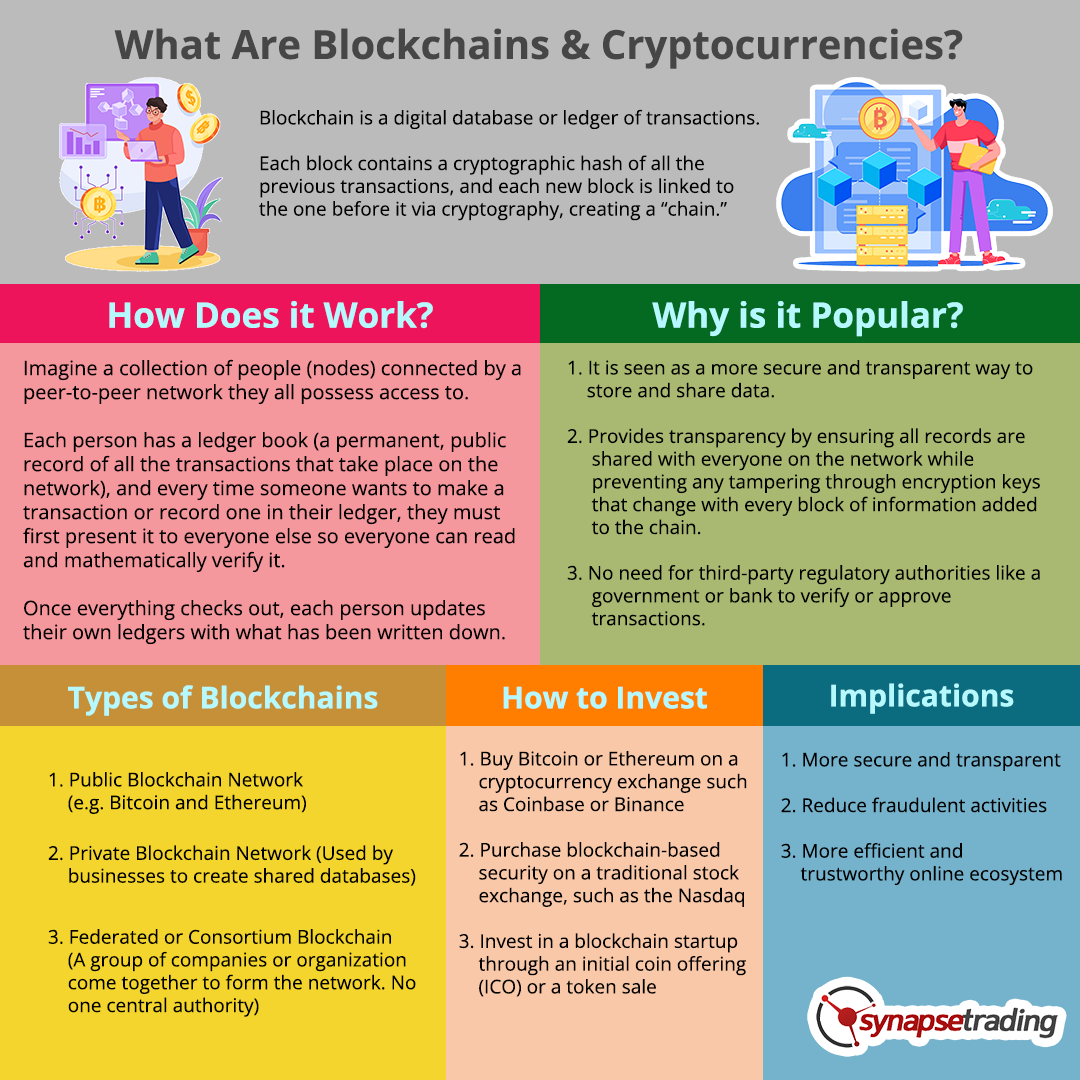
what are blockchains and cryptocurrencies infographic


History of Blockchains

Blockchain technology has a long and complicated history.

It was first conceptualized in 1991 by a group of researchers trying to create a system for timestamping digital documents so they could not be tampered with.

But it was not until 2008 that blockchain really came into its own when Satoshi Nakamoto first introduced the concept of blockchains in a white paper entitled Bitcoin: A Peer-to-Peer Electronic Cash System.

In this paper, Nakamoto described how a decentralized ledger could be used to record and verify transactions instead of the unstable traditional banking system.

Since then, blockchain has been hailed as a revolutionary new way of handling data.

What is a Blockchain?

At its simplest, blockchain is a digital database or ledger of transactions.

When someone uses cryptocurrency to buy something, they broadcast their transaction to the entire network of computers running the software.

These computers then race to verify the transaction, and the first one to do so adds it to the chain of past transactions or “block.”

The new block is then broadcast to the network and verified by more computers, and so on.

Each block contains a cryptographic hash of all the previous transactions, and each new block is linked to the one before it via cryptography, creating a “chain.”

How Does Blockchain Technology Work?

It can be difficult to understand how blockchain works by looking at its front-end alone.

The best way to describe blockchain technology is via an analogy…

Imagine a collection of people (nodes) connected by a peer-to-peer network they all possess access to.

Each person has a ledger book (a permanent, public record of all the transactions that take place on the network), and every time someone wants to make a transaction or record one in their ledger, they must first present it to everyone else so everyone can read and mathematically verify it.

Once everything checks out, each person updates their own ledgers with what has been written down.

As soon as this happens, each node checks to see if anyone has rejected the entry — if no one did, it is complete!

If someone did, this entire process starts over again until there is consensus across all nodes.

How is a Blockchain Different from a Typical Database?

A typical database is more vulnerable to data breaches and hacking because it is centralized, meaning all the data is stored in one place.

On the other hand, a blockchain is decentralized, meaning the data is spread across multiple computers across the decentralized network.

This makes it much more difficult for hackers to access and tamper with the data.

Why is Blockchain Technology Popular?

Blockchain technology is popular because it is seen as a more secure and transparent way to store and share data.

In theory, blockchain technology is highly secure as it is impossible to hack into multiple nodes at once without significant resources.

It also provides transparency by ensuring all records are shared with everyone on the network while preventing any tampering through encryption keys that change with every block of information added to the chain.

This makes it ideal for storing sensitive information like financial transactions.

Plus, since blockchain is decentralized, there is no need for third-party regulatory authorities like a government or bank to verify or approve transactions.

This makes the process faster and more efficient.

As we make our way to ‘Web 3.0’, one of the most popular applications of blockchain technology today is in the form of non-fungible tokens (NFTs).

NFTs are digital assets that are unique and cannot be replicated. They can be used to represent anything from art and collectibles to digital experiences and gaming items.

Because of their unique nature, NFTs have become extremely popular in recent years. In 2021 alone, the market for NFTs surpassed USD 40 Billion.

How to Process Transactions on a Blockchain?

Blockchain-based systems use what is called a hash function to encrypt transaction data. A hash function is a mathematical algorithm that takes input data of any size and converts it into output data of a fixed size.

The output of a hash function is commonly referred to as a hash or hash value.

In a blockchain, every transaction is stored in a block.

Each block has its own cryptographic hash and timestamp, as well as other data that may be specific to that block.

The blocks are stacked on top of each other, creating a digital ledger or chain of blocks.

This process is done through cryptography, which provides security and tamper-proofing for every block in the chain.

The hash from each block is used to create another cryptographic hash for each subsequent block, forming an unbroken chain and linking it all together.

For a new block to be added to the chain, miners must solve a complex mathematical problem.

This problem is known as the proof of work. Once a miner solves the proof of work, they can add the new block to the chain and they are rewarded in cryptocurrency for doing so.

The pieces of data stored in one block cannot be changed without changing all subsequent blocks; doing so would invalidate all following hashes and require massive amounts of computing power just to make a single change.

Types of Blockchains

Blockchain networks can be either public or private.

A public blockchain network is a decentralized network that anyone can join.

Bitcoin and Ethereum are examples of public blockchain networks.

A private blockchain network is a permissioned network where only approved participants can join.

Private blockchain networks are often used by businesses to create shared databases.

There is also a federated or consortium blockchain. In this type of blockchain, there is no one central authority.

Instead, a group of companies or organizations (known as a consortium) come together to form the network.

Each member of the consortium operates a node and has a vote in decision-making.

This type of blockchain is often used in industries where multiple parties must securely share data or conduct transactions, such as banking or supply chain management.

How to Invest in Blockchains?

There are several ways to make your first blockchain investment.

The most common way is to buy Bitcoin or Ethereum on a cryptocurrency exchange such as Coinbase or Binance.

Alternatively, you can purchase blockchain-based security on a traditional stock exchange, such as the Nasdaq.

Finally, you can invest in a blockchain startup through an initial coin offering (ICO) or a token sale.

When it comes to investing in blockchain technology, there are a few things you should keep in mind:

  • The cryptocurrency market is highly volatile. This means that prices can fluctuate wildly from day to day, and you could lose a significant amount of money if you are not careful.
  • You should only invest as much money as you are comfortable losing. Remember, there is always a risk of losing your entire investment when dealing with cryptocurrencies.
  • Finally, make sure you do your research before investing in any blockchain-based project. There are a lot of scams out there, and it is important to know what you are getting yourself into before putting any money down.


What are the Implications of Blockchain Technology?

As the technology behind Bitcoin and other cryptocurrencies, blockchain has the potential to revolutionize the way we interact with the digital world.

With its distributed ledger system, blockchain offers a new way of storing and verifying data that is more secure and transparent than traditional methods.

In addition, blockchain could help reduce fraudulent activities, such as identity theft and money laundering.

Ultimately, this could lead to a more efficient and trustworthy online ecosystem.

Concluding Thoughts on Blockchain

Overall, blockchain technology is a way to store and transmit information in a secure, decentralized manner.

Blockchain technology can provide greater transparency and security for online transactions by using a distributed database.

Additionally, blockchain technology has the potential to streamline many business processes and reduce costs.

However, the full potential of blockchain technology has yet to be realized.

As the technology continues to evolve, we can expect to see even more innovative applications of blockchain technology in the future.

Now that you know a little more about how blockchain technology works, what do you think of it?

Do you think it has the potential to revolutionize our financial ecosystem?

And besides the finance world, what other real-world applications do you foresee it being used for?

Let me know in the comments below!


thumbnail the ultimate guide to blockchain and crypto assets

If you would like to learn more about crypto & DeFi, also check out: “The Ultimate Guide to Blockchain & Cryptocurrencies”

0 Comments/by Spencer Li
https://synapsetrading.com/wp-content/uploads/2022/08/what-are-blockchains-and-cryptocurrencies-thumbnail.png 720 1280 Spencer Li https://synapsetrading.com/wp-content/uploads/2019/10/logo.jpg Spencer Li2022-08-17 06:11:302022-12-19 01:42:33What are Blockchains & Cryptocurrencies?
Page 1 of 212

Free Trading Guides

Free Trading Guides

Blog Categories

  • Beginner's Guide
  • Blockchain & Crypto
  • Book Summaries
  • Candlestick Patterns
  • Economics & News Trading
  • Investing & Portfolio Management
  • Living Your Best Life
  • Market Analysis
  • News & Events
  • Price Chart Patterns
  • Promotions
  • Risk & Money Management
  • Stock Trading
  • Testimonials
  • Tools & Resources
  • Trading Psychology
  • Trading Strategies
  • Trading Tips
  • Travel & Lifestyle

Free Trading Guides

Free Trading Guides

Contact Us

Synapse Trading Pte Ltd
Registration No. 201316168H

Whatsapp: +65-8897-1204
Telegram: @iamrecneps
Email: info@synapsetrading.com

Links

Disclaimer
Privacy policy
Terms & Conditions
Contact us
Partnerships

© 2012-2024 Synapse Trading | All rights reserved | - powered by Enfold WordPress Theme
  • Link to Facebook
  • Link to X
  • Link to Instagram
  • Link to Youtube
  • Link to LinkedIn
  • Link to Mail
Scroll to top Scroll to top Scroll to top