

How to Develop Mental Agility in Trading

Join our Telegram channel for more market analysis & trading tips: t.me/synapsetrading
Table of Contents
Mental Agility in Trading: 5 Rules to Stay Objective With Open Positions
Last updated: 3 July 2026 · By Spencer Li, CFTe
Mental agility in trading is the ability to drop an opinion the moment the market disagrees with it, even when you are holding the position that opinion put you in. It rests on five rules: trade what you see, not what you think; stay objective despite having an open position; anticipate a move, but only act once the market confirms it; when you see danger, get out first and ask questions later; and clear your positions whenever you need a neutral, un-anchored frame of mind. The thread running through all five is the same. Your job is to read the market as it is, not to defend the trade you already put on. The trader who can change his mind in one bar keeps far more of his account than the one who needs to be right.
Here is each rule, what it protects you from, and how to actually run it.
What is mental agility in trading?
Mental agility is the gap between what the market is doing and how fast you are willing to update on it. A trade is a hypothesis. The moment you click buy, something quietly changes: you stop being a neutral reader of the chart and start being a part-owner of one outcome. That ownership is where the damage starts. You begin to see the evidence that says you are right and skim past the evidence that says you are wrong.
Agility is the discipline of refusing that. It is holding your view loosely enough that price can talk you out of it in seconds, not days. Note that this is not the same as being indecisive. You still take a firm position. You just refuse to marry it.
The 5 rules, side by side
| Rule | What it means | What it protects you from |
|---|---|---|
| 1. Trade what you see, not what you think | Act on price action on the chart, not on your forecast or your story | Confirmation bias (seeing only what fits your view) |
| 2. Stay objective with open positions | Read the chart the same way you would if you held nothing | Ownership bias (defending the trade instead of the trade idea) |
| 3. Anticipate, act on confirmation | Plan the move early, enter only once the market confirms | Front-running a setup that never arrives |
| 4. See danger, get out first | Exit on the warning sign, review the reasoning afterward | Hesitation turning a small loss into a large one |
| 5. Clear positions for a neutral mind | Flatten the book when you need to think without bias | Anchoring (a position quietly skewing every read after) |
The table is the summary. The rest of this post is each rule unpacked, because the wording is short but the habit is hard.
Rule 1: Trade what you see, not what you think
Your opinion about where the market should go is the most expensive thing you bring to the screen. The chart does not owe your thesis anything.
So separate the two. “What I think” is the forecast: rates are too high, this stock is overvalued, the trend has to break soon. “What I see” is the price action in front of you right now: the actual high, the actual low, the actual close. You trade the second one. The first one is for deciding which charts to watch, not for overriding what those charts are printing.
When the two disagree, the chart wins. Every time. Personally, this is the rule I had to learn the hard way, because being early on a good call still feels like being right, and the account does not care how it feels.
Rule 2: How do you stay objective when you already hold a position?
This is the hard one, and it is the reason agility is rare. The instant you have an open position, you have an incentive to be right. You start reading the chart as a shareholder, not as an analyst.
The fix is a simple mental test. Ask yourself: if I held nothing right now, flat and neutral, would I put this trade on at this price? If the honest answer is no, the only reason you are still in it is that you are already in it. That is not a reason. That is the position reading the chart for you.
Hence the discipline: judge the trade, not your involvement in it. The market does not know you are long, and it will not reward you for loyalty.
Rule 3: Anticipate, but only act on confirmation
Good traders anticipate. They see the level building, the pattern forming, the setup that is about to trigger, and they get ready. That part is fine. Anticipation is how you avoid chasing.
The error is acting on the anticipation alone. You see the setup coming, you jump in before it confirms, and you are now in a trade the market never actually gave you. Half the time the move you anticipated never arrives, and you are sitting in a position built entirely on your own forecast (which Rule 1 already told you not to trade).
So hold the two apart. Anticipate freely. Act only when price confirms (the breakout closes, the level holds, the candle finishes). Plan early, pull the trigger late.
Rule 4: When you see danger, get out first
When something on the chart tells you the trade is wrong, the instinct is to investigate. To check the news, to find a reason, to talk yourself into holding “just to see.” That delay is where small losses become large ones.
Flip the order. Get out first, then ask questions. If you exit and it turns out the danger was nothing, the cost is a small commission and you can always get back in. If you stay to investigate and the danger was real, the cost is the part of your account you spent finding out. Those two mistakes are not symmetrical, so do not treat them as if they are.
This is the one rule where speed beats analysis. Protect the capital, review the decision later, with the position already closed and your head clear.
Rule 5: Clear all positions for a neutral frame of mind
Sometimes the best position is none. When you notice you can no longer read the chart cleanly, when every glance is coloured by what you are holding, the move is to flatten the book and reset.
A flat trader sees the market as it is. A positioned trader sees the market through the position. So when a decision really matters, or when you have been chewed up and your judgement feels off, close everything and look again from zero. The cost of being flat for an hour is nothing. The cost of making a big call through a biased lens can be a great deal.
Do note that, this is not a trade signal. It is a reset button. Use it when your objectivity, not your analysis, is the thing that has broken.
Where the human edge comes in
A scanner will flag the setup, calculate the levels, and fire the alert faster than you ever could. What it will not do is notice that you have quietly started defending a losing trade because it is yours. The mechanics of trading are being automated away. The mental agility to update on new information, to get out first and ask later, to flatten the book when your own head is the problem, is the part no tool trades for you. That is psychology and discipline, and it is squarely in the Five Edges a machine cannot supply.
FAQ
What is mental agility in trading?
It is the ability to change your mind quickly when the market disagrees with you, even while holding an open position. You read price as it is, instead of defending the trade you already put on.
How do you stay objective when you have an open position?
Ask yourself whether you would enter the same trade right now if you held nothing. If the answer is no, the only thing keeping you in is the position itself, which is not a reason to stay.
Should I act as soon as I anticipate a move?
No. Anticipate freely, but act only once the market confirms the move (the breakout closes, the level holds). Acting on anticipation alone means trading your forecast instead of the chart.
Why should I exit before investigating a warning sign?
Because hesitation is asymmetric. Exiting wrongly costs a small commission and you can re-enter; staying wrongly can cost a large part of your account. Get out first, review the reasoning afterward.
When should I clear all my positions?
When your objectivity has broken, not your analysis. If every read is coloured by what you hold, flatten the book, reset to a neutral frame of mind, and look at the chart again from zero.
Which of the five is hardest for you? For most traders it is Rule 2, staying objective with money on the line. Tell me in the comments.
For the full treatment of how the mind sabotages a trade and how to build the discipline around it, read the pillar: The Complete Guide to Investing and Trading Psychology.
Want the routine that makes this automatic? Grab the free 15-Minute Swing Trading Starter Kit. It is the exact once-a-day process I use so I am not staring at the screen long enough to fall in love with a position.
About the author. Spencer Li is the founder of Synapse Trading and a Certified Financial Technician (CFTe) with 15+ years of trading across stocks, forex, crypto, commodities, and bonds. His trade log is public: every trade since April 2024, dated, losses left in. He has taught a 15-minute daily trading routine since 2014, one system for any market.
Education, not financial advice. Synapse Trading is not licensed by MAS to advise on investment products. Trading carries risk of loss; past performance is not indicative of future results.
Related
The Complete Guide to Investing and Trading Psychology (pillar) · New insights on trading psychology · Habits and trading psychology
Want the daily routine? Enter your email for the free 15-Minute Swing Trader's Checklist.
Free, 5 pages, PDF. You get the checklist, then my occasional trading emails. Education only, not financial advice. Unsubscribe anytime.
Where your details go: Kit, our email provider, stores your email address in the United States. Our contract with Kit lets it use your address only to send our emails, and requires Kit to keep it secure. The United States has no national privacy law like Singapore's, so that contract is the main protection. More in our privacy policy.
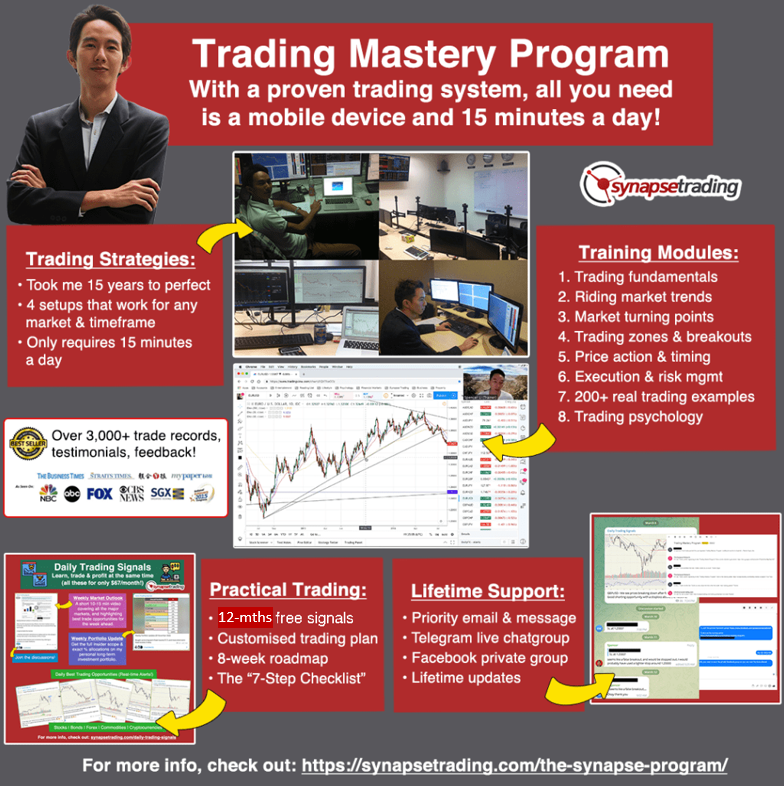 Our flagship mentoring program is suitable for both beginners and advanced traders, covering the 4 strategies which I used over the past 15 years to build up my 7-figure personal trading portfolio.
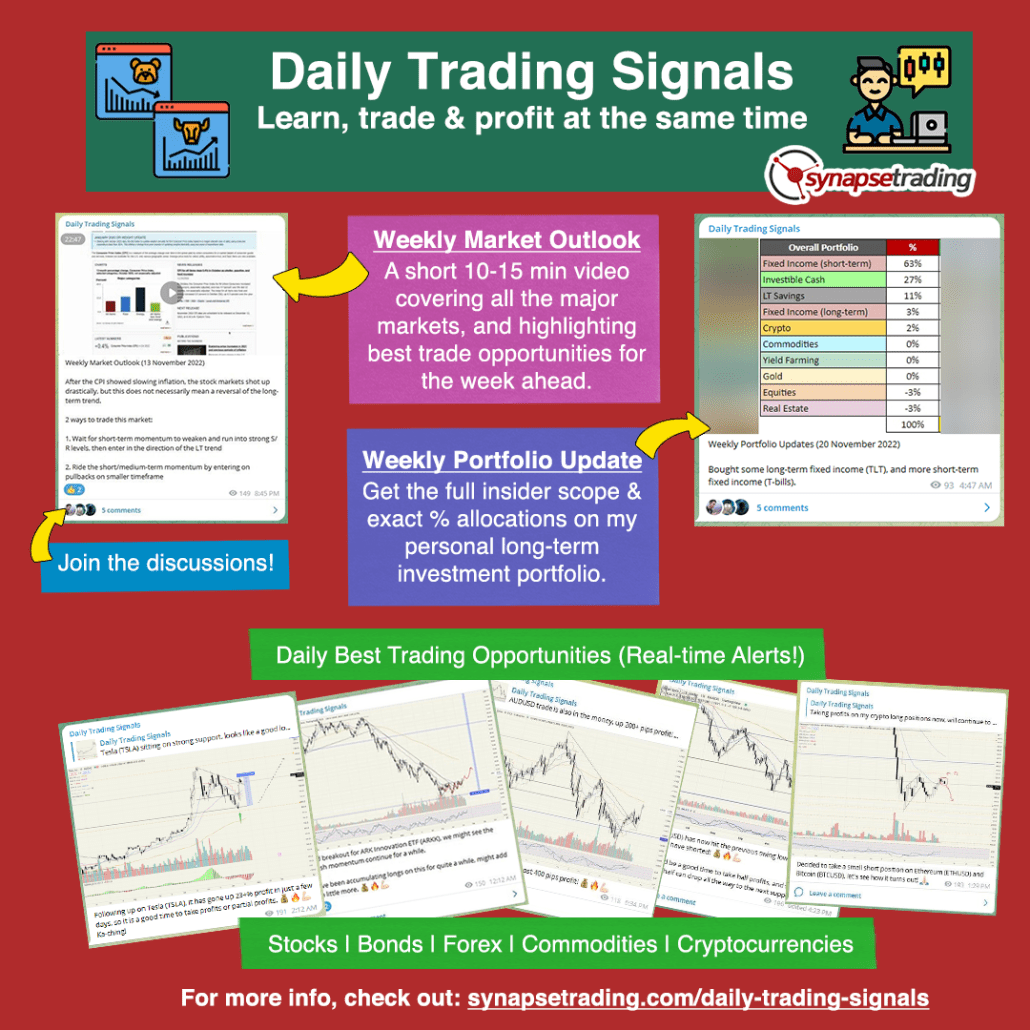 If you're looking for the best trading opportunities every day across various markets, and don't want to spend hours doing the research yourself, check out our private Telegram channel!


Leave a Reply
Want to join the discussion?Feel free to contribute!