• Link to Facebook
  • Link to X
  • Link to Instagram
  • Link to Youtube
  • Link to LinkedIn
  • Link to Mail
Synapse Trading
  • Home
  • About
    • My Background
    • My Trading Journey
    • My Travel Log
    • Media & Interviews
  • Mentoring
    • Trading Mastery Program
    • Results & Testimonials
  • Signals
    • Telegram (Free to join!)
    • Daily Trading Signals
    • Daily Trading Signals (Results)
  • Resources
    • Free Trading Guides
    • Tools & Resources
    • Blog & Infographics
  • Contact
    • Contact Us
    • Partnership Opportunities
  • Click to open the search input field Click to open the search input field Search
  • Menu Menu

Tag Archive for: cryptocurrency

Spencer Li

What is Cryptocurrency, and is it a Good Investment?

Blockchain & Crypto
What is a Cryptocurrency and is it a Good Investment thumbnail

Is Cryptocurrency a Good Investment? An Honest Answer for Beginners

Last updated: 3 July 2026 · By Spencer Li, CFTe


Cryptocurrency can be a good investment, but only as a small, high-risk, high-reward slice of a portfolio, never the bulk of it. Crypto is a peer-to-peer digital currency that runs on a blockchain instead of a bank, and the same things that make it exciting (no middleman, fast cross-border transfers, the potential for large gains) also make it dangerous (extreme volatility, exchange hacks, outright fraud). Personally, I hold some, and I treat it as a speculative position I am fully prepared to lose. The honest answer to “is it a good investment for you?” is: yes, if you have an emergency fund, you start small, and you accept that the same coin that can multiply your money can also take all of it. The investors who blow up are the ones who skip those three conditions. The rest of this post explains what crypto actually is, why it swings so hard, and the exact steps I would use to start.

So, is crypto the biggest innovation of our generation, or a scam? Here is how I think about it.

What is cryptocurrency?

A cryptocurrency (or “crypto”) is any peer-to-peer digital currency that uses cryptography (math-based encryption) to create and manage its money supply and confirm transactions.

Bitcoin (BTC) was the first and is still the most well-known, but there are thousands of others. A few you will see often:

  • Ethereum (ETH)
  • Ripple (XRP)
  • Cardano (ADA)
  • Solana (SOL)
  • Tether (USDT), a stablecoin (a token designed to hold a fixed value, usually pegged to the US dollar)

Most cryptocurrencies are decentralized systems built on blockchain technology. The network itself verifies transactions, so there is no central authority like a bank or a government sitting in the middle. In plain terms, no single institution controls it.

It is more mainstream than people assume. Over 30% of all US adults now own crypto, yet despite the headlines and the gains, many still cannot explain what they actually bought.

What is the difference between real money and cryptocurrency?

Real money, like the US dollar, is fiat currency (money that has value because a government says it does). It is not backed by a physical commodity like gold or silver. It is backed by the full faith and credit of the issuing government.

Cryptocurrencies are different. They are decentralized digital assets, not subject to government control or regulation. Bitcoin was created in 2009 as a peer-to-peer electronic cash system designed to work without any central authority.

Because crypto settles on public blockchains rather than through banks, transaction fees can be lower, which lets you send funds across borders cheaply and quickly.

Blockchain explained: proof of work vs proof of stake

Most cryptocurrencies, including Bitcoin, run on a method called proof-of-work.

Proof-of-work asks “miners” (computers competing to validate transactions) to solve complex math problems to find blocks (a group of transactions), and the winner gets a reward, usually the coin itself. The difficulty varies by coin. Common proof-of-work algorithms include SHA-256, Scrypt, X11, Ethash, Equihash, and Lyra2REv2.

The catch is cost. Proof-of-work eats a huge amount of computing power and electricity. After paying for power and hardware, miners can barely break even on what they earn.

To cut that energy use, many coins moved to proof-of-stake instead. With proof-of-stake, how much you can verify is limited by how much crypto you are willing to “stake” (lock up as a deposit) for the chance to participate. It is far more efficient because it removes the energy-intensive math-solving and allows faster verification.

This is why Ethereum completed “the Merge” in September 2022, switching from proof-of-work to proof-of-stake.

Is cryptocurrency a good investment?

Since crypto arrived, people have argued about whether it belongs in a portfolio. Some experts call it a global phenomenon in the making. Others call it a bubble waiting to pop.

Here is the honest pros-and-cons view before I give you my own take.

Potential benefitsReal risks
ControlYour wallet gives you direct control of your assets, no third party can intervene, no intermediary clips a fee on every transferLose your keys and you lose the coins, with no bank to call
TransparencyEvery transaction sits on a public ledger anyone can inspect (parties stay pseudonymous, but the flows are visible)Pseudonymity also attracts scams and bad actors
UpsidePotential for very large growth, fast processing, fraud protection, international acceptanceThe same volatility that gives the upside can wipe you out
SecurityThe consensus mechanism (e.g. proof-of-work) makes it an open system no single party controlsExchanges and projects still get hacked, see below

The risks are not theoretical

Investing in any cryptocurrency carries real risk, from outright fraud to exchange hacks. You can lose all of your investment, and in some setups even more.

Two cases worth remembering:

  • Mt. Gox was once the most popular exchange for trading Bitcoin into dollars and euros, until hackers stole roughly $450 million worth of Bitcoin from users’ wallets. It shut down soon after and filed for bankruptcy protection.
  • CoinDash lost about $7 million in investor money when its site was hacked shortly before its token sale went live.

Then there is volatility. Crypto can swing hard in both directions, sometimes more than once in a single day. That makes it unreliable for long-term savings and unsuitable as everyday spending money. It is far better understood as speculative trading, much like stocks and commodities.

So even with the wild swings and the overnight-millionaire (and overnight-zero) stories, would a prudent investor still put money in?

My answer: crypto might be a good investment for you, provided you treat it as a risky, high-reward gamble that can pay well but can also go to zero. Plenty of people have lost thousands, even millions. Make sure you can manage your risk before committing any meaningful amount of your wealth.

How do I start investing in crypto?

Many would-be investors respond to crypto ads or DMs pushing “get rich quick” schemes. Do not. Instead of an impulsive buy, vet the coin first.

1. Research the currency. Confirm it is legitimate and secure before you hand over any personal or financial information. Read the project’s white paper (the founding document that explains what the coin does). Check security ratings with the Crypto Rating Council and CertiK, and use a price tracker like CoinMarketCap to see how it has performed.

2. Choose a platform. The right exchange depends on how you will use the coin. Will you buy and hold, or trade and cash out regularly? Each platform charges different fees and some limit which transactions you can do. Review the fees, the limits, and the exchange’s security ranking before you commit. I would stick to the top few established players (the ones I list under the tools and resources tab) rather than an obscure exchange.

What should I consider before investing in crypto?

Three rules, in order. Get the first two right before you even think about the third.

1. Build a six-month emergency fund first. Decide what your emergency fund covers, six months of expenses (food, transport, the essentials), or six months of income. Sorry if this sounds boring, but with risk comes caution. You have heard about the one person who turned $1,000 into a fortune overnight. You never hear about the many who watched $1,000 become $0.10. Do not put money into something you do not fully understand.

2. Start small, in blue chips, and dollar-cost average. Passive investing in “blue chip” coins like BTC and ETH is the safer entry. Because crypto is so volatile, the sensible way in is DCA (dollar-cost averaging, buying a fixed amount on a regular schedule so you average your price up and down instead of betting on one entry). A monthly budget of $50 to $100 is a fine place to start. You can also balance crypto against steadier holdings like ETFs (exchange-traded funds) and bonds. As your earning power grows, you can allocate more.

3. Only then, consider active investing. Once your emergency fund and passive portfolio are in place, you can look at active strategies. Again, start small. Allocate no more than 10% of your risk capital to active trading. Earning a yield through staking or yield farming, or using leverage (borrowed money to size up a position), are all mid-to-high-risk plays. Only do them with money you can fully afford to lose.

Notice that none of those three rules are about picking the right coin. The hard part of crypto was never finding the asset, an app will surface the trending token in a second. The hard part is the discipline to size it small, sit through the volatility, and not let a green week talk you out of your own rules. That judgment is the one edge no exchange app supplies, and it is the first of the Five Edges that survive any market.

My take: a small slice, not the bulk

Some people see crypto as an investment opportunity. Others see a volatile gamble. It depends on what you want from the market, and the industry is still so young that no project is guaranteed to survive.

Personally, I think crypto is an exciting opportunity, but it should be treated as a high-risk, high-reward asset. That means it can have a place in your portfolio to boost returns, but it should not form the bulk of it.

If you are already invested, the question I would ask yourself is the one that actually matters: what percentage of your portfolio is in crypto, and could you sleep at night if that slice went to zero tomorrow? If the answer is no, your position is too big.

FAQ

Is cryptocurrency a good investment for beginners?
It can be, as a small, high-risk slice of a diversified portfolio. For most beginners the safer entry is dollar-cost averaging a small monthly amount into blue-chip coins like Bitcoin and Ethereum, only after building a six-month emergency fund.

How much of my portfolio should be in crypto?
There is no single right number, but the principle is that crypto should boost returns at the margin, not form the bulk of your portfolio. Size it so that a total loss of your crypto position would be uncomfortable but not life-changing.

Is cryptocurrency safe?
The blockchain itself is hard to tamper with, but the surrounding ecosystem is not “safe” in the everyday sense. Exchanges get hacked (Mt. Gox lost roughly $450 million in Bitcoin) and projects get defrauded (CoinDash lost about $7 million). The asset is also highly volatile, so you can lose a large part of your money quickly.

What is the difference between proof of work and proof of stake?
Proof-of-work has miners solve energy-intensive math problems to validate transactions and earn coins. Proof-of-stake instead lets holders lock up (“stake”) their coins for the right to validate, which is far more energy-efficient. Ethereum switched from proof-of-work to proof-of-stake in its 2022 Merge.

How do I start investing in crypto step by step?
Research the coin (read its white paper, check ratings on the Crypto Rating Council and CertiK), choose a reputable exchange after comparing fees, limits, and security, build a six-month emergency fund, then start small with dollar-cost averaging into blue chips before ever considering active trading.


Now that you have the honest version, is crypto something you would add to your portfolio, and at what percentage? Let me know in the comments.

And if you want the deeper dive on how the technology actually works, read the companion guide: The Ultimate Guide to Blockchain and Cryptocurrencies.

Want a system for the speculative side? Grab the free 15-Minute Swing Trading Starter Kit. It is the exact routine I use to scan once a day and trade any market, stocks, forex, or crypto, in 15 minutes.


About the author. Spencer Li is the founder of Synapse Trading and a Certified Financial Technician (CFTe) with 15 years of trading across stocks, forex, crypto, commodities, and bonds. His trade log is public, 404 trades, losses left in. He teaches low-risk swing trading in 15 minutes a day, one system for any market.

Education, not financial advice. Synapse Trading is not licensed by MAS to advise on investment products. Trading carries risk of loss; past performance is not indicative of future results.


Related

The Ultimate Guide to Blockchain and Cryptocurrencies (pillar) · What is dollar-cost averaging? · How to build a diversified portfolio · Risk management for traders

0 Comments/by Spencer Li
https://synapsetrading.com/wp-content/uploads/2022/08/What-is-a-Cryptocurrency-and-is-it-a-Good-Investment-thumbnail.png 720 1280 Spencer Li https://synapsetrading.com/wp-content/uploads/2019/10/logo.jpg Spencer Li2022-08-22 19:54:582026-07-06 01:52:09What is Cryptocurrency, and is it a Good Investment?
Spencer Li

Crypto Mastery Program (CMP) – The Dawn of a New Age!

News & Events
cmp ad 1

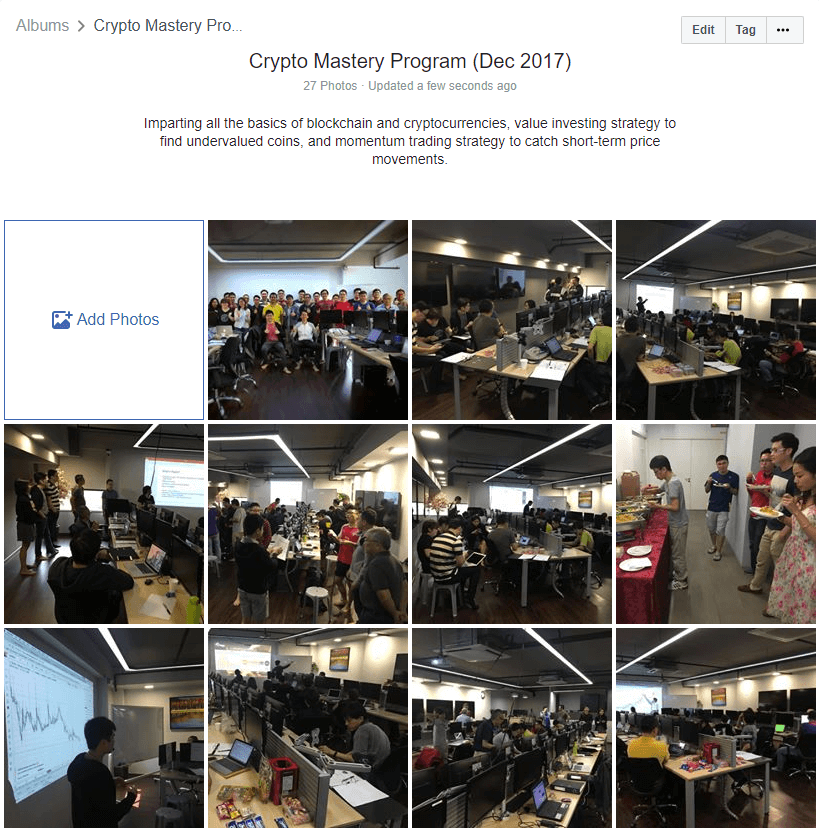
Last weekend, we conducted out first run of the “Crypto Mastery Program”, and it was a full-house turnout for our first batch of crypto enthusiasts!

Based on the feedback we got, this is the first and only fully comprehensive course on Cryptocurrencies in Singapore, which covers:

  • Fundamentals of Blockchain technology, cryptocurrencies, bitcoins, Alt coins, etc
  • Value investing strategies to find undervalued coins for long-term investment
  • Technical analysis & short-term trading strategies to capture smaller price movements, and to time the entry for long-term investments
  • ICOs (initial coin offerings) and how to profit from them while avoiding the scams
  • How to mine for coins with zero technical knowledge (includes free tour to mining farm)
  • How to create a diversified portfolio of crypto assets to ride this next big wave of wealth creation

This course is taught by 2 trainers:

  • Spencer Li – Self-made millionaire professional trader with 10+ years of experience, and specialises in technicals & price action
  • Ong Jun Hao – Crypto trader who made 100x returns in less than a year, and specialises in fundamentals & news analysis

Registration is open for 2018: https://wp.me/P1riws-78a

Crypto Mastery Program

Training Feedback from Attendees:

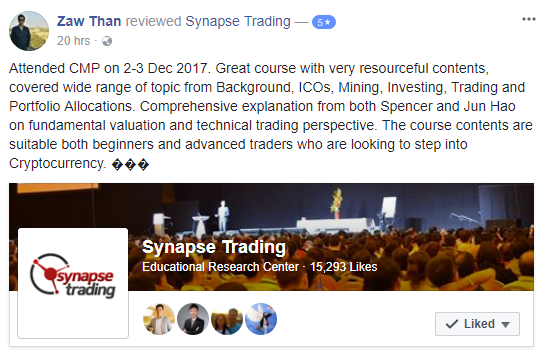
“Attended CMP on 2-3 Dec 2017. Great course with very resourceful contents, covered wide range of topic from Background, ICOs, Mining, Investing, Trading and Portfolio Allocations. Comprehensive explanation from both Spencer and Jun Hao on fundamental valuation and technical trading perspective. The course contents are suitable both beginners and advanced traders who are looking to step into Cryptocurrency.” – ZT

“Great programme! Really learned alot about cryptocurrencies. As a beginner, it really felt like I took a knowledge express train. Jun Hao & Spencer are also very willing to share their knowledge!” – Aw Jian Yang

“A useful start to those who want to learn more about cryptocurrency investment instead of jumping in blindly.” – Susan Tan

“SL & JH are well verse in their domain. For newbie/noob, it is 2 days well spent to get started in Crypto World.” – Gary Koh

“Great course! Provides a good foundation to understanding & trading cryptocurrencies!” – Ed

“Very informative, easy pace for beginners.” – Al

“Opened my eyes to a whole new dimension on cryptocurrencies. Jun Hao is very knowlegeable on cryptocurrency.” – Eugene

“Jun Hao and Spencer are very good teachers, very clear in their explanation, very knowledgeable and professional. They selflessly share their knowledge with students. The course is very good and must attend for anyone interested in cryptocurrency investing and trading.” – Adrian

“Great program for those who are interested to know crypto and want to profit from it. The program content is very useful for both beginner and advanced traders. Definitely must attend couse.” – Kwaw Zaw Than

“A good framework for people who intends to dive into the crypto world, be it investing or trading. The course covers fundamental, technical, behavioral and news analysis, which makes it comprehensive. Thank you Spencer and Jun Hao for the wonderful sharing.” – Darrell Su

“This course is very informative. The instructors are very knowledgeable and open to share their trading experience and tips.” – CW Tay

“Highly recommended to those who wants to know what is crypto/invetsment/mining.” – YC

“I would recommend this program to friends who are keen in trading/investing into cryptocurrencies.” – Goh Lily

“Attended the first cryptocurrency course and it was extremely informative for a complete newcomer such as myself. The theory behind it was in-depth, coupled with practical examples which helped consolidate what we learnt. Turns out cryptocurrency isn’t as complex as is looks and sounds. Both spencer and jun hao were forthcoming, constantly highlighting the pitfalls of dabbling in cryptocurrencies. Great introductory lesson for those just starting out. What i liked was also how the tools could be employed across all financial instruments will also benefit me as an equity investor.” – Wei Keong


Crypto Mastery Program 2

Crypto Mastery Program 3


Crypto Mastery Program 4 Crypto Mastery Program 5(click here to see full album)

Register Early to Avoid Disappointment!

All of slots are closed for 2017, but we have opened new slots for 2018, so those who are keen can start registering now to avoid disappointment, as our last course was sold out within a week after we opened the registration.
Registration link: https://wp.me/P1riws-78a

Good luck to all future “Crypto Millionaires”, and see you all at the top! 😀

0 Comments/by Spencer Li
https://synapsetrading.com/wp-content/uploads/2017/12/cmp-ad-1.png 436 988 Spencer Li https://synapsetrading.com/wp-content/uploads/2019/10/logo.jpg Spencer Li2017-12-05 15:27:252022-03-09 11:10:31Crypto Mastery Program (CMP) – The Dawn of a New Age!
Spencer Li

5 Unconventional Ways You Can Make Money From Bitcoin (And Other Cryptocurrencies)

Market Analysis
bitcoin

bitcoin

Firstly, what is Bitcoin and how does it work?

In simple terms, Bitcoin is a cryptocurrency, which is essentially a currency that is not owned by any particular group or person. It allows fast and cheap transactions, and the more people start to use it, the more its value increases. In fact, if you had bought $5 worth of Bitcoins 7 years ago, it would now be worth $4-5M.

And bitcoin could still be in its infancy, since its number of transactions are only a fraction of what the banks and other financial institutions are currently doing. Which means there is a huge potential for more upside. So, how can we get a share of the pie?

1. Investing in Bitcoins

This is the most common way for retail investors to get in on the action, by simply opening an account and purchasing the coins. Some of the common platforms are Coinbase and Coinhako, and it is not hard to open an account and take a nibble. The challenge here is making sure you do not end up buying at the high, so take advantage of price dips (usually happens when there is some negative news about cryptocurrencies) to accumulate more coins.

2. Trading Bitcoin Derivatives

If you are more interested in profiting from the short-term movements in Bitcoin, then you can use derivative instruments that track the price of Bitcoin, for example products like CFDs (contract for differences). The price of the derivative will track the price of Bitcoin, moving up and down in sync with the actual price of Bitcoin, so by buying or selling the derivative, you can profit from the price moves in Bitcoin without actually buying or owning Bitcoin. To do this well, you will need to know how to read charts and price action.

Sharing live on #cryptocurrencies like #bitcoin and #ethereum ? Are you ready for the next big thing? #visionaryinvesting

A post shared by Spencer Li ?? Synapse Trading (@iamrecneps) on Aug 6, 2017 at 11:11pm PDT

3. Lending out Bitcoins

Lending is perhaps the oldest way to use money to make money. Basically, you loan out money to a relevant party and they pay you back, with interest. Interest rates will vary with the risk involved. If you get collateral in exchange for your loan, interest rates will be low. No collateral means higher risks, but it also means higher interest rates. So if you have already purchased some Bitcoins, you can loan them out for some extra interest instead of just keeping them in your account.

4. Bitcoin Mining

Bitcoins are created through solving complex algorithms that create blocks that are added to the public ledger. The public ledger is the history of all transactions conducted through bitcoin. Basically, miners build the public ledger and allow the whole bitcoin system to function. As they create new blocks, miners are rewarded with new Bitcoins. This encourages more miners to get in on the action, which allows the Bitcoin community to grow. In the past, people could use their home computers to mine Bitcoins, but over time mining has become more difficult as the algorithms have become more complex. Now, you’ll either have to buy a specially built mining rig, or join up with a Bitcoin mining pool that harnesses the power of multiple computers.

5. Bitcoin Arbitrage

This is perhaps the least common way of making money from Bitcoins due to its difficulty level. If you have started dabbling in Bitcoins, you might have noticed that the prices of Bitcoins can vary a lot across different exchanges. For example, if the Bitcoins in Singapore are cheaper than the ones in China, you could buy some Bitcoins here, transfer them to China, and cash them out over there. The challenge however would be bringing your money back to Singapore, and also you would need a bank account in China. But some people have managed to come up with creative solutions around theses problems.

0 Comments/by Spencer Li
https://synapsetrading.com/wp-content/uploads/2017/09/bitcoin.jpg 437 1024 Spencer Li https://synapsetrading.com/wp-content/uploads/2019/10/logo.jpg Spencer Li2017-09-27 06:34:032022-03-15 18:23:565 Unconventional Ways You Can Make Money From Bitcoin (And Other Cryptocurrencies)
Spencer Li

Picking the Bottom for Bitcoin & Ethereum – When to Buy?

Market Analysis
2017 08 25 17.17.38

Recently, Bitcoin prices have crossed $4,800, and year-to-date, its price has surged nearly 400%, making it one of the best investments for the year. And it is not alone.

Other cryptocurrencies, such as Ethereum, have also been making new highs, and many more new products are hitting the market every day.

Which is why many of my friends, followers, and students have been asking me a lot about theses products, and most importantly, “when is a good time to buy?”


Sharing live on #cryptocurrencies like #bitcoin and #ethereum ? Are you ready for the next big thing? #visionaryinvesting

A post shared by Spencer Li ?? Synapse Trading (@iamrecneps) on Aug 6, 2017 at 11:11pm PDT

When I first started trading, I was mainly doing stocks and CFDs, and I developed my “15 minutes a day” price action strategies for these. And as I expanded to new markets, I was pleasantly surprised to find that the same strategies worked perfectly well. To date, I have used them successfully on forex, futures, options, and most recently, on cryptocurrencies.

This means that for a new product like Bitcoin, which behaves very similarly to IPO stocks or some less popular penny stocks, its behavior can be best understood by studying its underlying price behaviour.

Many people who take one look at its prior meteoric rise will immediately come to the conclusion that is it near its high and too late to buy. But many people probably thought the same way about Apple and Tesla’s stock a few years back.

2017-08-25-17.17.38-1030x773

Hands-on analysis and study of Bitcoin chart for precise timing (at my new cafe)


This means that there is potential for cryptocurrencies to go much higher, but how do we time our entry into something that is moving so fast?

Turns out we do have the perfect strategy for that, which is similar to the strategy we use to enter fast-moving counters in times of a strong trend. In fact, I pointed this out using the chart of Bitcoin during my last few workshops, and also at Invest Fair.

synapse-network-bitcoin-040917

Snippet from the “Synapse Network” private forum (posted 24 August 2017)


Bitcoin-040917

Bitcoin chart today (04 September 2017)


How far can this trend continue to run?

To be honest, no one can really tell, but all I know is that whenever there is a good buying opportunity, I will continue to add more positions to ride this strong trend until it ends. And when it does, I will get ready to short it down as well. 😀

But that is a story for another post.

Till then, trade safe, and aim big. Cheers!

0 Comments/by Spencer Li
https://synapsetrading.com/wp-content/uploads/2017/09/2017-08-25-17.17.38.jpg 3024 4032 Spencer Li https://synapsetrading.com/wp-content/uploads/2019/10/logo.jpg Spencer Li2017-09-04 18:10:362022-03-16 17:53:30Picking the Bottom for Bitcoin & Ethereum – When to Buy?

Free Trading Guides

Free Trading Guides

Blog Categories

  • Beginner's Guide
  • Blockchain & Crypto
  • Book Summaries
  • Candlestick Patterns
  • Economics & News Trading
  • Investing & Portfolio Management
  • Living Your Best Life
  • Market Analysis
  • News & Events
  • Price Chart Patterns
  • Promotions
  • Risk & Money Management
  • Stock Trading
  • Testimonials
  • Tools & Resources
  • Trading Psychology
  • Trading Strategies
  • Trading Tips
  • Travel & Lifestyle

Free Trading Guides

Free Trading Guides

Contact Us

Synapse Trading Pte Ltd
Registration No. 201316168H

Whatsapp: +65-8897-1204
Telegram: @iamrecneps
Email: info@synapsetrading.com

Links

Disclaimer
Privacy policy
Terms & Conditions
Contact us
Partnerships

© 2012-2024 Synapse Trading | All rights reserved | - powered by Enfold WordPress Theme
  • Link to Facebook
  • Link to X
  • Link to Instagram
  • Link to Youtube
  • Link to LinkedIn
  • Link to Mail
Scroll to top Scroll to top Scroll to top