

Short Interview with Business Insider: My Insights on the TerraUSD & Luna Crash

Join our Telegram channel for more market analysis & trading tips: t.me/synapsetrading
Last week, I had a short interview with Business Insider to share some of my insights on the TerraUSD and Luna crash.
For those who are not in the loop, it was one of the biggest crashes in the crypto market, causing many investors to lose all their life savings.
So, how did it all happen, and what are the lessons we can learn from it?

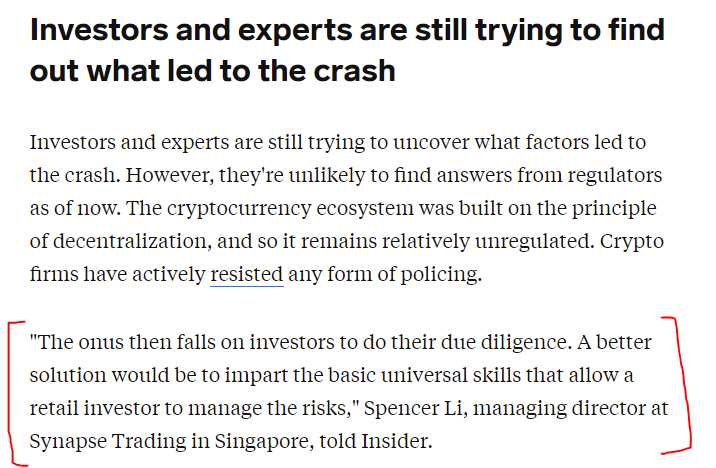
The article is mainly about the experiences of retail investors coping with the big crash, so I thought I’ll share some of the other points not included in the article, for education purposes.
Here goes:
Table of Contents
What does a stablecoin mean? How do they differ from other cryptocurrencies?
One way is to think of it in terms of real world currencies. The price of a currency fluctuates according to demand and supply, unless it is a pegged currency, for example the HKD is pegged to the USD, so its price movements follow the USD. If we think of cryptocurrencies as a currency, then a stablecoin is a cryptocurrency which is pegged to another asset or currency (usually the USD).
Reference: https://synapsetrading.com/best-stablecoin-crypto/
What about TerraUSD and luna? How do they differ from other stablecoins?
There are several types of stablecoins, depending on what they are pegged to and the pegging mechanism. For example, there are metal-backed stablecoins, currency-backed stabelcoins, or algorithmic stablecoins.
For stablecoins like Tether (USDT) and USD Coin (USDC), they are purportedly backed by fully reserved assets, similar to how a nation holds reserves to back its currency.
TerraUSD (UST) is an example of an algorithmic stablecoin, where instead of being backed by collateral, the price is managed by an algorithm which maintains its peg to the US dollar through an arbitrage mechanism with LUNA.
Are stablecoins a good form of savings/preserving value, why or why not?
If you are talking about stablecoins purely as a store of value, then holding fiat USD would be a better option because you can avoid unnecessary risks such as depegging risk, or the risk of getting your hot wallets/accounts compromised.
Of course, this is assuming you can get access to fiat USD, if not stablecoins would be the next best option to preserve your wealth if you live in a country which has a fast depreciating currency.
Are stablecoins a good form of investment, why or why not?
I assume that by investment, you are not referring to the appreciation of the USD (and hence the pegged stablecoin), but rather the 20% APY by staking on Anchor Protocol.
I would say it is a good investment if you know what you are doing, for example understanding the product and the associated risks, and taking steps to minimise the risk.
For example, in DeFi (decentralised finance), there are common risks such as software risk, counterparty risk, token risk, regulatory risk, impermanent loss, gas fees, etc.
Just a few weeks prior to the crash, I highlighted that the funding rate to short UST was about -10%, meaning people were willing to pay 10% APR just to have a short position on TerraUSD. This was an early warning signal of sorts.
I suggested to hedge any open UST positions, because you can still get a net 10% APY (20% from Anchor minus 10% for short position funding rates), and you would be fully protected if UST depegs and crashes (your gains from the short positions would offset any losses).
In your view, what were the different factors that resulted in the crash?
I think firstly the market was already on edge, because prices have been on the decline for most cryptocurrencies, so people became more risk averse. This also lowered the value of their reserves, which were held in mostly cryptocurrencies.
The actual catalyst was several large accounts withdrawing large quantities of UST (either for risk management or some yield farming strategies), causing a slight depegging.
Normally, the algorithm would be able to restore the peg via its arbitrage mechanism, but more UST holders got spooked and started withdrawing their UST as well.
Thus, as more people withdrew their UST, the lower the demand for UST, which caused the price of UST to drop, which in turn caused more people to withdraw…
This caused a positive feedback loop, straining the system, and resulted in something akin to a traditional bank run, thus leading to a depegging of the stablecoin and its price crashing.
The investors I spoke to seemed to come from places where USD was not easily convertible. They also seemed to be in tighter economic conditions and were attracted by Anchor’s 20% APY. Do you think what TerraUSD and luna were marketed as appealed to them? Do you think the marketing was a big part of why they were attracted to TerraUSD/Luna?
I’m not sure what kind of marketing they were exposed to that convinced them to invest, but based on the retail investors that I came across, a lot of them found out about it via word of mouth, or from bloggers or influencers who parroted it without really understanding the product or associated risks. Thus they might get the idea that this is a “risk-free” 20% investment, and when greed takes over they decide to go all-in on it.
There are some who actually know about the Terra network yet still lost money. What about financial savviness/education as a factor in finding out why these investors lost money?
Knowing about how the system works might not mean they are fully aware of all the potential risks, or even if they are aware of it, they might not be aware of the magnitude or probability of the risk, or even worse, decide not to take steps to mitigate it due to faith in the system.
Hence when we approach this from a financial perspective, I feel that technical knowledge alone is not enough, because one has to consider other factors like financial savviness, behavioral psychology, portfolio risk management, etc.
Do you think there should be more oversight or regulation on education and marketing?
Normally, for financial products, there are pretty strict guidelines on marketing, including checks like KYC to assess the risk appetite and savviness of the investor, as well as full disclosure on the risks and returns.
However, in the crypto space, it ist somewhat less regulated, so the onus falls on investors to do their own due diligence.
However, every new product is going to be pretty technical and hard for the average retail investor to understand and assess the risk, so there is a limitation on product education as the solution.
A better solution would be to impart the basic universal skills that allow a retail investor to manage the risk of any investment product in general, such as those mentioned above (financial savviness, behavioral psychology, portfolio risk management).
What is the biggest takeaway for the crypto community from this incident? What about for investors?
For professional and seasoned investors, this will likely not be their first rodeo, as 80-90% of crypto projects historically have crashed and burned. They most likely did not put all their eggs into one basket, as they are aware of the risks of any individual crypto investment. So I would say some seasoned investors might have suffered some losses, but not to the point where they go totally bust.
For retail investors, especially for those getting burnt the first time, this will be a good lesson not to be too greedy, and to diversify your portfolio. Another important lesson is that there is no truly risk-free investment, so before investing in a product, you need to know all the risks associated with it, and decide how much risk you want to take on (and mitigate the risks you don’t want).
Read the full article here:
https://www.businessinsider.com/terrausd-luna-60-billion-crash-sparks-fears-suicide-self-harm-2022-6
Want the daily routine? Enter your email for the free 15-Minute Swing Trader's Checklist.
Free, 5 pages, PDF. You get the checklist, then my occasional trading emails. Education only, not financial advice. Unsubscribe anytime.
Where your details go: Kit, our email provider, stores your email address in the United States. Our contract with Kit lets it use your address only to send our emails, and requires Kit to keep it secure. The United States has no national privacy law like Singapore's, so that contract is the main protection. More in our privacy policy.
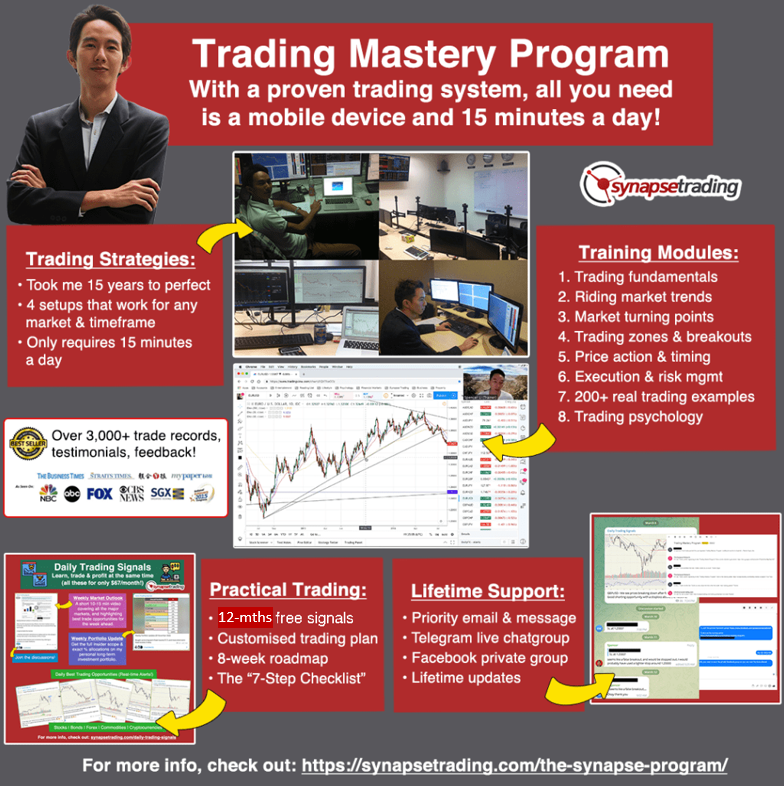 Our flagship mentoring program is suitable for both beginners and advanced traders, covering the 4 strategies which I used over the past 15 years to build up my 7-figure personal trading portfolio.
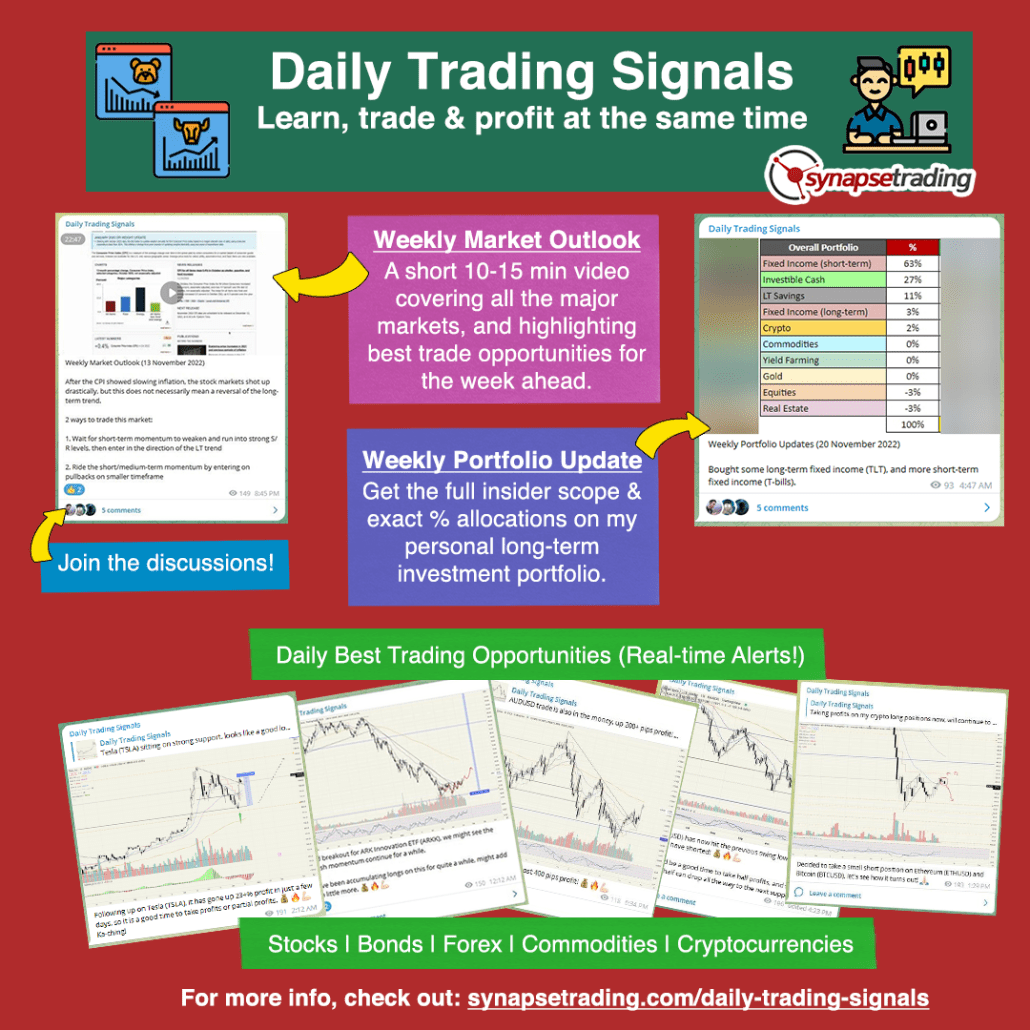 If you're looking for the best trading opportunities every day across various markets, and don't want to spend hours doing the research yourself, check out our private Telegram channel!


Leave a Reply
Want to join the discussion?Feel free to contribute!