

Trade Your Way to Financial Freedom Summary: Why Position Sizing Beats Entry
Want the daily routine? Get the free 15-Minute Swing Trader’s Checklist. Get it free →
Van Tharp’s classic on expectancy, R-multiples, and the coin-flip test behind his claim that entry barely matters
Published: 4 November 2026 · By Spencer Li, CFTe
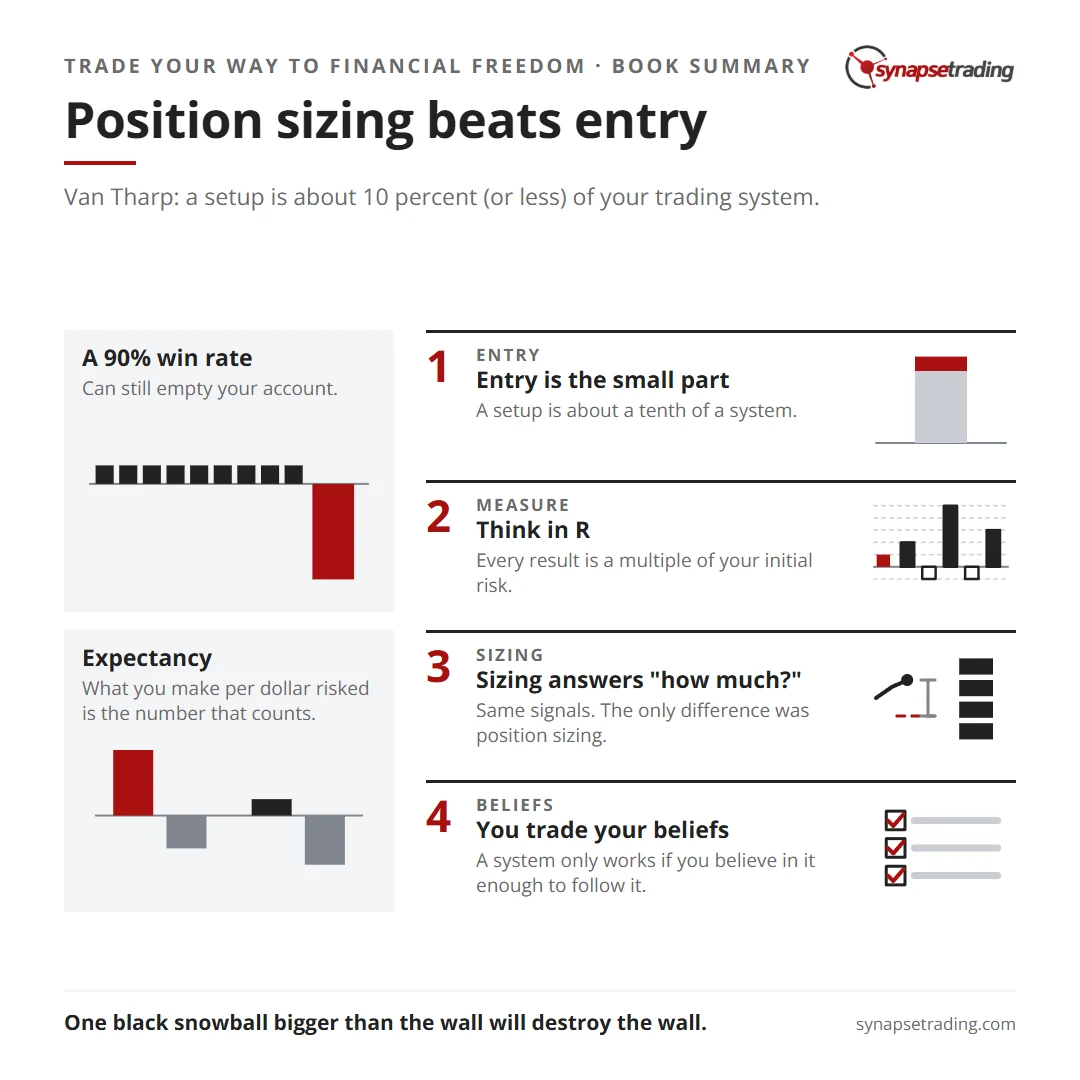
What is Trade Your Way to Financial Freedom about? Van Tharp’s 1998 book argues that most traders pour their effort into the wrong part of the system. They hunt for the perfect entry, when a setup is “about 10 percent (or less) of your trading system.”
What decides results, in his telling, are two numbers few traders track: expectancy, the average you make per dollar risked, and position sizing, which answers “how much?” on each trade. Get both right, and even a coin-flip entry can make money. Get them wrong, and a system that wins 90% of the time can still empty your account.
Who is Van Tharp?
Tharp held a PhD and spent his career coaching traders, with “over 15 years of experience as a coach for traders” by 1998. This summary follows the 1998 first edition. A revised second edition came out in 2006, and Tharp died in 2022.
What are the 10 key ideas at a glance?
| # | The idea | What it means for your trading |
|---|---|---|
| 1 | Entry is the small part | A setup is about a tenth of a system |
| 2 | Expectancy beats win rate | What you make per dollar risked is the number that counts |
| 3 | Think in R | Every result is a multiple of your initial risk |
| 4 | One trade can carry a record | Check whether your profit rests on a single winner |
| 5 | Random entry can still win | Exits and sizing did the work in his coin-flip test |
| 6 | Sizing answers “how much?” | It decides whether you survive long enough to collect your edge |
| 7 | Keep risk per trade small | Under 1% with other people’s money, under 3% with your own |
| 8 | Stops belong beyond the noise | About 3 times the average true range |
| 9 | Scaling out is reverse sizing | You hold the most shares on your worst trades |
| 10 | You trade your beliefs | A system only works if you believe in it enough to follow it |
What is expectancy, and why does it beat win rate?
Tharp defines it in one line: “Expectancy, as defined in this book, tells you how much you can expect to make on the average (over a number of trades) per dollar risked.”
He teaches it with bags of marbles. A bag that wins 60% of the time, paying 1 to 1, makes 20 cents per dollar risked. A second bag wins only 36% of the time, but a few of its marbles pay 5, 10 or 20 times the bet, so it makes 78 cents per dollar. “Game 2 is almost four times as good as game 1,” he writes, even though you lose almost two draws in three.
Now flip it. Tharp sketches a system that wins 90% of the time, with an average winner of 275 and an average loser of 2,700. Over ten trades, nine winners make 2,475 and one loser takes 2,700. You were right nine times in ten, and you are down 225. “This is a system through which you get to be right 90 percent of the time and you eventually lose all your money trading it.”
See our guides to the trading expectancy formula and win rate vs risk-reward.
What is an R-multiple?
R is your initial risk, the distance from your entry to your stop: “R simply being a symbol for the initial risk.” Every exit then becomes a multiple of R. In his worked example, a trade risked 104 points and made 558, so it was a 5.37R winner. “The losing trades will simply be a negative R multiple.”
If your trailing stops work, Tharp expects your average loss to settle near 0.5R. If yours sits at a full 1R, your exits are doing less than you think. (Our post on where to put your stop loss covers that first R.)
His sample record of 103 trades carries a warning too: “The entire profit is due to one trade.” It pays to check whether yours rests on a single winner.
Why does Tharp say entry is only 10% of a system?
“Most people will place 90 percent of their emphasis on finding the right setups, but setups are actually one of the least important parts of the system.”
His evidence is a coin flip. At a 1991 seminar, someone asked Tom Basso whether a random entry could make money with good exits and sizing, and Basso went back and tested it. Tharp’s team then repeated the test on 10 futures markets. A coin flip picked long or short, a stop trailed 3 times the average true range behind price, and each trade risked 1%.
“This system made money on 80 percent of the runs when it only traded one contract per futures market. It made money 100 percent of the time when a simple 1 percent risk money management system was added.” It won only 38% of its trades. Hold that result loosely, though (see the weak spots below).
How does position sizing change your results?
Tharp’s definition: “Money management is that part of your trading system that answers the question ‘how much?’ throughout the course of a trade.”
Picture a snow fight, with your capital as the wall you hide behind. Winning trades are white snowballs that build it, and losing trades are black ones that melt it. Sizing decides how big each snowball gets, and “one black snowball bigger than the wall will destroy the wall.”
Ralph Vince tested this on 40 PhDs, who played 100 rounds of a game they won 60% of the time. Only 2 of the 40 finished ahead. The usual way to blow it was to bet big after a losing streak, because a win felt due.
What did the Dow 30 test show?
Tharp’s most useful test ran one long-only breakout system on the 30 Dow stocks from January 1992 to June 1997: 595 trades, 45.9% of them winners. Then he changed only the sizing model.
| Sizing model | Yearly return | Max drawdown |
|---|---|---|
| 100 shares on every trade | 0.58% | 0.75% |
| 100 shares per 100,000 of equity | 5.75% | 7.13% |
| 3% of equity in each position | 3.86% | 3.72% |
| 1% risk per position | 20.92% | 14.14% |
| 0.5% volatility per position | 22.93% | 16.61% |
“Remember that each model used the same trading signals. The only difference was position sizing.”
Do note that the higher returns came with deeper drawdowns. And Tharp admits he never tuned the levels: “I simply picked an arbitrary level to show you the effect of position sizing.” See also the Kelly criterion and risk of ruin.
How much does Tharp say to risk per trade?
His guideline: “If you are trading other people’s money, you probably should risk less than 1 percent per position.” With your own money, “Anything under 3 percent is probably fine.” Above that, he calls you a “gunslinger”. Those figures assume wide stops. With stops inside the daily range, he says to use “about half (or less)” of them.
The reason is in his recovery table. A 40% drawdown needs a 66.7% gain to get back to even, and a 50% drawdown needs 100%. Five losses in a row at 1% risk cost about 4.9% of your account. At 5% risk, the same five losses cost about 22.6%.
These are Tharp’s 1998 guidelines, shared for education. Your own number depends on your system and the drawdown you can live with.
Want a set of risk rules to practise on? Our free 15-Minute Swing Trader’s Checklist has them. The sign-up box is at the end of this post.
What does the book say about stops and exits?
For stops, Tharp favours one built on the average true range: “Multiply the 10-day moving average of the average true range by some constant between 2.7 and 3.4 and you’ll have a stop that’s far enough away to be out of the noise.”
He also offers a test for your own log: record how far each trade went against you, its maximum adverse excursion. In his British pound sample, no winner had gone more than 1.5 times the average true range against him, because “good trades seldom go too far against us.” If your winners behave the same way, a tighter stop may cost you little.
On exits, he warns against scaling out. Say you buy 300 shares, sell 200 on the way up, and hold 100 for the big move. Tharp calls it “reverse position sizing.” It means “you will have multiple positions when you take your largest losses,” and only a third of your size on the big winner.
Where the human edge comes in
For a book full of formulas, it ends on beliefs. “You cannot trade the markets,” Tharp writes in the closing chapter, “you can only trade your beliefs about the market.”
Ed Seykota once taught a 10-week trading course, with one week of basics and one week on a simple moving-average system. He then “needed the remaining 8 weeks of the class to convince people to use the system that he had taught.”
Software can size a position to 1% risk in a second. It cannot make you take the next signal after five losses. Position sizing sits under discipline, the second of the Five Edges no scanner can trade for you.
Tharp’s fix is one question at the end of each day: “Did I follow my rules?” If you did and still lost money, he says to “pat yourself on the back twice.”
What are the book’s weak spots?
The first is age. The futures tests run from 1981 to 1991, a good decade for trend following, with 1998 costs. Treat every parameter as a 1998 reading.
The second is evidence. The coin-flip study gives no run count, time period, market list or drawdown. The Dow 30 test used the Dow stocks of the day, so it quietly picked survivors. The trader success stories carry no drawdown figures at all.
The third is a conflict Tharp disclosed: he was “consulting for a company that is producing position-sizing software,” and recommended it. And his System Quality Number is not in the 1998 text. Neither is any out-of-sample testing, which later books on systematic trading cover.
When should you read Trade Your Way to Financial Freedom?
Read it once you have a trade log of your own to plug in. Read Chapter 6 on expectancy and Chapter 12 on position sizing twice. Skim the guest essays in Chapter 5.
It pairs well with the Turtle trading rules, since Tharp credits the Turtles’ success more to “their position-sizing algorithm” than to their breakouts. For the psychology side, read our Trading in the Zone summary, and for the rest of the shelf, the best investing and trading books of all time.
Concluding thoughts
Trade Your Way to Financial Freedom will not give you a better entry. It shows why your entry matters less than you think, and what to measure instead.
So, do you know your expectancy in R? And if your next five trades all lose, how much of your account is left?
FAQ
What is the main idea of Trade Your Way to Financial Freedom?
That expectancy and position sizing, rather than entry, decide trading results. Tharp puts the setup at about 10% of a system.
Is the second edition different?
Yes. The 2006 edition adds a revised system-building model, a chapter on R-multiples and new trader interviews. Expectancy and position sizing are already in the 1998 text.
Go deeper
Tharp says to decide how much you risk before you decide what to buy. The free 15-Minute Swing Trader’s Checklist builds that into a daily routine, with the five rules that keep you in the game. Sign up in the box below this post.
More reading:
About the author. Spencer Li is The 15-Minute Trader and the founder of Synapse Trading. He is a Certified Financial Technician (CFTe) with 15+ years of trading, run from 70+ countries. He holds a B.Acc and B.BM from SMU. Every trade he takes is public, dated, losses left in. He teaches rules-based swing trading in 15 minutes a day, one system for any market.
Educational content only, not personalised financial advice. Trading carries risk, including loss of capital. Past performance is not indicative of future results. Synapse Trading is not licensed or regulated by MAS.
Want the daily routine? Enter your email for the free 15-Minute Swing Trader's Checklist.
Free 5-page PDF, then occasional trading emails. Education only, not financial advice. Unsubscribe anytime. Kit stores your email in the US: see our privacy policy.
Want to learn the full method? The Trading Mastery Program teaches the 4 strategies I have traded since 2011. It suits beginners and experienced traders.
Rather follow the trades as they happen? Daily Trading Signals is our Telegram channel: my trade ideas with entry, stop and exit, and every trade is public.
Questions about this post? Ask in the free Telegram channel →
Educational content only, not personalised financial advice. Trading carries risk, including loss of capital. Past performance is not indicative of future results. Synapse Trading is not licensed or regulated by MAS.
